
This article was updated in August 28, 2026 with new products and information by Mark S. Taylor
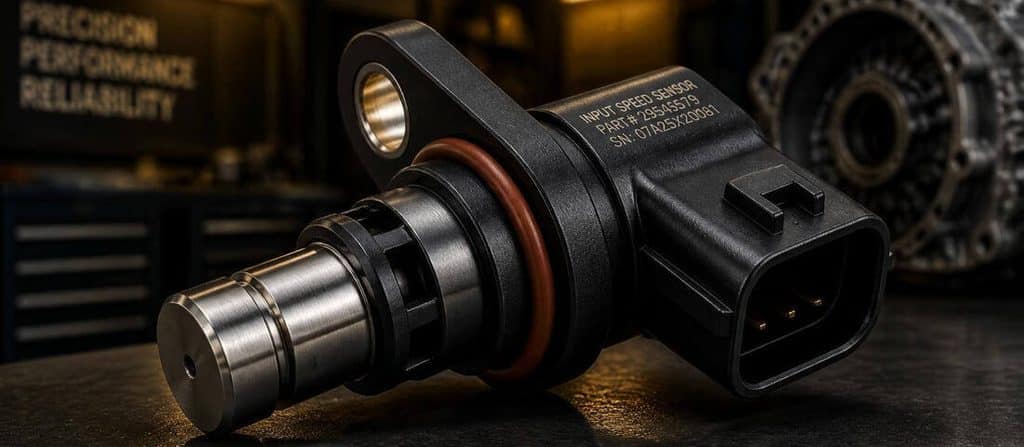
A failing transmission input speed sensor can cause hard or erratic shifting, delayed gear changes, limp mode, warning lights, and unusual engine RPM behavior. The sensor provides the transmission computer with information about how fast the transmission’s input side is rotating, which helps the control system manage and verify shifts.
But there’s an important catch: a bad input-speed signal does not automatically mean the sensor itself has failed. Damaged wiring, a poor connector, a damaged reluctor or target, and other transmission problems can produce similar symptoms.
The most common transmission input speed sensor symptoms are:
- Harsh or erratic shifting
- Delayed or incorrect gear changes
- Limp mode or being stuck in one gear
- Check-engine or transmission warning lights
- RPM flare or unusual shift behavior
- Poor acceleration
- Intermittent transmission problems
Diagnostic trouble codes such as P0715, P0716, and P0717 can point to input/turbine speed sensor circuit problems, but the code itself doesn’t prove the sensor is defective. Proper diagnosis may require checking the wiring, power, ground, signal, and live transmission data.
Contents
- 1 What Does a Transmission Input Speed Sensor Do?
- 2 7 Transmission Input Speed Sensor Failure Symptoms
- 3 Input Speed Sensor vs Output Speed Sensor
- 4 What Causes an Input Speed Sensor Problem?
- 5 P0715 vs P0716 vs P0717
- 6 How to Diagnose a Transmission Input Speed Sensor
- 7 Can You Drive With a Bad Input Speed Sensor?
- 8 How Much Does It Cost to Replace a Transmission Input Speed Sensor?
- 9 DIY or Mechanic?
- 10 Common Diagnostic Mistakes
- 10.1 Replacing the sensor immediately
- 10.2 Ignoring wiring
- 10.3 Confusing input and output speed sensors
- 10.4 Using generic electrical specifications
- 10.5 Clearing the code before recording freeze-frame data
- 10.6 Assuming limp mode means the transmission is destroyed
- 10.7 Assuming a new sensor fixed the problem
- 11 FAQs About Transmission Input Speed Sensor Symptoms
- 11.1 What are the most common transmission input speed sensor symptoms?
- 11.2 Can a bad input speed sensor cause hard shifting?
- 11.3 Can a bad input speed sensor cause limp mode?
- 11.4 Can a bad input speed sensor cause the speedometer to stop working?
- 11.5 What code does a bad input speed sensor cause?
- 11.6 Is P0715 proof that the input speed sensor is bad?
- 12 FINAL VERDICT
What Does a Transmission Input Speed Sensor Do?
The transmission input speed sensor measures how quickly the transmission’s input or turbine side is rotating.
You’ll also see it called an:
- Input shaft speed sensor
- Turbine speed sensor
- Input/turbine speed sensor
- ISS
- TSS
The terminology depends on the manufacturer.
The transmission computer uses this speed information along with other inputs, such as engine RPM and output speed, to determine whether the transmission is operating and shifting as expected.
Think of it as one of the transmission computer’s eyes.
If that eye stops reporting accurately, the computer may no longer know exactly what the transmission is doing.
That’s why a relatively small electrical problem can produce noticeable shifting problems.
7 Transmission Input Speed Sensor Failure Symptoms
1. Harsh or Erratic Shifting
A bad input-speed signal can cause the transmission to shift harder, later, earlier, or at unexpected times.
You might feel:
- A hard bump during an upshift
- A harsh downshift
- A hesitation followed by a sudden shift
- A shift that happens at the wrong RPM
- Repeated changes between gears
The reason is straightforward: the transmission controller uses speed information to help determine when and how transmission events should occur.
However, hard shifting doesn’t prove the input sensor is bad.
Low fluid, solenoid problems, valve-body issues, wiring faults, and internal transmission problems can produce similar symptoms.
2. Delayed or Incorrect Gear Changes
Another possible symptom is a transmission that hesitates before shifting.
You might notice that:
- The transmission holds a gear too long
- A downshift happens late
- The vehicle hesitates before changing gears
- The transmission appears confused about which gear it should select
If the input-speed signal is inaccurate or missing, the transmission controller loses information it uses for shift control.
But again, the symptom isn’t specific enough to condemn the sensor.
3. Limp Mode or Stuck in One Gear
This is one of the more noticeable signs.
If the transmission controller loses important speed information, some vehicles can enter a reduced-function or fail-safe strategy.
The driver may find that the transmission:
- Stays in one gear
- Won’t shift normally
- Has very limited acceleration
- Feels unusually harsh
- Doesn’t respond normally to manual gear selection
The exact fail-safe behavior depends on the vehicle.
For example, Nissan service information for a P0715 condition describes reduced acceleration and loss of torque-converter lockup as possible fail-safe behavior.
So don’t assume that every vehicle will behave exactly the same way.
4. Check Engine or Transmission Warning Light
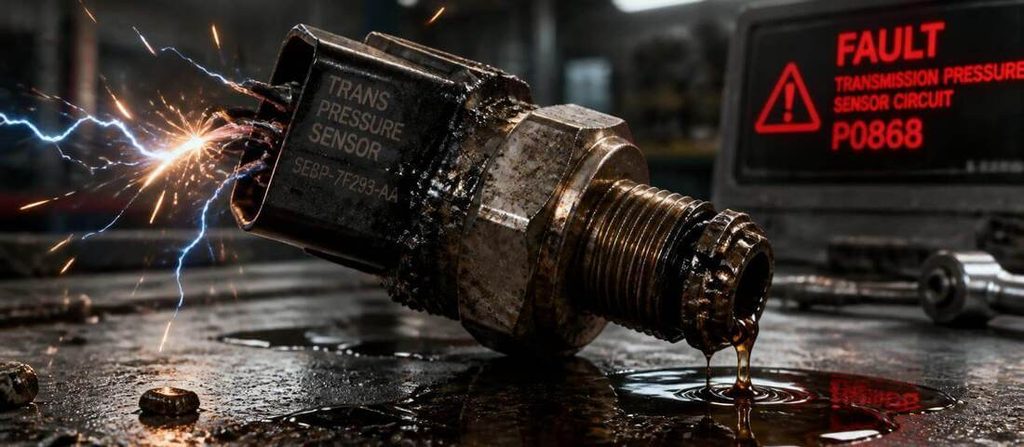
A failed input-speed signal can trigger a warning light and store a transmission-related diagnostic trouble code.
Common related generic codes include:
- P0715 — Input/Turbine Speed Sensor A Circuit
- P0716 — Input/Turbine Speed Sensor A Circuit Range/Performance
- P0717 — Input/Turbine Speed Sensor A Circuit No Signal
These codes describe different types of circuit/signal problems.
Important:
A P0715, P0716, or P0717 code does not automatically mean “replace the sensor.”
The problem could be:
- Sensor
- Wiring
- Connector
- Power supply
- Ground
- Reluctor/target
- Internal transmission wiring
- Another vehicle-specific fault
Nissan’s factory diagnostic procedure for P0715, for example, starts with power and sensor-ground checks and then moves into signal and harness testing.
5. RPM Flare or Unusual Shift Behavior
You may notice the engine RPM suddenly rises during a shift or behaves differently than normal.
For example:
You accelerate, the transmission begins to shift, and engine RPM briefly jumps before the next gear engages.
That can be a sign of a transmission-control or ratio problem.
But don’t automatically blame the input sensor.
A slipping clutch pack, pressure problem, solenoid fault, or other transmission issue can also create an RPM flare.
The input speed sensor is one possible cause—not a diagnosis.
6. Poor Acceleration
A faulty input-speed signal can affect the transmission’s ability to select and maintain the appropriate gear.
You may notice:
- Slow acceleration
- Delayed downshifts
- Transmission staying in the wrong gear
- Reduced performance after a warning light appears
Nissan’s service information for a P0715 condition specifically lists slow acceleration as part of its fail-safe behavior.
If acceleration suddenly becomes poor at the same time the transmission enters limp mode, have the vehicle diagnosed rather than repeatedly driving it under heavy load.
7. Intermittent Transmission Problems
Not every sensor failure is permanent.
An intermittent electrical problem can cause symptoms that appear and disappear.
You may notice:
- Transmission works normally one day
- Shifts badly the next day
- Warning light comes on and later disappears
- Problem occurs when the vehicle gets hot
- Problem appears after hitting bumps
- Transmission temporarily enters limp mode
Intermittent symptoms should make you suspicious of the wiring and connector as well as the sensor.
A loose terminal, damaged wire, corrosion, or heat-related electrical problem can interrupt the signal.
Don’t assume intermittent means “the computer is acting crazy.”
Input Speed Sensor vs Output Speed Sensor
These sensors are not necessarily interchangeable.
Input speed sensor
Measures rotational speed on the transmission’s input/turbine side.
Output speed sensor
Measures rotational speed on the transmission’s output side.
The transmission controller can use both pieces of information to determine what the transmission is doing.
The exact sensor arrangement varies by transmission.
Some vehicles use multiple speed sensors, while others integrate sensing into different assemblies.
That’s why you should use the vehicle-specific wiring diagram and service information when diagnosing a particular vehicle.
What Causes an Input Speed Sensor Problem?
1. Failed Sensor
The sensor can fail internally and stop producing the expected signal.
2. Damaged Wiring
An open circuit, short, damaged insulation, or broken wire can interrupt the signal.
3. Bad Electrical Connector
Corrosion, loose terminals, or poor pin contact can produce an intermittent or missing signal.
4. Power or Ground Problem
Some sensor systems depend on proper power and ground circuits. A fault in those circuits can make a good sensor appear bad.
5. Contamination or Metal Debris
Depending on sensor design, contamination around the sensing area can interfere with signal generation.
6. Damaged Reluctor or Target
The sensor needs something moving past it to generate or detect the speed signal. Damage to the reluctor, tone wheel, or target can produce an abnormal signal even when the sensor itself is good.
7. Internal Transmission Problem
A sensor code can sometimes accompany a deeper transmission problem.
This is why replacing the sensor without diagnosis can waste money.
P0715 vs P0716 vs P0717
| Code | General meaning | Important point |
|---|---|---|
| P0715 | Input/Turbine Speed Sensor A Circuit | Circuit malfunction; investigate sensor and circuit |
| P0716 | Input/Turbine Speed Sensor A Circuit Range/Performance | Signal is outside expected performance |
| P0717 | Input/Turbine Speed Sensor A Circuit No Signal | Controller isn’t receiving the expected signal |
These are generic OBD-II definitions. The exact diagnostic strategy and sensor arrangement can vary by manufacturer and transmission.
For example, P0717 references describe a complete loss/no-signal condition, while P0716 is a range/performance fault.
How to Diagnose a Transmission Input Speed Sensor
The exact procedure varies by vehicle, but the diagnostic logic should be:
Step 1: Scan All Transmission Codes
Use a scan tool capable of reading transmission/TCM data when possible.
Record:
- Stored codes
- Pending codes
- Freeze-frame data
- Related transmission codes
Don’t immediately clear the codes.
Step 2: Look at Live Data
A capable scan tool can show input/turbine speed on many vehicles.
Compare it with:
- Engine RPM
- Output speed
- Vehicle speed
- Gear command
The objective is to determine whether the input-speed signal behaves logically.
A sensor reading of zero while the transmission is clearly turning would be very different from a signal that intermittently drops out.
Step 3: Inspect the Wiring
Check:
- Connector condition
- Terminal tension
- Corrosion
- Broken wires
- Chafing
- Fluid contamination
- Harness damage
Don’t skip this step.
A replacement sensor won’t repair a broken wire.
Step 4: Check Power and Ground
Depending on the sensor design, verify the required electrical circuits using the manufacturer’s wiring diagram and test specifications.
Don’t use a generic voltage or resistance number from another vehicle.
Step 5: Check the Signal
Depending on sensor type and vehicle, testing may involve:
- Voltage
- Resistance
- Frequency
- Oscilloscope waveform
- Scan-tool live data
The correct test depends on the sensor technology.
Step 6: Check the Mechanical Target if Necessary
If the sensor and wiring test correctly but the signal is still wrong, the technician may need to investigate the reluctor, tone wheel, target, or related internal transmission components.
This is where a seemingly simple sensor code can become a transmission diagnosis.

Can You Drive With a Bad Input Speed Sensor?
It depends on how the vehicle is behaving.
If the vehicle has a stored code but is currently shifting normally, arrange diagnosis soon.
But don’t continue normal driving if you have:
- Severe slipping
- Very harsh shifting
- No normal gear changes
- Limp mode
- Unpredictable transmission behavior
- Severe transmission noise
- Overheating
- Burning transmission-fluid smell
A vehicle stuck in a fail-safe strategy may have limited acceleration and may not behave predictably in traffic.
For some applications, manufacturer service information specifically identifies reduced acceleration and loss of lockup under a P0715 fail-safe condition.
How Much Does It Cost to Replace a Transmission Input Speed Sensor?
The price varies substantially because sensor location is a major factor.
Some vehicles have an externally accessible sensor.
Others require substantially more transmission disassembly.
Current repair references put many straightforward input-speed-sensor replacements around $175–$450 installed, while labor-intensive applications can cost considerably more.
For example, current vehicle-specific estimates show:
- Accessible sensor: roughly $170–$365 on some applications
- Internal sensor: roughly $280–$525 on some GMC applications
- Some applications requiring valve-body access: approximately $350–$750
These are examples, not universal prices.
What determines your actual cost?
- Vehicle
- Transmission
- Sensor location
- Labor rate
- OEM vs aftermarket part
- Need for fluid/filter/gasket
- Additional wiring repairs
- Diagnostic time
Always get the diagnosis and repair estimate for your specific vehicle before approving the job.

DIY or Mechanic?
| Task | Difficulty | Recommendation |
|---|---|---|
| Scan transmission codes | Easy–Moderate | Good DIY first step |
| Inspect connector | Easy | Reasonable DIY |
| Inspect wiring | Moderate | DIY with experience |
| Live-data diagnosis | Moderate | Good with capable scan tool |
| Electrical testing | Moderate–Advanced | Requires correct wiring diagram |
| Sensor replacement | Vehicle-dependent | DIY only if accessible and procedure is known |
| Internal transmission sensor | Advanced | Professional repair recommended |
The mistake is assuming:
“It’s just a sensor, so it must be easy.”
The sensor may be inexpensive while access to it is not.
Common Diagnostic Mistakes
Replacing the sensor immediately
A sensor code is not automatically proof of sensor failure.
Ignoring wiring
A broken wire can create the same symptoms as a failed sensor.
Confusing input and output speed sensors
They’re different components and provide different information.
Using generic electrical specifications
Sensor design varies.
Clearing the code before recording freeze-frame data
You may lose useful diagnostic information.
Assuming limp mode means the transmission is destroyed
A control-system fault can trigger fail-safe operation without proving catastrophic internal damage.
Assuming a new sensor fixed the problem
If the code returns, continue diagnosis instead of repeatedly replacing parts.
FAQs About Transmission Input Speed Sensor Symptoms
What are the most common transmission input speed sensor symptoms?
Common symptoms include harsh or erratic shifting, delayed or incorrect gear changes, limp mode, warning lights, unusual RPM behavior, poor acceleration, and intermittent transmission problems. The exact symptoms depend on the vehicle and how the control system responds to the missing or inaccurate signal.
Can a bad input speed sensor cause hard shifting?
Yes. If the transmission controller receives incorrect input-speed information, shift timing and control can be affected. But hard shifting can also result from fluid, solenoid, valve-body, wiring, or internal transmission problems.
Can a bad input speed sensor cause limp mode?
Yes, some vehicles can enter a fail-safe or reduced-function strategy when input-speed information is missing or implausible. The exact behavior varies by vehicle.
Can a bad input speed sensor cause the speedometer to stop working?
On some vehicles, possibly, but this is not a universal symptom. Speedometer operation depends on which sensors and modules the vehicle uses for vehicle-speed information. Don’t diagnose an input sensor solely because the speedometer stopped working.
What code does a bad input speed sensor cause?
Common generic codes include P0715, P0716, and P0717, but other manufacturer-specific or related codes may occur. The exact code should be interpreted using the vehicle’s service information.
Is P0715 proof that the input speed sensor is bad?
No. P0715 identifies a problem with the input/turbine speed sensor circuit. Wiring, connectors, power/ground, sensor faults, and other vehicle-specific problems can cause the code.
FINAL VERDICT
If your transmission is suddenly shifting hard, delaying shifts, entering limp mode, or showing P0715/P0716/P0717, the input speed sensor is one possible cause—but don’t buy the sensor based on the symptom or code alone.
Start with the diagnostic code and freeze-frame information, then check the wiring, connector, power/ground, and live input-speed data. If those checks don’t explain the problem, the sensor and its mechanical target may need further testing.
The most important lesson is:
A bad input-speed signal is a problem to diagnose, not a part to automatically replace.