
This article was updated in June 28, 2026 with new products and information by Mark S. Taylor
The transmission of hydraulic force within an automotive braking system demands an absolute, uncompromised closed-loop liquid boundary. Modern braking layouts operate on the foundational principles of Pascal’s Law, which dictates that any pressure applied to a confined, incompressible fluid is transmitted equally and undiminished throughout the entire multi-wheel network.
The fluid inside that sealed loop is doing vastly more than transmitting raw foot-pounds of energy—it also provides crucial surface lubrication for every single rubber plunger seal, valve O-ring, and dust boot between your foot pedal and the heavy iron rotors. Introduce the incorrect fluid chemistry into this sensitive hydraulic ecosystem, and the internal seals will not experience an immediate blowing explosion. Instead, they absorb the foreign compounds, swell, soften, and fail quietly over a period of days—right up until the moment your pedal sinks completely flat to the floorboards at highway speeds.
As an ASE-Certified Master Technician, I have diagnosed hundreds of contaminated brake systems. In this comprehensive workshop guide, we will break down the precise chemical degradation timelines of Ethylene Propylene Diene Monomer (EPDM) rubber, detail the definitive driveway static pressure test, analyze structural ABS modulator block failures, and outline actual 2026 workshop restoration parameters.

Contents
- 1 The Chemical Matrix: Why Wrong Fluids Destroy EPDM Rubber
- 2 Master Brake Fluid Chemical Compatibility Reference
- 3 The Degradation Timeline: How Fast Does System Damage Scale?
- 4 The Master Technician Driveway Static Pedal Hold Test
- 5 Fluid Contamination Urgency & Action Matrix
- 6 System Restoration & Overhaul Cost Matrix (US Estimates)
- 7 Why You Cannot Fully Flush an ABS Modulator at Home
- 8 FAQs About Wrong Brake Fluid in Car
- 9 The Verdict: Act Within the First 6 Hours to Save the System
The Chemical Matrix: Why Wrong Fluids Destroy EPDM Rubber
The multi-wheel braking architecture of every modern vehicle is engineered around a highly specific synthetic elastomer known as EPDM rubber. This exact compound is chosen because it exhibits total chemical immunity to synthetic, glycol-ether-based fluids—the precise foundational chemistry behind all DOT 3, DOT 4, and DOT 5.1 fluids on the global market.
The moment a foreign, non-specified fluid crosses the reservoir cap seal, the structural chemistry flips into an aggressive degradation loop:
1. Petroleum-Based Fluids (Power Steering Fluid, Engine Oil, ATF, or WD-40)
Petroleum formulations consist of heavy hydrocarbon molecular chains. EPDM rubber behaves like a chemical sponge when exposed to hydrocarbons, actively absorbing the molecules into its polymer matrix.
As absorption scales upward, the rubber swells and fully loses its mechanical tensile strength. A primary cup seal inside a master cylinder machined to maintain a tight 0.002-inch interference fit against the metal bore wall will soften into a mushy, jelly-like texture. This induces an immediate internal hydraulic bypass fault—meaning brake fluid simply slips backward past the collapsed rubber seal instead of being forced down the steel lines to clamp the wheels.
2. Silicone-Based Fluids (Pure DOT 5)
Pure silicone fluid does not aggressively dissolve EPDM rubber like petroleum does. Instead, it triggers an immediate phase separation crisis. Silicone and traditional glycol-ether fluids are completely immiscible—they can never mix or form a stable solution.
When combined inside a brake rail, they form a thick, milky, emulsified sludge. This sludge carries a specific particulate size that instantly plugs the microscopic dampening orifices and valve ports inside your anti-lock braking system (ABS) hydraulic block. While normal, low-speed braking may feel fine, the exact millisecond the ABS system triggers during a panic stop on a wet road, the plugged solenoid valves freeze open or closed, completely locking up the wheels and forcing an uncontrollable vehicle skid.
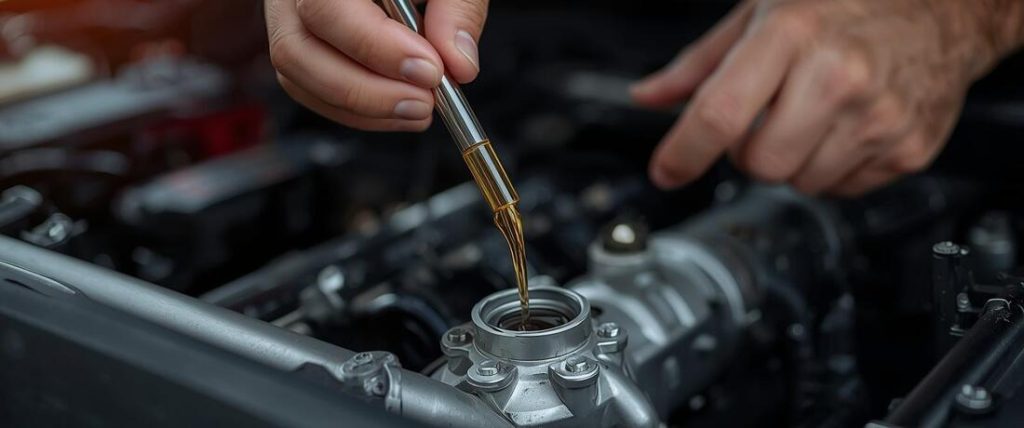
Master Brake Fluid Chemical Compatibility Reference
Every automotive entry system must comply with the strict parameters established under the FMVSS No. 116 federal safety standard. Differentiating these formulas is critical to preventing system cross-contamination:
| Fluid Classification Grade | Core Chemical Base Foundation | Dry Boiling Minimum Threshold | Wet Boiling Minimum Threshold | Cross-System Mixing Compatibility |
| DOT 3 | Synthetic Glycol-Ether | $401^\circ\text{F}$ | $284^\circ\text{F}$ | Fully compatible with DOT 4 and DOT 5.1 |
| DOT 4 | Advanced Glycol-Ether | $446^\circ\text{F}$ | $311^\circ\text{F}$ | Fully compatible with DOT 3 and DOT 5.1 |
| DOT 5.1 | Premium Glycol-Ether | $500^\circ\text{F}$ | $356^\circ\text{F}$ | Fully compatible with DOT 3 and DOT 4 lines |
| DOT 5 | Pure Silicone Base | $500^\circ\text{F}$ | $356^\circ\text{F}$ | INCOMPATIBLE WITH ALL GLYCOL FLUIDS |
| Power Steering / ATF | Heavy Hydrocarbon Petroleum | N/A | N/A | Lethal Contaminant; destroys EPDM seals |
⚠️ THE CRITICAL DOT 5.1 VS. DOT 5 BLUNDER: The single most dangerous misconception shared on automotive parts counters is assuming DOT 5.1 is simply a slight upgrade to DOT 5. They are completely different chemical species. DOT 5.1 is a high-performance glycol-ether fluid that can safely mix with DOT 3 or DOT 4 lines. DOT 5 is a pure silicone fluid designed strictly for non-ABS military or classic show-car platforms. Pouring DOT 5 silicone into a standard DOT 4 ABS system will immediately wipe out the anti-lock modulator valves.
The Degradation Timeline: How Fast Does System Damage Scale?
If you or a lube technician accidentally poured the wrong fluid into your master cylinder reservoir, your total repair bill is governed entirely by a ticking clock. EPDM chemical absorption scales across four distinct operational windows:
Phase 1: The Clean Window (0 to 6 Hours)
The foreign fluid rests stagnant inside the plastic reservoir container and has not yet penetrated past the primary master cylinder seal lips or traveled down the steel lines. If you execute an immediate emergency evacuation and flush within this window, removing every drop of fluid before turning the key, your probability of total component survival stands near 95 percent.
Phase 2: Internal Seal Absorption Initiates (6 to 48 Hours)
The primary and secondary cup seals inside the master cylinder take a direct chemical hit. Because these seals sit under continuous mechanical pre-load tension against the metal bore, the hydrocarbon absorption rate accelerates. The seals begin to soften and expand. Even if you flush the system now, the master cylinder cup seals are highly likely to develop an uneven wear track and fail within 90 days. Proactive master cylinder replacement is highly advised.
Phase 3: Caliper and ABS Modulator Contamination (48 Hours to 2 Weeks)
Driven by regular brake pedal strokes, the contaminated fluid travels down the steel plumbing, reaching the four-wheel caliper bores and the internal valve block of the ABS module. The thick rubber square-cut caliper piston seals swell up, preventing the pistons from retracting when you lift your foot off the pedal. This creates severe, continuous brake drag, smoking pads, and vehicle pulling. Simultaneously, the rubber-tipped spool valves inside the ABS block expand, freezing the solenoids shut.
Phase 4: Full System Delamination and Failure (2 Plus Weeks)
The chemical damage penetrates the inner core linings of your flexible rubber brake hoses. The inner walls begin to delaminate, shredding microscopic rubber flakes directly into the fluid stream. These black particles migrate globally, permanently clogging the microscopic fluid orifices (which are machined to tolerances under 0.010 inches) inside the ABS block. At this stage, the system is fully compromised; every single hydraulic component—including the ABS unit, master cylinder, hoses, and all four calipers—must be completely stripped out and replaced.
The Master Technician Driveway Static Pedal Hold Test
To verify if your master cylinder seals are already experiencing an internal hydraulic bypass failure without unbolting a single line, execute this precise technician test:
1. Neutralize the Power Brake Booster Vacuum Reserve: 1 min.
With the vehicle engine completely turned off, press the brake pedal firmly five times in succession to fully bleed away any residual vacuum pressure stored inside the booster shell. This isolates the raw hydraulic lines.
2. Apply an Absolute Continuous Foot Load: 1 min.
Press your foot down flat onto the brake pedal using a steady, firm force of roughly 40 pounds of pressure. Lock your leg completely rigid and do not pump or slide your foot.
3. Track the Pedal Height Plane for 60 Full Seconds: 2 min.
Keep your eyes locked on the pedal position for one full minute. A healthy hydraulic circuit will maintain a rock-solid, fixed height plane indefinitely. If you feel the pedal slowly, smoothly, and silently creep downward toward the floor mats under steady pressure, the master cylinder internal EPDM seals are actively bypassing fluid. The component is mechanically dead.
Fluid Contamination Urgency & Action Matrix
| Fluid Contaminant Type | Exposure Time | Target Fleet Urgency Status | Mandatory Mechanical Response Protocol |
| Wrong DOT Glycol Grade | Any Duration | Low Urgency Baseline | Execute standard 4-wheel fluid flush; zero seal damage expected |
| DOT 5 Pure Silicone | Under 6 Hours | High Urgency Window | Immediate reservoir siphon, emergency line flush, ABS scan check |
| DOT 5 Pure Silicone | 6 Hrs to 2 Weeks | Critical System Risk | Multi-stage pressurized solvent flush; bench-test ABS module codes |
| Petroleum / Power Steering | Under 6 Hours | MAXIMUM EMERGENCY | DO NOT START ENGINE. Tow to shop or execute immediate reservoir siphon |
| Petroleum / Power Steering | 6 to 48 Hours | MAXIMUM EMERGENCY | DO NOT DRIVE. Flush lines completely; replace master cylinder |
| Petroleum / Power Steering | 48 Hours Plus | System Fully Compromised | DO NOT DRIVE. Full replacement of master cylinder, calipers, and ABS HCU |
System Restoration & Overhaul Cost Matrix (US Estimates)
| Operational Repair Stage | Sourced Replacement Components | Required Labor Hours | Total Independent Shop Bill |
| Stage 1: Clean Window Flush | Premium DOT 4 Fluid / Detergents | 0.8 to 1.2 Hours | $116 – $287 |
| Stage 2: Mid-Window Escalation | Stage 1 Flush + New Master Cylinder | 1.8 to 2.7 Hours | $416 – $942 |
| Stage 3: Multi-Axle Caliper Swap | Stage 2 + Front & Rear Caliper Units | 4.8 to 6.7 Hours | $1,096 – $2,482 |
| Stage 4: Complete System Overhaul | Full Lines, All Calipers, HCU Modulator | 7.5 to 10.5 Hours | 💰 $1,880 – $4,715+ |
Labor values reflect the current 2026 independent US mechanical shop baseline of $120 to $210 per hour. Dealership service centers utilizing proprietary scan equipment typically charge 30 percent to 50 percent higher across the board.
Why You Cannot Fully Flush an ABS Modulator at Home
If your contamination involves a wrong glycol grade caught early, you can safely execute a manual two-person pedal flush in your driveway. However, if petroleum or silicone fluid has sat inside the system for more than 6 hours, a standard driveway gravity or pressure bleed hits a hard mechanical wall: the ABS Hydraulic Control Unit (HCU).
Inside the ABS HCU sits a complex network of internal fluid accumulator chambers and high-frequency solenoid valves. When the vehicle is driving normally without skidding, these internal solenoid valves are spring-loaded to a completely closed position.
When you push fluid through the lines using a manual pedal bleed, the fresh fluid simply sails right past the exterior casing of the HCU block. The contaminated fluid trapped behind the closed solenoid valves remains completely stagnant inside the module chambers.
Fully purging this contamination requires a Bi-Directional Diagnostic Scan Tool (such as a Snap-on Zeus or Autel MaxiSys costing between $3,000 and $8,000). The technician hooks the scanner to the OBD2 port and initiates the automated factory bleed routine. This digital command forces the internal ABS pump motor to spin and rapidly cycles the internal solenoid valves open and shut in a precise frequency loop. This forces fresh fluid straight through the accumulator cores, driving the destructive hydrocarbons or silicone emulsions out to the wheel bleeder screws where they can be successfully removed.
FAQs About Wrong Brake Fluid in Car
Can I still drive my car if I put the wrong brake fluid in?
Depends entirely on what was added and how recently. Wrong DOT glycol grade added today — yes, but get it flushed within 48 hours. Petroleum-based fluid — no. Stop driving immediately. Silicone DOT 5 — if added within the last few hours and you feel no change in pedal behavior, drive directly to a shop for an emergency flush. Don’t make stops, don’t drive on the highway.
How do I know if my brakes are already damaged?
Run the static pedal hold test. Press the pedal firmly with the engine off and hold for 60 seconds. If it sinks, the master cylinder seals are already bypassing. Check the reservoir fluid color — milky or cloudy means silicone contamination; oily sheen or dark separation means petroleum. Feel for brake drag after a short stop.
Will my brakes still work with the wrong fluid?
Initially, yes — that’s what makes this situation dangerous. The hydraulic system still generates pressure and still slows the car. Seal degradation happens invisibly over days and weeks. You won’t notice anything until the pedal starts sinking or brake fade sets in during heavy use. By that point, the damage is already done.
What happens if you mix DOT 3 and DOT 4?
Nothing catastrophic. Both are glycol-ether based with identical rubber compatibility. The mixed system’s effective boiling point will land somewhere between the two specs depending on the ratio — closer to DOT 3 performance if the reservoir was mostly DOT 4 and you topped it with DOT 3. Flush and refill with the correct spec at your next service. No seal damage occurs.
Does insurance cover wrong brake fluid damage?
Comprehensive or collision coverage does not apply. This is a maintenance-related mechanical failure. Some extended warranty policies cover brake system components but specifically exclude damage caused by incorrect fluid — check the exclusions section of your policy. In a shop scenario where the wrong fluid was added by the service department, the shop’s general liability coverage should address repair costs. Get it in writing.
The Verdict: Act Within the First 6 Hours to Save the System
Managing a wrong brake fluid contamination error is a high-stakes, time-sensitive mechanical race where your total repair bill climbs with every passing hour. If you or a service facility accidentally poured power steering or engine oil into your master cylinder reservoir, do not turn the vehicle ignition key and do not attempt to drive the car under its own power. Shifting fluid down the steel rails turns an easily fixable $150 reservoir siphon task into a catastrophic $3,500 total system delamination nightmare. Take 5 minutes to execute a clear visual fluid color check, run a systematic static pedal hold test, and call a professional flatbed tow truck immediately if hydrocarbons have spent more than 6 hours inside your lines.
(Want to ensure your vehicle’s alternative mechanical components, charging loops, and engine computer diagnostics are functioning with absolute factory precision? Read our master workshop guide on How to Read Check Engine Light Codes Without a Scanner or check out The Car Buzz Official Testing and Editorial Integrity Guidelines Page).