
This article was updated in July 9, 2026 with new products and information by Mark S. Taylor
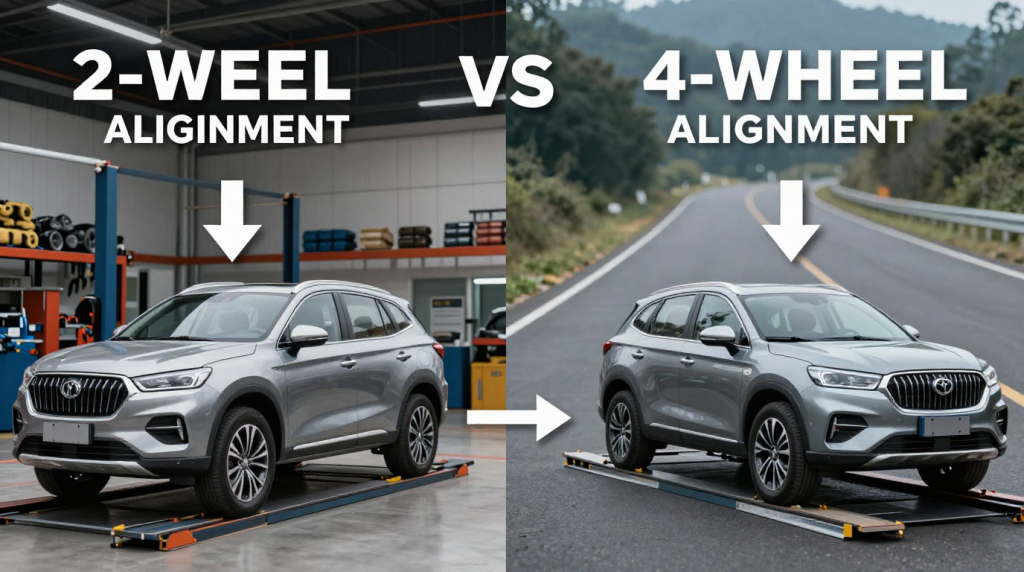
The service counter question is simple: 2-wheel vs 4-wheel alignment? The answer is not simple — because the right choice isn’t determined by your suspension type or the price difference. It’s determined by whether your rear axle is pointed straight. Most drivers don’t know that. Most service advisors don’t explain it. And some alignment shops don’t check it before setting the front wheels.
This is the full explanation: what each service actually measures, the one principle that determines which you need, and why a $35 to $80 decision can protect or destroy a $600 to $1,200 set of tires.
Contents
- 1 What the Two Alignment Types Actually Measure
- 2 The Thrust Angle — Why This Is the Real Question, Not Rear Adjustability
- 3 What Dog-Tracking Is and How a Wrong Alignment Choice Causes It
- 4 Which Vehicles Need a 4-Wheel Alignment — and Which Can Use a 2-Wheel
- 5 When a 2-Wheel Alignment Is the Wrong Choice Even for the Right Vehicle
- 6 The Six Angles Measured in a 4-Wheel Alignment — What Each One Does
- 7 When You Need a 4-Wheel Alignment Regardless of Your Suspension Type
- 7.1 Scenario 1 — After Any Suspension Component Replacement
- 7.2 Scenario 2 — After Any Rear Impact
- 7.3 Scenario 3 — When the Steering Wheel Is Off-Center
- 7.4 Scenario 4 — When the Vehicle Pulls After a Previous Front Alignment
- 7.5 Scenario 5 — When Installing New Tires on a Vehicle With Any Alignment Symptoms
- 8 The ADAS Complication — Why Modern Vehicles Make This Question More Expensive
- 9 What To Ask Before You Approve an Alignment Service
- 10 2-Wheel vs 4-Wheel Alignment Cost — What You’re Actually Paying For
- 11 The Tire Cost vs. Alignment Differential Calculation
- 12 How To Make an Alignment Last Longer
- 13 FAQs About 2-Wheel vs 4-Wheel Alignment
- 13.1 Is a 4-wheel alignment always better than a 2-wheel alignment?
- 13.2 My car has a solid rear axle — do I still need a 4-wheel alignment?
- 13.3 How often should I get a wheel alignment?
- 13.4 Can incorrect alignment damage more than just tires?
- 13.5 What’s the difference between an alignment and a tire balance?
- 14 The Expert Verdict
What the Two Alignment Types Actually Measure
The names are slightly misleading. A 2-wheel alignment doesn’t align two wheels — it measures and adjusts the geometry of the front axle only. A 4-wheel alignment measures and adjusts the geometry of all four corners.
2-Wheel (Front-End) Alignment measures:
- Front caster (left and right)
- Front camber (left and right)
- Front toe (left and right, total and individual)
That’s six angle measurements across two wheels. The rear suspension is not measured, not documented, and not considered when setting the front angles. The technician sets the front wheels to the vehicle’s geometric centerline — the line connecting the midpoints of the front and rear axles — and hands the car back.
4-Wheel Alignment measures:
- Front caster (left and right)
- Front camber (left and right)
- Front toe (left and right)
- Rear camber (left and right)
- Rear toe (left and right)
- Thrust angle (the direction the rear axle is actually pushing the vehicle)
- Setback (fore-aft position difference between left and right wheels on each axle)
That’s thirteen measurements across four corners. On vehicles with adjustable rear suspension, the technician corrects any out-of-specification rear angles before touching the front. On vehicles with non-adjustable rear suspension, the technician still measures all thirteen values — and uses the rear measurements to correctly position the front wheels.
That last sentence is the one most drivers and many service advisors don’t fully understand. According to Hunter Engineering alignment system documentation, the thrust angle measurement is performed on every 4-wheel alignment regardless of rear suspension adjustability — because the thrust angle determines how the front wheels must be positioned to make the vehicle track straight, even when the rear cannot be changed.
The Thrust Angle — Why This Is the Real Question, Not Rear Adjustability
Every vehicle has a geometric centerline — the theoretical straight line from the center of the front axle to the center of the rear axle. In a perfect vehicle, the rear axle pushes the vehicle exactly along this line.
In the real world, it doesn’t always. Manufacturing tolerances, asymmetric tire wear, subframe mounting variation, minor rear impacts, asymmetric spring sag, and worn rear bushings can all cause the rear axle to push the vehicle at a slight angle relative to the geometric centerline. That angle is called the thrust angle.
Thrust angle of zero: the rear axle is pushing the vehicle exactly along the geometric centerline. Front and rear axles are parallel and perpendicular to the direction of travel. A front-only alignment that sets the front wheels straight to the geometric centerline produces a vehicle that tracks straight. The 2-wheel alignment is correct for this vehicle.
Thrust angle above zero: the rear axle is pushing the vehicle at an angle — off to the left or right of the geometric centerline. The vehicle dog-tracks. The front wheels must be set to compensate for this offset, not set straight to the geometric centerline. A front-only alignment that ignores the thrust angle and sets the front wheels to the geometric centerline produces a vehicle where the driver must steer into the thrust angle correction permanently to hold a straight line.
This is the principle that makes rear suspension adjustability secondary to the thrust angle measurement. The question is not “can the rear be adjusted?” The question is “what is the thrust angle, and is it within specification?”
The factory specification for thrust angle on most passenger vehicles is 0.00 degrees ± 0.10 degrees. A thrust angle above 0.15 degrees is perceptible to most drivers as an off-center steering wheel or a tendency to drift. A thrust angle above 0.30 degrees produces visible dog-tracking — the rear wheels follow a different path than the front wheels, visible in a tight parking lot maneuver.
What Dog-Tracking Is and How a Wrong Alignment Choice Causes It
Dog-tracking is the condition where a vehicle moves with its rear wheels offset laterally from its front wheels — as if the car is moving slightly sideways rather than straight forward. The name comes from the way a dog trots diagonally, body angled while moving forward.
It’s most visible during a slow forward roll in a parking lot — looking back at the vehicle, the rear tires appear to track in a slightly different lane position than the front tires. In the driver’s seat, it manifests as a steering wheel that’s never centered at straight-ahead, requiring a constant slight turn to hold a straight line on a flat road.
The specific scenario that produces dog-tracking after an alignment: a vehicle has a thrust angle of 0.25 degrees — the rear axle is pushing the car 0.25 degrees to the right. The driver takes it in for a 2-wheel front alignment. The technician measures the front wheels against the geometric centerline, sets them to specification, produces an alignment printout showing all green numbers, and returns the car. The front wheels are now geometrically correct relative to the centerline. But the rear axle is still pushing the vehicle to the right at 0.25 degrees. The driver immediately notices the car pulls right and the steering wheel is off-center to the left — because the driver is unconsciously steering left to compensate for the thrust angle, and the newly aligned front wheels no longer require as much left steer input. The driver returns to the shop. The shop performs another front alignment. Nothing changes, because the front alignment was never the problem.
The correct procedure for this vehicle: measure the thrust angle, confirm it’s 0.25 degrees, set the front wheels to the thrust line rather than the geometric centerline — splitting the 0.25 degree error between left and right front toe adjustments so the steering wheel centers at the corrected position. This requires a 4-wheel measurement setup, even though no rear adjustments were made.
Which Vehicles Need a 4-Wheel Alignment — and Which Can Use a 2-Wheel
The decision tree is simpler than most alignment articles suggest, but it has an important conditional branch that most articles miss.
Vehicles where a 2-wheel alignment is appropriate:
- Vehicles with non-adjustable rear suspension AND a confirmed thrust angle within ±0.15 degrees
- Older trucks and body-on-frame SUVs with solid rear axles that have had no recent rear impacts, suspension component replacements, or asymmetric spring sag — and where a pre-alignment thrust angle measurement confirms the axle is pointed straight
Vehicles that require a 4-wheel alignment:
- Any vehicle with independent rear suspension (IRS) — multi-link, double-wishbone, rear MacPherson strut with adjustable geometry
- Any vehicle where the rear toe or camber is adjustable (cam bolts, eccentric adjusters, lateral link eccentrics)
- Any vehicle where the thrust angle measures above ±0.15 degrees, regardless of rear adjustability
- Any vehicle after rear suspension component replacement (rear shocks, springs, control arms, trailing arms, subframe mounts)
- Any vehicle after a rear impact — even cosmetically minor
- Any vehicle after front suspension replacement that may have altered subframe position
- Any vehicle where the pre-alignment inspection shows asymmetric rear tire wear
The suspension type guide:
| Rear Suspension Type | Typical Adjustability | Alignment Needed |
|---|---|---|
| Solid rear axle (truck, older SUV) | None | 2-wheel IF thrust angle ≤ 0.15 degrees; measure first |
| Twist-beam / torsion beam (FWD hatchbacks, sedans) | None to minimal | 2-wheel IF thrust angle ≤ 0.15 degrees; measure first |
| Multi-link independent (most modern sedans, crossovers) | Camber and toe adjustable | 4-wheel — always |
| Double-wishbone independent rear | Camber adjustable, often toe also | 4-wheel — always |
| Rear MacPherson strut with fixed geometry | None | 2-wheel IF thrust angle ≤ 0.15 degrees; measure first |
| Air suspension (independent rear) | Geometry adjustable | 4-wheel — always |
The conditional “measure first” requirement for non-adjustable suspensions is the detail that most service menus omit. A shop that offers a 2-wheel alignment on a twist-beam vehicle without first measuring the thrust angle is offering a service that may be geometrically incorrect — and has no way to know it without the measurement.
When a 2-Wheel Alignment Is the Wrong Choice Even for the Right Vehicle
Four specific scenarios where a vehicle with non-adjustable rear suspension still requires 4-wheel measurement — and where a 2-wheel front-only service leaves the driver with an incorrectly aligned vehicle:
Scenario 1 — Minor rear impact with no obvious damage:
A parking lot collision that dented the rear bumper cover but appeared to cause no structural damage can shift a rear subframe mount by 0.25 to 0.50 inches laterally. That shift changes the thrust angle by 0.30 to 0.80 degrees on most rear suspension geometries. A 2-wheel alignment performed after this impact sets the front wheels to a geometric centerline that has shifted relative to the actual vehicle structure. The result is a vehicle that pulls and dog-tracks despite perfect front alignment numbers.
Scenario 2 — Rear spring replacement or sag:
A rear spring on a twist-beam suspension that has sagged 0.75 inches on one side compared to the other changes the rear axle’s effective toe through the suspension geometry. On a twist-beam design, the lateral compliance of the trailing arm bushings means the toe angle is partially determined by the ride height through the twist-beam geometry. Asymmetric spring sag produces a non-zero thrust angle. A 2-wheel alignment doesn’t detect or correct for this.
Scenario 3 — Used vehicle purchase:
A used vehicle may have had rear impact history that wasn’t disclosed and isn’t visible externally. The pre-purchase inspection may not have included an alignment check. A 2-wheel front alignment on a vehicle with undisclosed rear impact history and a resulting thrust angle error produces the same steering pull scenario — the shop aligns the front correctly to a rear that’s incorrect, and the driver gets a car that handles worse than before the alignment.
Scenario 4 — New tire installation on an older vehicle:
New tires have a slightly larger loaded radius than the worn tires they replace — typically 0.10 to 0.30 inches larger at the same inflation pressure. If the worn tires were not worn evenly between left and right (a common finding on vehicles with pre-existing alignment issues), the loaded radius difference between left and right rear tires may have been partially masking a thrust angle error. New tires with equal loaded radius on both sides unmask the thrust angle error. A 2-wheel front alignment after new tire installation on this vehicle perpetuates the error.
The Six Angles Measured in a 4-Wheel Alignment — What Each One Does
A 4-wheel alignment printout shows six primary angles measured at multiple corners. Understanding what each one controls lets you read the printout intelligently rather than just confirming that the numbers are green.
Front Caster
The rearward inclination of the steering axis when viewed from the side. Caster is not visible from outside the vehicle — you can’t observe it by looking at the wheel. Its effect is felt through the steering wheel: positive caster creates self-centering force after turns and provides straight-line stability. Insufficient caster produces a steering wheel that wanders and doesn’t return to center. Cross-caster — a difference of more than 0.50 degrees between left and right — produces a pull toward the low-caster side regardless of whether individual readings are within spec. Cross-caster pull worsens under braking because braking transfers weight forward, loading the front suspension and amplifying the caster difference’s effect on steering geometry.
Front Camber
The inward or outward tilt of the wheel from vertical when viewed from the front. Negative camber (top of wheel tilted inward) improves cornering grip by keeping the tire’s contact patch flat on the road during cornering loads. Excessive negative camber causes accelerated inner tread wear during straight-line driving. Cross-camber above 0.50 degrees between left and right produces a pull toward the more negative camber side. The tire on the more-negative-camber side generates more lateral force, pulling the vehicle.
Front Toe
The degree to which the front wheels point inward (toe-in) or outward (toe-out) from straight ahead. Toe is the alignment parameter with the highest impact on tire wear. Per research documented in SAE J1033, a 1-degree toe error produces approximately 0.17 inches of tread wear per 1,000 miles — consuming a tire in roughly 20,000 miles. Factory toe specifications are tight: typically ±0.05 to ±0.10 degrees total toe. Toe is also the most commonly misadjusted parameter because it’s the last adjustment made and is sensitive to thread engagement depth on the tie rod ends.
Rear Camber
On adjustable rear suspensions, rear camber affects rear tire wear and cornering stability. Excessive rear negative camber wears the inner rear tire edges — a pattern often misidentified as overinflation wear because it appears centered on the inner tread zone. On performance vehicles, slight negative rear camber (−0.50 to −1.50 degrees) improves cornering by keeping the contact patch loaded during cornering. On daily drivers, rear camber outside of ±0.30 degrees from spec is consuming tires.
Rear Toe (Thrust Angle)
The direction each rear wheel points relative to the vehicle’s centerline. Rear toe is the primary determinant of thrust angle. A rear wheel with excessive toe-out pushes the vehicle toward the toe-out side during forward motion — the wheel is pushing sideways as well as forward. Rear toe is adjustable on multi-link and double-wishbone independent rear suspensions via cam bolts, eccentric adjusters, or lateral link length changes. On non-adjustable suspensions, rear toe is documented but cannot be corrected — it becomes an input to the front alignment positioning calculation.
Setback
The fore-aft position difference between the left and right wheels on the same axle. A front setback above 0.25 inches indicates that one front wheel is positioned further rearward than the other — from a bent spindle, a shifted subframe, or crash damage to the front structure. Setback cannot be corrected by alignment adjustment — it indicates a structural issue requiring physical repair. An alignment performed on a vehicle with significant setback produces out-of-spec readings that cannot be brought into specification through normal adjustments, because the geometry itself is wrong.

When You Need a 4-Wheel Alignment Regardless of Your Suspension Type
Five scenarios where every vehicle — including solid-axle trucks and non-adjustable twist-beam hatchbacks — requires a 4-wheel measurement setup before the front alignment is set.
Scenario 1 — After Any Suspension Component Replacement
Any time a component in the suspension or steering system is replaced — tie rod ends, ball joints, control arms, struts, springs, subframe mounts, wheel bearings — the geometry of at least one corner has changed. The change may be minor (new tie rod end threaded to the same depth) or significant (new control arm with slightly different bushing geometry). Either way, the only way to confirm the geometry is correct after the replacement is to measure it. A 4-wheel measurement after any suspension work is not an upsell — it’s the confirmation step that the repair was completed correctly.
The specific scenario that catches many drivers: tie rod replacement. The technician replaces one or both tie rods, counts the exposed threads to approximate the original toe setting, and the service advisor quotes an alignment as an add-on. The driver declines to save $100. Two months later, the inside edge of one front tire is worn to the cord. The tie rod thread count was off by one revolution — a 0.10 to 0.15 degree toe error that consumed the tire in 15,000 miles. The alignment would have caught it in 45 minutes.
Scenario 2 — After Any Rear Impact
A rear impact that appears cosmetically minor — a low-speed parking lot collision, a backup into a fixed object, a minor fender-bender — can shift rear subframe mounting points by fractions of an inch. That shift changes the thrust angle. A 2-wheel alignment after a rear impact that hasn’t been checked for thrust angle change is setting the front wheels to a centerline that may no longer represent the vehicle’s actual forward direction.
Scenario 3 — When the Steering Wheel Is Off-Center
An off-center steering wheel at straight-ahead driving is not a steering wheel adjustment problem. It’s an alignment problem. The steering wheel position is mechanically linked to the front wheel position through the steering rack. An off-center wheel means the front wheels are not centered relative to the rack’s neutral position — either from incorrect toe setting or from a thrust angle that has shifted the driver’s straight-ahead compensation away from center. Adjusting the steering wheel independently of the alignment is masking the symptom, not fixing the cause.
Scenario 4 — When the Vehicle Pulls After a Previous Front Alignment
A vehicle that pulls after a recently completed front alignment has one of three situations: the front alignment was set incorrectly, the front alignment was set correctly but the thrust angle wasn’t measured and remains non-zero, or a new suspension problem has developed since the alignment. A 4-wheel measurement is the diagnostic tool that differentiates these scenarios. If the front angles are within specification and the thrust angle is non-zero, the front alignment was the wrong service. If the front angles are out of specification, the previous alignment was done incorrectly. Either way, 4-wheel measurement is the diagnostic step.
Scenario 5 — When Installing New Tires on a Vehicle With Any Alignment Symptoms
New tires on a vehicle with pre-existing pull, wander, or uneven tire wear from the set being replaced is one of the most common sources of alignment-related complaints. The driver buys new tires hoping the fresh rubber resolves the handling issue. The alignment problem that wore the old tires transfers immediately to the new ones. A 4-wheel alignment at the time of tire installation is the only way to confirm the new tires are starting their life at correct geometry — not being consumed by the same error that destroyed the previous set.

The ADAS Complication — Why Modern Vehicles Make This Question More Expensive
On any vehicle built after approximately 2018 with forward collision warning, lane keep assist, automatic emergency braking, or adaptive cruise control, an alignment is no longer just a geometry service. It’s potentially also a camera and radar calibration service.
Here’s the mechanism. A front-facing ADAS camera sits behind the windshield, typically mounted to the rearview mirror housing or the windshield itself. The camera is calibrated to a specific angular relationship between its lens axis and the vehicle’s forward direction of travel. That calibration tells the AEB system exactly where the lane markings are, how far ahead objects are, and at what distance to initiate a braking response.
A wheel alignment that changes the caster angle — which happens during any alignment that adjusts caster — changes the front suspension geometry. The front suspension geometry partially determines the vehicle’s relationship between the wheel plane and the chassis. A caster change of 0.50 degrees changes the geometric relationship between the wheel plane and the chassis at that corner by a proportional amount. The chassis-mounted ADAS camera is now at a slightly different angle relative to the direction the front wheels are pointing. The AEB system’s distance calculations are now based on a calibration that no longer matches the vehicle’s actual geometry.
Per NHTSA’s ADAS technology safety guidance, improperly calibrated forward collision warning and automatic emergency braking systems can fail to engage at the correct distance or engage unnecessarily — creating a safety hazard rather than preventing one.
The practical impact:
| Vehicle Type | ADAS Camera Present | Alignment Changes Caster/Camber | Recalibration Required |
|---|---|---|---|
| Pre-2015, no ADAS | No | Yes/No | No |
| 2015–2018, basic ADAS | Possible | If yes | Possibly |
| Post-2018 with standard ADAS | Yes (most) | If yes | Yes — before driving |
| Post-2020 with full ADAS suite | Yes | If yes | Yes — static + dynamic |
Static vs. dynamic recalibration:
Static recalibration uses a calibration target — a specific pattern placed at a precise distance and angle in front of the vehicle — and the calibration software recalibrates the camera to the target. Requires a flat floor, typically 20 to 30 feet of clear space in front of the vehicle, and 20 to 45 minutes. Cost: $150 to $250.
Dynamic recalibration requires a road test at a minimum specified speed (typically 30 to 50 mph) on roads with visible lane markings, allowing the camera to recalibrate by observing the lane markings in real conditions. Can be performed by the alignment shop or the driver following the specific procedure in the owner’s manual. Some manufacturers require both static and dynamic calibration. Cost: $200 to $400.
The alignment shop may not mention this until the technician calls from the bay to report that the vehicle’s ADAS system needs calibration. Ask before you approve the alignment: “Does this vehicle require ADAS camera recalibration after alignment, and is that included in the quoted price?” The answer determines whether your $130 alignment is actually a $330 service.
What To Ask Before You Approve an Alignment Service
Three questions that protect your money and ensure the right service is performed.
Question 1: “Will you measure the thrust angle before setting the front alignment?”
The correct answer is yes — on any full alignment service, the rear axle direction is measured before the front is adjusted. If the answer is “we don’t need to, your rear suspension isn’t adjustable,” the shop is offering an incomplete service. Thrust angle measurement is required to correctly position the front wheels regardless of rear adjustability. A shop that skips it is saving themselves 10 minutes of setup time and leaving you with a potentially incorrect front alignment.
Question 2: “Does my vehicle need ADAS recalibration after this alignment, and is that included?”
On any vehicle post-2018 with a forward-facing camera system, the answer to the first part is likely yes. The answer to the second part determines your actual total cost before you approve the service. Get this in writing before the vehicle goes on the rack — not after.
Question 3: “Can I see the before-and-after alignment printout?”
A legitimate alignment service produces a computerized printout showing every angle measured at every corner before and after adjustment — typically printed in color with red indicating out-of-specification and green indicating within-specification. Before adjustment: some red numbers are normal. After adjustment: all adjustable angles should be green. Any shop that cannot produce this printout either doesn’t have the equipment to perform a true 4-wheel alignment or didn’t perform the measurements they charged for. The printout is your evidence that the service was performed correctly.
2-Wheel vs 4-Wheel Alignment Cost — What You’re Actually Paying For
The price differential is real. The question is whether the cheaper option is actually appropriate for your vehicle and situation.
Side-by-Side Cost Comparison
| Service | Independent Shop | Dealership | What’s Included |
|---|---|---|---|
| 2-wheel (front-end) alignment | $65–$110 | $80–$130 | Front caster, camber, toe measurement and adjustment; no rear measurement |
| 4-wheel alignment | $100–$175 | $130–$250 | All four corners measured; rear adjusted where possible; thrust angle calculated and used for front positioning |
| Price differential | $35–$80 | $50–$120 | The rear measurement, thrust angle calculation, and rear adjustment if applicable |
| ADAS recalibration (add-on) | $150–$400 | $200–$500 | Camera/radar recalibration to new geometry; may be mandatory |
| Lifetime alignment program | $150–$200 one-time | $180–$250 one-time | Unlimited alignments during vehicle ownership; cost-effective in high-pothole regions |
The Tire Cost vs. Alignment Differential Calculation
The $35 to $80 that separates the two services is the financial decision point for most readers. Here’s the consequence math.
A 1-degree toe error — the kind produced by a front alignment that ignores a non-zero thrust angle and sets the front wheels to the wrong reference line — consumes approximately 0.17 inches of tread depth per 1,000 miles of driving per the data in SAE J1033 tire wear research. A typical passenger tire starts with 10/32 inches of tread and is replaced at 2/32 inches — 8/32 inches (0.25 inches) of usable tread. At 0.17 inches of abnormal wear per 1,000 miles, a 1-degree toe error reduces tire life by approximately 1,500 miles per tire.
On a vehicle that normally gets 40,000 miles from a set of tires, a 1-degree toe error reduces tire life to approximately 30,000 to 35,000 miles — 5,000 to 10,000 miles less per set. A set of four mid-range tires runs $600 to $1,200. The cost of the alignment differential — $35 to $80 — versus the cost of one premature tire replacement cycle — $600 to $1,200 — makes the 4-wheel alignment the correct financial decision in any scenario where the thrust angle might be non-zero.
The only scenario where the 2-wheel alignment is definitively the correct choice: the thrust angle has been measured and confirmed within ±0.10 degrees, the rear suspension is non-adjustable and in known good condition, and no rear impact or component replacement has occurred since the last full alignment check. That combination describes a specific subset of vehicles and situations. For everything else, the $35 to $80 differential is not a savings — it’s a deferred expense with a $600 to $1,200 consequence.
How To Make an Alignment Last Longer
An alignment is a snapshot of geometry at a point in time. Road conditions, component wear, and driving habits all push geometry away from the alignment settings between services.
1. Check alignment annually or after any significant impact.
Most alignment shops recommend an annual alignment check — not necessarily adjustment, but measurement. The check costs $20 to $45 at shops that offer a measure-only service. If all angles are within specification, no adjustment is needed and no charge for adjustment applies. If angles have drifted, adjustment is done at the standard rate. This annual measurement approach catches thrust angle drift early — before it consumes tire tread.
2. Replace suspension components in pairs.
A new control arm bushing on one side changes the effective geometry on that corner while the opposite corner remains at its original geometry. Asymmetric bushing stiffness produces asymmetric suspension behavior under load — the side with new, stiff bushings responds differently to bump inputs than the side with old, compliant bushings. This asymmetry changes camber and toe dynamically under load, pushing the effective geometry away from the static alignment setting faster than symmetrical wear would.
3. Maintain correct tire inflation.
Tire inflation affects the loaded radius of the tire, which affects the effective camber angle at normal ride height. A tire underinflated by 10 PSI has a slightly smaller loaded radius — the suspension drops slightly on that corner, increasing the negative camber by a small but measurable amount. On a vehicle with tight camber specifications, consistent underinflation on one corner produces the same inside-edge wear as a marginally incorrect camber alignment. Check tire pressure monthly — not at the pump when the tires are hot, but at the vehicle parked overnight with cold tires.
FAQs About 2-Wheel vs 4-Wheel Alignment
Is a 4-wheel alignment always better than a 2-wheel alignment?
Better is the wrong frame. Appropriate is the right one. A 4-wheel alignment with thrust angle measurement is the correct service for any vehicle where the thrust angle hasn’t been confirmed zero before setting the front wheels. A 2-wheel alignment is only appropriate when the thrust angle has been measured and confirmed within specification and the rear suspension is non-adjustable. The problem is that most 2-wheel alignment services don’t measure the thrust angle at all — making the cheaper option a gamble rather than a reasoned choice.
My car has a solid rear axle — do I still need a 4-wheel alignment?
You need a thrust angle measurement before anyone sets the front wheels. If the thrust angle is within ±0.15 degrees, a 2-wheel front alignment is appropriate. If the thrust angle is outside that range — from a bent axle, an asymmetrically sagged spring, or a shifted Panhard rod — the front alignment must be set to compensate for the thrust angle error, which requires the 4-wheel measurement setup even though no rear adjustments can be made.
How often should I get a wheel alignment?
Most manufacturers recommend checking alignment annually or every 12,000 to 15,000 miles. Additionally: after any suspension or steering component replacement, after any impact significant enough to affect suspension geometry (a pothole that bent a wheel, a curb strike, any rear impact), and any time tire wear appears uneven across the tread or between the inner and outer edges. New tire installation is also an appropriate alignment occasion — starting fresh tires on incorrect geometry wastes the investment.
Can incorrect alignment damage more than just tires?
Yes. Incorrect camber accelerates wheel bearing wear by applying an asymmetric load to the bearing through the altered contact angle. Incorrect caster affects steering returnability and can mask other steering system problems by partially compensating for wander. Incorrect rear toe on an independent rear suspension vehicle changes the effective slip angle of the rear tires, altering oversteer and understeer balance in a way that can catch drivers off guard during emergency maneuvers. The handling consequences of alignment error go beyond tire wear.
What’s the difference between an alignment and a tire balance?
Completely different services addressing completely different problems. An alignment corrects the angles at which the tires contact the road — preventing uneven wear and pulling. A tire balance corrects the mass distribution of the tire-and-wheel assembly — preventing vibration at speed from the wheel rotating with a heavy spot. Both are maintenance services. Both affect tire longevity. Neither substitutes for the other. A vehicle that pulls to one side needs an alignment, not a balance. A vehicle that vibrates at 65 mph needs a balance, not an alignment. A vehicle that has both symptoms needs both services.
The Expert Verdict
The 2-wheel vs. 4-wheel alignment question is really one question: has anyone measured the thrust angle before setting the front wheels? If yes, and the thrust angle is within specification, a 2-wheel front alignment is geometrically correct for a non-adjustable rear suspension. If no — if the thrust angle is an unknown — a 2-wheel front alignment is a partial service being sold as a complete one.
The $35 to $80 price differential does not justify the risk on any vehicle where the thrust angle is unknown. Ask the shop to measure the thrust angle before quoting the service. If the thrust angle is within spec and the rear is non-adjustable, take the 2-wheel alignment with confidence. If the thrust angle is non-zero or the rear is adjustable, the 4-wheel alignment is the only service that produces a correctly aligned vehicle — and the $35 to $80 is the cheapest tire insurance available.