
This article was updated in April 25, 2026 with new products and information by Mark S. Taylor
That strange rattling noise from the back of your engine at idle. The clunk when you shift into Drive. The morning when your car just wouldn’t start — then fired right up on the second try. These are all classic symptoms of a bad flexplate. Most drivers have never heard of a flexplate — but if your car has an automatic transmission, you have one. And when it cracks or fails, it sends very clear signals. This guide explains every symptom, how to confirm the diagnosis, and exactly what the repair will cost.
🔶 IMPORTANT: Only Automatic Transmissions Have a Flexplate If your car has a manual transmission (stick shift), you have a flywheel — not a flexplate. Everything in this guide applies to automatic transmission vehicles only.
Contents
- 1 What Is a Flexplate? (Quick Explainer)
- 2 Flexplate vs. Flywheel — Quick Comparison
- 3 What Does a Bad Flexplate Sound Like?
- 4 7 Symptoms of a Bad Flexplate
- 4.1 1. Rattling or Ticking Noise at Idle (Most Common Early Sign)
- 4.2 2. Clunking or Knocking Noise When Shifting Into Drive or Reverse
- 4.3 3. Grinding or Metallic Scraping During Engine Startup
- 4.4 4. Intermittent No-Crank / Engine Won’t Start
- 4.5 5. Vibration Through the Floor, Seat, or Pedals
- 4.6 6. Engine Stalling or Rough Running
- 4.7 7. Visible Cracks, Stress Marks, or Oil Fouling on Flexplate
- 5 Urgency Scale — How Serious Is Your Flexplate Problem?
- 6 Is It the Flexplate, the Torque Converter, or a Heat Shield? How to Tell
- 7 What Causes a Flexplate to Fail?
- 8 How to Inspect Your Flexplate Without Dropping the Transmission
- 9 Flexplate Replacement Cost — Full Breakdown
- 10 Is It Safe to Drive With a Bad Flexplate?
- 11 FAQs About Symptoms of a Bad Flexplate
- 12 Bottom Line — Verdict
What Is a Flexplate? (Quick Explainer)
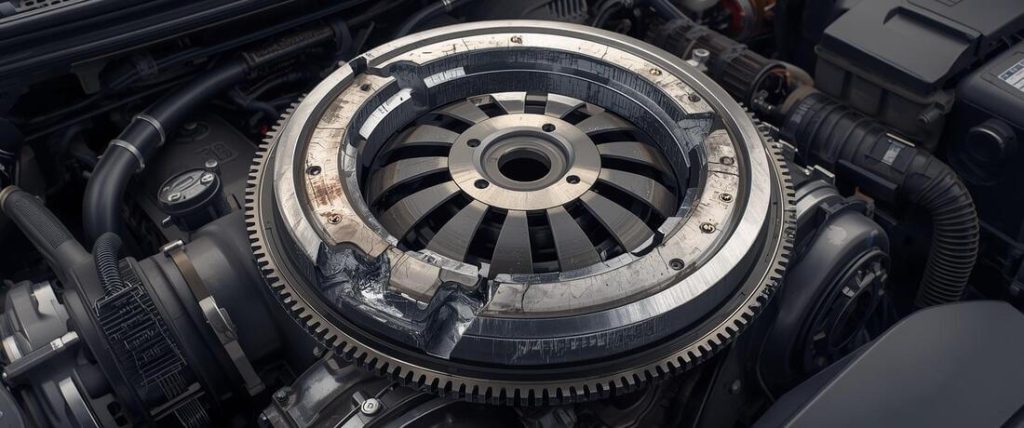
A flexplate is a thin, lightweight steel disc. It bolts to the back of the engine’s crankshaft. It connects the engine to the torque converter in an automatic transmission. It has a ring gear around the edge for the starter motor. Unlike a heavy flywheel, a flexplate is light. It can flex slightly to absorb movement.
Flexplate vs. Flywheel — Quick Comparison
It is important to know the difference. A flexplate is for automatics. A flywheel is for manuals. They do the same basic job but look different.
| Feature | Flexplate | Flywheel |
|---|---|---|
| Transmission type | Automatic only | Manual only |
| Weight | 5–15 lbs (thin steel) | 15–50 lbs (thick steel) |
| Clutch surface | ❌ No | ✅ Yes |
| Torque converter mount | ✅ Yes | ❌ No |
| Energy storage | ❌ No | ✅ Yes |
| Ring gear replaceable? | ❌ Integral | ❌ Integral |
What Does a Bad Flexplate Sound Like?
The most common sound is a rattling or ticking noise at idle. It fades or disappears when you rev the engine. The sound comes from the area where the engine meets the transmission. This is often called the “bell housing” area.
Different sounds mean different types of damage.
| Sound | When It Happens | What It Suggests |
|---|---|---|
| Rattling / ticking | At idle; fades above ~1,000 RPM | Crack vibrating at low frequency |
| Clunking / knocking | When shifting into Drive or Reverse | Crack flexing under torque load |
| Grinding / scraping | During engine startup | Ring gear damage — starter grinding |
| Metallic “tap” | Deceleration in Park | Cracked section flexing as load releases |

7 Symptoms of a Bad Flexplate
1. Rattling or Ticking Noise at Idle (Most Common Early Sign)
A cracked flexplate vibrates at certain engine speeds. This happens most at low RPM or idle. The sound often fades when you rev the engine above 1,500 RPM. People often mistake this for a loose heat shield or exhaust rattle.
Key test: If the rattle changes with engine speed, suspect the flexplate.
2. Clunking or Knocking Noise When Shifting Into Drive or Reverse
When you shift gears, the transmission applies load. A cracked plate flexes under this load. This causes a sharp metallic clunk. The sound comes from the bell housing area. It is often louder when the engine is cold.
Differentiator: If the clunk happens specifically when shifting gears, check the flexplate first. You can compare this to symptoms of a bad torque converter.
3. Grinding or Metallic Scraping During Engine Startup
The ring gear teeth are on the edge of the flexplate. The starter motor grabs these teeth to turn the engine. If teeth are worn or damaged, the starter will grind. Also, a cracked flexplate can wiggle. This causes a brief metallic scrape when the starter tries to engage.
⚠️ Warning: Repeated grinding ruins the starter motor too.
4. Intermittent No-Crank / Engine Won’t Start
If the ring gear is missing teeth in one spot, the starter works sometimes. If the engine stops on a good spot, it starts fine. If it stops on a damaged spot, the starter just spins freely. Most drivers blame the battery first. If the battery and starter are good, look at the flexplate.
5. Vibration Through the Floor, Seat, or Pedals
A cracked or warped plate creates an imbalance. You feel this as a shudder. It is most noticeable at low speeds or light acceleration. This can feel like symptoms of a bad transmission, but it comes from the engine connection.
Differentiator: If the vibration started with a rattling noise, it is likely the flexplate.
6. Engine Stalling or Rough Running
In severe cases, a bad flexplate disrupts the engine torque. The engine may stumble or stall at idle. It might idle roughly. This is less common than noise symptoms. It usually means the crack is very bad or the bolts are loose.
7. Visible Cracks, Stress Marks, or Oil Fouling on Flexplate
A mechanic can look directly at the flexplate. They must remove the inspection cover first. They look for cracks or rust streaks.
What to look for:
- Rusty streaks: Radiating from the center bolt holes. This means metal pieces are rubbing together.
- Cracks: Look around the bolt holes.
- Oil: Oil on the plate means a rear main seal leak. This can weaken the metal.
Urgency Scale — How Serious Is Your Flexplate Problem?
A bad flexplate can leave you stranded. Use this scale to decide when to fix it.
| Symptom Combination | Severity | Action |
|---|---|---|
| Occasional rattle at idle only | 🟡 Monitor | Get it inspected within 1–2 weeks |
| Rattle + clunk into gear | 🟠 Moderate | Schedule inspection this week |
| Grinding on startup + clunk | 🔴 Serious | Book repair — starter damage risk |
| Intermittent no-crank | 🔴 Serious | Don’t ignore — could leave you stranded |
| All above + vibration + stalling | ⛔ Critical | Stop driving — transmission damage risk |

Is It the Flexplate, the Torque Converter, or a Heat Shield? How to Tell
It is hard to tell the difference by sound alone. Use this table to help diagnose. This is a common confusion for many drivers.
| Symptom | Flexplate | Torque Converter | Heat Shield |
|---|---|---|---|
| Rattle changes with RPM | ✅ Yes | Sometimes | Sometimes |
| Clunk only into Drive/Reverse | ✅ Yes | Sometimes | ❌ No |
| Grinding on startup | ✅ Yes (ring gear) | ❌ No | ❌ No |
| Intermittent no-crank | ✅ Yes | ❌ No | ❌ No |
| Shudder during acceleration | Sometimes | ✅ Yes | ❌ No |
| Transmission slipping | ❌ No | ✅ Yes | ❌ No |
💡 Quick field test: You can inspect it with a flashlight. Safely raise the car on jack stands. Remove the inspection cover (4–5 bolts under the bell housing). Shine a light in. Have a helper briefly turn the engine key. Look for cracks or missing teeth.
What Causes a Flexplate to Fail?
Metal fatigue is the main cause. The plate is always flexing, and it gets tired over time. Here are other common causes:
- Loose bolts: If the mounting bolts are not tight, the plate wobbles and cracks.
- Misalignment: If the transmission is not aligned right, it puts stress on the plate.
- Worn parts: A worn pilot bushing can cause a wobble.
- High mileage: Certain cars, like some Fords, have known cracking patterns.
- Oil leaks: A rear main seal leak can contaminate the metal. This weakens it over time.
How to Inspect Your Flexplate Without Dropping the Transmission
You do not always need to take the transmission out to check. You can see a lot through the inspection hole.
What you need: Flashlight, floor jack + jackstands, 8–10mm socket, brake cleaner.
Steps:
- Safely raise and support the vehicle on jack stands.
- Locate the inspection cover. It is a small metal plate on the bottom of the bell housing. It usually has 4–5 small bolts.
- Remove the inspection cover.
- Shine a bright flashlight through the gap. You will see a section of the flexplate.
- Have an assistant rotate the engine by hand. Or use a remote starter switch in short bursts.
What to look for:
- Cracks in the metal (especially near the crankshaft bolts).
- Rusty streaks radiating from the center. This confirms a crack.
- Missing or chipped ring gear teeth.
- Oil on the flexplate surface.
⚠️ Note: If you find damage, do not drive. The repair involves removing the transmission. This is usually not a DIY job unless you have experience.

Flexplate Replacement Cost — Full Breakdown
The part itself is cheap. The labor is expensive because the transmission must be removed.
| Cost Component | Estimated Range | Notes |
|---|---|---|
| Flexplate part (aftermarket) | $20 – $100 | Most vehicles |
| Flexplate part (OEM Ford) | $160 – $200 | Ford OEM pricing |
| Flexplate part (OEM Honda) | $600 – $800 | Premium OEM pricing |
| Labor (transmission removal) | $300 – $1,500 | 3–15 hours depending on vehicle |
| Total (typical shop) | $800 – $1,800 | Most vehicles |
| Total (complex/AWD/4WD) | $1,800 – $2,500+ | Transfer case removal adds cost |
| DIY (parts only) | $20 – $100 | Only for experienced mechanics |
💡 Pro Tip: Replace the Torque Converter at the Same Time? Since the transmission is out, mechanics often recommend checking the torque converter. If it has high miles, replace it now. The labor is already paid for.
Is It Safe to Drive With a Bad Flexplate?
The short answer is no. It is not safe to drive for long or without risk.
A cracked flexplate can break completely. This causes a sudden loss of power to the wheels. A failed plate can damage the torque converter and starter. Debris can enter the transmission. If the ring gear fails, you will be stranded. If you must drive a short distance, avoid hard acceleration. Do not drive on the highway.
FAQs About Symptoms of a Bad Flexplate
Can I drive with a bad flex plate?
You should not drive with a bad flexplate. It can break completely and leave you stranded. It can also damage the transmission or torque converter.
What can be mistaken for a bad torque converter?
A bad flexplate is often mistaken for a torque converter issue. Both cause rattling and clunking. Heat shields and engine mounts are also commonly confused with them.
How much does it cost to replace a cracked flexplate?
The cost is usually between $800 and $1,800 at a shop. The part is cheap ($20–$100), but labor is high because the transmission must be removed.
When to replace a flex plate?
Replace the flexplate as soon as you hear rattling or clunking. If you see visible cracks or rust streaks during an inspection, replace it immediately.
How do I know if it’s the flexplate or the torque converter?
Listen to when the noise happens. If it happens when shifting gears, it is often the flexplate. If the car shudders while driving, it might be the converter. Inspecting the ring gear through the cover is the best way to be sure.
Bottom Line — Verdict
A bad flexplate announces itself clearly if you know what to listen for. Rattling at idle. A clunk into gear. Grinding on startup. These are signs the plate is cracked. Do not wait to fix it. A cheap $100 part can become a $2,000 repair if it damages the transmission. Get it inspected the moment you notice the signs.
Quick Summary
- Rattling Noise: Listen for a rattle at idle that goes away when you rev the engine.
- Clunking Gear: A clunk when shifting into Drive or Reverse is a key sign.
- Grinding Start: Grinding noise when starting means ring gear damage.
- Visual Check: Look through the inspection cover for cracks or rust streaks.
- Stop Driving: A broken flexplate can leave you stranded or damage the transmission.
- Repair Cost: Expect to pay $800–$1,800 mostly for labor.
- Automatic Only: Remember, manual cars have flywheels, not flexplates.