
This article was updated in September 19, 2026 with new products and information by Mark S. Taylor
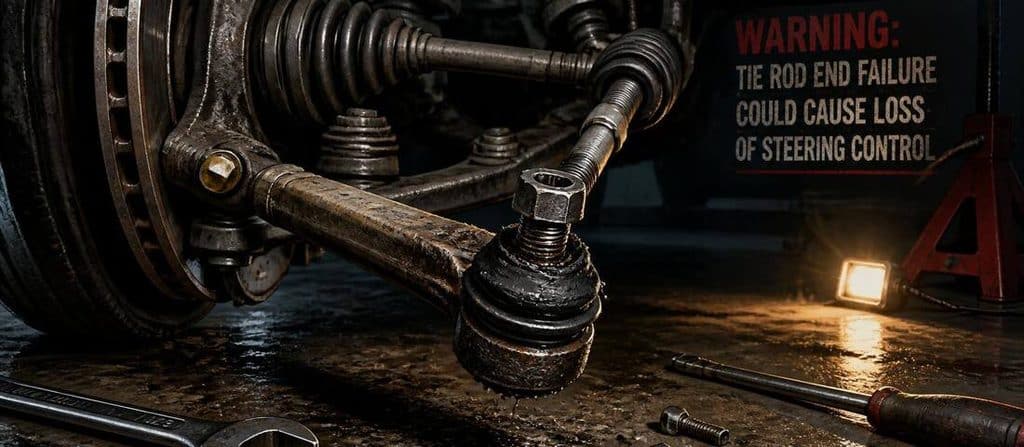
A bad tie rod end can change the way your car steers, tracks and handles. The first signs are often subtle: a little looseness in the steering wheel, a clunk over bumps, or uneven wear on one front tire.
As the joint wears further, those symptoms can become more obvious.
The most common bad tie rod end symptoms are loose or wandering steering, steering-wheel vibration, clunking or knocking from the front end, uneven tire wear, and changes in wheel alignment.
But there’s an important catch: these symptoms can also be caused by ball joints, wheel bearings, control-arm components, inner tie rods, steering racks and alignment problems.
So don’t replace a tie rod end based on symptoms alone. The steering joint needs to be inspected for actual play or damage.
Contents
- 1 What Are the Symptoms of a Bad Tie Rod End?
- 2 What Is a Tie Rod End?
- 3 7 Bad Tie Rod End Symptoms
- 3.1 1. Loose or Excessive Steering Play
- 3.2 Important distinction
- 3.3 2. Steering-Wheel Vibration or Shaking
- 3.4 3. Clunking or Knocking From the Front End
- 3.5 4. The Vehicle Wanders or Doesn’t Track Straight
- 3.6 But don’t confuse wandering with alignment alone
- 3.7 5. Uneven or Rapid Front-Tire Wear
- 3.8 6. The Vehicle Keeps Going Out of Alignment
- 3.9 7. Steering Feels Less Precise
- 4 Bad Tie Rod End vs. Bad Ball Joint
- 5 Bad Outer Tie Rod vs. Bad Inner Tie Rod
- 6 How to Check for a Bad Tie Rod End
- 7 Can You Drive With a Bad Tie Rod End?
- 8 What Causes Tie Rod Ends to Go Bad?
- 9 Do Bad Tie Rod Ends Affect Wheel Alignment?
- 10 Do Bad Tie Rod Ends Make Noise?
- 11 Bad Tie Rod End Repair
- 12 Should You Replace One Tie Rod End or Both?
- 13 Common Diagnostic Mistakes
- 13.1 Blaming the tie rod for every steering problem
- 13.2 Assuming a bad alignment means a bad tie rod
- 13.3 Replacing the tie rod without checking the inner joint
- 13.4 Ignoring wheel bearings
- 13.5 Replacing a tie rod without an alignment
- 13.6 Continuing to drive with severe steering play
- 13.7 Diagnosing by noise alone
- 14 FAQs About Tie Rod End inspection
- 15 Final Verdict
What Are the Symptoms of a Bad Tie Rod End?
Common symptoms include:
- Loose or excessive steering play
- Steering-wheel vibration
- Clunking or knocking from the front end
- Vehicle wandering or pulling
- Uneven front-tire wear
- Poor or inconsistent alignment
- Steering that feels less precise than normal
A damaged tie rod can affect steering control and, in severe cases, can lead to loss of control. MOOG identifies loose steering, vibration, uneven tire wear and front-end alignment problems as common warning signs.
If you notice significant steering looseness or a tie rod joint has visible excessive movement, have the vehicle inspected before continuing to drive it normally.
What Is a Tie Rod End?
The tie rod is part of the steering linkage.
On a typical rack-and-pinion system, the inner tie rod connects to the steering rack, while the outer tie rod end connects the steering linkage to the steering knuckle.
The outer tie rod end contains a ball-and-socket-style joint that allows the steering knuckle to move as the suspension travels and the wheels turn.
When you turn the steering wheel, the steering rack moves the tie rod.
The tie rod then moves the steering knuckle and changes the direction of the front wheel.
That is why a worn tie rod isn’t just another suspension noise.
It’s a steering-component problem.
7 Bad Tie Rod End Symptoms
1. Loose or Excessive Steering Play
One of the most important symptoms is a steering wheel that feels less connected to the front wheels.
You may notice:
- Extra steering-wheel movement before the vehicle responds
- Sloppy steering
- Delayed steering response
- The need to constantly correct the steering
- A vague feeling from the front end
A worn tie rod joint can develop excessive movement, allowing the steering linkage to move without immediately moving the wheel as it should.
MOOG describes loose or excessive steering-wheel play as a common symptom of damaged tie rods.
Important distinction
Loose steering doesn’t automatically mean the outer tie rod is bad.
The inner tie rod, steering rack, ball joints and other steering components can also create steering play.
That’s why the joint should be physically inspected.
2. Steering-Wheel Vibration or Shaking
A worn tie rod end can contribute to steering-wheel vibration because excessive joint movement allows the wheel assembly to move differently from the steering input.
The vibration may become more noticeable:
- During turns
- Over uneven roads
- During acceleration
- At certain road speeds
MOOG notes that a loose or damaged tie rod can cause steering-wheel shaking or vibration and excessive play.
However, vibration has many possible causes.
A tire imbalance, bent wheel, wheel bearing, brake problem or suspension component can create similar symptoms.
Don’t diagnose a tie rod from vibration alone.
3. Clunking or Knocking From the Front End
A worn tie rod end may produce a clunk, knock or rattle when the steering linkage moves.
You may notice the noise:
- While turning at low speed
- When entering a driveway
- Going over bumps
- When changing direction
- When steering left and right while stationary
MOOG identifies knocking or clunking during low-speed turns as a possible sign of worn tie rods.
But several other components can make similar noises.
Ball joints, sway-bar links, control-arm bushings and other steering components should also be checked.
A dry-park test can help a technician isolate movement in the steering linkage.
4. The Vehicle Wanders or Doesn’t Track Straight
A worn tie rod can affect the relationship between the steering rack and the front wheel.
The result may feel like the vehicle:
- Wanders within the lane
- Requires frequent steering corrections
- Doesn’t hold a straight line
- Feels unstable on uneven roads
- Changes direction more than expected
MOOG notes that worn tie rods can contribute to wandering and erratic steering.
But don’t confuse wandering with alignment alone
A vehicle that pulls or wanders can also have:
- Incorrect wheel alignment
- Uneven tire pressure
- Tire conicity
- Worn control-arm bushings
- Ball-joint wear
- Wheel-bearing problems
- Steering-rack problems
The steering and suspension need to be inspected as a system.
5. Uneven or Rapid Front-Tire Wear
A worn tie rod can allow the front wheel’s position to change enough to affect alignment.
That can produce abnormal tire wear, particularly across the inner or outer edge.
Look for:
- One-sided tread wear
- Feathering
- Abnormally fast wear
- Different wear patterns between the front tires
MOOG specifically identifies excessive or uneven tire wear as a potential symptom of a damaged tie rod.
But remember:
Uneven tire wear does not prove the tie rod is bad.
Alignment, worn suspension parts, incorrect tire pressure and other steering components can produce similar patterns.
6. The Vehicle Keeps Going Out of Alignment
If the vehicle was aligned correctly but the steering geometry keeps changing, worn steering or suspension components should be investigated.
A tie rod controls the position of the front wheel relative to the steering system.
If the joint develops excessive play, the wheel’s effective alignment can change.
MOOG notes that worn tie rods can contribute to front-end misalignment.
This is particularly important if:
- The steering wheel won’t stay centered
- Toe settings change
- Tire wear returns shortly after an alignment
- The vehicle develops new wandering after alignment
Don’t keep paying for alignments without finding the worn component.
7. Steering Feels Less Precise
Sometimes the first symptom isn’t a dramatic clunk or vibration.
The car simply doesn’t feel as precise as it used to.
You may notice:
“I have to move the steering wheel more than before.”
Or:
“The car feels loose over rough roads.”
That vague steering sensation can be caused by a worn tie rod, but it can also come from other steering and suspension components.
This is why a hands-on inspection is more valuable than trying to diagnose the exact component from one symptom.
Bad Tie Rod End vs. Bad Ball Joint
These two problems are commonly confused.
| Symptom | Tie Rod End | Ball Joint |
|---|---|---|
| Loose steering | Common possibility | Possible |
| Clunking | Possible | Possible |
| Steering vibration | Possible | Possible |
| Uneven tire wear | Possible | Possible |
| Wandering | Possible | Possible |
| Wheel movement | Possible | Possible |
| Direct steering-linkage play | Strong clue | Not necessarily |
| Joint play found during inspection | Confirms worn joint if excessive | Confirms worn joint if excessive |
The key difference is where the movement is occurring.
A tie rod end connects the steering linkage to the steering knuckle.
A ball joint connects the suspension control arm to the steering knuckle.
Both can produce overlapping symptoms.
That’s why physically locating the play matters.
Bad Outer Tie Rod vs. Bad Inner Tie Rod
A vehicle can have a worn outer tie rod end or a worn inner tie rod.
Outer tie rod symptoms
The outer joint is closer to the steering knuckle.
Possible signs include:
- Steering looseness
- Clunking
- Visible joint movement
- Alignment changes
- Uneven tire wear
Inner tie rod symptoms
The inner joint connects the tie rod to the steering rack.
Possible symptoms can overlap:
- Steering play
- Clunking
- Wandering
- Poor steering response
- Front-end looseness
A dry-park test can help locate looseness in inner and outer tie rods.
Don’t assume an outer tie rod is bad simply because the steering feels loose.

How to Check for a Bad Tie Rod End
A proper inspection is more reliable than diagnosing the part from symptoms.
Step 1: Inspect the Tie Rod Boot
Look for:
- Torn rubber
- Cracks
- Missing boot
- Grease leakage
- Dirt or water contamination
A damaged sealing boot can allow contaminants into the joint and accelerate wear.
However, a torn boot doesn’t automatically mean the joint has excessive play yet.
Step 2: Check the Joint for Excessive Play
The exact inspection procedure depends on the vehicle and suspension design.
A technician may use a lift and observe the steering linkage while another person moves the steering wheel.
MOOG describes a dry-park test where an assistant moves the steering wheel while the technician watches steering components for looseness.
The goal is to determine where the movement originates.
Step 3: Watch the Tie Rod End While the Steering Moves
If the steering wheel is moved slightly left and right, watch the tie rod end and steering knuckle.
The steering components should move together without excessive joint movement.
If the joint visibly moves independently or has measurable play beyond the manufacturer’s limit, it needs further attention.
HELLA’s current steering/brake inspection guidance specifically includes checking tie-rod-end joint play, sealing-collar condition and joint fasteners.
Step 4: Check Other Steering Components
Don’t stop at the tie rod.
Inspect:
- Inner tie rods
- Ball joints
- Control arms
- Steering rack
- Steering gear
- Wheel bearings
- Steering knuckle
- Sway-bar components
A good diagnosis identifies the actual loose component.
Can You Drive With a Bad Tie Rod End?
It depends on the severity, but significant tie-rod play should be treated as a safety issue.
The tie rod is directly involved in steering control.
A severely worn or damaged tie rod can progress from steering looseness and tire wear to loss of steering control. MOOG specifically warns that tie-rod failure can have consequences ranging from premature tire wear to loss of vehicle control.
NHTSA recall documentation also illustrates the potential consequence of a tie-rod connection becoming loose: a tie rod can eventually separate from the steering knuckle, resulting in loss of control of the affected wheel.
Don’t drive normally if you have:
- Severe steering looseness
- A visibly loose tie rod
- Significant clunking accompanied by steering play
- A steering wheel that suddenly becomes difficult to control
- A wheel that appears to change direction independently
- A suspected broken or disconnected tie rod
In those situations, have the vehicle inspected and repaired before driving it.
What Causes Tie Rod Ends to Go Bad?
Tie rod ends can wear from normal use, but several factors can accelerate failure.
Normal wear
The joint moves every time you steer.
Over time, the ball-and-socket joint can develop wear and play.
Potholes and impacts
Hard impacts can damage steering components.
Road debris
Objects striking the steering linkage can bend or damage components.
Torn dust boot
A damaged boot can allow dirt and moisture into the joint.
Corrosion
Water and contaminants can contribute to joint deterioration.
Incorrect installation
Installation matters.
MOOG notes that improper tie-rod-end installation can contribute to excessive play, clunking and premature failure.
Do Bad Tie Rod Ends Affect Wheel Alignment?
Yes.
A worn tie rod can contribute to alignment changes because the tie rod is part of the steering geometry.
But a worn tie rod should generally be repaired before performing a final alignment.
There’s little value in setting alignment precisely while a steering joint still has excessive play.
After tie-rod replacement, a wheel alignment is normally required because the tie rod affects steering geometry. MOOG specifically recommends alignment whenever new tie rod ends are fitted.
Do Bad Tie Rod Ends Make Noise?
They can.
Common descriptions include:
- Clunk
- Knock
- Pop
- Rattle
- Clicking
The noise may be more noticeable during low-speed turns or when the steering direction changes.
But noise alone cannot identify a tie rod end.
Other front-end components can make similar sounds.
The noise tells you where to investigate—not automatically what part to replace.

Bad Tie Rod End Repair
If inspection confirms excessive play or a damaged joint, replacement is generally the repair.
Depending on the vehicle, the repair may involve:
- Removing the wheel
- Disconnecting the tie rod from the steering knuckle
- Removing the tie rod from the steering linkage
- Installing the replacement
- Tightening fasteners to manufacturer specifications
- Installing a new cotter pin where specified
- Checking steering operation
- Performing a wheel alignment
Don’t guess at torque specifications.
Tie-rod fastener requirements vary by vehicle.
A recent Honda service bulletin, for example, calls for inspection of outer tie-rod looseness and specifies replacement of the nut and cotter pin as part of its repair procedure, followed by wheel alignment.
Should You Replace One Tie Rod End or Both?
It depends on the condition of the other side.
Tie rod ends don’t automatically need to be replaced in pairs simply because one has failed.
However, the opposite side should be inspected for:
- Excessive play
- Torn boot
- Corrosion
- Wear
- Damage
If the other side is worn, replacing it at the same time may make sense.
The correct decision should be based on inspection rather than an automatic “replace both” rule.
Common Diagnostic Mistakes
Blaming the tie rod for every steering problem
Steering systems have multiple wear points.
Assuming a bad alignment means a bad tie rod
Alignment problems have many causes.
Replacing the tie rod without checking the inner joint
The inner tie rod can create similar symptoms.
Ignoring wheel bearings
Wheel-bearing play can be mistaken for steering-component looseness.
Replacing a tie rod without an alignment
The steering geometry should be checked after replacement.
Continuing to drive with severe steering play
A steering component is not a good place to gamble.
Diagnosing by noise alone
A clunk identifies a symptom, not necessarily the failed part.
FAQs About Tie Rod End inspection
What are the most common bad tie rod end symptoms?
The most common symptoms include loose steering, steering-wheel vibration, front-end clunking or knocking, wandering, uneven tire wear and alignment problems.
Can a bad tie rod cause vibration?
Yes. A worn tie rod can contribute to steering-wheel vibration, although tire, wheel-bearing and other suspension problems can cause similar symptoms.
Can a bad tie rod cause uneven tire wear?
Yes. Excessive tie-rod play can affect front-end alignment and contribute to uneven tire wear.
Does a bad tie rod make a clunking noise?
It can, particularly during low-speed steering or changes in steering direction. But ball joints and other suspension components can make similar noises.
Can a bad tie rod cause the car to pull?
It can contribute to wandering or steering problems, but pulling can also result from alignment, tires, brakes or other suspension components.
How do I know if my tie rod is bad?
The most reliable answer comes from an inspection for excessive joint play, combined with checking the surrounding steering and suspension components.
Final Verdict
The clearest bad tie rod end symptoms are loose steering, wandering, steering-wheel vibration, front-end clunking, uneven tire wear and recurring alignment problems.