
This article was updated in May 22, 2026 with new products and information by Mark S. Taylor
Front-wheel drive and rear-wheel drive are the two most common drivetrain layouts on the road — and they feel completely different to drive, handle differently in every condition, and cost different amounts to own. Whether you’re buying a car, curious about the difference, or trying to decide if RWD is worth it for a performance build, here’s the honest breakdown.
Contents
Quick Winner
For daily commuting, family use, or budget-conscious buying: FWD. Better traction in rain and light snow, more interior space, lower cost, better fuel economy. Most people driving most cars in most conditions are better served by FWD.
For sports cars, track use, or driving enjoyment: RWD. Better handling balance, more driver engagement, and the separation of steering and power delivery that makes performance driving possible.
For winter driving in serious snow country: FWD with winter tires beats RWD with all-season tires. RWD with winter tires is genuinely competitive with FWD. Tires matter more than driven wheels — more on this below.
For trucks, body-on-frame SUVs, and towing: RWD (or 4WD based on RWD). Rear-wheel drive is structurally suited to towing loads and the demands of truck-based platforms.
For a first car or a car you just want to own without thinking about it: FWD. Simpler, cheaper, more forgiving.
How Each Drivetrain Works
Front-Wheel Drive (FWD)
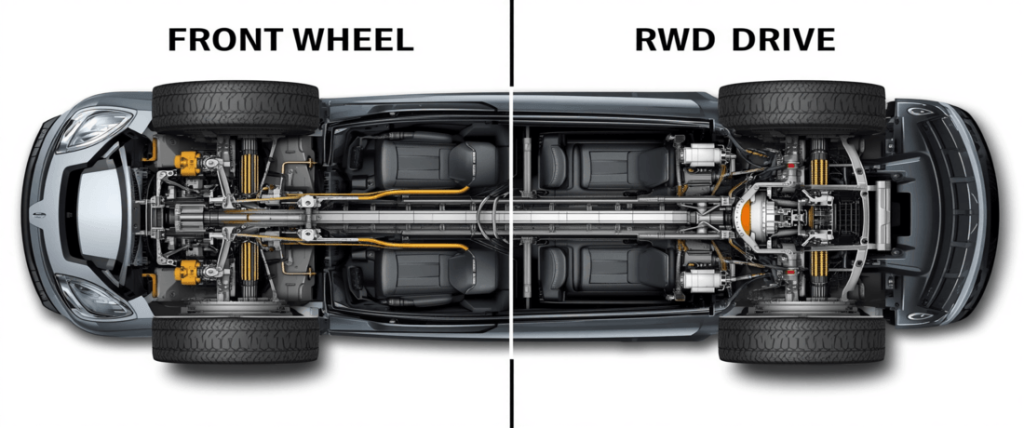
In a front-wheel drive car, the engine sits transversely (sideways) over the front axle, and the transmission, differential, and driven wheels are all packaged together at the front of the car in a unit called a transaxle. The front wheels do everything — they steer the car and they deliver the engine’s power to the road simultaneously.
The result is a compact, space-efficient package that puts the heavy drivetrain components over the driven wheels — which helps traction but creates a front-heavy weight distribution.
Think of it as a dog sled. The power is at the front, pulling the rest of the car behind it.
Rear-Wheel Drive (RWD)
In a rear-wheel drive car, the engine typically sits longitudinally (front to back) in the engine bay. Power travels through a transmission, down a driveshaft running the length of the car, through a rear differential, and out to the rear wheels. The front wheels steer only. The rear wheels drive only. Each axle has one job.
This separation allows a more balanced weight distribution — typically closer to 50/50 front to rear — and gives engineers more freedom to tune handling independently for each axle.
Think of it as a rowboat. The power is at the back, pushing the boat forward while the front steers freely.

Key Differences Table
| Feature | FWD | RWD |
|---|---|---|
| Driven wheels | Front | Rear |
| Steering wheels | Front (same as driven) | Front (separate from driven) |
| Typical weight distribution | 60–65% front / 35–40% rear | 50–55% front / 45–50% rear |
| Handling characteristic | Understeer | Oversteer (at limit) |
| Traction in snow (stock tires) | Better | Worse |
| Traction in snow (winter tires) | Good | Good |
| Interior space efficiency | Higher | Lower (driveshaft tunnel) |
| Typical fuel economy advantage | +1–3 MPG | Baseline |
| Drivetrain weight | Lighter | Heavier |
| Primary maintenance item | CV axles / CV boots | Rear differential fluid / driveshaft |
| Performance ceiling | Lower | Higher |
| Typical vehicle segment | Economy, compact, FWD sedans/hatchbacks | Sports cars, trucks, luxury, performance |
| Average price premium | Baseline | $2,000–$5,000+ in same segment |
Pros & Cons
FWD
Pros:
- Better traction in rain, snow, and low-grip conditions — engine weight sits directly over driven wheels
- More interior space — no driveshaft tunnel means more legroom and floor space for the same exterior size
- Lighter overall weight — typically 100–150 lbs less than an equivalent RWD setup
- Better fuel economy — lighter weight and simpler drivetrain reduces parasitic losses
- Lower purchase price — simpler to manufacture, savings passed to buyer
- More forgiving at the handling limit — understeer is easier for average drivers to manage than oversteer
- Lower maintenance cost in most scenarios — no rear differential to service
Cons:
- Torque steer — under hard acceleration, the steering wheel can pull toward the stronger CV axle, especially on high-power FWD cars
- Front tires do everything — steering, accelerating, and braking loads all on one axle accelerates front tire wear
- Handling limit is understeer — the car plows wide instead of rotating, which feels unresponsive and can’t be corrected with throttle the way RWD oversteer can
- Poor weight distribution limits performance ceiling — 65/35 front bias means less rear grip for cornering
- CV axle replacement when worn — $150–$400 per axle, though failures are uncommon on modern vehicles
RWD
Pros:
- Better handling balance — near 50/50 weight distribution optimizes grip at all four corners
- Front wheels steer only — steering feel is lighter, more precise, and uncontaminated by torque
- Power oversteer capability — skilled drivers can use throttle to rotate the car through corners (essential for performance driving)
- Better suited for high-power applications — rear axle handles drive loads while front handles steering independently
- Structurally suited for towing — rear-biased load management benefits from rear-wheel traction
- More engaging to drive at the limit — oversteer requires and rewards driver skill
Cons:
- Poor traction in snow on all-season tires — rear wheels have less weight over them and break traction more easily
- Oversteer is less forgiving for average drivers — a rear-end slide requires quick, precise correction to recover
- Driveshaft tunnel reduces interior space — the transmission hump intrudes into rear passenger footwell
- Heavier drivetrain — driveshaft and rear differential add weight and mechanical complexity
- Higher purchase and maintenance cost — rear differential requires periodic fluid service; RWD cars typically cost more in the same segment
- Torque steer is replaced by rear traction issues under hard acceleration in low grip
Performance Differences
This is where the real difference lives — and where most guides abandon readers with terminology instead of explanation.
Understeer vs. Oversteer: What They Actually Feel Like
Understeer (FWD characteristic): You’re driving into a corner. You turn the steering wheel. The front tires run out of grip before the rears do. Instead of rotating through the corner, the car keeps going straight — toward the outside of the bend — no matter how much you turn the wheel. The car is pushing, not turning. The instinctive response — more steering input — makes it worse. The correct response is to back off the throttle and let the front tires regain grip.
Understeer is safe and boring. It’s predictable. Average drivers recover from it without realizing it happened. The car just doesn’t turn as much as you asked it to.
Oversteer (RWD characteristic at the limit): You’re in the same corner. The rear tires lose grip before the fronts do. The back of the car steps out, rotating the nose toward the inside of the corner — or beyond. If you don’t correct it, the car spins. The correct response is opposite lock (steering into the slide) and measured throttle to balance the rear.
Oversteer is exciting and demanding. In the hands of a skilled driver, controlled oversteer is exactly what makes RWD sports cars feel alive. In the hands of an unprepared driver, it’s a spin.
Torque Steer (FWD Problem)
High-power FWD cars suffer from torque steer — when you floor it from a standstill or out of a corner, the steering wheel pulls toward one side. It happens because the two front CV axles are different lengths, creating unequal forces under hard acceleration. It’s annoying, slightly unsettling, and a primary reason performance cars above a certain power threshold almost universally use RWD.
The Performance Ceiling
FWD cars have a lower performance ceiling not because the engines aren’t powerful enough, but because asking one axle to simultaneously steer and deliver power creates an inherent conflict. Above roughly 250 horsepower in a FWD car, torque steer becomes severe and cornering grip is compromised by the combined demands on the front tires.
RWD separates these functions. The front tires steer. The rear tires drive. Each can be optimized independently — which is why virtually every serious performance car, sports car, and supercar uses RWD as its foundation.
Reliability
Modern FWD and RWD drivetrains are both extremely reliable. The gap that existed in earlier generations has largely closed.
FWD reliability: The primary wear item is the CV (constant velocity) axle — specifically the rubber boots that protect the CV joints from contamination. A torn CV boot left unaddressed allows grease to escape and dirt to enter, eventually destroying the joint. Caught early (a torn boot replacement costs $80–$150), the joint is saved. Neglected, the joint itself needs replacement at $150–$400 per axle. On modern vehicles with intact boots, CV axle failures before 150,000 miles are uncommon.
RWD reliability: The primary maintenance item is the rear differential — a sealed unit containing gears and bearings that requires periodic fluid changes (every 30,000–60,000 miles depending on manufacturer). Neglected differential fluid causes bearing wear and eventual gear damage — a $500–$2,000+ repair. Driveshaft U-joints are another RWD-specific wear item, though failures are infrequent on properly maintained vehicles.
The honest reliability verdict: Both drivetrains routinely reach 200,000+ miles on well-maintained vehicles. The reliability difference between a well-maintained FWD Honda Civic and a well-maintained RWD BMW 3 Series is marginal — the maintenance habits of the owner matter far more than the drivetrain layout.
Maintenance & Cost
Drivetrain-Specific Maintenance Cost Comparison
| Service Item | FWD | RWD | Interval |
|---|---|---|---|
| CV boot inspection | $0 (visual check) | N/A | Every oil change |
| CV boot replacement (if torn) | $80–$150 per boot | N/A | As needed |
| CV axle replacement | $150–$400 per axle | N/A | As needed |
| Rear differential fluid | N/A | $80–$150 | 30,000–60,000 miles |
| Driveshaft U-joint inspection | N/A | $0 (visual check) | Annually |
| Driveshaft U-joint replacement | N/A | $150–$400 | As needed |
| Transfer case (if applicable) | N/A | N/A | 4WD only |
100,000-Mile Cost Reality
Over a typical 100,000-mile ownership period on a well-maintained vehicle:
A FWD owner might replace one or two CV axles ($300–$800 total) and one CV boot ($80–$150) over that distance. Total drivetrain-specific cost: roughly $380–$950.
An RWD owner will service the rear differential fluid 2–3 times ($160–$450 total) and may replace U-joints once ($150–$400). Total drivetrain-specific cost: roughly $310–$850.
The honest math: Over 100,000 miles, the drivetrain-specific maintenance cost difference between FWD and RWD is typically under $200. The tire cost difference — RWD cars wear rear tires faster under acceleration and FWD cars wear front tires faster from the combined steering/driving load — is often larger than the mechanical maintenance gap.

Fuel Economy
FWD cars are consistently more fuel-efficient than equivalent RWD vehicles — typically by 1–3 MPG in real-world driving.
The reasons are straightforward:
Weight: A FWD drivetrain eliminates the driveshaft and rear differential — components that add 100–150 lbs to an RWD vehicle. Less weight requires less fuel to accelerate and maintain speed.
Drivetrain friction: The driveshaft and rear differential introduce additional rotational friction that the engine must overcome. FWD’s simpler transaxle has fewer friction-generating components in the power path.
Aerodynamics and packaging: FWD’s compact transverse layout allows lower hood lines and smaller engine bays on economy cars, contributing to better aerodynamic efficiency in the segments where FWD dominates.
Real-world impact: On a vehicle driven 15,000 miles per year at $3.50/gallon, a 2 MPG advantage equals roughly $100–$150 in annual fuel savings. Modest, but real — and it compounds over a 5–7 year ownership period into $500–$1,000 in total fuel savings.
The caveat: vehicle weight, aerodynamics, and engine efficiency matter far more than drivetrain layout for real-world fuel economy. A well-engineered RWD sports car can out-MPG a heavy FWD crossover easily. Drivetrain type is one input among many.
Best for Daily Driving
FWD wins for daily driving — and it’s not particularly close.
The first thing I tell anyone buying a commuter car is to stop worrying about rear-wheel drive. For getting to work, running errands, parking in tight spaces, carrying passengers, and managing rain-slicked roads, FWD does everything better or equal to RWD at lower cost.
The practical advantages compound daily:
- Better traction pulling away from stop lights in wet conditions
- No driveshaft tunnel intruding into rear passenger floor space
- Lighter weight reduces fuel costs every single day
- Lower purchase price means more money for other priorities
The one daily driving scenario where RWD earns consideration: if you live somewhere with serious winter weather and are committed to fitting proper winter tires. A RWD car on dedicated winter tires is genuinely capable in snow — not the liability its reputation suggests. But a FWD car on the same winter tires is still easier to manage for most drivers.
For the vast majority of daily drivers — buy the best car you can afford in the segment you need, and don’t let RWD be a deciding factor unless you’re buying a performance car.

Best for Performance
RWD wins for performance — definitively and for clear reasons.
The separation of steering and power delivery between the front and rear axles is not just a nice-to-have for performance driving. It’s foundational. Here’s why it matters:
When a FWD car corners hard, the front tires are simultaneously asked to steer the car and put power down. Under the stress of cornering G-forces, those two demands conflict directly — the front tires have only so much grip to give, and splitting it between steering and traction compromises both.
When an RWD car corners hard, the front tires steer and only steer. The rear tires drive and only drive. The contact patch of each tire can be fully committed to its single function. The result is more total grip, better balance, and the ability to use throttle to actively manage the car’s attitude through a corner.
Beyond the physics, RWD enables power oversteer — the ability to rotate the rear of the car with throttle, the technique behind every controlled drift and every proper racing line entry. This is simply not possible in FWD.
For track days, autocross, canyon runs, or any driving where you’re actually engaging with the car rather than just piloting it — RWD is the answer, and good drivers know it.
Which Lasts Longer?
Both drivetrains last as long as their maintenance allows. The honest answer is that drivetrain layout is not a meaningful longevity differentiator on modern vehicles.
A FWD Honda Accord regularly crosses 250,000 miles with nothing more than CV boot checks and routine fluid service. A RWD Toyota Camry (the rare RWD version from the 1980s) was equally bulletproof. Modern examples from both camps — a FWD Toyota Corolla and a RWD BMW 3 Series — both routinely reach 200,000 miles when properly maintained and both fail prematurely when neglected.
The longevity factors that actually matter:
- Oil change frequency (the single biggest longevity driver for any drivetrain)
- Differential fluid service on RWD (overlooked by many owners; catastrophic when neglected)
- CV boot condition on FWD (cheap to fix when caught early; expensive when ignored)
- Driving style — sustained hard acceleration, track use, and towing accelerate wear on any drivetrain
Bottom line on longevity: Maintain either drivetrain properly and it will outlast most owners’ interest in keeping the car. The question of which lasts longer is less important than whether you’ll actually follow the maintenance schedule for whichever one you own.
FAQs About FWD vs RWD
Is FWD or RWD better in snow?
FWD has a genuine advantage over RWD in snow on all-season tires — the engine’s weight sits over the driven front wheels, improving traction. But the more important variable is tire type, not driven wheels. A RWD car on dedicated winter tires outperforms a FWD car on worn all-seasons in serious snow. If you’re in heavy snow country, invest in winter tires regardless of drivetrain — that decision matters more than FWD vs. RWD.
Can you daily drive an RWD car in winter?
Yes — with proper winter tires and adjusted driving habits. Millions of people daily drive RWD BMWs, Mercedes, Mustangs, and Camaros through northern winters. The key is winter tires (not all-seasons), smooth throttle inputs, and understanding that the rear can step out under hard acceleration in low-grip conditions. RWD in winter is manageable, not dangerous, when the driver is prepared.
Is RWD more expensive to maintain than FWD?
Marginally, over the long term. The rear differential requires periodic fluid changes ($80–$150 every 30,000–60,000 miles) that FWD owners never pay. FWD owners face CV axle and boot replacement costs that RWD owners don’t. Over 100,000 miles, the total drivetrain maintenance cost difference is typically under $200 either direction — not a meaningful factor in a vehicle purchase decision.
Why do sports cars use RWD instead of FWD?
Because separating steering (front axle) from power delivery (rear axle) allows each to be fully optimized. FWD cars above roughly 250 horsepower suffer from torque steer and handling compromises because the front tires can’t efficiently handle steering and traction simultaneously under high loads. RWD eliminates this conflict, enables power oversteer, and produces better handling balance — which is why virtually every serious performance car uses RWD as its foundation.
Does FWD get better gas mileage than RWD?
Generally yes — by 1–3 MPG in equivalent vehicles. FWD drivetrains eliminate the driveshaft and rear differential, reducing weight by 100–150 lbs and drivetrain friction losses. The savings are real but modest — roughly $100–$150 per year at average fuel prices and mileage. Vehicle weight, aerodynamics, and engine efficiency have a larger MPG impact than drivetrain type alone.
Verdict
Buy FWD if: You want a practical, cost-efficient daily driver. You live in a climate with rain or occasional snow. Interior space and fuel economy matter to you. You’re buying in the economy, compact, or family segment where FWD dominates anyway. You don’t want to think about your car’s drivetrain — you just want it to work.
Buy RWD if: You’re buying a sports car, performance sedan, or truck. Driving engagement matters to you and you’re willing to develop the skills RWD rewards. You live in a mild climate or are committed to winter tires in cold weather. You’re towing and need the structural and traction advantages RWD provides at the rear axle.
The market reality nobody says out loud: In the under-$35,000 new car market, you largely don’t have a choice. Nearly every affordable sedan, hatchback, and compact crossover is FWD by default. RWD in that price range means a sports car — a Mustang, a Miata, a BRZ. If you’re not buying one of those, you’re buying FWD whether you think about it or not.
The honest one-line verdict: FWD is the right answer for most people’s real lives. RWD is the right answer for anyone who drives for the joy of it.