
This article was updated in May 23, 2026 with new products and information by Mark S. Taylor
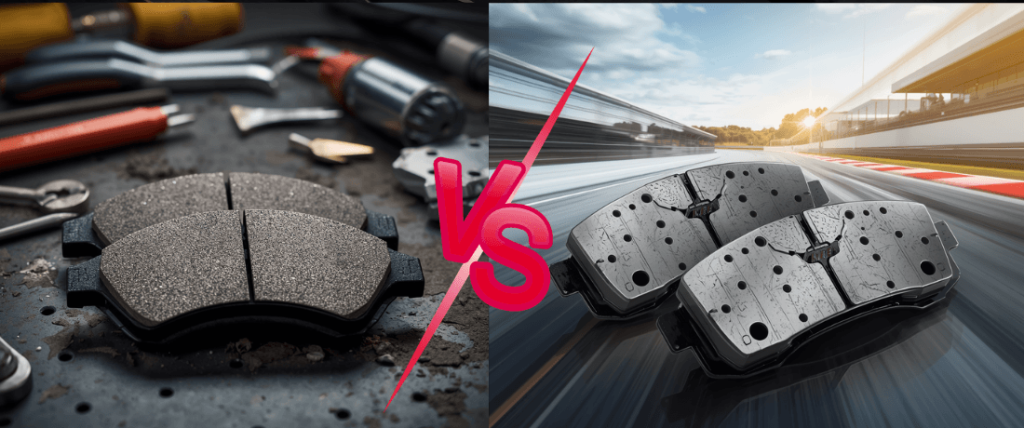
You’re replacing your brake pads and the auto parts store has three tiers on the shelf — economy, mid-range, and premium — at three very different prices. The difference between most of them comes down to one thing: what the friction material is made of. Ceramic vs metallic brake pads. That choice affects how your brakes feel, how long they last, how much dust ends up on your wheels, and whether your brakes hold up under heavy use.
Here’s exactly what each one does — and which one belongs on your car.
Contents
Quick Winner
For daily commuting, family vehicles, and standard street driving: Ceramic. Quieter, cleaner, longer pad life, and consistent cold-morning performance. Worth the modest price premium for most drivers.
For towing, hauling, or mountain driving with sustained heavy braking: Semi-metallic. Higher heat tolerance prevents the brake fade that ceramic pads develop under sustained thermal load. Not optional for these use cases.
For track days or performance driving: Semi-metallic or dedicated high-performance compound (Hawk HPS, EBC Yellowstuff, Ferodo DS). Ceramic pads are not a performance product — they will fade under track conditions regardless of price.
For a budget-conscious daily driver replacement: Quality semi-metallic is a perfectly legitimate choice. The noise and dust difference between quality semi-metallic and ceramic is smaller in real life than the price gap suggests.
For a truck or SUV with heavy loads: Semi-metallic. The thermal demands of stopping a heavier vehicle require the heat capacity metallic compounds provide.
What Each Pad Type Is
Ceramic Brake Pads
Ceramic pads are made from a dense ceramic compound reinforced with copper fibers and bonded with high-temperature resin. They contain little to no metal in the friction material itself. The ceramic compound is hard, stable at street temperatures, and produces fine, light-colored dust that doesn’t stick aggressively to wheel surfaces.
Ceramic pads operate most effectively in the temperature range typical of normal street driving — roughly 200°F to 800°F. Below that range, they have good cold bite. Above it, they begin to fade.
Semi-Metallic Brake Pads
Semi-metallic pads contain 30–70% metal by weight — typically a mixture of steel wool, iron powder, copper, and other metallic particles bound with resin. The metal content is the variable that drives every performance difference. More metal means more heat capacity, more friction under load, more rotor wear, and more noise.
Semi-metallic pads operate effectively across a much wider temperature range than ceramic — typically 300°F to 1,400°F+ depending on formulation — which is why they’re the standard choice for heavy-duty and performance applications.
Full-Metallic (Sintered) Pads — Brief Context
Full-metallic or sintered pads contain 90–100% metal and are designed exclusively for race and extreme duty applications. They require high operating temperatures to work properly — they perform poorly on cold rotors in street driving — and they are extremely aggressive on rotors. Unless you’re racing, full-metallic pads have no place on a street car.
When a guide says “metallic pads,” it almost always means semi-metallic for street use. Keep that distinction in mind.
Key Differences Table
| Feature | Ceramic | Semi-Metallic |
|---|---|---|
| Friction material | Ceramic fibers + copper + resin | 30–70% metal (steel, iron, copper) + resin |
| Optimal temperature range | 200°F – 800°F | 300°F – 1,400°F+ |
| Cold bite (first stop from cold) | Excellent | Good to moderate |
| Heat fade resistance | Moderate (fades above ~900°F) | Excellent (handles sustained heat) |
| Noise level | Low — quieter operation | Moderate — more prone to squeal |
| Brake dust color/quantity | Light gray, low quantity | Dark black/gray, higher quantity |
| Rotor wear rate | Lower | Higher |
| Pad lifespan (street use) | 50,000–70,000 miles typical | 30,000–60,000 miles typical |
| Cost per axle (parts only) | $40–$120 | $25–$80 |
| Best application | Daily driving, comfort, light use | Towing, performance, heavy vehicles |
| Track use suitability | Not recommended | Yes (performance formulations) |
| Bedding-in required | Yes — moderate | Yes — thorough |

Pros & Cons
Ceramic Brake Pads
Pros:
- Significantly less brake dust — and the dust that is produced is light-colored and doesn’t bond aggressively to alloy wheel surfaces
- Quieter operation — ceramic compound produces less vibration and noise across most temperature ranges
- Excellent cold bite — perform consistently from the first stop on a cold morning, unlike some semi-metallic compounds that need heat to reach full friction
- Longer pad lifespan in street use — 50,000–70,000 miles typical vs. 30,000–60,000 for semi-metallic
- Lower rotor wear — gentler on rotors, extending rotor service life and reducing total braking system cost
- Consistent friction coefficient across street temperature ranges — predictable, linear pedal feel
- Better for alloy wheel preservation — less abrasive dust means less chemical and abrasive damage to wheel finish over time
Cons:
- Higher upfront cost — typically $15–$40 more per axle than equivalent semi-metallic
- Not suitable for sustained high-heat applications — fade above approximately 900°F makes them inappropriate for towing, track use, or repeated mountain descents
- Not available in true high-performance formulations — ceramic chemistry doesn’t scale to race-level thermal demands
- Slightly less initial bite than performance semi-metallic compounds — the pedal feel is softer and less aggressive, which some drivers prefer and others don’t
Semi-Metallic Brake Pads
Pros:
- Superior heat dissipation — metal content conducts heat away from the rotor surface more efficiently, enabling sustained heavy braking without fade
- Better for high-demand applications — towing, performance driving, heavy vehicles, mountain grades
- Lower upfront cost — $25–$80 per axle vs. $40–$120 for ceramic
- More aggressive initial bite — the higher friction coefficient delivers a more immediate pedal response that some drivers prefer
- Available in performance-specific formulations — Hawk HPS, EBC Redstuff/Yellowstuff, Ferodo DS, and others designed specifically for spirited street and track use
- Better suited for heavier vehicles — trucks and SUVs generate more kinetic energy to dissipate; metallic compounds handle it more reliably
Cons:
- More brake dust — dark, fine metallic particles that bond to hot alloy wheel surfaces and require more frequent, more aggressive cleaning
- More noise-prone — metallic content increases the likelihood of squeal, particularly when cold or when pads are near the end of their service life
- Higher rotor wear rate — harder metallic particles abrade rotor surfaces more aggressively, accelerating rotor replacement intervals
- Less consistent cold performance — some semi-metallic formulations require heat cycling before reaching optimal friction levels
Performance Differences
This is the section most guides get wrong — by treating stopping power as a single variable instead of a temperature-dependent range.
Cold Bite — First Stop Performance
Ceramic pads win on cold bite. On a cold car sitting overnight, the first few stops of the day are cleaner and more consistent with ceramic pads. Some semi-metallic compounds — particularly higher-metal-content formulations — need one or two heat cycles before they reach their rated friction coefficient.
For daily driving in a cold climate, ceramic’s cold-bite advantage is a real, every-morning quality-of-life difference.
Street Temperature Range — Normal Driving
In the 200°F–800°F range typical of normal street driving, both pad types perform comparably. Stopping distances are similar on well-maintained rotors. The difference in braking feel — ceramic is slightly softer and more linear, semi-metallic is slightly more immediate — comes down to personal preference more than objective performance.
High-Temperature Performance — Where It Really Matters
Above 900°F, the comparison is no longer competitive. Semi-metallic wins decisively.
When brakes get hot — from repeated hard stops, sustained highway braking on a grade, towing a loaded trailer, or any track driving — the friction material in ceramic pads begins to degrade. The pedal goes soft. Stopping distances increase. This is brake fade, and it’s a safety issue.
The first time I had a customer come back complaining that their brakes felt spongy after a mountain descent, nine times out of ten they’d put ceramic pads on a truck that towed regularly. The pads weren’t defective. They were the wrong tool for the job.
Semi-metallic pads handle sustained heat because the metal content conducts heat away from the friction interface more efficiently. The pads can absorb and dissipate the thermal energy that would overwhelm a ceramic compound.
Track Use
Ceramic pads are not a track product. Full stop. Even premium ceramic pads from reputable brands will fade on a track day — the thermal demands of repeated hard braking laps exceed the operating range of ceramic chemistry.
For track use, purpose-built semi-metallic compounds are the minimum. Hawk HPS and HP Plus, EBC Yellowstuff, and Ferodo DS2500 are commonly used street-to-track transition pads. Dedicated race compounds (Hawk DTC series, Carbotech XP) are full-metallic or high-metallic formulations with operating temperatures starting above what street pads can handle at all.
Reliability
Ceramic pads are highly consistent in street use. Their friction coefficient varies less across the 200°F–800°F range than semi-metallic, giving a predictable, linear pedal feel from the first stop to the last. They don’t squeal as readily, don’t require significant heat to activate, and resist glazing under light use. The main reliability concern is thermal overload — push them past their operating range and performance drops sharply.
Semi-metallic pads are more consistent under thermal stress — their reliability advantage is specifically in the high-temperature range where ceramic fades. The trade-off is cold-temperature consistency: high-metal-content pads used on very light-duty applications in cold climates can glaze from insufficient heat cycling, causing reduced friction and squeal until heat is reintroduced.
Glazing is worth understanding for both types. Glazed pads have a hardened, shiny friction surface from overheating (ceramic) or underuse cycling (semi-metallic). The result is reduced friction, longer stopping distances, and often noise. Proper bedding-in after installation significantly reduces glazing risk for both pad types.
Bedding-in: Both ceramic and semi-metallic pads require a proper break-in procedure — a series of controlled moderate stops from highway speed to transfer an even layer of pad material onto the rotor surface. Skip this and you get uneven pad transfer, vibration, and reduced performance from day one.
Maintenance & Cost
Upfront Cost Per Axle
| Pad Type | Budget Tier | Mid-Range | Premium |
|---|---|---|---|
| Semi-Metallic | $20–$35 | $35–$60 | $60–$80 |
| Ceramic | $35–$55 | $55–$85 | $85–$120+ |
True Cost Including Rotor Wear
This is the number most buyers ignore — and it’s where the real cost comparison lives.
Semi-metallic pads are measurably harder on brake rotors. The harder metallic particles abrade the rotor surface more aggressively with every braking event. Over the life of a set of semi-metallic pads, rotors wear faster — often requiring replacement one full pad cycle earlier than they would with ceramic pads.
A set of replacement rotors costs $80–$200 per axle in parts, plus $100–$200 in labor if you’re not doing it yourself. That’s $180–$400 of additional cost per axle that the $20 savings on the semi-metallic pads quietly generates over 18–36 months.
The honest math:
Semi-metallic pads (one set) + one earlier rotor replacement: $200–$480 total per axle over 60,000 miles Ceramic pads (one set) + standard rotor life: $180–$320 total per axle over 70,000 miles
For a daily driver with no heavy-duty demands, ceramic pads are often cheaper per mile of total braking system life — the opposite of what the sticker price suggests.
Fuel Economy
Brake pad type has a negligible direct effect on fuel economy under normal driving conditions — but the indirect effects are worth understanding.
Brake drag: All brake pads create some residual contact with the rotor surface even when not applied. The drag coefficient difference between ceramic and semi-metallic pads is minimal and not measurable in real-world MPG for street use.
Rotor surface condition: Glazed or scored rotors from aggressive metallic pads can increase brake drag slightly over time — which does affect rolling resistance and fuel economy marginally. Maintaining smooth, properly conditioned rotor surfaces with compatible pads has a tiny but real effect on efficiency.
The bottom line on fuel economy: Don’t choose your brake pads based on MPG impact. The difference is too small to measure at the pump. Choose based on stopping performance, noise, dust, and operating temperature range — all of which matter far more.

Best for Daily Driving
Ceramic pads win for daily driving — and the case is strong on nearly every metric that matters to a commuter.
Quieter. Cleaner wheels. Better cold-morning performance. Longer pad life. Lower total braking system cost when rotor wear is factored in.
The wheel cleanliness angle is underappreciated. A car with semi-metallic pads and alloy wheels needs the wheels cleaned every 1–2 weeks in typical driving to prevent the dark metallic dust from baking onto the finish. A car with ceramic pads needs it once a month, if that. Over five years of ownership, that’s a real time and cleaning product cost difference.
The one daily driving scenario where semi-metallic earns the nod: if your “daily driver” regularly tows a trailer, hauls heavy loads, or involves sustained mountain driving. In that case, the thermal demands exceed ceramic’s operating range and semi-metallic is the responsible choice regardless of the noise and dust tradeoffs.
For everything else — commuting, school runs, weekend errands, highway cruising — ceramic is the better daily pad, and the price premium pays for itself.
Best for Performance and Heavy-Duty Use
Semi-metallic wins for any application involving sustained heavy braking — and it’s not a close call.
For towing: A loaded trailer behind a truck or SUV increases stopping mass and the thermal load on the braking system proportionally. On a long interstate descent or repeated ramp exits with a heavy load, the difference between ceramic and semi-metallic isn’t a matter of comfort — it’s a matter of stopping distance when the pads are hot. Semi-metallic is the correct pad for any regular towing application.
For track days: Purpose-built semi-metallic or high-metallic compounds are mandatory. Hawk HPS is a widely used street-to-track transition pad that handles sustained heat significantly better than any ceramic formulation. For dedicated track use, step up to Hawk HP Plus, EBC Yellowstuff, or Ferodo DS2500 at minimum.
For performance street driving: Spirited canyon driving, autocross, or any driving that involves repeated hard braking from high speeds generates enough heat to push ceramic pads toward their limits. A quality semi-metallic formulation — not the economy shelf option — delivers better fade resistance and more confident pedal feel under these conditions.
For heavy trucks and SUVs: The increased vehicle weight means more kinetic energy to dissipate on every stop. Semi-metallic compounds handle the thermal demands of stopping heavier vehicles more reliably, particularly under repeated braking.

Which Lasts Longer?
Ceramic pads last longer — typically 50,000–70,000 miles on a daily driver vs. 30,000–60,000 miles for semi-metallic — but the gap depends heavily on driving style.
| Pad Type | Light Driver | Average Driver | Aggressive/Heavy Driver |
|---|---|---|---|
| Ceramic | 60,000–70,000 miles | 50,000–65,000 miles | 35,000–50,000 miles |
| Semi-Metallic | 50,000–60,000 miles | 35,000–50,000 miles | 25,000–40,000 miles |
The longevity advantage of ceramic is most pronounced for light-to-average street drivers. An aggressive driver who brakes late and hard narrows the gap considerably — the higher temperatures generated by hard braking push ceramic pads closer to their operating limit with every hard stop.
The rotor longevity caveat: A set of ceramic pads that lasts 65,000 miles on a set of rotors that also last 65,000 miles is a better outcome than a set of semi-metallic pads that lasts 50,000 miles but wears the rotors down to replacement at 40,000 miles. Total system longevity — pads and rotors together — favors ceramic for non-performance street use.
FAQs About Ceramic vs Metallic Brake Pads
Are ceramic brake pads worth the extra cost?
For most daily drivers, yes. The price premium over quality semi-metallic is typically $15–$40 per axle. In return, you get quieter brakes, cleaner wheels that need less frequent washing, longer pad life, and lower rotor wear — which means less frequent (and expensive) rotor replacement. When total braking system cost is calculated over the full service life, ceramic pads often cost less per mile than semi-metallic despite the higher upfront price.
Which brake pads last longer — ceramic or metallic?
Ceramic pads typically last 50,000–70,000 miles in street use vs. 30,000–60,000 miles for semi-metallic. The gap is real but driving-style dependent — aggressive braking narrows it. More importantly, ceramic pads are also gentler on rotors, so the total braking system (pads plus rotors) lasts longer with ceramic on a daily driver.
Can I switch from semi-metallic to ceramic pads without changing anything else?
Yes — in most cases, it’s a direct swap. Ceramic pads fit the same calipers and work with the same rotors. However, if your rotors are heavily scored or worn from previous semi-metallic use, replacing them at the same time as the new ceramic pads makes sense — new pads on scored rotors bed in unevenly and wear faster. Always inspect rotor thickness and surface condition when changing pads.
Do ceramic brake pads produce less dust?
Yes, significantly. Ceramic pads produce less dust overall, and the dust they do produce is light gray — it doesn’t bond as aggressively to hot alloy wheel surfaces as the dark metallic particles from semi-metallic pads. For drivers with expensive alloy wheels or light-colored wheels, this is a real quality-of-life and wheel preservation difference, not just a marketing claim.
Which brake pads are better for towing?
Semi-metallic — without question. Towing a loaded trailer dramatically increases the thermal demands on the braking system. Ceramic pads reach their fade threshold faster under the sustained heavy braking that towing requires. Semi-metallic compounds handle higher temperatures, dissipate heat more efficiently through their metal content, and maintain consistent friction where ceramic compounds begin to fade. If you tow regularly, do not use ceramic pads regardless of their other advantages.
Verdict
Buy ceramic if: You drive a passenger car, crossover, or light SUV primarily on streets and highways. You want quiet brakes, clean wheels, and a set of pads you replace less often. Your driving doesn’t involve regular towing, heavy loads, or track days. You want the lowest total braking system cost over the life of the pads including rotor wear. Ceramic is the right answer for the majority of daily drivers in the USA.
Buy semi-metallic if: You tow a trailer regularly. You drive a heavy truck or SUV with significant payloads. You use your car on track days or push it hard on mountain roads with repeated hard braking. You prefer a more immediate, aggressive pedal feel. You’re on a tight budget and a quality semi-metallic from a reputable brand is a completely legitimate street-use choice — the noise and dust gap is smaller in real life than the marketing suggests.
The honest one-line verdict: Ceramic for your driveway; semi-metallic for your trailer hitch or your track day.