
This article was updated in May 23, 2026 with new products and information by Mark S. Taylor
Here’s the truth that makes everything else click: shock absorbers don’t absorb shocks. Your car’s springs do that. What shock absorbers actually do is dampen the oscillation — they stop your car from bouncing up and down like a pogo stick after you hit a bump. A more accurate name would be “damper,” and that’s what engineers call them.
I’ve spent 20 years as an ASE-certified master mechanic, and I’ve replaced thousands of shocks and struts. The #1 thing I explain to customers is that a shock isn’t a cushion — it’s a controller. It doesn’t make the bump softer. It makes the bump end faster. In this guide, you’ll learn exactly how do shock absorbers work, what’s inside that metal tube under your car, and why your vehicle would be undriveable without them.
Contents
- 1 What Shock Absorbers Actually Do: The Physics in Plain English
- 2 What’s Inside the Tube: The Parts That Make It Happen
- 3 Compression vs. Rebound: Why Your Car Handles Differently Going Up and Down
- 4 How Shocks “Know” When to Be Stiff or Soft (Velocity Sensitivity)
- 5 Shock vs. Strut: The Critical Difference
- 6 Types of Shock Absorbers (From Basic to Space-Age)
- 7 What Happens When Shocks Wear Out
- 8 How to Test Your Shocks (The Bounce Test and Beyond)
- 9 FAQs About How do shock absorbers work?
- 10 Do shock absorbers actually absorb shocks?
- 11 What’s the difference between a shock and a strut?
- 12 Why does my car bounce after hitting a bump?
- 13 How long do shock absorbers last?
- 14 Can I drive with bad shocks?
- 15 The Bottom Line
What Shock Absorbers Actually Do: The Physics in Plain English
To understand shocks, you need to understand springs first.
When your wheel hits a pothole, the spring compresses and stores energy — like squeezing a coil mattress. When the pothole passes, the spring releases that energy and pushes the wheel back down. Without anything to stop it, the spring would overshoot, compress again, overshoot again, and keep bouncing. On a car with no shocks, you’d feel every bump for three or four cycles before the motion died out.
Shock absorbers exist to kill that bounce in one cycle. They do it by converting the spring’s kinetic energy (movement) into thermal energy (heat) and bleeding it off into the air.
Think of it like this: a spring is a rubber ball — it bounces back with almost the same energy it absorbed. A shock absorber is a pillow — it catches the ball and stops it cold, turning the bounce into warmth. The pillow doesn’t make the floor softer. It just makes the ball stop moving.
The mechanic’s rule: Springs carry the weight and absorb the impact. Shocks control the motion and kill the energy. Neither job can work without the other.
What’s Inside the Tube: The Parts That Make It Happen
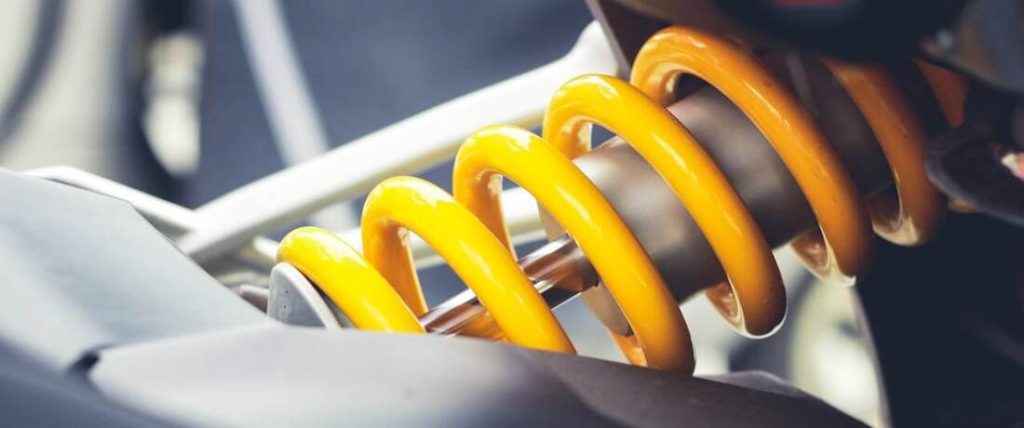
Pop the hood of any modern car and look at the suspension. That cylindrical metal tube with a rod sticking out the top? That’s your shock absorber. Inside it is a surprisingly elegant hydraulic system.
The Pressure Tube
The outer body of the shock is a sealed steel tube filled with hydraulic fluid — a specially formulated oil that resists breakdown under extreme heat and pressure. This fluid is the medium that does the actual work.
The Piston and Piston Rod
Inside the tube is a piston attached to a rod that extends out the top of the shock. The piston is the heart of the system. It divides the tube into two chambers: one above the piston, one below.
The piston has small holes drilled through it — called orifices — and flexible metal discs called shims stacked on top and bottom. The shims act like one-way valves.
How It Moves
When your wheel hits a bump, the suspension compresses. The piston rod pushes down into the tube. Hydraulic fluid is forced through the orifices in the piston. But the shims on the bottom of the piston flex just enough to let a controlled amount of fluid pass. The resistance of forcing oil through tiny holes creates friction. That friction generates heat. The heat dissipates through the shock body into the air.
When the spring rebounds and pushes the wheel back down, the piston moves up. Now the shims on the top of the piston flex, controlling flow in the opposite direction. The resistance is different — usually stiffer on rebound than compression — because controlling the body’s weight (sprung weight) requires more force than controlling the wheel’s weight (unsprung weight).
The mechanic’s take: The first time I cut open a shock absorber in trade school, I was shocked by how simple it is. It’s just a piston with holes in it, pushing through oil. The genius is in the size of those holes and the thickness of those shims. Change the hole size by 0.1 millimeter and you completely change how the car rides.

Compression vs. Rebound: Why Your Car Handles Differently Going Up and Down
Shock absorbers don’t work the same in both directions. The resistance is tuned separately for compression (the wheel moving up toward the body) and rebound (the wheel moving back down). This asymmetry is what makes your car handle predictably.
Compression damping controls the unsprung weight — your wheels, tires, brakes, and half the suspension. When you hit a bump, compression damping determines how fast the wheel can move upward. Too stiff, and the wheel can’t react fast enough — you feel every crack in the pavement. Too soft, and the suspension bottoms out on big bumps.
Rebound damping controls the sprung weight — everything above the suspension: the body, engine, you, your groceries. After the wheel moves up, rebound damping determines how fast the body settles back down. Too little rebound, and the car wallows and floats like a boat. Too much, and the suspension can’t extend fast enough to keep the tire on the road over the next bump.
What you feel: When you brake hard, the nose dives. That’s compression of the front springs. A good shock controls how fast that dive happens and how quickly the nose comes back up. When you accelerate hard, the rear squats. Rebound damping controls how the body settles after the weight transfer.
Most standard shocks have roughly a 50/50 ratio — equal resistance in both directions. Performance shocks might be tuned 70/30 or even 90/10 for specific applications. Drag racers use 90/10 front shocks: soft compression lets the nose rise easily for weight transfer, stiff rebound keeps it from slamming back down too fast.
How Shocks “Know” When to Be Stiff or Soft (Velocity Sensitivity)
This is the part that feels like magic. The same shock that gives you a smooth ride over a gently rolling road also keeps you from bottoming out when you hit a pothole. It does this without a computer, without sensors, and without you touching a dial.
Shock absorbers are velocity-sensitive hydraulic devices. The faster the piston moves, the more resistance it creates.
Here’s how: The piston has two sets of fluid paths. Small orifices handle low-speed movement — the kind you get from normal road undulations. A larger valve opens only when fluid pressure gets high enough, which happens when the piston moves fast — like hitting a pothole or a speed bump.
On a smooth road, the suspension moves slowly. Fluid flows through the small orifices with relatively little resistance. The ride feels soft and compliant. Hit a pothole, and the piston slams through the tube. The small orifices can’t move enough fluid, pressure spikes, and the high-speed valve opens. Resistance jumps dramatically. The shock stiffens instantly to absorb the impact.
The mechanic’s analogy: It’s like drinking through a coffee stirrer vs. a milkshake straw. Gentle sipping works fine through the stirrer. But if someone shoves the cup at your face, you’d need the milkshake straw to handle the volume. The shock has both straws built in, and fluid pressure automatically selects the right one.
Shock vs. Strut: The Critical Difference
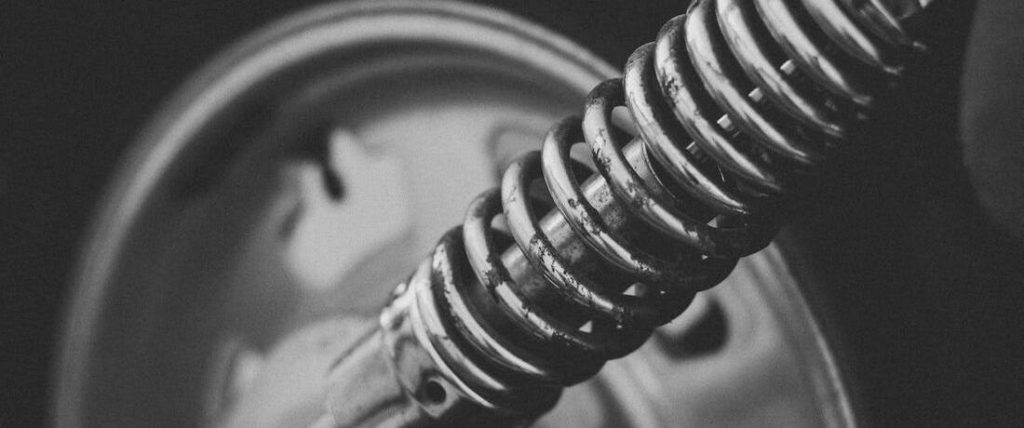
This is where most drivers get confused. Shocks and struts are not interchangeable, even though they do the same damping job inside.
A shock absorber is a standalone component. It bolts to the suspension and the frame, controls spring motion, and does nothing else. If you remove a shock, the suspension still holds itself together — it just bounces uncontrollably. Shocks are found on the rear of most cars and trucks, and sometimes on all four corners of body-on-frame vehicles.
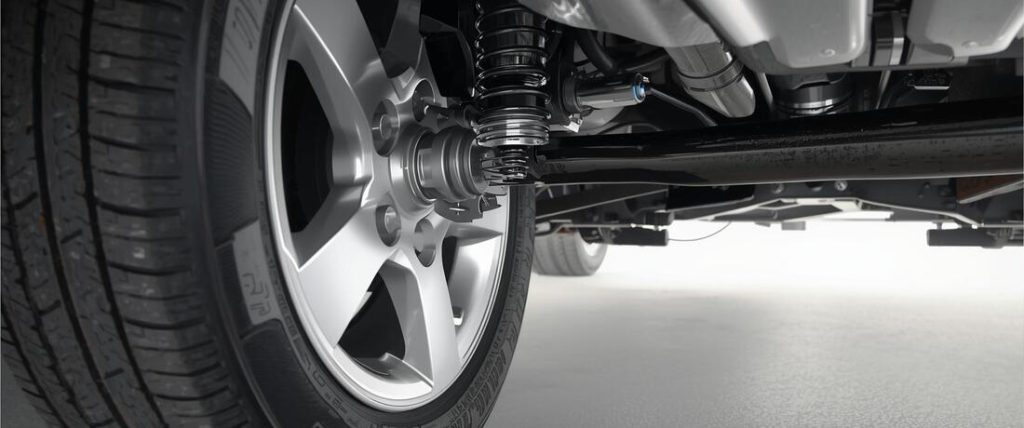
A strut — specifically a MacPherson strut — is a shock absorber built into a structural assembly. The strut housing replaces the upper control arm and upper ball joint. It holds the coil spring, supports the vehicle’s weight, and maintains wheel alignment. The strut is a load-bearing structural member of the suspension.
Why it matters: You can’t replace a strut with a shock or vice versa. Your vehicle has one or the other at each corner — never both. Strut replacement costs more because the coil spring must be compressed and transferred, and because wheel alignment is required afterward. Shock replacement is simpler and cheaper.
Table
| Shock Absorber | MacPherson Strut | |
|---|---|---|
| Supports vehicle weight? | No | Yes |
| Holds the spring? | No | Yes |
| Affects wheel alignment? | No | Yes |
| Replacement requires alignment? | No | Yes |
| Typical location | Rear of cars/trucks; all corners of trucks/SUVs | Front of most modern cars; sometimes all four corners |
| Average replacement cost (pair) | $300–$600 | $600–$1,200 |
Types of Shock Absorbers (From Basic to Space-Age)
Not all shocks are built the same. Here’s the spectrum from what you probably have to what’s on a Formula 1 car.
Twin-Tube Hydraulic — The oldest and most common design. Two nested tubes: an inner working cylinder and an outer reservoir. As the piston moves, fluid displaces from the inner to outer tube and back. Simple, reliable, and cheap. Found on most economy and mid-range vehicles.
Twin-Tube Low-Pressure Gas — Same as above, but the outer chamber has a 5–15 bar nitrogen charge instead of air. The nitrogen pressurizes the fluid, raising its boiling point and reducing aeration (cavitation) during hard use. The gas also adds slight damping of tiny vibrations that wouldn’t otherwise move the piston. Common on modern daily drivers.
Mono-Tube High-Pressure Gas — A single tube with a floating piston separating the oil from a high-pressure nitrogen charge. Better heat dissipation, more consistent damping, and inverted mounting capability (rod down). Found on performance cars and trucks. Bilstein and Fox specialize in these.
Adjustable Shocks — Manual or electronic adjustment of valving. Turn a knob to soften or stiffen the ride. Aftermarket performance shocks and some factory adaptive suspensions use this.
Adaptive / Electronic Shocks — Sensors monitor road conditions and driving behavior. The shock’s valve opens or closes in milliseconds to change damping on the fly. “Sport” mode stiffens everything; “Comfort” mode softens it. Found on luxury and performance vehicles.
MagneRide (Magnetorheological) — The space-age stuff. The fluid contains tiny iron particles. An electromagnet in the piston changes the fluid’s viscosity instantly by magnetizing the particles. Stiffness can change 1,000 times per second. Found on Cadillacs, Corvettes, Ferraris, and some Ford Mustangs.
DSSV (Dynamic Suspensions Spool Valve) — Instead of shims, these use precision-machined spool valves that open at exact pressure thresholds. More predictable and consistent than shim stacks. Found on the Ford GT, Chevrolet Colorado ZR2, and championship-winning race cars.
What Happens When Shocks Wear Out
Shock absorbers degrade slowly. Most drivers adapt to the gradual change and don’t realize how bad they’ve gotten until they drive a car with fresh shocks. Here’s what worn shocks feel like:
The bounce test failure. Push down hard on a front corner of your car and let go. A healthy shock settles in one bounce. A worn shock lets it bounce two, three, or four times.
Nose dive under braking. When shocks lose rebound damping, the front suspension can’t control the weight transfer. The nose plunges, the rear gets light, and your stopping distance increases.
Body roll in corners. Worn shocks can’t control the weight transfer from side to side. The car leans more than it should, and the tires lose grip.
Rear squat on acceleration. The back end drops and the front gets light. Traction suffers, especially in wet conditions.
Cupped tire wear. When a shock can’t control wheel hop, the tire bounces against the pavement. This creates scalloped or cupped wear patterns — high and low spots around the tire circumference.
Fluid leaks. A visible oily film or wetness on the shock body means the seal is blown. Once fluid leaks out, the shock can’t build hydraulic pressure and becomes a useless metal tube.
The mechanic’s rule: If your car has 50,000 miles and the ride feels “loose,” “floaty,” or “wallowy,” your shocks are probably done. Most drivers don’t notice because the degradation happens over years. But put new shocks on a high-mileage car, and the difference is night and day.
How to Test Your Shocks (The Bounce Test and Beyond)
You don’t need a shop to check your shocks. Here’s the 2-minute test:
Step 1: The bounce test. Go to each corner of your vehicle. Push down hard on the bumper or fender and release. Count the bounces. One bounce and settle = good. Two or more = worn.
Step 2: Visual inspection. Look at each shock body. Any wetness, oil streaks, or fluid dripping? The seal is blown. Also check for dents, cracks, or broken mounts.
Step 3: The drive test. On a safe road, drive over a series of bumps at 30–40 mph. Does the car settle immediately after each bump, or does it keep oscillating? Does the rear end feel like it’s skipping over bumps? That’s shock fade or failure.
Step 4: Check your tires. Look for cupped or scalloped wear patterns — high and low spots around the tire tread. This is a classic sign of wheel hop from worn shocks.
If you fail any of these tests, it’s time for replacement. Shocks aren’t a “wait until they break” item — they’re a safety component that affects braking, handling, and tire wear.
FAQs About How do shock absorbers work?
Do shock absorbers actually absorb shocks?
No — and that’s why “shock absorber” is technically a misnomer. Your car’s springs absorb the impact energy from bumps. Shock absorbers dampen the spring’s oscillation by converting that energy into heat. Engineers call them “dampers” because that’s what they actually do.
What’s the difference between a shock and a strut?
A strut is a shock absorber that also provides structural support for the suspension. It holds the coil spring, supports vehicle weight, and maintains wheel alignment. A shock is just a damping device — it doesn’t hold weight or affect alignment. You can’t swap one for the other.
Why does my car bounce after hitting a bump?
Your shocks are worn. Healthy shocks should settle the suspension in one bounce. If you feel two, three, or more bounces, the hydraulic fluid isn’t generating enough resistance to control the spring. The energy is cycling back and forth instead of being converted to heat.
How long do shock absorbers last?
Typically 50,000 to 100,000 miles, depending on road conditions and driving style. Rough roads, heavy loads, and aggressive driving wear shocks faster. Most manufacturers don’t specify a replacement interval, but Monroe and other experts recommend inspection at 50,000 miles.
Can I drive with bad shocks?
You can, but you shouldn’t. Worn shocks increase stopping distance, reduce cornering grip, accelerate tire wear, and make emergency maneuvers unpredictable. They’re a safety component, not a comfort item. Replace them when they fail the bounce test or show fluid leaks.
The Bottom Line
Shock absorbers don’t absorb shocks. Springs do. What shocks do is control the energy that springs store — converting movement into heat, one piston stroke at a time. That simple hydraulic action is what keeps your tires on the road, your body roll in check, and your car from bouncing down the highway like a Ford Model T on a dirt road.
Here’s what to remember: If your car bounces more than once after a bump, dives hard under braking, or feels “floaty” in corners, your shocks are telling you they’re done. Don’t ignore them — they’re the difference between a car that handles predictably and one that doesn’t handle at all.