
This article was updated in May 29, 2026 with new products and information by Mark S. Taylor
You reach for the AC button on a hot day. The moment you press it — before the cabin even starts to cool — the engine stumbles. It might recover after a second. It might keep running rough. In bad cases, it almost stalls.
The timing isn’t coincidence. The sputter happens at the exact moment the AC compressor clutch engages, and that precision tells you something important about where to look.
This isn’t always an expensive fix. Sometimes it’s a $20 throttle body cleaning. Sometimes it’s a $7 MAF sensor cleaning. But occasionally it points to something more serious. This guide covers all eight causes, what each one feels like, how to tell them apart, and what it costs to fix each one.
Contents
- 1 Why Does the Engine Sputter Specifically When the AC Turns On?
- 2 Sputter at Engagement vs Continuous Rough Idle — Key Difference
- 3 8 Causes of Engine Sputtering When AC Turns On
- 3.1 1. Dirty or Faulty Throttle Body
- 3.2 2. Bad Idle Air Control (IAC) Valve
- 3.3 3. Worn Spark Plugs or Weak Ignition Coils
- 3.4 4. AC Compressor Clutch Hard Engagement
- 3.5 5. Weak or Failing Fuel Pump
- 3.6 6. Dirty MAF Sensor
- 3.7 7. Worn or Slipping Serpentine Belt
- 3.8 8. Weak Alternator Under AC Electrical Load
- 4 Why It Gets Worse on Hot Days
- 5 How to Diagnose It at Home — Step by Step
- 6 Is It Safe to Drive With This Problem?
- 7 Repair Cost Summary
- 8 FAQs About Engine Sputters When AC Turns On
- 8.1 Why does my engine sputter when I turn on the AC?
- 8.2 Is it normal for an engine to hesitate when AC turns on?
- 8.3 Can a bad AC compressor cause engine sputtering?
- 8.4 Why does the sputter get worse on hot days?
- 8.5 Can a dirty MAF sensor cause sputtering when AC turns on?
- 8.6 What should I check first if my engine sputters when AC turns on?
- 8.7 The Bottom Line
Why Does the Engine Sputter Specifically When the AC Turns On?
Here’s something most drivers don’t know — and most articles never explain.
When you press the AC button, your car’s ECU receives a signal from the AC control system a fraction of a second before the compressor clutch actually engages. The ECU uses this preview signal to pre-emptively raise the idle speed — opening the throttle slightly or signaling the IAC valve to let more air bypass the throttle plate. This compensates for the load the compressor is about to place on the engine.
When this compensation works correctly, you feel nothing. The idle stays smooth and the engine absorbs the compressor load without a stumble.
When the compensation fails — because the throttle body is clogged, the IAC valve is stuck, the fuel system can’t keep up, or the load is simply too high — the RPM drops sharply the moment the clutch engages. That sharp drop is what you feel as a sputter or stumble.
The key insight: the engine sputters because the compensation mechanism failed, not just because the AC is on. Something is preventing the engine from absorbing the compressor load smoothly.
Sputter at Engagement vs Continuous Rough Idle — Key Difference
Before diving into causes, it helps to know exactly what you’re experiencing. The two patterns point in different directions.
| Pattern | What It Means | Where to Start |
|---|---|---|
| Sputter only at the moment AC turns on, then smooths out | IAC valve, throttle body, or compressor clutch hard engagement | Throttle body cleaning first |
| Sputter at engagement that never fully recovers | Spark plugs, MAF sensor, or weak fuel pump | Scan for misfire codes first |
| Gets worse the longer AC runs | Failing AC compressor building resistance | Listen for compressor noise |
| Worse in Drive than Park with AC on | Engine mounts amplifying compressor torque | Check mounts |
| Sputter plus electrical symptoms | Weak alternator under AC electrical load | Check battery voltage |
| Only sputters on very hot days | High refrigerant pressure overloading compressor | Check refrigerant pressure |
8 Causes of Engine Sputtering When AC Turns On
1. Dirty or Faulty Throttle Body
This is the most common cause — and the cheapest to fix.
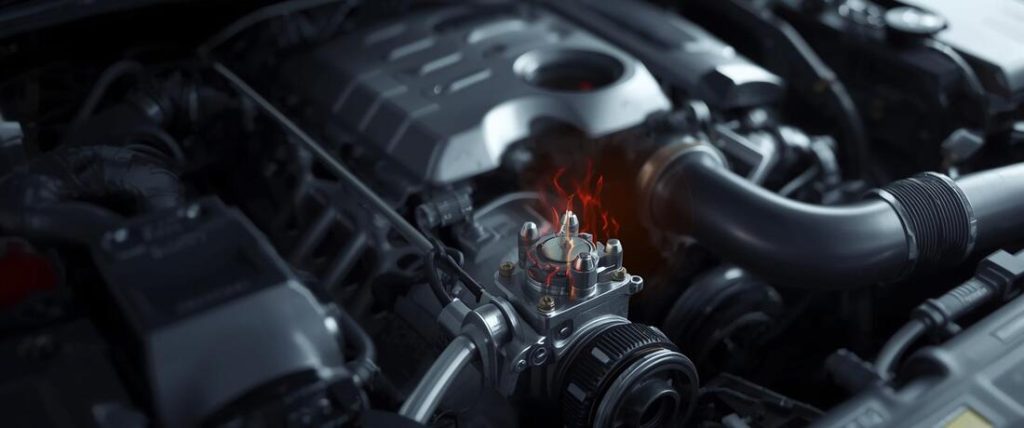
The throttle body controls how much air enters the engine. Carbon deposits build up on the throttle plate and bore walls over time, restricting airflow especially at low throttle positions. When the AC turns on and the ECU tries to open the throttle slightly to compensate for the compressor load, the sticky, carboned-up throttle plate doesn’t respond quickly or accurately enough. The idle dips and the engine sputters.
What it feels like: A stumble or sputter specifically when the AC first engages. RPM dips noticeably before recovering — or doesn’t fully recover. The idle may surge or hunt. Sometimes there’s a slight hesitation when you first press the gas after the AC turns on.
Important detail: Carbon buildup doesn’t cause a check engine light until it’s severe. You can have a significantly dirty throttle body with no warning lights at all.
Try this first: Remove the air intake hose from the throttle body. Look at the throttle plate with a flashlight. If you see heavy black carbon coating the bore and plate edges, cleaning is overdue. A can of throttle body cleaner and 20 minutes solves this.
Urgency: Medium. Worsens gradually and affects fuel economy and overall throttle response.
Repair cost: $20–$50 (DIY cleaning) or $150–$350 (professional cleaning or replacement if damaged)
2. Bad Idle Air Control (IAC) Valve
The IAC valve manages idle speed by controlling a small air bypass channel around the throttle plate. When the AC signal comes in, the ECU commands the IAC valve to open further to raise idle speed and absorb the compressor load. A dirty, stuck, or failed IAC valve ignores this command — the idle speed doesn’t rise as commanded, the compressor load hits the engine unprepared, and the engine sputters.
What it feels like: Sputter or stumble specifically when AC engages. RPM drops sharply before recovering. On some vehicles the engine almost stalls. The problem is often reproducible — same stumble every time the AC is switched on from a cold start or at a stop.
Note: Many modern vehicles use electronic throttle control and don’t have a separate IAC valve. The throttle body itself handles idle control on these cars. If your vehicle uses drive-by-wire throttle, skip to throttle body diagnosis.
Urgency: Medium-high. A stuck IAC valve can cause stalling in traffic — a real safety concern.
Repair cost: $150–$400 (IAC valve replacement, parts and labor)
3. Worn Spark Plugs or Weak Ignition Coils
Worn spark plugs fire inconsistently — particularly under load. At normal idle with no AC, the engine might run smoothly enough to mask the weak spark. The moment the AC compressor engages and engine load increases, the marginal spark plugs start misfiring more consistently. The result is a sputter or rough running that starts with the AC engagement and may persist while the AC is on.
What it feels like: A rough, rhythmic sputter that begins when the AC turns on and continues while it’s running. Often accompanied by a check engine light with a misfire code (P0300–P0308). The miss feels like a regular engine hiccup rather than a single stumble at engagement.
Check this: Plug a cheap OBD-II scanner in and look for misfire codes. If you find P030X codes alongside the sputter, spark plugs and ignition coils are the priority — not the AC system.
Common on: High-mileage vehicles, any car past 60,000–100,000 miles without a tune-up, Toyota and Honda V6 engines, Ford 3.5L EcoBoost.
Urgency: High. Persistent misfires send raw fuel into the catalytic converter. A catalytic converter replacement costs $800–$2,500. Fix misfires promptly.
Repair cost: $100–$300 (spark plug replacement) or $150–$600 if ignition coils are also needed
4. AC Compressor Clutch Hard Engagement
The AC compressor clutch is an electromagnetic clutch that connects and disconnects the compressor pulley from the engine. There’s a small air gap between the clutch plate and the pulley — typically around 0.015–0.020 inches. When this gap is too large, the clutch engages with a hard jolt instead of a smooth grab, creating a sudden torque spike on the engine. The engine stumbles from the abrupt mechanical shock.
What it feels like: A noticeable clunk or jolt — not just a stumble — specifically at the moment the AC turns on. You may hear a thud from the engine bay when the AC engages. The sputter is brief, lasting less than a second, then the engine settles. The belt may also squeal briefly at AC engagement.
This cause is almost universally missed in online articles. It requires no failed sensor or worn component — just a clutch air gap that’s drifted out of specification from normal wear.
Urgency: Medium. Hard engagement accelerates belt wear and compressor clutch wear over time.
Repair cost: $50–$150 (clutch air gap adjustment) or $200–$500 (clutch replacement if worn)
5. Weak or Failing Fuel Pump
The fuel pump delivers pressurized fuel to the injectors. A weakening pump may maintain adequate pressure at normal idle but struggles when additional demand is placed on it. When the AC turns on and the engine needs slightly more fuel to maintain idle speed against the compressor load, a weak pump can’t deliver quickly enough — causing a brief lean stumble or sputter.
What it feels like: Sputter at AC engagement that may also appear under hard acceleration. Fuel pressure drops under load — symptoms often worsen in hot weather when fuel can partially vaporize in the lines. May also cause the engine to surge at highway speed or hesitate when merging.
Test: A fuel pressure gauge at the fuel rail tells the story quickly. Measure pressure at idle, then switch the AC on and watch what happens to the reading. A healthy pump holds steady. A weakening pump shows a pressure dip when the AC load increases fuel demand.
Urgency: High. A failing fuel pump can leave you stranded without warning and causes lean running that damages the catalytic converter.
Repair cost: $300–$800 (fuel pump replacement, parts and labor)
6. Dirty MAF Sensor
The Mass Airflow sensor measures incoming air so the ECU can calculate the correct fuel injection amount. A dirty MAF sensor under-reports actual airflow — telling the ECU there’s less air than there really is. When the AC engages and the ECU opens the throttle to compensate, the air increase isn’t accurately measured and the fuel delivery doesn’t match. The resulting brief lean condition causes a sputter.
What it feels like: Hesitation or stumble at AC engagement, poor acceleration after AC turns on, slightly rough idle while AC is running. Sometimes a check engine light with a mass airflow code (P0100–P0103).
Try this first: A $7 can of MAF sensor cleaner. Spray the sensing wire carefully, let it dry completely, and test. Many AC-related sputters clear up after a MAF cleaning because the sensor can finally accurately measure the increased airflow that AC compensation requires.
Urgency: Medium. A dirty MAF reduces fuel economy and can cause lean running over time.
Repair cost: $7–$15 (MAF sensor cleaning) or $150–$400 (MAF sensor replacement)
7. Worn or Slipping Serpentine Belt
The serpentine belt drives the AC compressor, alternator, power steering pump, and water pump. When the belt is worn, glazed, or has incorrect tension, it can slip under the sudden load of the AC compressor engaging. A slipping belt creates a sudden loss of accessory drive — the alternator momentarily drops voltage, the power steering assist changes, and the overall load spike on the engine is less smooth than it should be. The result is a stumble or sputter at AC engagement.
What it feels like: A squeal or chirp from the belt when the AC turns on, followed by a brief engine stumble. The squeal may be very brief — just a fraction of a second at engagement. Belt slipping is often worse in wet weather.
Check this: With the engine off, inspect the belt for glazing (shiny surface instead of matte), cracks, fraying edges, or visible wear. Press the belt with your thumb between pulleys — it should flex about half an inch. More than that indicates slack.
Urgency: Medium-high. A serpentine belt that fails completely stops the water pump, causing immediate overheating, and disables the alternator and power steering simultaneously.
Repair cost: $100–$250 (serpentine belt replacement, parts and labor)
8. Weak Alternator Under AC Electrical Load
The AC system draws significant electrical power — the blower motor, compressor clutch solenoid, control modules, and cabin sensors all run simultaneously. A weakening alternator struggles to supply this demand, causing voltage to drop when the AC turns on. Low voltage affects the ignition system, fuel injector timing, and engine sensors — all of which can produce a stumble or rough running the moment the AC engages.
What it feels like: Sputter at AC engagement accompanied by dim headlights, flickering dashboard lights, slow power windows, or a battery warning light. The electrical symptoms are the key differentiator — if lights dim when the AC turns on, the alternator is under suspicion.
Test: Use a multimeter at the battery terminals with the engine running. Normal: 13.5–14.8V. Switch the AC on. If voltage drops below 13V, the alternator is struggling under AC load.
Urgency: High. A failing alternator eventually drains the battery and leaves you stranded. It also causes the ECU to operate on insufficient voltage, potentially causing other fault codes to appear.
Repair cost: $350–$750 (alternator replacement, parts and labor)
Why It Gets Worse on Hot Days
Hot weather amplifies every one of these causes — and here’s why.
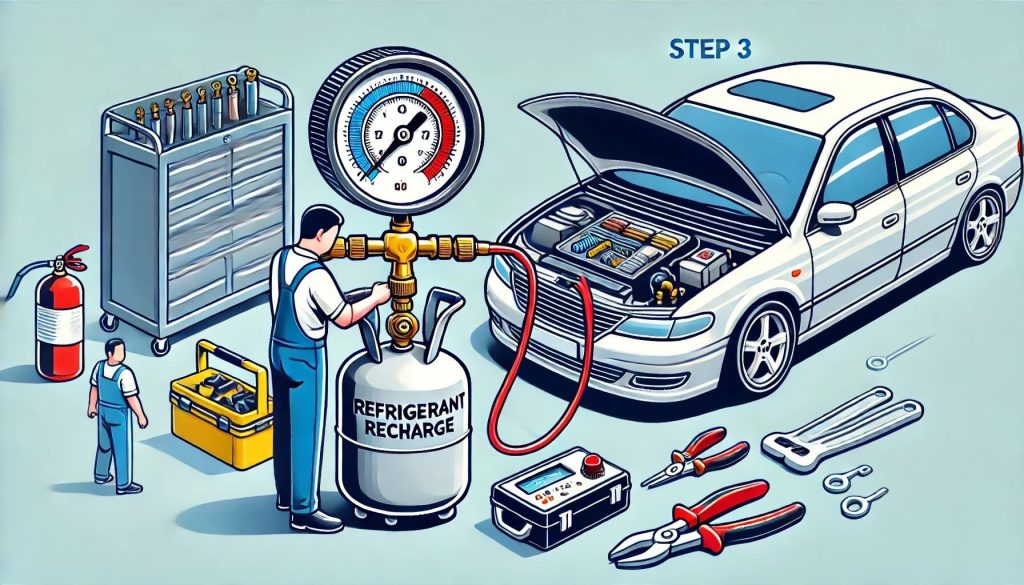
On a hot day, the refrigerant inside your AC system is under significantly higher pressure than on a mild day. Higher pressure means the compressor has to work harder to compress the refrigerant — which means it places more load on the engine at engagement. A car that sputters slightly on a mild day may almost stall on a 95°F afternoon.
If you notice the sputter is dramatically worse in summer heat, that’s a useful diagnostic clue. It points toward causes related to the compressor load itself — the compressor clutch air gap, a worn serpentine belt, or a weak fuel pump that can’t compensate for the higher demand.
Hot weather also causes fuel to partially vaporize in the fuel lines before reaching the injectors — which amplifies any existing weakness in the fuel delivery system.
How to Diagnose It at Home — Step by Step
Work through these checks in order before spending money on parts:
- Watch the tachometer at AC engagement. Turn the AC on and watch the RPM gauge. A healthy car dips 50–100 RPM then recovers within one second. A drop of 200+ RPM that takes more than two seconds to recover points to throttle body, IAC valve, or fuel delivery issues.
- Scan for fault codes. Use a cheap OBD-II scanner to check for misfire codes (P0300–P0308), MAF codes (P0100–P0103), or IAC codes. Any of these alongside the sputter narrows the cause significantly.
- Inspect and clean the throttle body. Remove the air intake tube. Look at the throttle plate. Heavy carbon means cleaning is the first step — do this before replacing any other parts.
- Clean the MAF sensor. Spray MAF cleaner on the sensing element, let it dry 10 minutes, reinstall and retest.
- Listen for belt noise at AC engagement. Any squeal or chirp from the serpentine belt area when the AC turns on points to belt wear or tension issues.
- Watch the compressor clutch. Look at the center hub of the AC compressor with the engine running and AC off. When you switch the AC on, the center hub should engage smoothly and stay engaged. A hard thud at engagement suggests the clutch air gap needs adjustment.
- Check battery voltage with AC on. Multimeter at battery terminals: 13.5–14.8V is healthy. Below 13V under AC load means the alternator is struggling.
- Test fuel pressure under load. Attach a gauge to the fuel rail test port. Normal pressure at idle, then switch AC on and watch for a pressure dip. Any significant drop under AC load points to a weakening fuel pump.

Is It Safe to Drive With This Problem?
| Cause | Safe to Drive? | Action |
|---|---|---|
| Dirty throttle body | Yes, short term | Clean within a few weeks |
| Dirty MAF sensor | Yes, short term | Clean this week — cheap and easy |
| Bad IAC valve | Caution — stalling risk | Fix within 1–2 weeks |
| AC compressor clutch gap | Yes, short term | Adjust within a month |
| Worn serpentine belt | Caution — failure risk | Replace promptly |
| Misfiring spark plugs | No — catalyst at risk | Fix immediately |
| Weak fuel pump | Caution — stalling risk | Fix soon |
| Weak alternator | No — stranding risk | Fix immediately |
Practical rule: If the sputter is brief and the engine recovers quickly, you have some time to diagnose and fix it. If the engine almost stalls every time the AC turns on, or if a check engine light is on, treat it as urgent and avoid using the AC until the cause is identified.
Repair Cost Summary
| Repair | DIY Friendly? | Average Cost |
|---|---|---|
| MAF sensor cleaning | Yes | $7–$15 |
| Throttle body cleaning | Yes | $20–$50 |
| Spark plug replacement | Yes | $100–$300 |
| Serpentine belt replacement | Intermediate | $100–$250 |
| AC compressor clutch adjustment | Intermediate | $50–$150 |
| IAC valve replacement | Intermediate | $150–$400 |
| Throttle body replacement | Intermediate | $150–$350 |
| Ignition coil replacement | Intermediate | $150–$400 |
| Fuel pump replacement | Mechanic recommended | $300–$800 |
| Alternator replacement | Mechanic recommended | $350–$750 |
| AC compressor replacement | Mechanic only | $600–$1,500 |
FAQs About Engine Sputters When AC Turns On
Why does my engine sputter when I turn on the AC?
The AC compressor places a sudden load on the engine when it engages. The ECU is supposed to pre-emptively raise idle speed to absorb this load. When the compensation mechanism fails — due to a dirty throttle body, bad IAC valve, worn spark plugs, or other issues — the RPM drops sharply and the engine sputters.
Is it normal for an engine to hesitate when AC turns on?
A barely perceptible RPM dip lasting less than one second is normal on many vehicles. The compressor clutch engagement creates a brief load spike before the ECU compensates. Any sputter, stumble, or hesitation that lasts more than one second, or that you can feel through the steering wheel or seat, is not normal and needs diagnosing.
Can a bad AC compressor cause engine sputtering?
Yes. A failing compressor with worn internal components creates more resistance than normal on the serpentine belt. In severe cases it begins to seize, creating a hard load spike at engagement that the engine can’t absorb smoothly. A compressor clutch with an out-of-specification air gap also causes a hard mechanical jolt at engagement.
Why does the sputter get worse on hot days?
On hot days, refrigerant pressure inside the AC system is significantly higher. The compressor has to work harder to compress it, placing more load on the engine at engagement. Any existing weakness in the throttle response, fuel delivery, or belt system is amplified by the higher compressor load on hot days.
Can a dirty MAF sensor cause sputtering when AC turns on?
Yes. A dirty MAF sensor under-reports airflow to the ECU. When the AC engages and the throttle opens slightly to compensate, the ECU can’t accurately measure the increased airflow and doesn’t add enough fuel. The brief lean condition produces a stumble. MAF cleaning often resolves AC-related sputtering and costs less than $10.
What should I check first if my engine sputters when AC turns on?
Start with the cheapest and most accessible checks: clean the MAF sensor ($7), inspect and clean the throttle body ($20), and scan for fault codes with a basic OBD-II reader. These three steps resolve the majority of AC engagement sputters before any parts need replacing.
The Bottom Line
An engine that sputters when the AC turns on is telling you one thing clearly: the compensation mechanism that’s supposed to absorb the compressor load isn’t working properly. That could be something as simple as carbon on the throttle plate or a dirty MAF sensor — or something more involved like a weak fuel pump or failing alternator.
The diagnostic approach matters more than the repair. Don’t start by replacing expensive parts. Start by watching the tachometer, scanning for codes, and cleaning the throttle body. Most AC engagement sputters are resolved before you spend more than $50.
Quick Summary:
- The engine sputters because the ECU’s idle compensation mechanism failed at AC engagement
- The most common causes are dirty throttle body and bad IAC valve — check these first
- Worn spark plugs cause continuous misfiring that AC load makes noticeably worse
- A compressor clutch with a worn air gap causes a hard mechanical jolt at engagement — an often missed cause
- Sputter that worsens on hot days points to high refrigerant pressure overloading a marginal system
- Misfires alongside sputtering are urgent — catalytic converter damage risk
- Start diagnosis with MAF cleaning ($7) and throttle body inspection ($0) before buying any parts