
This article was updated in June 24, 2026 with new products and information by Mark S. Taylor
Yes—a degraded or failing automotive battery can absolutely trigger severe engine misfires. However, it does not happen the way most casual vehicle owners assume, and it doesn’t manifest every single time a battery loses its chemical strength. There is a highly specific electrical pattern that points straight to the battery cell matrix as the primary culprit, and if you know exactly what parameters to look for, you can confirm it yourself in your driveway in under 10 minutes.
The primary diagnostic challenge is that engine misfire symptoms appear identical regardless of the root cause. A rough idle, a flashing check engine light, and a P0300 diagnostic code will surface whether your vehicle suffers from a dead battery, a shorted ignition coil, worn-out spark plugs, or a caked fuel injector.
As an ASE-Certified Master Technician, I have seen hundreds of drivers blindly throw money at expensive ignition components when the actual fault was a simple voltage drop. In this comprehensive workshop guide, we will break down the three hidden mechanisms of battery-induced misfires, how to differentiate voltage drop from component failure, and outline a professional driveway multimeter test loop.

Contents
- 1 3 Hidden Mechanisms: How a Bad Battery Triggers a Misfire
- 2 Symptoms: What a Battery-Induced Misfire Pattern Feels Like
- 3 Diagnostic Isolation: Battery vs. Coils vs. Spark Plugs
- 4 How to Test If Your Battery Is Causing Misfires in 5 Steps
- 5 Can You Drive With This Misfire?
- 6 Repair Cost Breakdown
- 7 DIY vs. Mechanic Decision Guide
- 8 What Causes a Battery to Weaken to This Point?
- 9 Prevention Tips
- 10 FAQs About Can a Bad Battery Cause a Misfire
- 10.1 Q: Can a bad battery cause a P0300 random misfire code?
- 10.2 Q: Will replacing the battery fix the misfire?
- 10.3 Q: Can a battery cause misfires even when the car starts fine?
- 10.4 Q: What’s the difference between a battery that causes misfires and one that just causes a no-start?
- 10.5 Q: My new battery still has misfires. What now?
- 11 The Verdict: Check the Voltage Rails Before Tearing Down Components
3 Hidden Mechanisms: How a Bad Battery Triggers a Misfire
An automotive battery does not supply high-voltage current to your spark plugs directly—that is the job of the ignition coils. Instead, a failing battery induces misfires through three advanced electrical anomalies:
1. Catastrophic Cranking Voltage Drop
When you activate the starter motor on a cold morning, the mechanical draw pulls a massive current load—anywhere from 150 to 400 Cold Cranking Amps (CCA) depending on cylinder displacement. A healthy battery handles this load easily, maintaining system voltage above 11V.
Conversely, a sulfated or failing battery experiences a severe voltage drop under starter load, often plummeting down to 9V or 10V during cranking. Modern electronic ignition coils demand a steady minimum threshold of 11.5V to 12.0V to saturate their internal windings. Below this limit, the coil’s output arc weakens drastically; the spark plug cannot gap the fuel mist, causing incomplete combustion across multiple cylinders. Once the alternator spins up and stabilizes system voltage to 14V, the engine smooths out within 30 seconds—but the permanent misfire trouble code is already locked in memory.
2. Engine Control Module (ECM) Reference Voltage Instability
Your vehicle’s engine computer is a high-speed micro-processor continuously reading digital data streams from the crankshaft position sensor, Mass Airflow (MAF) sensor, and oxygen sensors. It relies on a rock-steady, noise-free reference voltage to calculate fuel injector pulse widths down to the millisecond.
When a failing battery cannot buffer electrical loads, the reference voltage grid becomes highly erratic. The input sensor data undergoes digital “clipping” and signal noise. The ECM miscalculates ignition timing and injector durations, triggering random, unpredictable misfires across multiple cylinder banks simultaneously.
3. Alternator AC Ripple Contamination
A healthy lead-acid or AGM battery acts as a massive electrical capacitor and shock absorber—it naturally soaks up residual alternating current (AC) voltage ripples produced by the spinning mechanical alternator diodes.
When a battery suffers from dead internal cells or severe plate sulfation, it fully loses this filtering capacity. The alternator’s raw AC ripple bleeds straight into the DC electrical grid. This high-frequency electrical noise corrupts modern Coil-on-Plug (COP) electronics and variable valve timing (VVT) solenoids, triggering severe ghost misfire codes and lean matrix faults despite the physical parts being perfectly healthy.
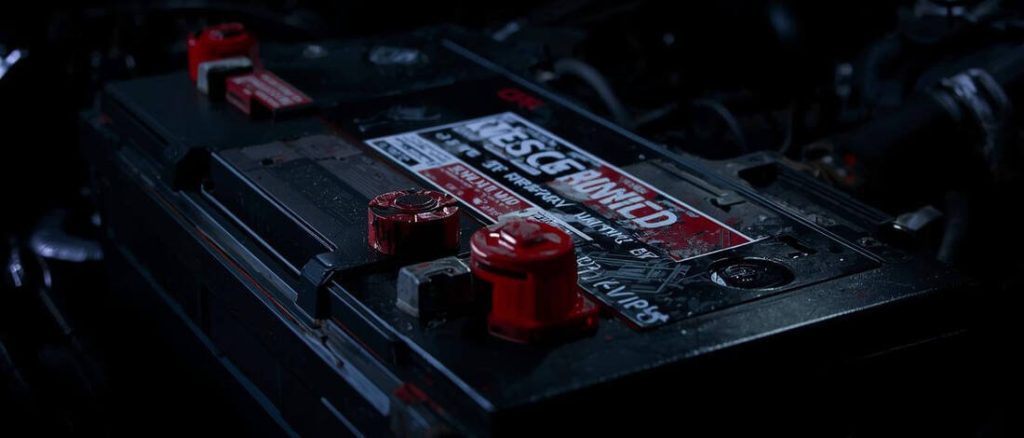
Symptoms: What a Battery-Induced Misfire Pattern Feels Like
To separate a battery issue from a dead ignition coil, track your vehicle for this specific operational pattern:
- Misfire Is Most Severe on Initial Cold Start, Then Vanishes: The vehicle starts incredibly rough, shakes the steering column, and flashes the Check Engine Light for the first 30 to 60 seconds of operation, then instantly smooths out once the alternator stabilizes the power line.
- Random Multiple-Cylinder Misfire Code (P0300 Active): A single bad ignition coil or fouled spark plug will take out one specific cylinder consistently, logging hard codes like P0301 or P0302. A systemic low-voltage supply fault acts globally, throwing a generic P0300 (Random/Multiple Cylinder Misfire) across the whole engine block.
- Audible Laboring or Slow Crank Speeds: The engine makes a sluggish, labored sound immediately before firing up, confirming the starter armature is starved for raw current.
- Misfires Spike Under Heavy Accessory Electrical Loads: The vehicle idles fine until you activate the headlights, the rear window defroster grid, and the air conditioning compressor. This massive accessory draw drops the system voltage of a weak battery past critical ignition thresholds.
Diagnostic Isolation: Battery vs. Coils vs. Spark Plugs
| Diagnostic Condition | Logged Trouble Code | Primary Failure Pattern | Most Severe Threshold | Clears with Engine Warm-Up? |
| Failing Battery Matrix | P0300 (Random Global) | Inconsistent across multiple cylinders | Initial cold crank / high accessory load | ✅ Yes (Once alternator takes over) |
| Failed Ignition Coil | P030X (Cylinder Specific) | Locked onto one single cylinder continuously | Consistent across all temperatures and loads | ❌ No |
| Worn Spark Plugs | P030X (One or more) | Localized to specific cylinders | High RPM acceleration and heavy load | ❌ No |
| Engine Vacuum Leak | P0300 / P0171 | Multiple cylinders running lean | Hot resting idle only | ❌ No (Often gets worse) |
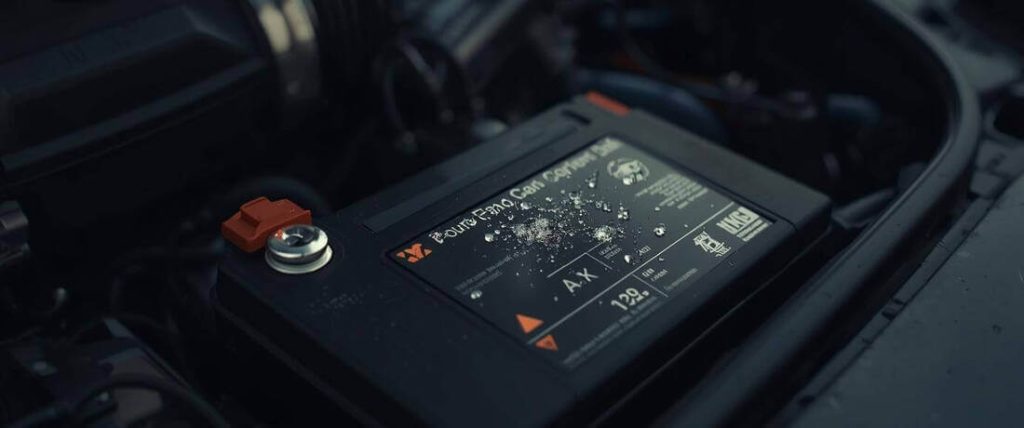
How to Test If Your Battery Is Causing Misfires in 5 Steps
Grab a standard digital multimeter and follow this precise technician diagnostic sequence:
1. Extract and Document the Diagnostic Trouble Codes: 1 min.
Plug an OBD2 scanner into your vehicle’s diagnostic link port beneath the dashboard. Document all active fault codes. If you see code P0300 logged alone or flanked by low-voltage system codes, the fault points heavily to a power delivery issue.
2. Measure the Resting Static Battery Voltage: 1 min.
With the vehicle ignition fully turned off for at least two hours, touch your multimeter leads directly to the battery posts. A fully charged healthy battery must read between 12.4V and 12.6V. If your multimeter screen reads below 12.0V, the battery cell density is severely depleted.
3. Execute the Critical Cranking Voltage Load Test: 2 min.
This is the definitive driveway test. Keep your multimeter leads connected to the battery posts and have an assistant crank the engine while you watch the screen digits. The voltage must not drop below 10.5 Volts during cranking. If the digits collapse down to 8.5V or 9.5V while the starter turns, the internal cell plates are compromised, starving your ignition coils.
4. Verify the Dynamic Alternator Charge Rate: 1 min.
Once the engine fires up and idles, read the running voltage across the posts. The meter should instantly climb and lock flat between 13.8V and 14.8V DC. If the reading jumps around erratically or exceeds 15.5V, your alternator’s internal voltage regulator has failed, baking your battery cells.
5. Clear the ECU Codes and Monitor the Drive Cycle: 5 min.
Install a fresh replacement battery or connect a workshop smart charger to restore full cell capacity. Clear out the stored P0300 code using your scanner. Execute a full highway drive cycle. If the cold-start roughness and random misfire codes completely fail to return, your diagnostic conclusion is verified.
Can You Drive With This Misfire?
It depends entirely on whether the misfire clears up once the engine warms up.
If the misfire only appears during cold start and clears within a minute: Low urgency. Don’t ignore it — it will get worse as the battery continues to degrade — but you’re not doing immediate damage by driving to a shop or auto parts store to get the battery tested that day.
If the misfire persists at operating temperature: Stop driving. A persistent misfire means unburned fuel is passing through the cylinder and into the exhaust. That unburned fuel hits your catalytic converter, where it ignites and superheats the substrate. Catalytic converter damage from sustained misfires starts within a few hours of driving and runs $800 to $2,500 to replace — far more expensive than whatever was causing the misfire in the first place.
The dashboard tells you which situation you’re in. A flashing check engine light means the ECM is detecting a misfire severe enough to damage the catalytic converter right now. Pull over. A solid (non-flashing) check engine light means misfires are logged but not at an actively damaging rate — get it diagnosed that day, not that minute.

Repair Cost Breakdown
What you’ll pay depends entirely on what’s actually causing the misfire. Here’s the honest range for each scenario.
| Item | DIY Cost | Shop Cost |
|---|---|---|
| Battery load test | Free (auto parts store) | Free |
| OBD-II code scan | Free (auto parts store) | Free–$50 |
| Battery replacement (standard) | $80–$180 (parts only) | $130–$250 installed |
| Battery replacement (AGM/premium) | $150–$250 (parts only) | $200–$350 installed |
| Spark plug replacement (4-cyl) | $20–$60 parts | $100–$220 |
| Ignition coil replacement (one) | $30–$90 parts | $150–$400 |
| Diagnostic fee (if needed) | N/A | $90–$150 |
| Catalytic converter (if damaged by misfire) | $300–$700 parts | $800–$2,500 installed |
DIY vs. Mechanic Decision Guide
Do it yourself if:
- You can run a free battery load test at an auto parts store and the battery fails
- You’re comfortable swapping a battery — it’s a 15-minute job requiring only a wrench
- You have or can borrow a basic OBD-II scanner to pull and clear codes
- The misfire resolves completely after battery replacement and doesn’t return
Call a mechanic if:
- The battery passes the load test but misfires persist
- You’re seeing cylinder-specific codes (P0301, P0302, etc.) pointing to a single cylinder
- Live scan data shows fuel trim corrections (LTFTs) that a basic OBD-II reader can’t display
- The misfire is present at operating temperature, not just cold start
- The check engine light is flashing — that’s catalytic converter damage territory and needs same-day attention
Diagnosing a misfire that persists after a new battery requires live data — real-time misfire counts per cylinder, long-term fuel trim values, oxygen sensor switching — that a $25 Bluetooth OBD dongle won’t provide. A shop scan tool gives a technician the full picture in 20 minutes. If you’ve replaced the battery and the misfire came back, that $90 to $150 diagnostic fee is worth it to avoid guessing through $400 in ignition parts.

What Causes a Battery to Weaken to This Point?
Understanding how batteries fail helps you catch the next one before it starts causing misfires.
- Age: Most automotive batteries last 3 to 5 years. After that, internal resistance increases and the battery struggles to deliver adequate cranking amps — even if it holds a resting charge just fine. A battery that’s 6 years old and “still starts the car” is often one cold morning away from causing exactly this symptom.
- Heat damage: Underhood heat is the primary killer of batteries in hot climates. High temperatures accelerate the chemical degradation of battery plates, reducing capacity permanently. Batteries in Southern states often fail in 2 to 3 years rather than the typical 4 to 5.
- Short-trip driving: If most of your driving is under 15 minutes, the alternator never fully recharges the battery from each cold start. Over months, the battery falls into a partial state of charge, accelerating sulfation — a condition where lead sulfate crystals build up on the plates and permanently reduce capacity.
- Parasitic drain: A slow electrical draw from a faulty module, a stuck relay, or an aftermarket accessory that doesn’t fully shut off can drain the battery overnight. Repeatedly deep-cycling a battery — running it down and recharging it — kills it far faster than normal use.
- Corroded or loose terminals: A poor connection at the battery terminal creates resistance and voltage drop under load, mimicking the symptoms of a weak battery even if the battery itself is healthy. Always check terminal condition before condemning the battery.
Prevention Tips
- Test your battery annually after age 3. Free at any auto parts store. Catching a battery that’s dropping in CCA before it causes misfires or a no-start is cheap insurance.
- Clean terminals every two years — especially in humid climates or anywhere road salt is used. White or blue-green corrosion at the terminal is adding resistance directly into the cranking circuit.
- Take longer drives occasionally if most of your driving is short trips. A 20-to-30-minute highway run gives the alternator time to bring the battery to a full state of charge.
- Replace proactively at 4 to 5 years if you’re in a hot climate or rely on the vehicle for critical use. A $150 planned battery replacement beats a $150 tow and a missed workday.
- Don’t ignore a slow crank. A sluggish start is the battery telling you it’s nearly done. By the time misfires start showing up, it’s already past the point where you should have replaced it.
FAQs About Can a Bad Battery Cause a Misfire
Q: Can a bad battery cause a P0300 random misfire code?
Yes. P0300 indicates misfires detected across multiple cylinders without a consistent pattern. When a failing battery drops voltage during cranking or causes ECM voltage instability, it can trigger random misfires across several cylinders simultaneously. This is one of the most common battery-related fault code patterns — particularly when it appears alongside a cold-start rough idle that clears up once the engine warms.
Q: Will replacing the battery fix the misfire?
If the battery was the root cause, yes. Replace the battery, clear the codes, and drive through a complete warm-up cycle. If the misfire doesn’t return across several drive cycles, the battery was your problem. If misfires come back within a few trips, something else — a coil, spark plug, or fuel injector — is the actual fault.
Q: Can a battery cause misfires even when the car starts fine?
Yes, and this is the scenario that trips people up most. A battery that starts the car without hesitation on a mild day can still drop voltage severely under cranking load on a cold morning. The car starts — barely — but the voltage sag during those first combustion cycles causes a misfire that gets logged even though you felt only a slight rough start. Always test under load, not just at rest.
Q: What’s the difference between a battery that causes misfires and one that just causes a no-start?
Degree of failure. A battery that causes misfires is weak enough to drop voltage under load but still has enough reserve to start the engine most of the time. A battery that causes a no-start has degraded past the point where it can deliver adequate cranking amps at all. The misfire symptom is typically the earlier warning sign — catch it there and you avoid the no-start.
Q: My new battery still has misfires. What now?
First, make sure the codes were cleared after the new battery was installed — battery replacement wipes the ECM’s memory, but any misfires that occur after that will be freshly logged. If genuine misfires are returning after a confirmed good battery, move to ignition diagnosis: check cylinder-specific misfire counts with a capable scan tool, perform a coil swap test on the misfiring cylinder, and inspect spark plugs for fouling or wear.
The Verdict: Check the Voltage Rails Before Tearing Down Components
Never blindly strip your cylinder head or replace ignition electronics based on a generic misfire alert. A bad automotive battery is one of the most frequently misdiagnosed triggers for a random P0300 trouble code. Take 5 minutes to run a systematic cranking voltage drop test with a digital multimeter, clean any blue-green acid corrosion off your terminal clamps, and verify your cell density under dynamic load early. Restoring a healthy voltage baseline keeps your input signals clean and protects your luxury powertrain investment from expensive, unnecessary replacement errors.
(Want to ensure your vehicle’s alternative mechanical loops, computer diagnostics, and drivetrain components are functioning with absolute factory precision? Read our master workshop guide on How to Read Check Engine Light Codes Without a Scanner or check out The Car Buzz Official Testing and Editorial Integrity Guidelines Page).