
This article was updated in September 23, 2026 with new products and information by Mark S. Taylor
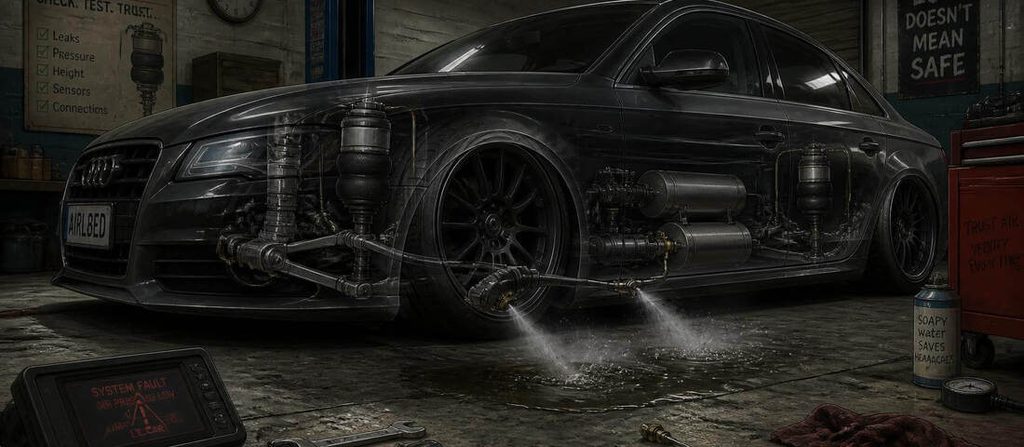
The classic air suspension leak symptom is a car that sits lower after being parked. It may be one corner or the whole car. Other common signs are a compressor that runs longer or more often, a hissing sound, a slow rise when you start up, a dash warning, and a bouncy or harsh ride. One sign doesn’t prove a leak. A tape measure and one night of parking will.
Air suspension is a set of rubber air bags that hold your car up, plus a pump that keeps them filled. Think of a slow tire leak. The tire goes soft, and the pump works overtime trying to keep up. Fix the leak early and you save the pump.
This guide covers factory air suspension on cars, SUVs, and pickups. Aftermarket “bag” kits and heavy-truck systems follow the same basic physics, but the parts and specs differ.
Contents
- 1 The 8 Air Suspension Leak Symptoms
- 1.1 1. The car sits low after parking
- 1.2 2. One corner sits lower than the others
- 1.3 3. The compressor runs more than it used to
- 1.4 4. The car takes a long time to rise
- 1.5 5. You hear hissing
- 1.6 6. A dash warning or fault code shows up
- 1.7 7. The ride gets bouncy, floaty, or harsh
- 1.8 8. The car bottoms out, clunks, or rubs a tire
- 2 What’s Leaking? The Six Usual Suspects
- 3 How to Confirm a Leak (Tape Measure, Overnight, Soap)
- 4 Is It Safe to Drive With an Air Suspension Leak?
- 5 What Air Suspension Leak Repairs Cost
- 6 Common Mistakes
- 7 Pro Tips
- 8 FAQs About Air Suspension Leak Symptoms
- 9 Bottom Line
The 8 Air Suspension Leak Symptoms
These are the ways a leak usually shows up, roughly in the order owners notice them. Each one says what it usually points to.
1. The car sits low after parking
You walk out in the morning and the car is lower than when you left it. Air escaped while the system was off.
If the whole car dropped evenly, something shared is more likely to blame: the reservoir, the valve block, or a main line. If it’s one corner, jump to symptom 2.
One caution. Some models settle a little overnight and re-level when you start them. Your maker’s spec decides what’s normal, not a rule of thumb.
2. One corner sits lower than the others
A leaning car usually means the leak is at that corner: the air spring, its line, or a fitting. Stand back at the front or rear and compare the gap between tire and fender on each side.
Don’t rule out a height sensor problem, though. A bad sensor can make a corner sit or read wrong without any air loss. The overnight test in Section 4 sorts this out.
3. The compressor runs more than it used to
The pump makes a humming or buzzing noise while it fills the system. If it runs longer or more often than it used to, or never seems to quit, air is going somewhere.
Here’s the trap. The pump isn’t always the villain. A busy compressor is often a symptom. It’s a sump pump in a flooded basement: running nonstop because water keeps coming in.
4. The car takes a long time to rise
After startup, the car crawls up to ride height or never gets there. Slow air-up times point to lost air, or to a pump that can’t build pressure. Section 4 shows how to tell the two apart.
5. You hear hissing
Air escaping makes a faint hiss. It’s easiest to hear right after the car airs up, when the system is at full pressure. Listen near each wheel and near the compressor and valve block. Some leaks are silent, so no hiss doesn’t mean no leak.
6. A dash warning or fault code shows up
Many cars show a message like “suspension fault” or “check air suspension.” A scan tool may add codes. Treat both as a clue, not a verdict. A code points to a circuit or a condition. It doesn’t prove a part failed.
7. The ride gets bouncy, floaty, or harsh
A weak air spring or a failing damper changes how the car rides. On many cars the air spring and shock are built into one strut. So this symptom can mean a leak, a worn shock, or both. If you’re not sure which, see our guide on bad struts and shocks symptoms.
8. The car bottoms out, clunks, or rubs a tire
If the suspension sits too low, you’ll feel the car hit the bump stops. In worse cases a tire rubs the fender. That’s the point where the car has lost too much support to be a normal driver. More in Section 5.
What’s Leaking? The Six Usual Suspects
Air springs and air lines are the most-reported leak points in parts-maker guidance. The others are less common but matter, because they fool people into buying the wrong part. Urgency tags are our judgment, not a rule.
Cracked air spring (the rubber bag) — URGENCY: HIGH Old rubber dries out and cracks from age and flexing. Signs: one corner low, hissing near the wheel. Confirm it with the soap test in Section 4.
Chafed air line or loose fitting — URGENCY: MEDIUM Lines rub on nearby parts and wear through. Fittings can loosen or seal poorly. A line or fitting is often a cheaper fix than a spring, so find the exact leak before ordering anything.
Air strut seals (spring and shock in one unit) — URGENCY: HIGH A bad seal or damper can show up as both a leak and a bouncy ride. Recalls have covered strut problems on some models, so check your VIN (Section 5).
Valve block, solenoids, or reservoir — URGENCY: MEDIUM to HIGH These route air to each corner. A leak here can make the whole car sag or refuse to lift. They’re harder to find and often need a scan tool and a leak-down test.
Compressor or dryer trouble that mimics a leak — URGENCY: MEDIUM A compressor can run without building pressure. The car won’t rise, and it looks like a leak, but no air is missing. It has to be tested for power, ground, and actual pressure output before replacement.
A sensor or control fault (not a leak at all) — URGENCY: LOW to MEDIUM A bad ride height sensor can trigger a warning or a wrong height with no air loss. The overnight measurement rules this in or out.
How to Confirm a Leak (Tape Measure, Overnight, Soap)
You can confirm most leaks with a tape measure, a night’s sleep, and a spray bottle. Do the steps in this order. It saves the most money.
- Baseline. Park on level ground, engine off. Measure each corner from the center of the wheel up to the fender lip. Write the numbers down and take a photo.
- Wait. Leave the car alone overnight. Skip starting it in between. Some models re-level when they wake up.
- Measure again. Compare the numbers. This overnight method is what manufacturers use too. See one manufacturer’s overnight ride-height procedure.
- Soap test. Start the car and let it air up to normal height. Spray mild soapy water on the air spring bags, line ends, and fittings. Bubbles mean air is escaping. Keep soap off electrical connectors.
- Scan for codes. A scan tool can show height sensor readings and stored faults. Our guide on reading trouble codes with an OBD-II scanner covers the basics. Remember: a code is a lead, not a diagnosis.
No universal number. Manufacturers differ. One service bulletin treats a drop of more than about 1 inch (25 mm) as a likely leak in its own test. Another flags a height sensor reading that falls more than 5 mm below the others. A third says small air loss is normal for its system. Look up your own vehicle’s spec before deciding.
Safety note: Air suspension can drop suddenly when air is released. Use your maker’s jack or transport mode, proper jack stands, and the correct lifting points. Never rely on air springs or a floor jack alone to hold the car. If you aren’t sure how to depressurize the system, let a shop do it. See our guide on how to lift a car safely.
What your result means
| What you see | Likely meaning | Next move |
|---|---|---|
| Same height in the morning | No meaningful leak while parked. Look at sensors, shocks, or the compressor | Scan for codes and watch how long the compressor runs |
| One corner lower | Leak at that corner: spring, strut, line, or fitting | Soap test that corner first |
| All corners lower, evenly | A shared point: reservoir, valve block, main line, or fitting | Scan, then a shop leak-down test |
| Height is fine but the compressor runs a lot | A slow leak, a weak compressor, or both | Log run times and leak-test before buying a compressor |
| Car won’t rise, compressor runs, no leak found | Compressor may not be building pressure | Pressure test the compressor |

Is It Safe to Drive With an Air Suspension Leak?
Sometimes, for a slow trip to a shop. Not as a daily driver. What matters is whether the car is still stable and off its bump stops.
Stop driving and call a tow if:
- A tire rubs the fender or the car sits on its bump stops
- The car leans, pulls, or feels unstable when you steer or brake
- A dash message tells you not to drive
- You see a damaged air line, hanging part, or fluid where a strut should be dry
Drive slowly and go straight to a shop if:
- One corner is low, but the car steers straight and brakes normally
Monitor and book a repair soon if:
- You have a small overnight sag and no warnings
Check for a recall. Enter your VIN in the NHTSA recall lookup. A sudden ride height drop isn’t always a leak. One recall, for example, covered a strut part that could fail and drop the ride height.
What Air Suspension Leak Repairs Cost
Costs swing a lot by vehicle. Expect a few hundred dollars for lines and seals, and roughly $800 to $1,200 or more per corner at a shop for an air spring on many SUVs. Luxury models run higher.
These are U.S. ranges from retailer, estimator, and repair-guide sites as of late 2026. They are not quotes. Shop labor is reported at roughly $80 to $250 per hour depending on where you live and whether it’s a dealer.
| Job | DIY parts (approx.) | Shop total (approx.) | Notes |
|---|---|---|---|
| Leak diagnosis | Tape measure, soap, scan tool | About 30 to 60 minutes of labor. Some dealers charge $150 to $300 flat | Do this before buying parts |
| Air line, fitting, or seals | Varies by part | Often the lowest-cost fix. $200 to $500 reported when added to a compressor job | Find the exact leak first |
| Air spring, per corner | About $54 to $537 (one parts catalog) | About $800 to $1,200 or more | 1 to 3 hours of labor. Higher on luxury vehicles |
| Compressor | About $300 to $800 | Roughly $500 to $1,500. Some models cost far more | Our estimate from parts and labor ranges. Test before replacing |
| Valve block service | About $200 to $600 | Varies widely | Often needs a scan tool |
| Worst-case whole system, some luxury SUVs | n/a | $2,000 to $5,000+ reported | Treat as an upper bound, not a typical bill |
DIY or shop? Measuring, listening, and the soap test are fair DIY jobs. Swapping an accessible line or fitting can be too, with your vehicle’s service information. Leave depressurizing, strut-style assemblies, and anything you can’t support safely to a shop. A bad install can strain the compressor or damage the valve block and run the bill past $1,500.
What about a coil spring conversion? Some owners swap air springs for conventional coils. It can cost less over time. You also lose ride height control, may face electronics and inspection questions, and should check your warranty and local rules first. Ask a trusted shop before you commit.

Common Mistakes
- Buying a compressor because it runs a lot. It may be trying to keep up with a leak. Prove the leak first.
- Trusting a code without testing. A code points to a circuit. It doesn’t name the part.
- Ignoring a small leak. More leaking means more compressor run time, and parts makers say that extra work speeds up wear.
- Working under a car that’s held up by air. Air springs can let go. Use stands.
- Skipping the recall check. It takes a minute and it’s free.
Pro Tips
- Take a “good day” measurement and photo of all four corners now. It makes future sag easy to prove.
- Ask the shop for the leak-down or soap test result before you approve a compressor.
- If one air spring failed from age, ask the shop to inspect the other one on that axle. It may be close behind.
- Get parts and labor itemized. It’s the easiest way to compare quotes.
FAQs About Air Suspension Leak Symptoms
Is it normal for air suspension to sag overnight?
A small amount of settling can be normal on some models. One manufacturer bulletin, for example, calls minor air loss normal for its system, and the car re-levels at start-up. But a corner that sits visibly low, or a drop past your maker’s limit, points to a leak. Check your service information for the spec on your vehicle.
Can I drive with a leaking air suspension?
Sometimes, for a short, careful trip to a shop, if the car isn’t sitting on its bump stops and steers normally. Don’t daily-drive it. Stop driving if a tire rubs the fender, the car leans or pulls, or a warning message tells you not to drive.
How do I tell a leak from a bad compressor?
A leak loses air. A bad compressor can’t make it. If the car sags overnight, suspect a leak. If it won’t rise and the compressor runs without building pressure, the compressor itself may be at fault. A leak can also overwork a good compressor, so confirm with a leak test before buying one.
Can a leak damage the compressor?
It can. A leak makes the compressor run more to hold pressure, and that extra work speeds up wear, according to parts maker Monroe. Fixing a small leak early usually costs less than replacing a compressor later.
How much does it cost to fix an air suspension leak?
It depends on the vehicle and the part. Reported ranges run from a few hundred dollars for lines and seals to roughly $800 to $1,200 or more per corner for a shop air-spring replacement, and higher on some luxury models. Get the leak located before you get a quote.
Bottom Line
- Sag that shows up after a night of parking is the tell. Measure it.
- A busy compressor is often the symptom, not the culprit.
- One corner low? Soap that corner first. The cheap fix often lives at a line or fitting.
- Tire rubbing, bump stops, or a car that leans or pulls means stop driving.
- Enter your VIN in the recall lookup before you pay for parts.