
This article was updated in September 24, 2026 with new products and information by Mark S. Taylor
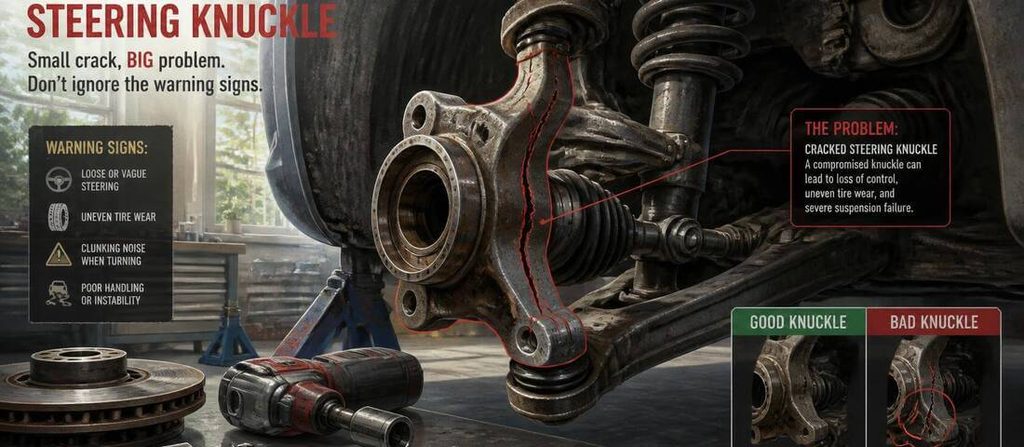
A bad steering knuckle can cause uneven tire wear, pulling, poor alignment, an off-center steering wheel, and unstable handling. You may also see cracks, bends, or impact damage around the knuckle. However, these symptoms do not automatically prove the knuckle is bad. Wheel bearings, ball joints, tie rods, control arms, tires, and other suspension parts can cause similar problems.
The steering knuckle itself is a strong component and does not usually fail without a reason. A curb strike, deep pothole, collision, severe corrosion, or damage to a mounting point can bend or crack it.
The key is to diagnose the knuckle before replacing it.
Contents
- 1 What Is a Steering Knuckle?
- 2 9 Bad Steering Knuckle Symptoms
- 2.1 1. Uneven Tire Wear
- 2.2 2. Your Vehicle Pulls to One Side
- 2.3 3. The Steering Wheel Is Off-Center
- 2.4 4. The Alignment Cannot Be Corrected Properly
- 2.5 5. Steering Feels Loose, Wandering, or Unstable
- 2.6 6. Clunking or Popping After a Curb or Pothole Impact
- 2.7 7. The Wheel or Brake Assembly Looks Misaligned
- 2.8 8. Visible Cracks, Bends, or Impact Damage
- 2.9 9. Repeated Problems at the Same Wheel
- 3 What Causes a Steering Knuckle to Go Bad?
- 4 Is It the Steering Knuckle or Another Part?
- 5 How Do You Diagnose a Bad Steering Knuckle?
- 6 Can You Drive With a Bad Steering Knuckle?
- 7 Can a Steering Knuckle Be Repaired?
- 8 FAQs About Bad Steering Knuckle Symptoms
- 8.1 What is the most common symptom of a bad steering knuckle?
- 8.2 Can a bad steering knuckle cause tire wear?
- 8.3 Can a bad steering knuckle cause a humming noise?
- 8.4 Can an alignment fix a bent steering knuckle?
- 8.5 What causes a steering knuckle to bend?
- 8.6 Is a steering knuckle the same as a spindle?
- 8.7 Should I replace the wheel bearing or steering knuckle?
- 9 The Bottom Line
What Is a Steering Knuckle?
The steering knuckle is the heavy suspension and steering component that connects the wheel assembly to the vehicle’s suspension and steering system.
Depending on the vehicle, it can connect to the:
- Wheel hub and bearing
- Steering arm
- Tie rod end
- Ball joint
- Strut
- Control arm
- Brake assembly
Its job is to help keep the wheel in the correct position while allowing it to turn with the steering system.
Because several important components connect to it, damage to the knuckle can affect wheel alignment and handling.
9 Bad Steering Knuckle Symptoms
1. Uneven Tire Wear
One of the most noticeable signs of a bent or damaged steering knuckle can be uneven wear on one tire.
You may see excessive wear on the:
- Inside edge
- Outside edge
- Tread surface
- One front tire compared with the other
A bent knuckle can change the wheel’s geometry and contribute to alignment problems. The result can be abnormal tire wear.
But don’t assume the knuckle is automatically responsible. Incorrect tire pressure, worn suspension parts, poor alignment, and other problems can also cause uneven wear.
2. Your Vehicle Pulls to One Side
Does your vehicle consistently pull left or right while driving?
A damaged or bent knuckle can alter suspension geometry and contribute to a persistent pull. This is especially suspicious if the problem began after hitting a curb, pothole, or another object.
However, pulling is not specific to the knuckle. Tire pressure, tire construction, alignment, brakes, and other suspension components can also cause it.
If the vehicle continues pulling after the basic causes have been checked and alignment cannot bring the affected corner into specification, the knuckle and other suspension components deserve closer inspection.
3. The Steering Wheel Is Off-Center
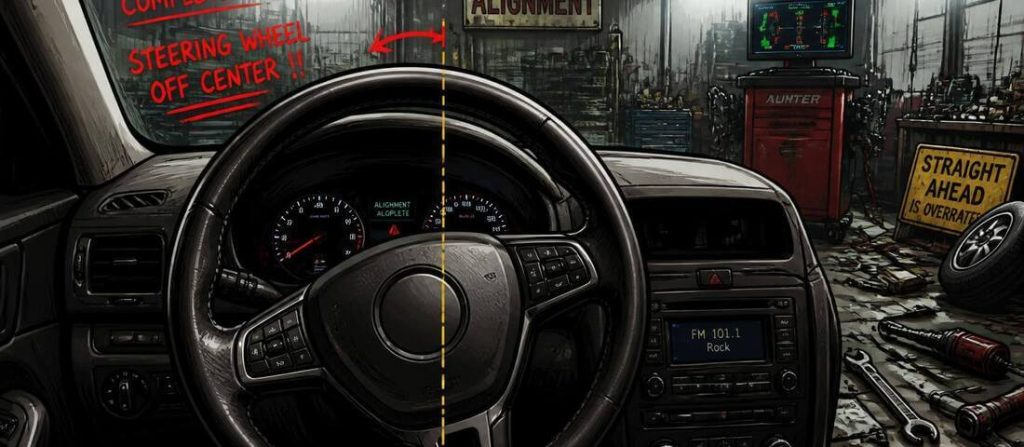
An off-center steering wheel can indicate an alignment problem.
If the steering wheel remains crooked after a proper alignment, the technician should determine why the wheel geometry cannot be corrected.
A bent knuckle is one possible cause, particularly after an impact. But a damaged control arm, strut, tie rod, or other suspension component can produce a similar result.
The steering wheel being crooked does not prove the knuckle is bent.
That distinction matters.
4. The Alignment Cannot Be Corrected Properly
This is one of the more useful diagnostic clues.
A damaged knuckle can physically change the position of the wheel. If the component is bent, the alignment machine may show abnormal geometry that cannot be brought into the manufacturer’s specified range through the available adjustments.
ASE-oriented inspection guidance notes that a bent knuckle can show up through alignment angles that will not adjust into specification.
If an alignment technician says one corner is significantly outside specification, don’t immediately buy a new knuckle.
First determine which component is actually bent or worn.
5. Steering Feels Loose, Wandering, or Unstable
A damaged knuckle or damaged mounting area can affect the way the wheel is located.
You may notice:
- Wandering on the highway
- Delayed steering response
- Unusual steering feel
- Instability during cornering
- The vehicle not tracking normally
But this symptom has many possible causes.
Worn tie rods, ball joints, control arms, tires, wheel bearings, and alignment problems can all affect steering feel.
This is why a steering complaint should be treated as a system diagnosis, not a parts-swapping exercise.
6. Clunking or Popping After a Curb or Pothole Impact
A sudden clunk after a hard impact deserves attention.
A curb strike or deep pothole can damage multiple parts around the wheel. The knuckle itself may be bent or cracked, but the noise could also come from a ball joint, tie rod, control arm, strut, or another damaged component.
The timing of the symptom is important.
If you hit a major pothole and immediately notice:
- A crooked steering wheel
- Pulling
- Tire damage
- New suspension noise
- Changed wheel position
have the entire corner inspected.
Do not assume that the noisiest component is necessarily the damaged component.
7. The Wheel or Brake Assembly Looks Misaligned
Severe knuckle damage can change the position of the wheel hub and the components attached to the knuckle.
You may notice that:
- The wheel appears to sit at an unusual angle.
- Brake components appear incorrectly positioned.
- The wheel has unusual clearance to nearby components.
- The suspension geometry looks different from the opposite side.
A side-to-side comparison can be useful because the undamaged side provides a reference.
However, subtle bends can be difficult to identify visually. Alignment measurements and component inspection may be necessary.
8. Visible Cracks, Bends, or Impact Damage
Visible physical damage is one of the strongest reasons to investigate the knuckle itself.
Look for:
- Cracks
- Significant deformation
- Severe corrosion
- Impact marks
- Damaged mounting ears
- Distorted steering-arm areas
- Damaged bearing mounting surfaces
AutoZone recommends inspecting the knuckle for impact marks, cracks, and damaged attachment points when checking for a broken knuckle.
A cracked or significantly deformed safety-critical steering component should not be treated like a cosmetic problem.
9. Repeated Problems at the Same Wheel
Repeated failures at one corner can provide an important clue.
For example, if a wheel bearing repeatedly develops problems at the same location, the technician should investigate the hub, bearing installation, mounting surfaces, and knuckle rather than simply installing another bearing.
The important point is that repeated component failure is a reason to investigate the system, not proof that the knuckle is defective.
What Causes a Steering Knuckle to Go Bad?
Steering knuckles are designed to withstand substantial loads. Actual knuckle damage is relatively uncommon compared with failures of components such as wheel bearings, ball joints, and tie rods.
Common causes include:
Curb or Pothole Impact
A severe impact can bend or crack the knuckle or another suspension component.
Collision Damage
A front-end collision can deform suspension geometry even when the damage is not immediately obvious.
Severe Corrosion
Advanced corrosion can weaken or damage mounting areas.
Damaged Bearing Mounting Surface
On some designs, damage around the bearing mounting area can create a problem with proper hub or bearing retention.
Improper Previous Repair
Incorrect installation or damage during previous suspension or bearing work can create additional problems.
Is It the Steering Knuckle or Another Part?
This is where diagnosis becomes important.
| Symptom | Possible Cause | Does It Prove a Bad Knuckle? |
|---|---|---|
| Humming that increases with speed | Wheel bearing | No |
| Pulling to one side | Alignment, tire, brake, suspension, knuckle | No |
| Uneven tire wear | Alignment, tire, suspension, knuckle | No |
| Clunk over bumps | Ball joint, tie rod, control arm, strut, knuckle area | No |
| Off-center steering wheel | Alignment or suspension geometry | No |
| Visible crack in knuckle | Knuckle damage | Strong evidence |
| Alignment cannot reach specification | Bent suspension component or knuckle | Strong clue |
| Wheel sitting at an abnormal angle | Suspension/knuckle damage | Strong clue |
One of the biggest diagnostic mistakes is confusing a wheel-bearing problem with a knuckle problem.
A wheel bearing can produce humming, grinding, or roaring that changes with vehicle speed. Because the bearing is housed in or attached to the knuckle on many vehicles, the two problems are easy to confuse.
How Do You Diagnose a Bad Steering Knuckle?
Start with the simplest evidence.
Step 1: Ask What Happened Before the Symptom
Was there:
- A curb strike?
- A deep pothole?
- A collision?
- Suspension work?
- Wheel-bearing replacement?
- A sudden alignment problem?
The history can narrow the diagnostic path.
Step 2: Inspect the Knuckle
Look for visible cracks, deformation, impact marks, damaged mounting points, or severe corrosion.
Step 3: Compare Both Sides
Compare the affected corner with the opposite side.
Look at the:
- Wheel position
- Steering arm
- Strut connection
- Ball-joint area
- Hub position
- Brake clearance
Step 4: Check Alignment Data
Don’t just look at whether the alignment machine says “green.”
Look at the actual measurements.
If one corner has abnormal camber, caster, toe, steering-axis inclination, or related geometry, the technician should determine why.
Step 5: Check the Other Components
Inspect the:
- Wheel bearing
- Ball joints
- Tie rod ends
- Control arm
- Strut
- Tire
- Wheel
- Brake components
This prevents a common mistake: replacing an expensive part because another worn component created the same symptom.

Can You Drive With a Bad Steering Knuckle?
If the knuckle is cracked, severely bent, or otherwise structurally compromised, driving should be treated as a safety issue.
The steering knuckle is part of the wheel, steering, suspension, and braking assembly. A serious structural failure can affect vehicle control.
NHTSA investigation material has documented cases where fractured steering knuckles could result in suspension-arm separation and loss of vehicle control.
If you can see a crack or major deformation, or the wheel position has changed dramatically after an impact, don’t continue driving simply to see whether the problem gets worse.
Have the vehicle inspected and determine whether it can be safely moved.
Can a Steering Knuckle Be Repaired?
A steering knuckle that is bent or cracked generally calls for replacement rather than attempting to straighten or weld the component.
The exact repair procedure depends on the vehicle and knuckle design.
Because the knuckle is a load-bearing steering and suspension component, the repair should follow the vehicle manufacturer’s service procedure.
After replacement, the connected components should be checked and the wheel alignment performed according to the vehicle’s specifications.
FAQs About Bad Steering Knuckle Symptoms
What is the most common symptom of a bad steering knuckle?
Persistent alignment or handling problems after an impact are important clues. Uneven tire wear, pulling, and an off-center steering wheel can occur when a knuckle is bent. However, these symptoms also have several other possible causes.
Can a bad steering knuckle cause tire wear?
Yes. A bent or damaged knuckle can alter wheel geometry and contribute to abnormal tire wear. But tire wear alone does not prove the knuckle is damaged.
Can a bad steering knuckle cause a humming noise?
Usually, a speed-related humming or growling noise points more strongly toward a wheel-bearing problem than the knuckle itself. The bearing is commonly housed in or attached to the knuckle.
Can an alignment fix a bent steering knuckle?
An alignment can correct adjustable geometry, but it cannot straighten a physically bent knuckle. If the underlying component is bent, the technician needs to identify and correct the damaged component.
What causes a steering knuckle to bend?
Severe pothole impacts, curb strikes, collisions, and other major impacts are common causes of knuckle damage.
Is a steering knuckle the same as a spindle?
Not always. The terminology varies by vehicle design. Some people use “spindle” and “steering knuckle” interchangeably, but the exact component and configuration depend on the vehicle.
Should I replace the wheel bearing or steering knuckle?
Do not choose based on the symptom alone. Diagnose the bearing, knuckle, hub, and related suspension components first. A bad wheel bearing can create symptoms that are incorrectly blamed on the knuckle.
The Bottom Line
The most important bad steering knuckle symptoms are:
- Uneven tire wear
- Persistent pulling
- Off-center steering
- Alignment that cannot be corrected properly
- Unusual steering or handling
- Clunks after a significant impact
- Abnormal wheel or brake positioning
- Visible cracks or deformation
- Repeated problems at the same wheel
But here’s the critical point:
None of these symptoms alone proves the steering knuckle is bad.
A damaged wheel bearing, ball joint, tie rod, control arm, strut, tire, or alignment problem can look very similar.
The best diagnostic approach is to inspect the knuckle, review alignment measurements, check the connected components, and identify the actual failed part before replacing anything.
That approach saves money and prevents a symptom from being mistaken for a diagnosis.