
This article was updated in September 24, 2026 with new products and information by Mark S. Taylor
Suspension noise over bumps usually means a worn or loose part is moving when it shouldn’t. Shops commonly find sway bar end links, strut mounts, worn bushings, and tired shocks or struts. The riskiest causes are ball joints and tie rod ends, because a failed one can cost you steering control. Match the sound (clunk, knock, squeak, rattle) and the situation (front or rear, cold or warm, turning or straight) to the table below. Then read the safety list before you drive again.
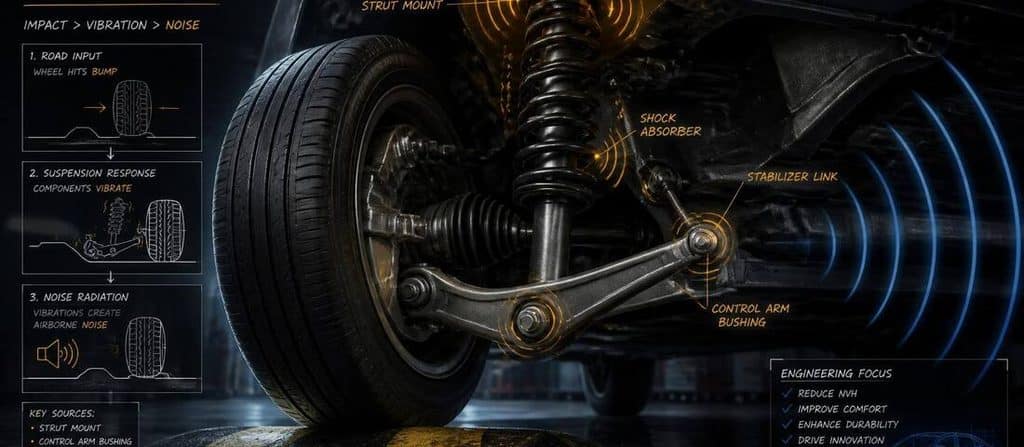
Your suspension is a set of joints, rubber cushions, and springs. When a joint gets sloppy or a cushion cracks, parts move where they shouldn’t and hit something. Picture a door hinge with a worn pin. It swings fine until the door slams. That slam is your noise.
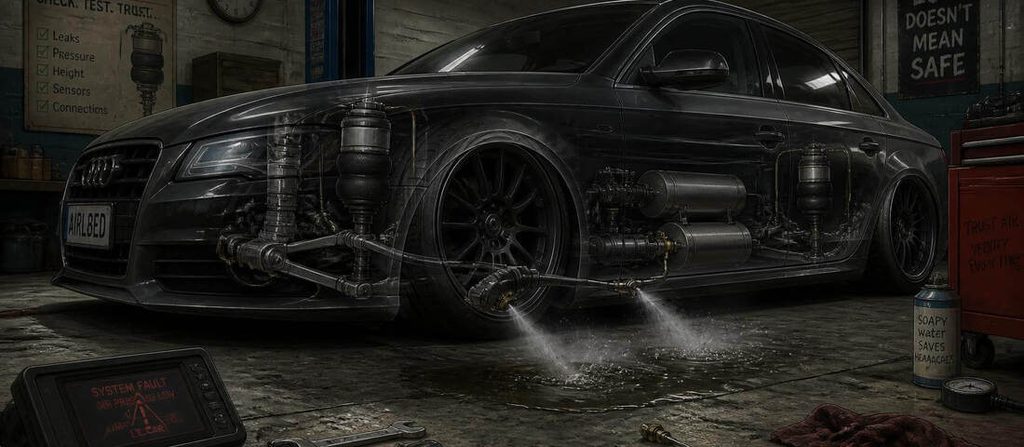
This guide covers most cars, SUVs, and pickups with conventional springs. If your car has air suspension, also read our guide on air suspension leak symptoms.
Contents
- 1 Before You Spend a Dollar: Note Three Things
- 2 Noise Decoder: What Each Sound Usually Means
- 3 The 8 Usual Causes, Ranked by Urgency
- 3.1 1. Sway bar end links: URGENCY LOW TO MEDIUM
- 3.2 2. Strut and shock mounts, plus loose hardware: URGENCY MEDIUM
- 3.3 3. Worn shocks and struts: URGENCY MEDIUM
- 3.4 4. Control arm bushings: URGENCY MEDIUM TO HIGH
- 3.5 5. Ball joints: URGENCY HIGH
- 3.6 6. Tie rod ends: URGENCY HIGH
- 3.7 7. Bump stops (jounce bumpers) and dust boots: URGENCY LOW
- 3.8 8. Look-alikes that aren’t the suspension: URGENCY VARIES
- 4 How to Narrow It Down (Safe Checks First)
- 5 Is It Safe to Drive?
- 6 What Fixing Suspension Noise Costs
- 7 Common Mistakes
- 8 Pro Tips
- 9 FAQs About
- 10 Bottom Line
Before You Spend a Dollar: Note Three Things
A shop finds a noise faster when you can describe it. Write these down.
- When. Cold start only, or after the car warms up? Small bumps, big bumps, or driveways?
- Where. Front or rear? Left, right, or both? Can a passenger point to a corner?
- What else changes. Does it happen while turning, braking, or going straight? Does the steering feel different?
That last one matters most. A noise with loose or vague steering is a different problem than a noise with normal steering.
Noise Decoder: What Each Sound Usually Means
Sounds overlap, so this table narrows the search. It doesn’t finish it. Each cause listed is a diagnostic possibility, not a diagnosis.
| What you hear | When you hear it | Common causes | Urgency |
|---|---|---|---|
| Sharp clack or light rattle | Small bumps, rough pavement | Sway bar end links, loose heat shield or hardware, loose cargo | Low to medium |
| Dull thunk or clunk | Bigger bumps, dips, driveways | Control arm bushings, strut or shock mounts, loose hardware | Medium |
| Knock or clunk that also shows up when turning or braking | Steering or braking over uneven pavement | Ball joints, tie rod ends, brake hardware | High. Get it inspected soon |
| Squeak or creak, worse in cold or at low speed | Speed bumps, driveways, parking lots | Bushings, bump stops, strut mount bearings, dry joints | Low to medium |
| Bounce, float, or bottoming out | After a bump, on rebound | Worn shocks or struts, worn bump stops | Medium |
| Metallic clank with a corner that sits low or leans | Any bump | Broken spring or mount, separated part | High. Stop driving |
| Clunk from the rear only | Rear bumps | Rear links, shock mounts, trailing arm bushings, cargo, hitch accessories | Low to medium |
The 8 Usual Causes, Ranked by Urgency
Urgency tags are our judgment, not a rule. They assume the noise is the only symptom. Any change in steering bumps the urgency up.
1. Sway bar end links: URGENCY LOW TO MEDIUM
These small rods connect the sway bar to the suspension near each wheel. The ball-joint or rubber ends wear out. Typical signs are a clack or rattle over small bumps and rough pavement, plus a looser feel in corners. Parts and shop sources give a wide range for how long they last, roughly 30,000 to 120,000 miles depending on the source and the roads.
They’re often the cheapest fix, which is why they get blamed first. But a worn ball joint can mimic sway bar noise, so confirm before you buy. Shops often replace links as a pair.
2. Strut and shock mounts, plus loose hardware: URGENCY MEDIUM
The top of the strut bolts to the body through a mount. When the mount or its bearing plate wears, you can get a knock over small bumps at low speed. Loose or improperly torqued bolts and brackets can make similar noises. The mount and the strut are close neighbors, so shops often inspect them together.
3. Worn shocks and struts: URGENCY MEDIUM
Weak shocks and struts usually cause bouncing more than a sharp clunk. Signs include a floaty ride, nose-dive when braking, uneven tire wear, and oily, wet shock bodies. A quick check: press down hard on each corner and let go. Repeated bouncing supports a worn damper. It isn’t proof, so pair it with a visual check.
4. Control arm bushings: URGENCY MEDIUM TO HIGH
Rubber bushings cushion the arm where it bolts to the car. Over time they crack and soften. The arm shifts under load and you get a dull clunk over bumps. Other signs: steering that drifts, and an alignment that won’t hold. Depending on the design, the shop replaces the bushing or the whole arm. Ask about an alignment after.
5. Ball joints: URGENCY HIGH
A ball joint is the pivot between the control arm and the steering knuckle. When it wears, it clunks over bumps and adds looseness to the steering. This is the one you don’t gamble on. NHTSA recall notices describe ball joint separation as a cause of loss of steering control. A recall notice for one Nissan model says exactly that.
Warning signs: clunking plus loose or wandering steering, a torn boot leaking grease, and uneven tire wear. See our guide on bad ball joint symptoms.
6. Tie rod ends: URGENCY HIGH
Tie rod ends link the steering rack to the wheels. When they loosen, you can hear a knock as the suspension moves and feel play in the steering. They’re part of the steering system, so treat any steering looseness as urgent. See our guide on bad tie rod end symptoms.
7. Bump stops (jounce bumpers) and dust boots: URGENCY LOW
Bump stops are rubber cushions that stop the suspension from bottoming out. They can squeak or creak over bumps without being “worn out” in a serious way. This is a good example of a noise that isn’t a failing part. Manufacturers have published service bulletins for it on specific models. One manufacturer bulletin on a front bump-stop squeak says the noise is more noticeable in cold weather and calls for replacing only the noisy side. Another bulletin traces a squeak, clunk, or knock over bumps to friction between the bump stop and the strut rod.
If your noise is a squeak and your car is a popular model, ask the dealer whether a bulletin exists.
8. Look-alikes that aren’t the suspension: URGENCY VARIES
Not every bump noise is the suspension. Loose brake caliper bolts or slide hardware can clunk over bumps or when you brake. Loose exhaust hangers and heat shields rattle. Cargo, a jack, or a roof rack shifts. Loose wheel hardware is a safety issue, so make sure lug nuts were torqued to spec if the wheels were recently off. Brake and wheel hardware are high urgency.
How to Narrow It Down (Safe Checks First)
Start with checks that keep all four wheels on the ground. Anything that needs the car lifted belongs to a shop or an experienced DIYer with the right stands and service information.
- Clear the car. Empty the trunk and cabin. Check the spare, jack, roof rack, and hitch accessories. It costs nothing.
- Repeat the noise. Drive the same bump at the same speed. Have a passenger point to the corner. Note whether it’s front or rear.
- Check cold vs. warm. A squeak that fades once the car warms up leans toward rubber parts and bump stops.
- Bounce test. Press down firmly on each corner and release. Note repeated bouncing.
- Look with a flashlight. Check for torn rubber boots, greasy or oily shock bodies, cracked bushings, loose or hanging parts, and uneven tire wear.
- Steering test. In an empty lot, turn the wheel slowly lock to lock with the window down. Listen for popping, clicking, or grinding, and feel for looseness.
- Hand it over for play checks. A shop raises the car and checks for movement at the ball joints, tie rod ends, sway bar links, strut mounts, and bushings. Ask them to show you the play or damage they find.
Safety note: Never work under a car held by a jack alone. Coil springs store a lot of energy, and strut work often needs a spring compressor. If you aren’t sure how to support the car or handle a spring, leave it to a shop. See our guide on how to lift a car safely.
What to tell the shop: “Clunk from the front right over medium bumps, worse when cold, steering feels normal. Please check sway bar links, strut mount, and bushings on that side, and check for a bulletin.”
Is It Safe to Drive?
It depends on what else changed besides the noise. A clunk with normal steering usually means a careful drive to a shop soon. A clunk with loose steering, pulling, or a tilted wheel is a stop-and-tow situation.
Stop driving and call a tow if:
- Steering feels loose, vague, or wanders
- The car pulls or darts to one side
- A wheel looks tilted, or a corner sits lower than the others
- A loud metallic clank changes when you steer or brake
- You see a separated or hanging part, a missing bolt or cotter pin, or a torn boot slinging grease
- A tire rubs the fender
Loose fasteners at a control arm ball joint or tie rod end are named in recall documents as raising the risk of losing steering control. So a noise with any looseness in the steering should be treated as urgent.
Drive carefully to a shop within days if:
- You have a new clunk over bumps and the steering feels normal
Monitor and book a repair soon if:
- It’s a squeak at low speed, or only in cold weather
- It’s a rattle over rough pavement only
Check for a recall and bulletins. Enter your VIN in the NHTSA recall lookup. Also ask your dealer about technical service bulletins for your model. Both are free to check.

What Fixing Suspension Noise Costs
Costs swing by vehicle, shop, and region. The ranges below come from retailer, estimator, and repair-guide sites as of late 2026. They are not quotes. Rust can turn a simple bolt-off job into a cut-and-replace job, which raises labor.
| Repair | Typical U.S. range | Notes |
|---|---|---|
| Sway bar end links | About $75 to $200 per side. A pair often runs $200 to $300 | RepairPal’s national estimate for one link is $123 to $186 |
| Strut mount bushing or mount | About $200 to $550 per side on sedans and compacts. $300 to $700 on midsize vehicles and trucks | Often done alongside struts |
| Shocks or struts | About $400 to $900 for a pair | Depends heavily on the vehicle |
| Control arm bushings | About $316 to $440 (RepairPal estimate, mid-2026). Whole arm about $250 to $650 per side | A parts seller lists pressing a bushing into an existing arm at $150 to $350 per side |
| Ball joint | About $200 to $400 each | Alignment is usually needed after |
| Tie rod end | Not priced here. Get an itemized quote | Ask whether an alignment is included |
| Bump stop | Not priced here. Get a quote | Ask about a bulletin first |
An alignment after control arm or ball joint work is commonly recommended. One parts seller lists it at $100 to $150.
DIY or shop? Clearing the cargo, the visual check, the bounce test, and the steering test are DIY. Sway bar links can be a DIY job when they’re visible and easy to reach. Ball joints, tie rods, control arms, and strut mounts belong to a shop unless you have the tools, stands, and service procedure. Anything that involves compressing a spring or touching the steering is not a place to learn on the job.
Smart shop habits: Ask to see the worn part. Ask which parts are being replaced and why. Related parts should be inspected, but not replaced without a sign of wear or a manufacturer procedure that calls for it.
Common Mistakes
- Replacing sway bar links on a hunch. They’re the usual suspect, but a ball joint can mimic the noise. Confirm first.
- Ignoring a clunk that comes with loose steering. That combination is the one to stop for.
- Buying the whole front end at once. Replace what testing shows is worn.
- Skipping the alignment. A geometry-related repair without an alignment can cost you tires.
- Assuming a cold-weather squeak is a failed part. It may be a bump stop with a known bulletin.
- Skipping the recall check. It takes a minute.
Pro Tips
- Record the noise on your phone while a passenger drives, and note the speed and location. Shops love this.
- Keep a short log: date, temperature, road type, and which corner.
- Ask whether parts on the same axle should be done as a pair, especially links.
- Ask the dealer about bulletins for your year, make, and model before paying for parts.
FAQs About
What does suspension noise over bumps usually mean?
It usually means a worn or loose suspension part is moving when it shouldn’t. Common culprits include sway bar end links, strut mounts, control arm bushings, and worn shocks or struts. Ball joints and tie rod ends can make similar noises and are more serious. The sound and when it happens help narrow it down, but a hands-on inspection confirms it.
Is it safe to drive with a clunking suspension?
It depends on what else is going on. A clunk with normal steering may allow a careful drive to a shop soon. Stop driving if the steering feels loose or wanders, the car pulls, a wheel looks tilted, or a corner sits low. NHTSA recall notices describe ball joint separation as a cause of loss of steering control.
Why does my suspension squeak over bumps in cold weather?
Rubber and plastic parts stiffen in the cold and can squeak as they flex. Bushings, strut mounts, and bump stops are common sources. Some manufacturers have issued service bulletins for bump stop squeaks that are more noticeable in cold weather. A squeak alone is often low urgency, but have it checked if steering or handling changes.
What is the cheapest cause of a clunk over bumps?
Sway bar end links are often the cheapest fix, commonly about $75 to $200 per side at a shop. They aren’t the only cause, though. A worn ball joint can mimic the noise, so confirm the source before buying parts.
How much does it cost to fix suspension noise over bumps?
It depends on the part and vehicle. Reported ranges run from about $75 to $200 per side for sway bar end links to roughly $200 to $400 each for ball joints, with control arm and strut work costing more. Alignment may add to the bill. Get the noise located before you get a quote.
Bottom Line
- Note when, where, and what else changes. Steering changes turn a noise into an urgent problem.
- Check the free stuff first: cargo, a visual look, the bounce test, recalls, and bulletins.
- Sway bar links are the usual cheap fix, but confirm before you buy.
- Ball joints and tie rod ends are the ones you don’t gamble on.
- A cold-weather squeak may be a known bump stop issue, not a failed part.