
This article was updated in October 26, 2026 with new products and information by Mark S. Taylor
Your engine is stumbling under acceleration and you’ve already swapped the spark plugs, or you’re about to. Here’s the direct answer: yes, a failing alternator can cause sputtering, but it’s an indirect cause, not the first one worth chasing. Scroll down for the voltage test that actually tells you which one you’ve got.
Now, you might be wondering how an electrical part causes what feels like a fuel or ignition problem. Fair question, and it’s worth answering before you buy a single part.
Contents
- 1 How This Actually Happens
- 2 The Honest Caveat
- 3 Symptoms That Point Toward the Alternator, Not Just Sputtering Alone
- 4 How to Tell It Apart: The Voltage Test
- 5 What to Do With Each Result
- 6 Is It Safe to Keep Driving?
- 7 What It Costs
- 8 Common Mistakes
- 9 FAQs About Can a Bad Alternator Cause Sputtering
- 9.1 Can a bad alternator really cause an engine to sputter?
- 9.2 How do I know if sputtering is from the alternator or spark plugs?
- 9.3 What other symptoms show up with alternator-related sputtering?
- 9.4 Is it safe to drive with sputtering caused by a bad alternator?
- 9.5 How much does it cost to fix sputtering caused by a bad alternator?
- 10 Bottom Line
How This Actually Happens
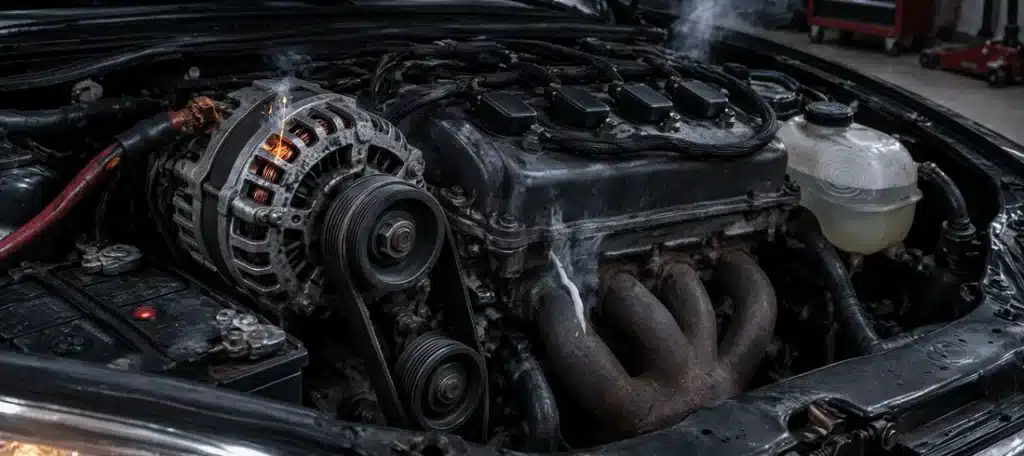
Your alternator isn’t just a battery charger. It’s the power source keeping the ignition coils, fuel injectors, and the engine’s computer running steady while the engine spins. When alternator output drops or gets unstable, usually falling below roughly 13.0 to 13.7 volts while the engine runs, that instability reaches the exact systems responsible for clean combustion.
Picture it like a kitchen running on a flickering circuit. The stove still works, but it surges and dips instead of holding steady heat, and every dish that depends on consistent heat comes out uneven. Your engine’s ignition coils and fuel injectors need the same kind of steady supply, and when they don’t get it, combustion gets uneven too, one or more cylinders firing weak, late, or not at all.
That’s the mechanism in plain terms:
- Weak or unstable voltage reaches the ignition coils, producing a weaker spark
- The same instability can throw off fuel injector timing and pulse
- The engine’s computer, starved of clean power, can’t manage ignition timing or fuel delivery the way it’s designed to
- The result: stumbling, hesitation, and the rough running you’re calling sputtering
The Honest Caveat
Here’s the catch: most of what causes sputtering has nothing to do with the alternator. Worn spark plugs, failing ignition coils, a clogged fuel filter, dirty injectors, or a bad MAF or O2 sensor account for the large majority of sputtering complaints. One source puts it plainly: it’s uncommon for an alternator to be the actual cause of a misfire.
The honest ranking: start with spark plugs and ignition components first, since they’re the most common cause and the cheapest to rule out. If those check out clean and the sputtering continues, especially alongside other charging-system symptoms, that’s when the alternator earns a real look.
Symptoms That Point Toward the Alternator, Not Just Sputtering Alone
Sputtering by itself doesn’t tell you much. These additional signs, happening around the same time, are what shift suspicion toward the charging system:
- Dimming or flickering headlights and dash lights, especially noticeable at idle or when you turn on the AC, blower, or defroster
- A battery warning light on the dash
- A whining or growling noise from the alternator area, often a sign of failing internal bearings
- The car dying shortly after a jump start, or struggling to restart
- Sputtering that gets worse specifically when more electrical load comes on (headlights, AC, heated seats all running at once)
AAA’s guidance on alternator warning signs lists this same cluster, flickering or erratic lights and repeated stalling among them, as the classic pattern of a failing alternator rather than a single isolated symptom.
How to Tell It Apart: The Voltage Test
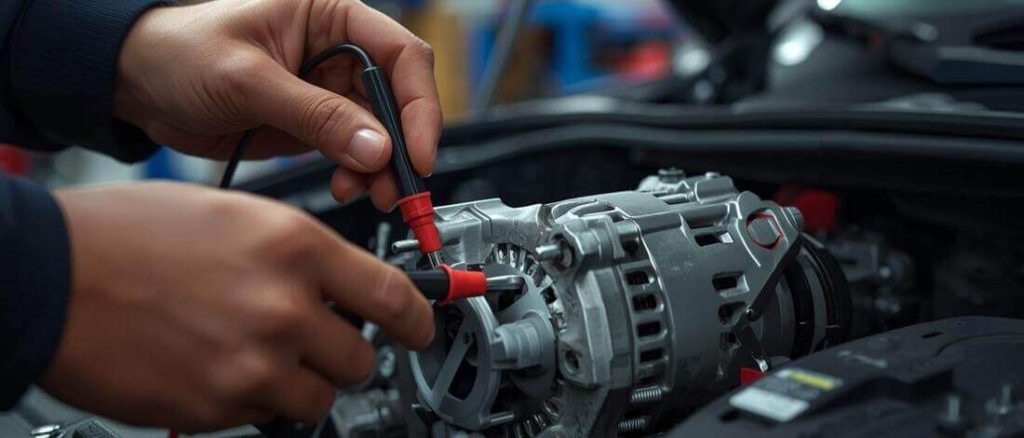
The best part? This takes a cheap multimeter and about five minutes, and it settles the argument better than guessing ever will.
- Engine off, test the battery. Red probe to positive, black to negative. A healthy, charged battery reads roughly 12.4 to 12.7 volts.
- Start the engine, test again. A healthy charging system should read roughly 13.5 to 14.8 volts at idle.
- Add electrical load. Turn on the headlights, blower motor, and rear defroster. Voltage should stay above roughly 13.0 volts. If it drops sharply or the lights visibly dim, the alternator is struggling to keep up.
- Rev the engine slightly while still connected. Voltage should rise a bit and hold steady. Flat or dropping voltage here points at the alternator, not spark or fuel.
| Reading while running | What it tells you |
|---|---|
| Roughly 13.5–14.8V, holds steady under load | Charging system is fine; look at spark plugs, ignition coils, or fuel delivery instead |
| Stuck near resting battery voltage (~12.6V) or drops below 13.0V | Alternator isn’t charging adequately; this can plausibly cause the sputtering |
| Sustained above 15V | A regulator fault (overcharging), a different problem with its own fix |
Big mistake: disconnecting the battery while the engine runs to “test” the alternator. Without the battery acting as a load, voltage can spike past 30 volts and fry the alternator’s internal diodes and regulator in seconds. Keep the battery connected for every test above.
On the flip side, if your multimeter readings come back completely normal and the sputtering continues, you’ve just ruled out the alternator and saved yourself from replacing the wrong part. That’s a win even though it doesn’t feel like one.
What to Do With Each Result
- Voltage checks out normal: the alternator isn’t your problem. Move to spark plugs and ignition coils first, since they’re the most common and cheapest cause, then fuel delivery if those come back clean.
- Voltage is low and unstable, especially under load: have the alternator tested and likely replaced. A failing alternator rarely gets better on its own.
- Voltage is fine at idle but drops hard when the AC, lights, and blower are all running: this still points to the alternator struggling under real-world load, even though a simple idle check alone might have missed it.

Is It Safe to Keep Driving?
Sputtering caused by a failing alternator tends to get worse, not better, and a charging system that can’t keep up can eventually leave you stranded with a dead battery on top of the rough running.
Get it looked at soon, don’t ignore it, if:
- Sputtering shows up alongside dimming lights, a battery warning light, or a whining noise
- The car struggled to restart after being jumped recently
Drive carefully and get a diagnosis promptly either way: sputtering itself, whatever the cause, means an engine that isn’t running cleanly, and sustained misfiring can risk damage to the catalytic converter from unburnt fuel passing through the exhaust.
What It Costs
These are U.S. ranges from repair-cost sources as of late 2026, not quotes. Costs here depend entirely on which cause you confirm.
| Repair | Typical U.S. range | Notes |
|---|---|---|
| Spark plugs and ignition coils (if that’s the actual cause) | Varies by cylinder count; get an itemized quote | Rule this out first, it’s usually cheaper than alternator work |
| Alternator replacement, total | Commonly $350 to $1,100 | More on performance models or hard-to-reach engines |
| Diagnostic fee | Often $50 to $150 | Ask if it’s credited toward the repair |
Common Mistakes
- Replacing the alternator first because it’s electrical and sounds serious. Spark plugs and ignition components cause sputtering far more often. Test before you buy.
- Testing the alternator with the battery disconnected. That’s how alternators get destroyed mid-test, not diagnosed.
- Ignoring the accompanying symptoms. Sputtering alone tells you little. Dimming lights, a whining noise, and a battery warning light together are what shift the odds toward the alternator.
- Assuming a clean idle-voltage reading rules out the alternator. Some alternators hold fine at idle but fail under real electrical load. Test with the lights, blower, and defroster running too.
FAQs About Can a Bad Alternator Cause Sputtering
Can a bad alternator really cause an engine to sputter?
Yes, but indirectly. Unstable or low voltage from a failing alternator can disrupt the ignition coils and fuel injectors, which the engine’s computer needs to maintain clean combustion. It’s a real but uncommon cause compared to worn spark plugs, ignition coils, or fuel delivery problems, which account for most sputtering complaints.
How do I know if sputtering is from the alternator or spark plugs?
Test charging voltage with a multimeter. A steady 13.5 to 14.8 volts while running, holding up under electrical load, points away from the alternator. A reading stuck near resting battery voltage or dropping below 13.0 volts under load points toward it. If voltage checks out normal, look at spark plugs and ignition coils first.
Dimming or flickering lights, a battery warning light, a whining noise from the alternator, and a car that struggles to restart after a jump are the classic cluster. Sputtering on its own, with none of these, is more likely spark plugs, fuel delivery, or a sensor issue.
Is it safe to drive with sputtering caused by a bad alternator?
Not as a long-term plan. A failing alternator tends to get worse and can eventually leave you with a dead battery on top of the rough running. Sustained misfiring of any kind also risks damage to the catalytic converter. Get it diagnosed promptly rather than waiting it out.
How much does it cost to fix sputtering caused by a bad alternator?
Alternator replacement commonly runs $350 to $1,100 total depending on the vehicle. If testing shows the alternator is fine and the real cause is spark plugs or ignition coils instead, that repair is typically cheaper. Get the cause confirmed with a voltage test before paying for either.
Bottom Line
- Yes, a bad alternator can cause sputtering, through unstable voltage reaching the ignition and fuel systems, but it’s an indirect, less common cause.
- Check spark plugs and ignition components first. They cause sputtering far more often.
- A five-minute voltage test, idle and under load, tells you which one you actually have.
- Never disconnect the battery to test the alternator while the engine runs. That destroys it.
- Dimming lights, a battery warning light, and a whining noise alongside the sputtering are what shift the odds toward the alternator.