
This article was updated in November 22, 2026 with new products and information by Mark S. Taylor
When one tire repeatedly loses air slowly, the most common causes are a small tread puncture, a leaking valve core or TPMS stem seal, or bead corrosion along the wheel rim. Measure all four tires cold to rule out temperature drops, then use soapy water around the valve before scheduling a shop dunk test.


You top off one tire, check it a few days later, and find it low again. The rubber looks fine from the outside, and there is no obvious nail sticking out of the tread.
Before you keep pumping air into it every week or buy a replacement tire you might not need, you have to separate normal weather swings from an actual leak. A few cold pressure readings and a safe visual check will point you in the right direction.
Contents
- 1 6 Common Causes of a Slow Tire Leak
- 2 Slow Tire Leak Diagnostic Triage Table
- 3 How to Check a Slow Tire Leak Safely at Home
- 4 What Not to Do When a Tire Loses Air
- 5 Can a Tire With a Slow Leak Be Repaired?
- 6 When Should You Stop Driving?
- 7 FAQs About Tire Losing Air Slowly?
- 7.1 Why does my tire lose air when I cannot find a nail?
- 7.2 Can cold weather make a tire lose pressure overnight?
- 7.3 Is it normal for one tire to lose more pressure than the others?
- 7.4 Can a leaking valve stem be repaired without replacing the tire?
- 7.5 Can I repair a nail in my tire myself with a plug kit?
- 7.6 Does a TPMS light mean the tire pressure sensor is bad?
6 Common Causes of a Slow Tire Leak
A tire and wheel assembly has several sealing points that can seep air slowly over days or weeks. Start by ruling out the weather, then work through the physical leak points.
1. Overnight Temperature Drops
Air contracts when temperatures fall, dropping tire pressure by roughly 1 PSI for every 10°F decrease in ambient temperature. A tire checked right after highway driving will also read 3 to 4 PSI higher than the same tire checked the next morning.
According to NHTSA TireWise cold-inflation guidance, you should always check tire pressure when the tires are cold. Cold means the vehicle has been parked for at least three hours or driven less than one mile at moderate speed.
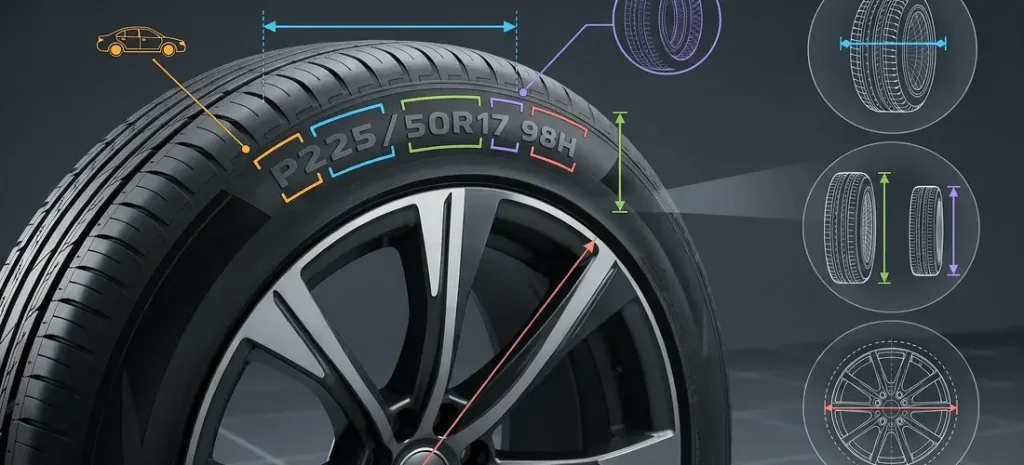
Compare your readings against the recommended cold pressure on the driver’s door-jamb placard or in your owner’s manual. Never inflate to the maximum pressure molded into the rubber. If you need help decoding those numbers, review our guide on reading the tire sidewall markings and door-jamb placard.
Do not wait for your dashboard light to warn you about a slow leak. Federal rules only require a vehicle’s TPMS light to turn on once a tire drops 25% below the placard specification (for example, dropping from 32 PSI down to 24 PSI). If all four tires drop together during a cold snap, top them off; if one tire keeps falling behind the other three, you have a leak.
2. Hidden Tread Punctures
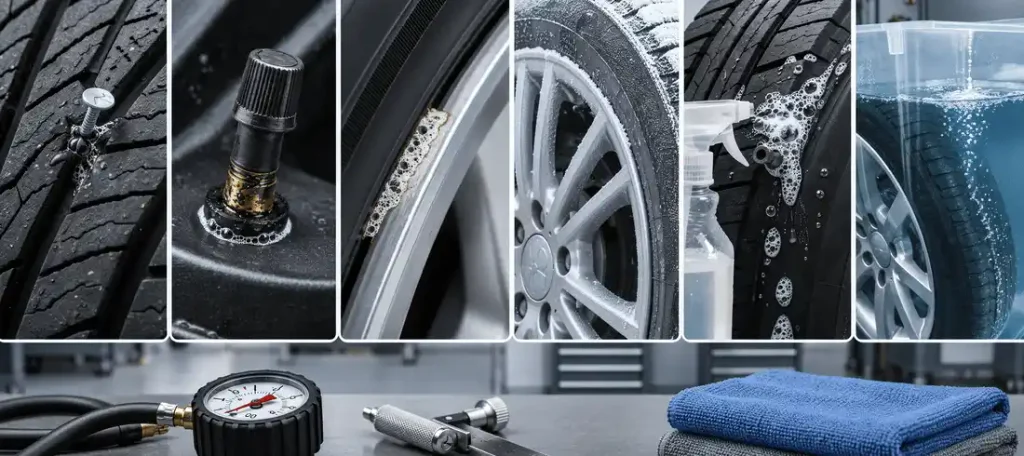
A small nail, screw, staple, or piece of wire can pierce the tread and stay lodged in the rubber. Because the metal object partially plugs the hole it created, air escapes slowly over several days instead of causing an instant flat.
Inspect the visible tread from a safe standing position. If you spot an embedded nail or screw, leave it in place. Pulling it out can turn a slow leak into a rapid blowout before you reach a tire shop.
3. Leaking Valve Core or Stem
The valve assembly is where you add air, and it can leak at three spots: the small spring-loaded valve core inside the tube, the rubber stem body itself, or the base where the stem seats into the wheel. Rubber stems dry out and crack with age, while loose or dirty valve cores allow a steady trickle of air to escape.
A valve leak often explains why a tire loses pressure steadily even when the tread is spotless. A quick soapy-water check around the valve opening and stem base can reveal growing bubbles in seconds.
4. Wheel Rim and Bead Corrosion
The tire bead is the reinforced inner edge of the tire that presses tightly against the metal wheel flange to form an airtight seal. Dirt, mounting debris, or corrosion along that flange breaks the seal and lets air seep out around the rim.
This problem is especially common on aluminum alloy wheels in regions that use road salt during winter. Moisture and salt collect along the bead seat, causing the aluminum to oxidize and blister microscopically beneath the rubber. No external sealant fixes bead corrosion permanently; a technician must dismount the tire, wire-brush the rim flange clean, and apply bead sealer before remounting.
5. Oxidized TPMS Sensor Seals
Vehicles with direct Tire Pressure Monitoring Systems (TPMS) use battery-powered sensors mounted inside the wheel, usually attached directly to the valve stem. Those metal stems rely on small rubber grommets, nuts, and seals that can degrade or corrode over time.
For example, an Acura ServiceNews bulletin on TPMS stem oxidation hosted by NHTSA documents how oxidation around the TPMS valve stem on specified Acura models can cause a slow air leak, using soapy water to confirm bubbles before service. That bulletin applies strictly to the listed Acura models, not every vehicle on the road, so a technician should still check the full wheel and tire assembly before replacing sensor hardware.
6. Bent or Cracked Wheels
Hitting a deep pothole or scraping a curb can bend the inner lip of a wheel or cause a hairline crack in the barrel. Even a slight bend on the inner edge of the rim (which you cannot easily see from outside the car) can break the bead seal under load.
Watch for physical warning signs around the tire and wheel:
- A bulge or bubble protruding from the sidewall
- Deep cuts or exposed structural cords
- A visibly dented, bent, or cracked wheel flange
- A tire that looks noticeably squatted compared to the others
If you spot a sidewall bulge, exposed cords, or a cracked wheel, stop driving and arrange roadside assistance or a tow.
Slow Tire Leak Diagnostic Triage Table
Use this quick reference to match what you see on your pressure gauge with the most likely cause and next step.
| Symptom / Observation | Most Likely Source | Safe DIY Check | Likely Shop Fix |
| All 4 tires drop 2–4 PSI together overnight | Ambient temperature drop (roughly 1 PSI per 10°F drop) | Log cold PSI on all 4 tires for 48 hours | Top off to door-jamb placard PSI |
| Only 1 tire drops 3–5+ PSI every few days; tread looks clean | Valve core, TPMS stem grommet, or rim bead corrosion | Spray soapy water on valve core, stem base, and outer bead lip | Valve core/TPMS service kit, or dismount + wire-brush rim flange |
| Visible nail or screw in the center tread | Embedded tread puncture | Do not pull it out; verify PSI before moving | Dismount, internal casing inspection, and 2-piece plug-patch combo |
| Visible bubble/bulge on sidewall, or puncture near shoulder | Internal belt/sidewall structural failure | Do not drive; mount spare or call a tow | Tire replacement (not safely repairable per TIA) |
How to Check a Slow Tire Leak Safely at Home
You can narrow down the cause in your driveway without removing the wheel or jacking up the car.
- Record cold pressure on all four tires. Before driving in the morning, measure every tire with an accurate tire pressure gauge. Write down all four readings and inflate any low tire to the door-jamb placard specification.
- Recheck under the same conditions. Measure all four tires again 24 to 48 hours later after the car has sat parked overnight. A repeatable drop in one single tire confirms a leak rather than a weather shift.
- Inspect the tread and outer sidewall visually. Walk around the vehicle and look for nails, screws, sidewall bulges, or obvious rim dents. Never crawl under a vehicle supported only by a jack to inspect the inner sidewall.
- Run a limited soapy-water check. Mix a few drops of mild dish soap with water in a spray bottle. Remove the valve cap and spray the valve opening, the base of the stem, and the outer edge where the tire meets the rim. Steady, growing foam bubbles pinpoint an active leak.
- Schedule a professional dunk test. If you see no bubbles on the outside, the leak is likely on the inner bead, hidden inside a tread groove, or caused by a hairline wheel crack. A tire shop can submerge the wheel in a water tank or inspect it on a lift to find the exact source.
What Not to Do When a Tire Loses Air
Taking the wrong shortcut on a slow leak can ruin an otherwise repairable tire or damage your TPMS hardware.
- Do not inject aerosol emergency sealants (such as Fix-a-Flat) into a tire with a slow leak. Liquid sealants coat the inside of direct TPMS sensors, throw off wheel balance, and often cause tire shops to charge extra cleanup fees or refuse a permanent patch altogether.
- Do not pull out an embedded nail or screw in your driveway.
- Do not rely on an external sticky string plug as a permanent fix.
- Do not try to tighten a leaking metal TPMS stem nut with pliers or sockets unless you have the exact torque specification, as aluminum stems snap easily.
- Do not attempt to break the tire bead or dismount the tire at home without proper mounting equipment.
Can a Tire With a Slow Leak Be Repaired?
Sometimes, depending on where the damage sits and what the inside of the tire looks like.
Under Tire Industry Association repair standards, a permanent puncture repair requires removing the tire from the wheel so a technician can inspect the inner liner for hidden heat or structural damage. A tire driven while severely underinflated can shred its internal casing even when the outside looks normal.
As outlined in Michelin’s puncture repairability guidelines, qualifying punctures must sit within the central tread area and meet strict size limits. Damage in the tire shoulder or sidewall cannot be repaired safely because those areas flex continuously at highway speeds. When a tread puncture qualifies, shops use a two-piece patch-and-plug combination installed from the inside out.
Keeping up with regular tire rotation and tread inspections also helps catch uneven shoulder wear and small embedded debris before a slow leak ruins the casing.
When Should You Stop Driving?
Never drive on a tire that is visibly flat, damaged, or losing pressure rapidly. Even if the tire still holds air, driving severely underinflated overheats the sidewall and destroys the internal casing.
Pull over safely and call for a tow or install your spare tire if you notice any of these signs:
- Pressure drops noticeably within a few hours of inflating
- A bulge, blister, or deep cut appears on the sidewall
- Internal steel or fabric cords are visible
- The wheel rim is visibly bent or cracked
- The steering wheel pulls sharply, vibrates, or feels unstable
Do not assume a tire is safe just because the TPMS light turned off temporarily after a warm drive.
FAQs About Tire Losing Air Slowly?
Why does my tire lose air when I cannot find a nail?
A slow leak with a clean tread usually comes from a leaking valve core, a cracked rubber stem, an oxidized TPMS sensor seal, or corrosion along the wheel bead. Cold overnight temperatures can also drop pressure readings. A soapy-water check or shop water-tank test confirms the exact spot.
Can cold weather make a tire lose pressure overnight?
Yes. Tire pressure drops roughly 1 PSI for every 10°F decrease in air temperature. Check all four tires when cold and compare them to your door-jamb placard. If all four tires dropped evenly, weather is likely responsible; if only one tire keeps losing air, suspect a leak.
Is it normal for one tire to lose more pressure than the others?
No. While minor 1 PSI differences can happen from uneven sun exposure or gauge error, one tire repeatedly losing 3 to 5 PSI more than the other three points to an active leak. Have the tire inspected instead of repeatedly topping it off.
Can a leaking valve stem be repaired without replacing the tire?
Yes. A leaking Schrader valve core, cracked rubber stem, or corroded TPMS seal can usually be serviced or replaced without buying a new tire. The exact repair depends on whether your vehicle uses standard rubber stems or direct TPMS sensor assemblies.
Can I repair a nail in my tire myself with a plug kit?
Do not treat an external string plug as a permanent repair. Industry safety standards require dismounting the tire to inspect the internal liner for underinflation damage and installing a proper combination plug-and-patch from the inside.
Does a TPMS light mean the tire pressure sensor is bad?
Not usually. A solid TPMS light means at least one tire has dropped roughly 25% below recommended pressure. A TPMS light that flashes for 60 to 90 seconds at startup and then stays solid typically signals a sensor battery or system malfunction. Always check pressure with a manual gauge first.
Log your cold tire pressures, run a quick soapy-water check around the valve and outer rim, and get a shop to dismount and inspect the tire if the leak keeps returning. Catching a valve core or bead leak early saves you from ruining an expensive tire carcass. For more seasonal inspection tips and upkeep schedules, explore our routine vehicle maintenance guides.