
This article was updated in November 13, 2026 with new products and information by Mark S. Taylor
You are shopping for replacement tires. The sidewall of your current tire says P225/60R16 97V, but the numbers look like a code. You know the new tire needs to fit the wheel, but you may not know what the other numbers mean.
Each part describes something different. Some numbers identify the tire’s dimensions and construction. Others describe how much load it can carry and its speed rating.
Understanding the code helps you compare tires. It does not, by itself, prove that a different size will fit your vehicle safely.
Contents
- 1 Quick Answer: What Do Tire Size Numbers Mean?
- 2 1. Start With the Tire Type Prefix
- 3 2. Understand the Section Width
- 4 3. Understand the Aspect Ratio
- 5 4. Know What R and the Final Wheel Number Mean
- 6 5. What Do 97V Mean?
- 7 Tire Size Code vs Service Description
- 8 6. Do Not Confuse Maximum Tire Pressure With Recommended Vehicle Pressure
- 9 7. How to Read the DOT Tire Date Code
- 10 8. What Are UTQG, M+S, and the Snowflake Symbol?
- 11 9. Where Should You Find the Correct Tire Size for Your Car?
- 12 10. Can You Use a Tire-Size Calculator to Choose a Different Size?
- 13 FAQs About How to Read Tire Size Numbers
- 13.1 What does 225/60R16 mean?
- 13.2 Does R mean rim size?
- 13.3 Does a higher load index mean I can carry more weight in my vehicle?
- 13.4 Can I use a tire with a lower speed rating?
- 13.5 Is the pressure on the tire sidewall the correct pressure for my car?
- 13.6 Does the DOT date code show the month and year?
- 14 Final Checklist Before Buying Replacement Tires
- 15 The Bottom Line
- 16 Technical References
Quick Answer: What Do Tire Size Numbers Mean?
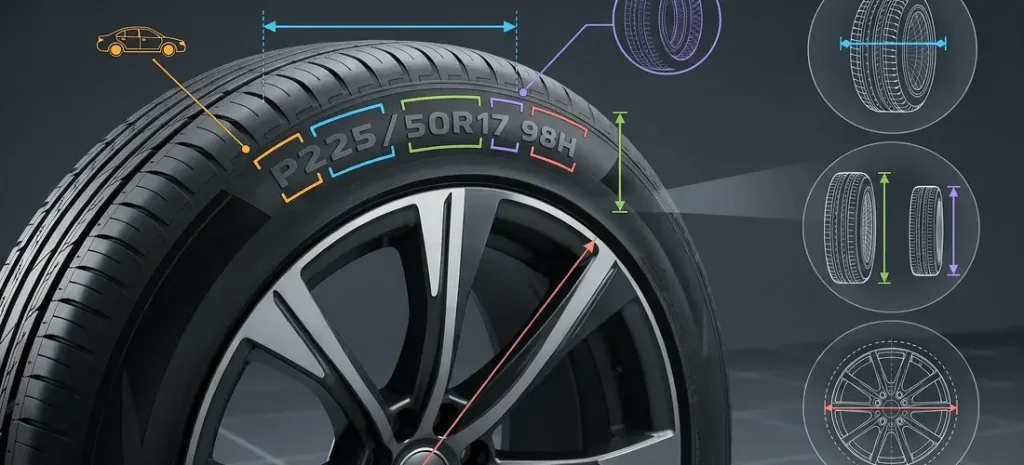
In a tire marking such as P225/60R16 97V, P identifies a passenger-metric tire, 225 is the nominal section width in millimeters, 60 is the aspect ratio, R means radial construction, and 16 is the wheel diameter in inches. The final 97V is the service description: load index 97 and speed symbol V.
Before buying a replacement, compare the complete specification with your vehicle’s Tire and Loading Information Label and owner’s manual.
1. Start With the Tire Type Prefix
The first letter, when present, identifies the tire’s intended category.
| Marking | Meaning |
|---|---|
| P | Passenger-metric tire |
| LT | Light-truck tire |
| ST | Special-trailer tire |
| T | Temporary spare tire |
| No prefix | May indicate a Euro-metric tire |
These categories are not interchangeable just because their main size numbers look similar.
For example, a P-metric tire and an LT tire can have different load characteristics and construction requirements. Follow the tire type and specifications approved for your vehicle.
You may also see XL, HL, or Reinforced markings.
- XL (Extra Load): Identifies a tire designed for higher load capacity than a standard-load tire of the same nominal size when used at the required pressure.
- HL (High Load): Identifies a tire built to meet higher load requirements under its applicable specification.
- Reinforced: Indicates an enhanced load-capacity construction.
These markings are not universal upgrades for every vehicle. Check the vehicle manufacturer’s tire requirements before selecting a replacement.
2. Understand the Section Width
In P225/60R16, the number 225 is the nominal section width in millimeters.
It describes the tire’s approximate width from sidewall to sidewall when mounted on its specified measuring rim.
It is not the width of the tread alone. It also does not describe the wheel’s width.
For example:
- 225 means a nominal section width of 225 millimeters.
- A wider tire may require a different approved wheel width.
- A wider tire may reduce clearance near the suspension, strut, fender, or inner wheel well.
The actual section width can vary by tire model and measuring-rim width. The number alone cannot confirm fitment.

3. Understand the Aspect Ratio
The number after the slash is the aspect ratio.
In 225/60R16, the number 60 means the nominal sidewall height is 60% of the tire’s section width.
Here is the calculation:
225 × 0.60 = 135 mm
The nominal sidewall height is approximately 135 millimeters.
This is a calculated nominal dimension, not a direct measurement of the complete tire. Actual dimensions can vary by tire model and measuring-rim width.
A lower aspect ratio generally means a shorter sidewall for the same section width. A higher aspect ratio generally means a taller sidewall.
Do not choose a different aspect ratio without checking the complete tire and wheel specification.
4. Know What R and the Final Wheel Number Mean
The letter R means radial construction.
Radial tires are the standard design for most modern passenger vehicles and light trucks.
The number after R identifies the wheel diameter in inches.
In P225/60R16:
- R means radial construction.
- 16 means the tire is designed for a 16-inch wheel.
This is an important detail to get right. A tire designed for a 16-inch wheel cannot be mounted on a 17-inch wheel.
Also, the number 16 does not describe the tire’s total outside diameter. Overall diameter depends on section width, aspect ratio, and wheel diameter together.
5. What Do 97V Mean?
The final number-and-letter pair is called the service description.
It contains two separate ratings:
- Load index: 97
- Speed symbol: V
Load Index: 97
The load index is a standardized numerical code that corresponds to the maximum load a single tire can carry under its specified conditions.
It is not a direct weight measurement printed in pounds or kilograms.
Use a recognized load-index chart to find the corresponding capacity. Then verify that the replacement tire meets the vehicle manufacturer’s required specification.
A replacement tire should not have a lower load rating than the vehicle requires.
A higher load index does not increase the vehicle’s GVWR, axle rating, payload, or towing capacity. Those limits remain set by the vehicle manufacturer.
Speed Symbol: V
The speed symbol is the letter that follows the load index.
It identifies the tire’s rated speed capability under specified load and inflation conditions.
It is not a recommendation to drive at that speed. It does not override posted speed limits, road conditions, or vehicle requirements.
The replacement tire’s load index and speed rating should meet the vehicle manufacturer’s specifications. Some manufacturers provide specific guidance for winter tires, so check the owner’s manual rather than applying a universal rule.
Tire Size Code vs Service Description
These two parts of the sidewall marking serve different purposes.
| Part of marking | Example | What it tells you |
|---|---|---|
| Tire type | P | Passenger-metric category |
| Section width | 225 | Nominal width in millimeters |
| Aspect ratio | 60 | Sidewall height as a percentage of width |
| Construction | R | Radial construction |
| Wheel diameter | 16 | Wheel diameter in inches |
| Load index | 97 | Standardized load-capacity code |
| Speed symbol | V | Speed rating under specified conditions |
The first group describes the tire’s size and construction. The final number-and-letter pair describes its load and speed ratings.
Both matter when choosing a replacement.
6. Do Not Confuse Maximum Tire Pressure With Recommended Vehicle Pressure
This is one of the most important sidewall details.
A tire may display markings such as MAX PRESS or MAX LOAD. These describe limits associated with the tire.
They are not the normal inflation target for your vehicle.
Find the recommended cold inflation pressure on the Tire and Loading Information Label. This label is usually located on the driver’s door edge or doorjamb. You can also check the owner’s manual.
The vehicle’s front and rear pressure recommendations may be different. Use the values specified for your vehicle.
NHTSA defines cold tires as tires that have not been driven on for at least three hours. Checking pressure when the tires are cold gives a more accurate comparison with the manufacturer’s recommendation.
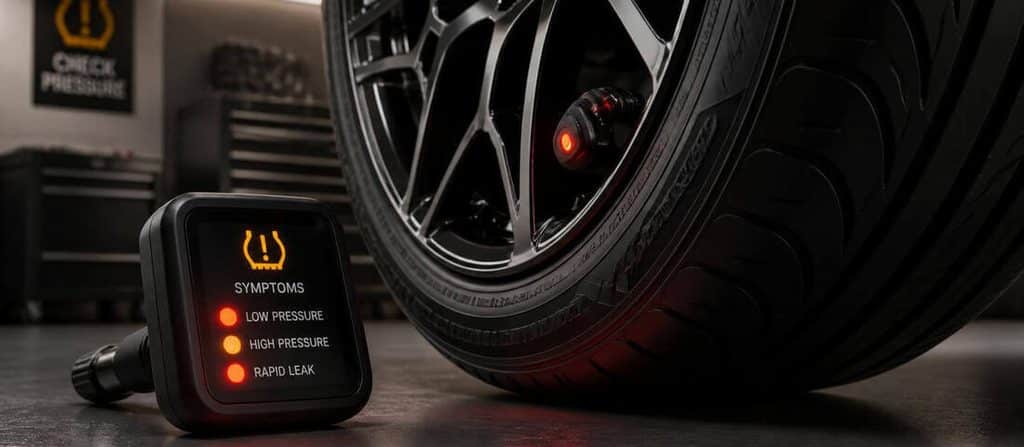
A TPMS warning is not a substitute for regular pressure checks. The system warns when pressure becomes significantly low, but routine manual checks are still necessary.
Remember: Use the vehicle’s recommended cold pressure, not the maximum pressure printed on the tire sidewall.
7. How to Read the DOT Tire Date Code
The DOT Tire Identification Number, or TIN, contains manufacturing information.
The final four digits on a current tire’s date code identify the week and year it was manufactured.
For example:
2524 = 25th week of 2024
The first two digits identify the manufacturing week. The last two digits identify the year.
The complete TIN may not be visible on both sidewalls. Some tires display the full date code on only one side.
If you cannot see the complete code from outside the vehicle, ask a tire shop to inspect it. Do not crawl under a vehicle that is not properly supported.
A date code does not tell you by itself whether a tire is safe to use. Age, storage, exposure, tread condition, cracks, bulges, repairs, and manufacturer guidance all matter.
For the regulatory definition of the date code, see 49 CFR § 574.5.

8. What Are UTQG, M+S, and the Snowflake Symbol?
You may see other markings that are not part of the main tire-size code.
These markings provide additional information about tire performance and intended use.
UTQG: Treadwear, Traction, and Temperature
Many passenger tires sold in the United States carry Uniform Tire Quality Grading information.
The system includes three grades:
| UTQG marking | What it describes |
|---|---|
| Treadwear | Comparative wear performance |
| Traction | Wet-pavement traction performance |
| Temperature | Resistance to heat under specified test conditions |
A treadwear grade is not a guaranteed mileage promise.
For example, a tire with a treadwear grade of 400 is not guaranteed to last twice as long as every tire with a grade of 200 in normal driving.
Actual tire life depends on driving habits, inflation, alignment, maintenance, road conditions, and climate.
NHTSA explains the grading system in its Consumer Guide to Uniform Tire Quality Grading.
M+S: Mud and Snow
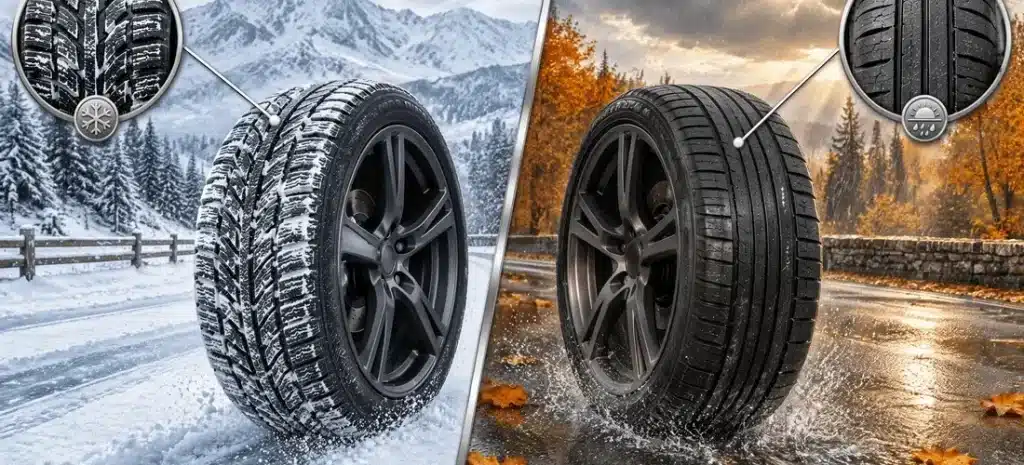
M+S means Mud and Snow.
This marking does not, by itself, prove that a tire passed the standardized severe-snow traction test.
Some all-season tires carry M+S markings without having the Three-Peak Mountain Snowflake certification.
3PMSF: Three-Peak Mountain Snowflake
The Three-Peak Mountain Snowflake symbol is commonly called 3PMSF.
It identifies a tire that meets a standardized snow-traction performance requirement.
If winter traction matters where you drive, check the exact tire’s certification and the vehicle manufacturer’s guidance.
Do not assume that M+S and 3PMSF mean the same thing.
9. Where Should You Find the Correct Tire Size for Your Car?
Start with the vehicle, not just the tire currently installed.
Check these three sources:
- The Tire and Loading Information Label on the driver’s door edge or doorjamb.
- The owner’s manual.
- The vehicle manufacturer’s approved tire specifications for your exact year, make, model, trim, and wheel package.
A previous owner may have installed a different tire size. Copying the current sidewall without checking the vehicle placard could repeat an incorrect choice.
Compare the complete specification, including:
- Tire type, such as P-metric or LT
- Section width and aspect ratio
- Wheel diameter
- Load index
- Speed symbol
- Original-equipment marking, if specified
- Approved wheel width
- Clearance around brakes, suspension, and bodywork
- Overall tire diameter and rolling circumference
- TPMS compatibility and vehicle-specific requirements
This matters especially on all-wheel-drive vehicles.
Some AWD systems have manufacturer limits for differences in rolling circumference and tread depth. Installing mismatched tires can affect the drivetrain, depending on the vehicle design.
NHTSA recommends using the vehicle’s Tire and Loading Information Label or owner’s manual to identify the correct tire size and recommended inflation pressure.
10. Can You Use a Tire-Size Calculator to Choose a Different Size?
A tire-size calculator can compare nominal dimensions, overall diameter, circumference, and estimated speedometer differences.
The The Car Buzz Tire Size Calculator can help you understand these dimensional changes.
For example, you can compare:
- Original and replacement section width
- Sidewall height
- Overall diameter
- Circumference
- Estimated speedometer difference
- Wheel offset and width, where supported
But a calculator cannot confirm every part of vehicle fitment.
It does not replace the manufacturer’s approved tire specifications, load and speed requirements, wheel-width limits, brake clearance, suspension clearance, TPMS requirements, or AWD requirements.
Use the calculator to understand dimensional differences. Do not treat its result as approval to install a different tire.
If you are changing tire or wheel size, verify the complete setup for your exact vehicle with the manufacturer or a qualified tire professional.
FAQs About How to Read Tire Size Numbers
What does 225/60R16 mean?
It describes a tire with a nominal section width of 225 millimeters, an aspect ratio of 60, radial construction, and a wheel diameter of 16 inches. The load index and speed symbol appear after the size as part of the service description.
Does R mean rim size?
No. R means radial construction. The number after R identifies the wheel diameter in inches. For example, R16 means the tire is designed for a 16-inch wheel.
Does a higher load index mean I can carry more weight in my vehicle?
No. A higher tire load index indicates a higher tire load rating under specified conditions. It does not increase your vehicle’s GVWR, axle rating, payload, or towing capacity. Those limits remain set by the vehicle manufacturer.
Can I use a tire with a lower speed rating?
Do not assume that you can. Follow the vehicle manufacturer’s requirements and applicable guidance. Some manufacturers provide specific winter-tire exceptions, but there is no universal rule that applies to every vehicle.
Is the pressure on the tire sidewall the correct pressure for my car?
No. The sidewall’s maximum pressure marking is not the vehicle’s normal inflation target. Use the Tire and Loading Information Label or owner’s manual to find the recommended cold pressure.
Does the DOT date code show the month and year?
No. The last four digits identify the week and year. For example, 2524 means the tire was manufactured during the 25th week of 2024.
Final Checklist Before Buying Replacement Tires
Use this checklist before ordering a new set:
- Confirm the approved tire size on the driver’s doorjamb label.
- Check the owner’s manual for additional tire requirements.
- Match the required tire type.
- Confirm the load index.
- Confirm the speed symbol.
- Check the wheel diameter and approved wheel width.
- Verify clearance around the suspension, brakes, and bodywork.
- Check TPMS and vehicle-specific requirements.
- Verify AWD rolling-circumference requirements, where applicable.
- Confirm the recommended cold inflation pressure.
The Bottom Line
A tire-size code tells you more than the tire’s width and wheel diameter. It also identifies the aspect ratio, construction, load index, and speed symbol.
Use the doorjamb placard and owner’s manual to confirm what your vehicle requires. Check the full service description, not just the first group of numbers.
And remember: a tire-size calculator can compare dimensions, but it cannot approve a replacement tire for your exact vehicle.