
This article was updated in September 21, 2026 with new products and information by Mark S. Taylor
Bad front shocks can make a car feel loose, bouncy, unstable and harder to control. The symptoms often develop gradually, which makes worn shocks easy to overlook.
The most common bad front shocks symptoms include excessive bouncing after bumps, nose diving during braking, excessive body roll in corners, steering vibration, uneven or cupped tire wear, clunking noises and a noticeable loss of ride control.
But there’s an important diagnostic point:
Not every suspension symptom means the front shocks are bad.
Strut mounts, control-arm bushings, ball joints, tie rod ends, wheel bearings, tires and alignment problems can produce similar symptoms.
And a shock doesn’t have to be leaking to be worn out. KYB notes that shocks can lose their performance internally without obvious external failure.
Contents
- 1 What Are the Symptoms of Bad Front Shocks?
- 2 What Do Front Shocks Do?
- 3 9 Bad Front Shocks Symptoms
- 3.1 1. Excessive Bouncing After Bumps
- 3.2 Don’t confuse a firm ride with a bad shock
- 3.3 2. Front-End Nose Dive When Braking
- 3.4 Why it matters
- 3.5 3. Excessive Body Roll in Corners
- 3.6 4. Loose or Vague Steering
- 3.7 5. Vehicle Feels Unstable Over Bumps
- 3.8 6. Uneven or Cupped Front-Tire Wear
- 3.9 But don’t blame the shocks automatically
- 3.10 7. Steering-Wheel Vibration
- 3.11 8. Clunking or Knocking From the Front Suspension
- 3.12 9. Shock Fluid Leakage
- 3.13 Important:
- 4 Bad Front Shocks vs. Bad Strut Mounts
- 5 Bad Front Shocks vs. Bad Control Arm Bushings
- 6 How to Check for Bad Front Shocks
- 7 Does the Bounce Test Prove the Shocks Are Bad?
- 8 Can You Drive With Bad Front Shocks?
- 9 What Causes Front Shocks to Go Bad?
- 10 Should Front Shocks Be Replaced in Pairs?
- 11 How Long Do Front Shocks Last?
- 12 Do Bad Front Shocks Affect Alignment?
- 13 Front Shocks vs. Front Struts
- 14 Common Diagnostic Mistakes
- 15 FAQs About Shock Absorber Testing Guide
- 16 Final Verdict
What Are the Symptoms of Bad Front Shocks?
The most common signs of worn front shocks or struts are:
- Excessive bouncing after hitting bumps
- Front-end nose dive during braking
- Excessive body roll when turning
- Loose or less precise steering
- Vehicle instability over rough roads
- Uneven or cupped front-tire wear
- Steering-wheel vibration
- Clunking or knocking noises
- Visible shock-fluid leakage
If the front suspension is bouncing excessively, the vehicle feels unstable during emergency maneuvers, or the front end dives significantly under braking, have the suspension inspected rather than continuing to drive normally.
What Do Front Shocks Do?
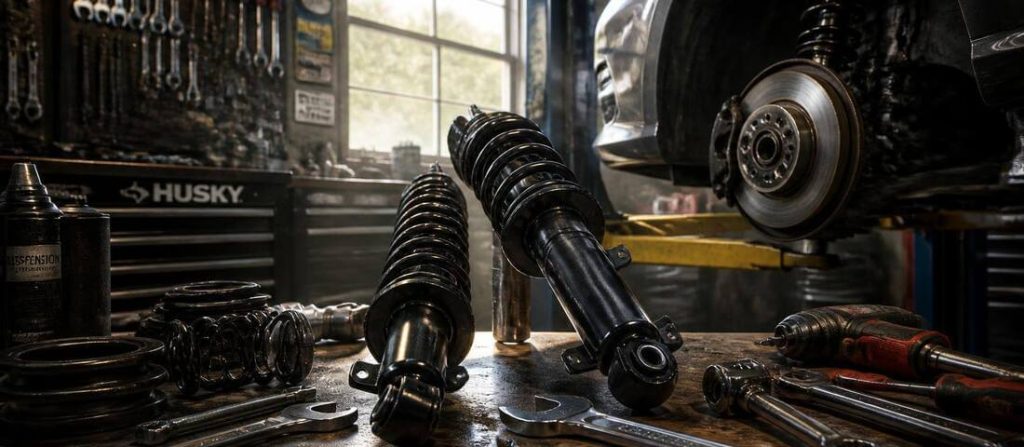
Shock absorbers control suspension movement.
They don’t primarily support the vehicle’s weight—that’s mainly the job of the springs.
Instead, shocks control how quickly the suspension moves after the springs are compressed or extended.
When you hit a bump, the spring absorbs the impact.
The shock absorber controls the spring’s movement so the vehicle doesn’t continue bouncing.
That affects:
- Ride quality
- Tire contact with the road
- Steering control
- Braking stability
- Body movement
- Cornering behavior
KYB explains that worn shocks allow the wheels to move up and down excessively, reducing tire contact with the road and potentially affecting braking, handling and electronic safety-system performance.
9 Bad Front Shocks Symptoms
1. Excessive Bouncing After Bumps
One of the easiest symptoms to recognize is a car that continues bouncing after hitting a bump.
A healthy suspension should settle relatively quickly after an impact.
With worn shocks, the spring can continue oscillating because the shock is no longer controlling its movement effectively.
You may notice this after:
- Speed bumps
- Potholes
- Rough pavement
- Railroad crossings
- Uneven driveways
Monroe identifies excessive bouncing after bumps as a common sign of worn shocks and struts.
Don’t confuse a firm ride with a bad shock
A stiff suspension isn’t necessarily a failed suspension.
The important symptom is excessive or poorly controlled movement, not simply whether the ride feels soft or firm.
2. Front-End Nose Dive When Braking
Does the front of the car drop noticeably when you brake?
That’s called nose dive.
Worn front shocks or struts can allow excessive forward weight transfer during braking.
You may notice:
- The hood appears to drop sharply
- The front suspension compresses excessively
- The car feels less controlled during hard braking
- The front end bobs after the stop
Monroe and KYB both identify excessive nose dive during braking as a sign that shocks or struts may be worn.
Why it matters
When the vehicle’s weight shifts forward excessively, the suspension and tires may not remain as well controlled.
KYB notes that worn shocks can increase stopping distance under certain conditions.
Don’t deliberately perform hard braking tests on public roads just to diagnose your shocks.
3. Excessive Body Roll in Corners
A car with worn front shocks may feel like it leans or rolls more than it used to when turning.
You may notice it during:
- Highway ramps
- Quick lane changes
- Roundabouts
- Tight corners
- Emergency steering maneuvers
Monroe explains that worn shocks can lose their ability to control weight transfer during cornering, resulting in increased body roll and a feeling of reduced control.
But body roll isn’t proof of bad shocks.
Sway-bar components, springs, bushings and other suspension parts can also contribute.
4. Loose or Vague Steering
Another common complaint is:
“The steering doesn’t feel as tight as it used to.”
You may notice:
- Delayed steering response
- More steering corrections
- A vague feeling around the center
- Reduced confidence at highway speed
- More movement over uneven pavement
KYB identifies loose or slow steering response as a potential indication that shocks or struts need replacement.
However, this symptom has many possible causes.
A loose tie rod, worn ball joint, control-arm bushing, steering rack or alignment problem can produce similar sensations.
That’s why steering looseness should be diagnosed as a complete system.
5. Vehicle Feels Unstable Over Bumps
Worn front shocks can allow the front tires to move excessively after hitting uneven pavement.
The vehicle may:
- Bounce
- Wander
- Feel unsettled
- Require additional steering corrections
- Take longer to stabilize after a bump
The problem can become more noticeable at highway speeds.
Monroe notes that worn shocks can compromise steering precision, stopping performance and vehicle stability.
6. Uneven or Cupped Front-Tire Wear
Look closely at the front tires.
Worn shocks can allow excessive vertical wheel movement, producing an irregular wear pattern commonly called cupping or scalloping.
You may see a repeating pattern of raised and worn areas around the tread.
KYB specifically identifies cupping as a characteristic wear pattern associated with worn shocks or struts.
Monroe also notes that worn shocks can contribute to accelerated tire wear, including cupping or scalloping.
But don’t blame the shocks automatically
Cupped tires can also be associated with:
- Wheel imbalance
- Tire problems
- Alignment issues
- Worn suspension components
The tire pattern should be considered together with the suspension inspection.
7. Steering-Wheel Vibration
A worn front shock or strut can contribute to steering-wheel vibration, particularly when suspension movement isn’t being controlled properly.
But this is one of the least specific symptoms.
A vibration can also come from:
- Wheel imbalance
- Bent wheel
- Tire defect
- Wheel bearing
- Brake rotor
- Suspension looseness
- Alignment problem
Monroe notes that steering-wheel vibration can be associated with worn shocks or struts, particularly when the vibration occurs on relatively smooth roads.
Don’t replace shocks based on vibration alone.
8. Clunking or Knocking From the Front Suspension
A worn shock or strut can make a clunking or knocking noise.
This can happen when:
- The shock bottoms out
- A mounting component is worn
- The shock has mechanical damage
- Another suspension component is loose
Monroe identifies clunking or knocking as a possible symptom of worn shocks and struts.
However, front-end noises are notorious for misleading drivers.
A bad:
- Strut mount
- Sway-bar link
- Ball joint
- Control-arm bushing
- Tie rod
- Spring
can produce a similar noise.
The noise tells you where to investigate—not automatically what part to replace.
9. Shock Fluid Leakage
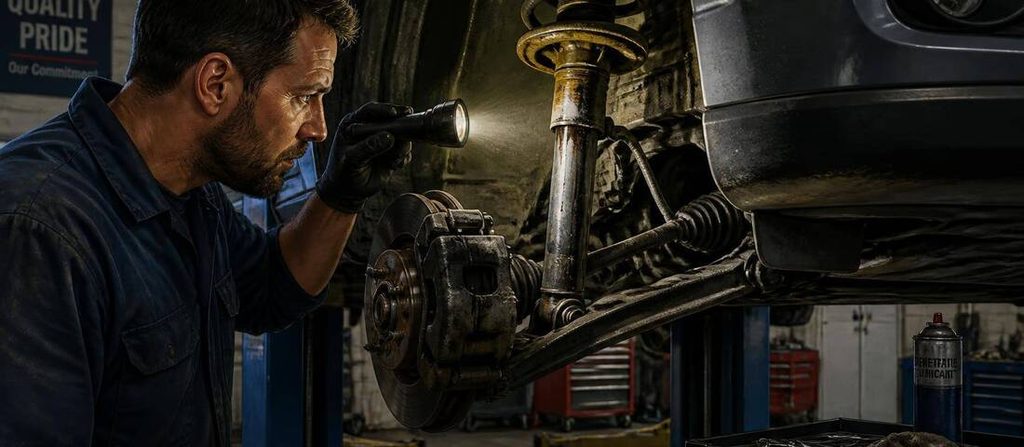
Look at the exterior of the front shock or strut.
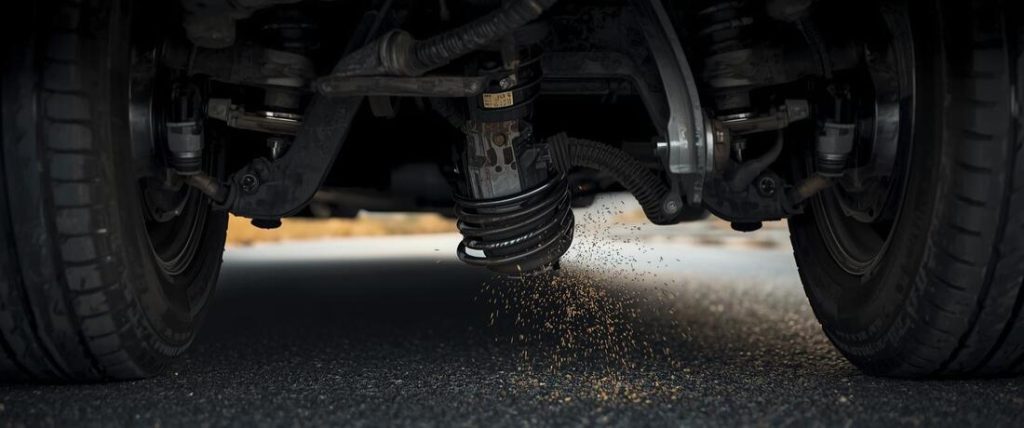
A heavy oil film or fluid running down the body can indicate a failed seal.
KYB distinguishes between minor traces and a shock with significant fluid leakage; a heavy leak indicates a worn or damaged unit that needs replacement.
Monroe likewise identifies excessive hydraulic-fluid leakage as a sign of worn shocks or struts.
Important:
A completely dry shock isn’t automatically good.
Internal wear can reduce damping performance without producing an obvious external leak. KYB specifically warns that shocks can require replacement even without visible mechanical failure.

Bad Front Shocks vs. Bad Strut Mounts
This is a common source of confusion.
The shock/strut controls suspension movement.
The strut mount connects the strut assembly to the vehicle body and, on many designs, allows the strut to rotate with steering input.
A bad strut mount can cause:
- Clunking
- Steering stiffness
- Binding
- Noise during turning
- Abnormal steering feel
A worn shock can cause:
- Bouncing
- Nose dive
- Body roll
- Poor damping
- Excessive suspension movement
Both can occur at the same time.
If replacing the shock doesn’t address the noise, inspect the mount and bearing assembly.
Bad Front Shocks vs. Bad Control Arm Bushings
These problems can feel surprisingly similar.
| Symptom | Worn Front Shocks | Control-Arm Bushing |
|---|---|---|
| Excessive bouncing | Strong clue | Less typical |
| Nose dive | Strong clue | Possible but less specific |
| Body roll | Possible | Possible |
| Clunking | Possible | Common possibility |
| Steering looseness | Possible | Possible |
| Uneven tire wear | Possible | Possible |
| Cupping | Stronger clue | Less typical |
| Visible shock leak | Strong clue | No |
| Bushing cracking/separation | No | Strong clue |
The physical inspection is what separates them.
How to Check for Bad Front Shocks
Step 1: Inspect for Visible Damage
Look for:
- Heavy fluid leakage
- Bent piston rod
- Damaged housing
- Broken mounting bracket
- Damaged bushings
- Corrosion
KYB specifically lists heavy fluid leakage, bent piston rods and cracked/broken mounting brackets as mechanical failures requiring shock replacement.
Step 2: Inspect the Tires
Look for:
- Cupping
- Scalloping
- Uneven wear
- Accelerated wear
Record the wear pattern before replacing anything.
Step 3: Compare Left and Right
Look at both front shocks/struts.
If one has obvious leakage or damage while the other doesn’t, that’s useful evidence.
But visual comparison alone doesn’t prove the internal condition of either unit.
Step 4: Perform a Road Test
A controlled road test can reveal:
- Excessive bouncing
- Nose dive
- Body roll
- Poor recovery after bumps
- Steering instability
KYB notes that professional technicians evaluate shocks and struts with a diagnostic road test as well as visual inspection.
Step 5: Inspect the Other Suspension Components
Before blaming the shocks, check:
- Strut mounts
- Springs
- Control-arm bushings
- Ball joints
- Tie rods
- Sway-bar links
- Wheel bearings
- Tires
- Wheel alignment
This is particularly important when the primary complaint is a noise or vibration.
Does the Bounce Test Prove the Shocks Are Bad?
Not necessarily.
The traditional “push down on the fender and see how many times it bounces” test can provide a clue, but it shouldn’t be treated as a definitive diagnostic method for every modern suspension.
A vehicle can behave differently depending on:
- Suspension design
- Spring rate
- Vehicle weight
- Shock condition
- Tire pressure
- Other worn components
A proper inspection and road test are more useful.
Don’t replace expensive shocks based on one bounce-test result.
Can You Drive With Bad Front Shocks?
Driving with significantly worn shocks isn’t something to ignore.
Worn shocks can reduce:
- Steering control
- Braking stability
- Tire contact
- Cornering control
- Overall vehicle stability
KYB states that worn shocks can reduce tire contact with the road and compromise braking and control, while Monroe notes that worn shocks can make vehicle control more difficult, especially in adverse conditions.
Have the vehicle inspected promptly if:
- The front end bounces excessively
- The car nose-dives severely during braking
- Steering feels unstable
- The vehicle sways excessively
- A shock is heavily leaking
- A shock mount is damaged
- Tire cupping is severe
- The vehicle feels difficult to control
If the suspension or steering is severely compromised, avoid driving it until it has been inspected.
What Causes Front Shocks to Go Bad?
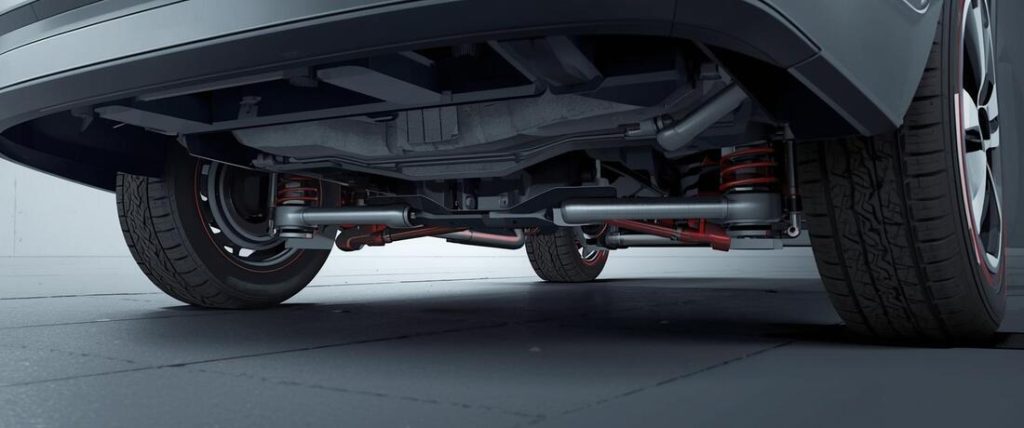
Shock absorbers wear gradually.
Common contributors include:
Normal wear
Internal valves and seals wear with use.
Rough roads
Potholes and repeated impacts increase suspension stress.
Heavy loads
Consistently carrying heavy loads can increase suspension workload.
Severe driving conditions
Off-road driving, towing and poor road surfaces can accelerate wear.
Corrosion
Rust can damage shock bodies, mounting hardware and piston rods.
Impact damage
A major pothole or collision can bend or damage a shock.
Monroe notes that shock wear varies with road and environmental conditions, driving style and vehicle load.
Should Front Shocks Be Replaced in Pairs?
Generally, replacing shocks/struts on the same axle as a pair is the more consistent approach when one has failed or worn significantly.
The reason is simple:
A new shock on one side and a significantly worn shock on the other can produce different damping characteristics from left to right.
However, the exact repair recommendation should consider the vehicle, shock condition and manufacturer’s guidance.
Don’t automatically replace every shock on the vehicle simply because one front unit is leaking.
Inspect the entire suspension.
How Long Do Front Shocks Last?
There is no universal mileage interval that guarantees a shock needs replacement.
Service life depends on:
- Road conditions
- Vehicle weight
- Driving style
- Climate
- Potholes
- Towing
- Off-road use
- Shock design
Monroe notes that shocks can deteriorate gradually and may not show obvious external wear.
KYB likewise emphasizes condition-based evaluation rather than relying solely on visible leakage.
So mileage is useful context, but symptoms and inspection should make the final call.

Do Bad Front Shocks Affect Alignment?
Worn shocks can contribute to tire wear and suspension movement, but don’t automatically assume a shock is the cause of an alignment problem.
Alignment can be affected by:
- Bent suspension components
- Worn bushings
- Ball joints
- Tie rods
- Ride-height changes
- Wheel damage
If you replace a shock/strut assembly, follow the vehicle’s service procedure and check alignment when appropriate.
Front Shocks vs. Front Struts
Drivers often use the terms interchangeably, but they’re not always the same thing.
A shock absorber primarily controls suspension movement.
A strut is a structural suspension component that can perform the damping function while also helping locate the wheel assembly.
Many modern vehicles use front struts rather than conventional shocks.
So when someone searches for “bad front shocks symptoms,” the same symptom discussion may apply to a vehicle equipped with front struts.
Always identify what suspension design your vehicle actually uses before ordering parts.
Common Diagnostic Mistakes
Replacing shocks because the car rides rough
A rough ride can have many causes, including tires, springs and other suspension components.
Assuming a dry shock is good
Internal wear can occur without obvious external leakage.
Blaming every clunk on the shock
Strut mounts, sway-bar links, ball joints and bushings can make similar noises.
Using tire wear as proof
Cupping can point toward worn shocks, but other tire, wheel and suspension problems can contribute.
Replacing only one shock without inspection
Compare both sides and consider replacing the same axle pair when appropriate.
Using the bounce test as the only diagnosis
Use visual inspection, road-test behavior and suspension-component inspection together.
Ignoring safety systems
Worn shocks can reduce tire contact with the road, which can affect the conditions under which ABS, traction control and ESC operate.
FAQs About Shock Absorber Testing Guide
What are the most common bad front shocks symptoms?
The most common symptoms include excessive bouncing, nose diving during braking, body roll, loose steering feel, vehicle instability, uneven or cupped tire wear, vibration, unusual noises and visible fluid leakage.
How do I know if my front shocks are bad?
Look for excessive suspension movement, nose dive, body roll, tire cupping, fluid leakage or damaged shock components, then have the suspension road-tested and inspected.
Can bad front shocks cause vibration?
Yes, worn shocks can contribute to vibration, but tire imbalance, bent wheels, wheel bearings and other suspension problems can also cause vibration.
Can bad shocks cause uneven tire wear?
Yes. Worn shocks can allow excessive tire movement and contribute to cupping or scalloped wear.
Do bad shocks make a clunking noise?
They can, particularly if the shock bottoms out or mounting components are worn. But other suspension parts can produce the same noise.
Final Verdict
The biggest bad front shocks symptoms are excessive bouncing, nose dive during braking, body roll, loose or unstable steering, uneven/cupped tire wear, vibration, unusual noises and visible fluid leakage.
But the diagnosis shouldn’t stop at the symptom list.
The correct process is:
Symptoms → visual inspection → tire inspection → road test → inspect mounts/bushings/ball joints/tie rods → evaluate shock condition → replace confirmed worn components.
And remember:
A shock doesn’t have to leak to be worn out.
Internal wear can reduce damping performance even when the shock looks perfectly dry from the outside.