
This article was updated in May 9, 2026 with new products and information by Mark S. Taylor
Your car won’t start. You turn the key and hear… nothing. Or maybe a click. Or a horrible grinding sound. Your mind starts racing — is it the battery? The alternator? Or something worse? As a mechanic, I see this panic all the time. The good news is that starter failure usually gives you warning signs before it leaves you stranded. The bad news is most drivers ignore those signs until it’s too late. Here’s exactly what to look for, how to confirm it’s your starter, and what it’ll cost to fix.
Contents
- 1 The Most Reliable Symptom: A Single Click and Nothing Else
- 2 Grinding or Whirring Noise When Starting
- 3 Intermittent Starting Problems
- 4 Dashboard Lights Work But Engine Won’t Crank
- 5 Slow Cranking That Gets Worse Over Time
- 6 Smoke or Burning Smell From the Engine Bay
- 7 Starter Stays Engaged After Engine Starts
- 8 Starter vs Battery vs Alternator: How to Tell the Difference
- 9 What Causes a Starter to Go Bad?
- 10 How to Test Your Starter at Home
- 11 How Much Does a Starter Replacement Cost?
- 12 Can You Drive With a Bad Starter?
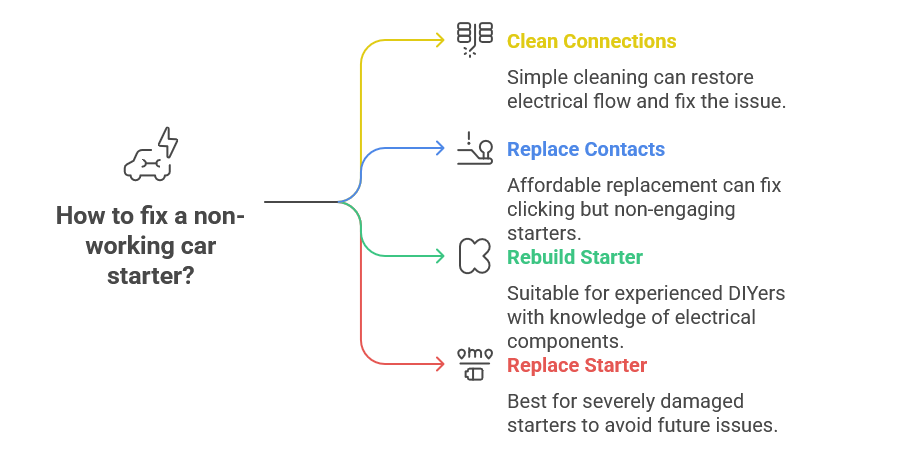
- 13 DIY vs Mechanic: Should You Replace a Starter Yourself?
- 14 How to Prevent Starter Problems
- 15 FAQs About Symptoms of a Bad Starter
- 16 The Bottom Line
Quick Answer:
The most common symptom of a bad starter is a single click when you turn the key, but the engine doesn’t crank. Other clear signs include grinding noises, intermittent starting problems, dashboard lights working but no engine crank, slow cranking that worsens over time, smoke from the engine bay, or the starter staying engaged after the engine starts. If you hear a rapid clicking, that’s usually a weak battery, not a bad starter.
The Most Reliable Symptom: A Single Click and Nothing Else
You turn the key. You hear one solid click. Then silence. The engine doesn’t turn over.
This is the most reliable indicator of starter failure I see in the shop.
Here’s what’s happening: the starter solenoid is receiving power and engaging (that’s the click), but the starter motor itself isn’t spinning. This usually means the internal motor windings have failed, or the brushes are worn out.
Don’t confuse this with rapid clicking. Rapid clicking almost always means a weak battery or poor connections. A single click points directly to the starter.
I’ve had customers come in after replacing their battery thinking that would fix the single-click problem. It didn’t. Because the battery wasn’t the issue — the starter was already dead.
Grinding or Whirring Noise When Starting
This one makes me wince every time I hear it.
If you hear a grinding, whirring, or high-pitched spinning sound when you turn the key, the starter’s pinion gear isn’t properly meshing with the flywheel. The starter motor might be spinning, but it’s not engaging the engine.
Urgency level: HIGH.
Keep trying to start the car with this symptom, and you’ll grind down the teeth on your flywheel. Flywheel replacement adds hundreds of dollars to your repair bill. I’ve seen cases where ignoring this sound turned a $400 starter job into a $1,200 starter-plus-flywheel job.
If you hear grinding, stop cranking immediately. Get the car towed or have a mobile mechanic come to you.
Intermittent Starting Problems
This one frustrates drivers the most.
Your car starts fine in the morning. You drive to work. You go to leave at 5 PM, and… nothing. Or it works fine for three days, then fails twice in one day.
Intermittent starting problems often point to a failing starter, specifically the solenoid contacts. Over time, the electrical contacts inside the solenoid develop hot spots and pitting. Sometimes they make contact, sometimes they don’t.
Heat soak is another culprit. When your engine gets hot, heat transfers to the starter. A weak starter might work fine when cold but fail when hot. If your car starts reliably in the morning but struggles after it’s warmed up, heat soak is likely involved.
Loose or corroded wiring connections can also cause intermittent issues. Before condemning the starter, check the connections at the battery terminals and the starter itself.
Dashboard Lights Work But Engine Won’t Crank
This symptom confuses a lot of people.
You turn the key. The dashboard lights come on bright. The radio works. Everything looks normal. But when you turn to “start,” nothing happens — no crank, no click, just silence.
This actually helps narrow down the problem. If your battery were completely dead, the dashboard lights would be dim or nonexistent. Seeing bright lights with no crank tells us the battery has enough power, but it’s not reaching the starter motor.
This points to either:
- A bad starter
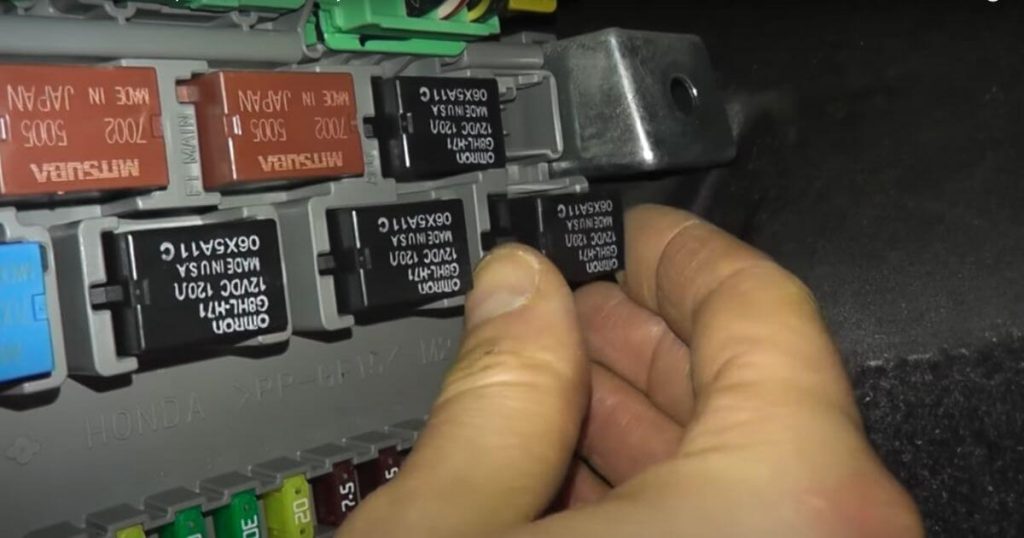
- A failed starter relay
- A bad ignition switch
- A faulty neutral safety switch (automatic) or clutch switch (manual)
The starter is still the most likely culprit, but you’ll need to do some testing to confirm.
Slow Cranking That Gets Worse Over Time
We’ve all heard that slow, labored cranking sound — rrr-rrr-rrr-rrr — like the engine is struggling to turn over.
A weak battery causes this too. But here’s the difference:
Battery-related slow crank: Happens suddenly, often in cold weather, and the battery is usually older (4-5+ years). Jump-starting fixes it, at least temporarily.
Starter-related slow crank: Develops gradually over weeks or months. The cranking gets progressively slower even when the battery is fully charged. Jump-starting doesn’t help much because the starter is drawing too much power due to internal wear.
If your battery tests healthy but the engine still cranks slowly, the starter is likely dragging. The internal bearings wear out, the armature drags against the field coils, and the motor can’t spin at full speed.
Smoke or Burning Smell From the Engine Bay
Urgency level: CRITICAL. Stop immediately.
If you see smoke or smell something burning when trying to start your car, stop turning the key. Right now.
Smoke usually means the starter is drawing excessive current because of an internal short circuit. The windings are overheating, the insulation is melting, and you’re on the verge of an electrical fire.
Sometimes this happens because the starter stays engaged and keeps trying to spin after the engine is running. Other times, it’s a direct internal short.
Either way, continuing to crank will make it worse. The starter can get hot enough to damage surrounding wires, melt the insulation on the main power cable, or even start a fire.
Have the car towed. Don’t try to start it again until a mechanic has inspected it.
Starter Stays Engaged After Engine Starts
This is a scary one if you know what’s happening.
Normally, the starter spins the engine, then the solenoid disengages the pinion gear from the flywheel as soon as the engine starts. But if the solenoid sticks in the engaged position, the starter keeps spinning even after the engine is running.
Turn off the engine immediately if this happens.
A running engine spins much faster than the starter is designed to handle. The starter can literally tear itself apart. I’ve seen starters explode from this, sending shrapnel into the bell housing. At minimum, you’ll destroy the starter. At worst, you’ll damage the flywheel and possibly the transmission bell housing.
This usually indicates a stuck solenoid, but it can also be caused by a shorted ignition switch or a wiring problem that keeps power flowing to the starter circuit.
Starter vs Battery vs Alternator: How to Tell the Difference
This is where most people get confused. Let me break it down simply.
| Symptom | Bad Starter | Bad Battery | Bad Alternator |
|---|---|---|---|
| Single click, no crank | Yes | Rare | No |
| Rapid clicking | Rare | Yes | No |
| Grinding noise | Yes | No | No |
| Slow cranking | Yes (gradual) | Yes (sudden) | No |
| Car dies while driving | No | No | Yes |
| Dashboard lights dim | No | Yes | Yes |
| Jump-start fixes it | No | Yes | Temporary |
| Battery won’t hold charge | No | Yes | Yes |
Simple testing sequence:
- Check dashboard lights when you turn the key — bright lights mean battery has power
- Listen to the sound — single click = starter, rapid click = battery
- Try jump-starting — if it works, probably battery; if not, probably starter
- If car dies while driving, it’s alternator, not starter
Starters don’t affect your car once it’s running. If the engine starts and then dies, or if you lose power while driving, look at the alternator, not the starter.
What Causes a Starter to Go Bad?
Understanding what kills starters can help you avoid making the same mistakes.
Normal wear and tear: Most starters last 100,000 to 150,000 miles. The internal brushes wear down, bearings get sloppy, and electrical contacts degrade. This is just age.
Heat damage: Starters live next to the engine and exhaust. Constant heating and cooling degrades insulation and weakens solder joints. Turbocharged engines and tight engine bays accelerate this.
Water and corrosion: Leaking coolant or oil can drip onto the starter. Road salt and moisture corrode connections. Corroded terminals increase resistance, which makes the starter work harder and run hotter.
Overcranking: Holding the key in the start position for more than 10-15 seconds at a time overheats the starter. If the engine doesn’t start in 10 seconds, let go, wait 30 seconds, and try again.
Voltage issues: Low voltage from a failing battery makes the starter draw more current to compensate. More current means more heat. More heat means faster failure.
Physical damage: Impact from road debris, accidents, or botched repairs can crack the starter housing or damage internal components.
How to Test Your Starter at Home
You can do some basic testing before committing to a replacement. Here’s what I recommend.
What you’ll need:
- Digital multimeter ($20-30 at any parts store)
- Socket set
- Jack and stands (if starter is hard to reach)
- Safety glasses
Test 1: Voltage at the starter
- Locate the starter (usually on the lower side of the engine, near where the transmission bolts up)
- Connect your multimeter’s black lead to a clean ground
- Have someone turn the key to “start” while you touch the red lead to the main power terminal on the starter (the big cable)
- You should see battery voltage (12.6V or so) during cranking
- If voltage drops below 9-10V during cranking, the battery or cables are the problem
- If voltage is good but starter doesn’t spin, the starter is bad
Test 2: Voltage drop test This is what professional mechanics do to find bad connections.
- Connect your multimeter in DC millivolt mode
- Put one lead on the battery positive terminal, other lead on the starter main terminal
- Have someone crank the engine
- If you see more than 0.5V (500mV), you have excessive resistance in that cable
- Repeat for the ground side (battery negative to starter case)
Test 3: The bypass test (use caution) This is old-school but effective. Using a screwdriver with an insulated handle, briefly bridge the main power terminal to the smaller solenoid terminal. If the starter spins, the starter itself is good and the problem is in the wiring, relay, or ignition switch.
Warning: This can spark, and if the car is in gear, it could lunge forward. Make sure the car is in park or neutral with the parking brake set.
If the starter fails any of these tests, it’s done. Replace it.
How Much Does a Starter Replacement Cost?
Let’s talk money. Here’s what you’re looking at.
| Vehicle Type | Parts Cost | Labor Cost | Total Range |
|---|---|---|---|
| Compact car (Honda Civic, Toyota Corolla) | $100-$200 | $150-$300 | $250-$500 |
| Midsize sedan (Camry, Accord, Fusion) | $150-$300 | $200-$400 | $350-$700 |
| Full-size sedan (Impala, Charger) | $200-$400 | $250-$450 | $450-$850 |
| Small SUV (CR-V, RAV4, Escape) | $150-$350 | $200-$450 | $350-$800 |
| Full-size SUV/Truck (Silverado, F-150, Tahoe) | $250-$500 | $250-$500 | $500-$1,000 |
| Luxury/European (BMW, Mercedes, Audi) | $400-$800 | $400-$800 | $800-$1,600 |
OEM vs aftermarket: OEM starters are more expensive but typically last longer and fit perfectly. Quality aftermarket brands like Denso, Bosch, and AC Delco are good alternatives. Avoid the cheapest options — a $60 starter from an unknown brand will likely fail within a year.
Remanufactured vs new: Remanufactured starters cost 30-50% less than new. They’re rebuilt to OEM specs with new wear parts. Quality reman starters are fine for most drivers. Cheap reman starters can be hit or miss.
Labor time: Most starters take 1-2 hours to replace. Some vehicles (looking at you, certain BMWs and minivans) require removing intake manifolds or other components first, pushing labor to 3-4 hours.
Can You Drive With a Bad Starter?
Here’s the thing about starters: they only work when you’re starting the car.
Once the engine is running, the starter does nothing. It just sits there. So technically, if your car starts, you can drive it.
But here’s the risk:
A failing starter can fail completely at any time. You might start fine at home, drive to the grocery store, and then be stranded in the parking lot when you try to leave. That’s more than inconvenient — it could be dangerous depending on where and when it happens.
If you’re experiencing intermittent starting problems, I wouldn’t drive the car far from home or to remote locations. Get it fixed sooner rather than later.
And if you’re hearing grinding, don’t drive at all until it’s fixed. You’re risking flywheel damage every time you try to start it.
DIY vs Mechanic: Should You Replace a Starter Yourself?
Easy jobs (difficulty 2/5): Front-wheel-drive compact cars with the starter accessible from above. Hondas, older Toyotas, and some domestic compacts fall into this category. If you can change your own oil and own basic tools, you can probably handle this.
Moderate jobs (difficulty 3-4/5): Most midsize cars and small SUVs. The starter might be buried under the intake manifold or accessible only from underneath. You’ll need jack stands, possibly a ratchet with extensions, and patience. Still doable for experienced DIYers.
Hard jobs (difficulty 5/5): Transverse-mounted V6 engines, luxury cars, and anything where the starter is buried behind other components. Some BMWs require removing the intake manifold, throttle body, and various brackets just to reach the starter. Unless you have experience, pay a professional.
Tools you’ll need:
- Socket set (metric and SAE)
- Ratchet with extensions
- Wrenches
- Jack and jack stands
- Torque wrench
- Battery terminal wrench
- Penetrating oil (for rusted bolts)
- Wire brush (for cleaning connections)
Time estimate: 1-4 hours depending on vehicle
If you’re not comfortable working around electrical systems or don’t have the tools, there’s no shame in paying a mechanic. A botched starter installation can leave you stranded or cause electrical problems.
How to Prevent Starter Problems
You can’t make a starter last forever, but you can avoid killing it early.
Keep your battery healthy: A weak battery makes the starter work harder and run hotter. Replace your battery every 4-5 years, and have it tested annually if it’s older.
Clean your connections: Corroded battery terminals and starter connections increase resistance. Clean them with a wire brush and terminal cleaner once a year.
Don’t overcrank: If the engine doesn’t start in 10 seconds, stop. Wait 30 seconds before trying again. This gives the starter time to cool down.
Fix leaks promptly: Oil or coolant dripping onto the starter will shorten its life. If you see leaks, get them fixed.
Address warning signs early: That intermittent starting problem won’t fix itself. The longer you wait, the more likely you’ll end up stranded.
Use quality parts: When you do replace the starter, don’t cheap out. A quality starter from a reputable brand will last much longer than a budget option.
FAQs About Symptoms of a Bad Starter
What does a bad starter sound like?
The most common sound is a single, solid click when you turn the key with no engine cranking. You might also hear grinding (like metal-on-metal), whirring (the motor spinning but not engaging), or nothing at all.
Can a bad starter drain my battery?
Not directly. A bad starter doesn’t drain your battery while the car is off. However, repeatedly trying to start a car with a bad starter can run down your battery. Also, if a bad starter is drawing excessive current due to an internal short, it could drain the battery during cranking attempts.
How much does it cost to replace a starter?
For most vehicles, expect to pay $300-$700 total including parts and labor. Compact cars might be as low as $250, while luxury vehicles and trucks can exceed $1,000.
Can I drive with a bad starter?
If the car starts, you can drive it — the starter doesn’t affect the running engine. But a failing starter can fail completely at any time, leaving you stranded. If you’re hearing grinding, don’t drive until it’s fixed to avoid flywheel damage.
What’s the difference between a bad starter and a bad battery?
A bad battery usually causes rapid clicking and dim dashboard lights. Jump-starting will get the car running. A bad starter typically causes a single click with bright dashboard lights, and jump-starting won’t help because the starter itself has failed.
The Bottom Line
Starter failure doesn’t usually happen without warning. If you’re paying attention, the symptoms are there: that single click, the grinding sound, the intermittent starting problems. The mistake most drivers make is ignoring these signs until the starter fails completely and leaves them stranded.
Don’t be that person.
If you’re experiencing any of these symptoms, get your starter tested. Most auto parts stores will test it for free if you bring it in (though you’ll have to remove it first). Or have a mechanic diagnose it — the diagnostic fee is usually $50-$100, which is cheaper than a tow truck when you’re stuck somewhere.
A starter replacement isn’t the end of the world. It’s a straightforward repair that most shops can handle in a couple of hours. Address it early, and you’ll save yourself the headache of an unexpected breakdown.
Quick Summary
- Single click, no crank is the most reliable bad starter symptom
- Rapid clicking usually means bad battery, not starter
- Grinding noise = stop cranking immediately to avoid flywheel damage
- Intermittent starting often means failing solenoid or heat soak
- Dashboard lights work but no crank points to starter or starter circuit
- Smoke or burning smell = stop trying to start, risk of fire
- Repair cost typically ranges from $300-$700 for most vehicles
- Starter doesn’t affect running engine — if car dies while driving, it’s not the starter