
This article was updated in May 15, 2026 with new products and information by Mark S. Taylor
Your engine is a furnace. Every minute you’re driving, thousands of controlled explosions happen inside the cylinders, generating temperatures hot enough to melt steel. Friction from spinning parts adds even more heat. Without a way to manage all that thermal energy, your engine would seize, warp, or destroy itself in minutes.
The cooling system is your engine’s temperature regulator. It absorbs heat from the metal, carries it away through fluid, and releases it into the air. It keeps the engine hot enough to run efficiently but cool enough to survive. When it works, you never think about it. When it fails, you’re stranded on the side of the road watching steam pour from under the hood.
This guide explains how the car engine cooling system works, what each part does, and what to do when things go wrong.

Contents
- 1 What Does the Cooling System Actually Do?
- 2 The Heat Problem: Why Engines Need Cooling
- 3 How Heat Travels: From Cylinder to Atmosphere
- 4 Inside the System: Key Components and Their Jobs
- 4.1 The Engine Block and Cylinder Head (Where Heat Starts)
- 4.2 The Water Pump (The Heart of Circulation)
- 4.3 The Thermostat (The Temperature Gatekeeper)
- 4.4 The Radiator (The Heat Exchanger)
- 4.5 The Radiator Fan (Airflow When You Need It)
- 4.6 The Radiator Cap (Why Pressure Matters)
- 4.7 The Heater Core (Cabin Heat Is Engine Heat)
- 4.8 The Overflow/Expansion Tank (Where Excess Goes)
- 5 Why Pressure Matters: The Pressure Cooker Principle
- 6 Coolant Types: Green, Orange, Yellow, and Blue
- 7 Warning Signs Your Cooling System Is Failing
- 8 Emergency Guide: What to Do When Your Car Overheats
- 9 Can You Maintain the Cooling System Yourself?
- 10 How Much Does Cooling System Work Cost?
- 11 FAQs About – How the Car Engine Cooling System Works
- 12 The Bottom Line
What Does the Cooling System Actually Do?
The cooling system maintains the engine at its optimal operating temperature by circulating coolant through passages in the engine block and cylinder head, transferring that heat to the radiator, and releasing it into the atmosphere.
Think of it as your engine’s air conditioning — but instead of cooling the cabin, it cools the metal. The system doesn’t just prevent overheating. It also helps the engine warm up quickly from a cold start, maintains steady temperature in all driving conditions, and provides heat for the cabin defroster and heater.
The Heat Problem: Why Engines Need Cooling
A typical four-cylinder engine running at highway speed produces roughly 4,000 combustion events per minute. Each explosion reaches 2,500 to 4,500 degrees Fahrenheit at the flame front. Steel melts at about 2,500 degrees. Aluminum alloys used in modern heads melt even lower, around 1,200 degrees.
The engine survives because each explosion lasts only milliseconds, and the heat is absorbed by the surrounding metal and transferred to coolant before it can accumulate. But without continuous cooling, temperatures rise fast. An idling engine can overheat in under 10 minutes if the cooling system stops working.
Engines also can’t run too cold. Below about 160 degrees Fahrenheit, oil doesn’t flow properly, fuel doesn’t vaporize well, and emissions skyrocket. The cooling system actually helps the engine warm up by keeping coolant from circulating through the radiator until the engine reaches operating temperature.
The sweet spot is 180 to 220 degrees Fahrenheit — hot enough for efficiency, cool enough for safety.
How Heat Travels: From Cylinder to Atmosphere
Heat moves through the cooling system in three ways:
Conduction through metal. The combustion chamber walls, cylinder head, and engine block absorb heat directly from burning gases. Metal is an excellent heat conductor, so this transfer happens instantly.
Convection through coolant. Hot metal transfers heat to the liquid coolant flowing through passages surrounding the cylinders and combustion chambers. The coolant carries that heat away as it circulates.
Radiation through the radiator. As hot coolant flows through the radiator’s thin tubes, heat passes through the tube walls into aluminum fins. Air flowing past those fins carries the heat into the atmosphere. The fins multiply the surface area dramatically — a radiator might have the heat-dissipating surface area of a football field packed into a space the size of a briefcase.

Inside the System: Key Components and Their Jobs
The Engine Block and Cylinder Head (Where Heat Starts)
Coolant passages are cast directly into the engine block and cylinder head, surrounding the cylinders and combustion chambers. These passages form a continuous circuit that allows coolant to flow around every hot spot.
The head gasket seals the joint between block and head, keeping coolant, oil, and combustion gases in their separate passages. A blown head gasket — one of the most feared cooling system failures — allows these fluids to mix, causing overheating, white exhaust smoke, and milky oil.
The Water Pump (The Heart of Circulation)
The water pump is a centrifugal pump driven by the engine’s crankshaft via the serpentine belt or timing belt. Inside, an impeller with curved vanes spins at engine speed, flinging coolant outward and creating suction that draws more coolant in from the radiator.
The impeller is the critical wear item. Over time, cavitation — tiny vapor bubbles collapsing violently against the metal — can erode the impeller vanes. Debris in old coolant accelerates this damage. A worn impeller can’t move enough coolant, leading to overheating even though the pump is still spinning.
Water pumps also have a shaft seal that prevents coolant from leaking along the rotating shaft. When this seal fails, coolant drips from a small weep hole on the pump housing — your early warning sign.
The Thermostat (The Temperature Gatekeeper)
The thermostat is a temperature-sensitive valve that sits between the engine and radiator. It controls when coolant flows to the radiator for cooling.
Inside the thermostat is a wax pellet enclosed in a metal cylinder. When cold, the wax is solid and a spring keeps the valve closed. As coolant warms, the wax melts and expands, pushing a piston that gradually opens the valve. At about 180 to 195 degrees Fahrenheit, the thermostat is fully open.
This simple mechanism serves two purposes. First, it blocks coolant from the radiator during warmup, allowing the engine to reach operating temperature quickly. Second, it regulates how much coolant reaches the radiator, maintaining steady temperature once warm.
A thermostat stuck closed causes rapid overheating — coolant circulates in the engine but never reaches the radiator. A thermostat stuck open causes the engine to run too cold — coolant flows constantly, preventing proper warmup.
The Radiator (The Heat Exchanger)
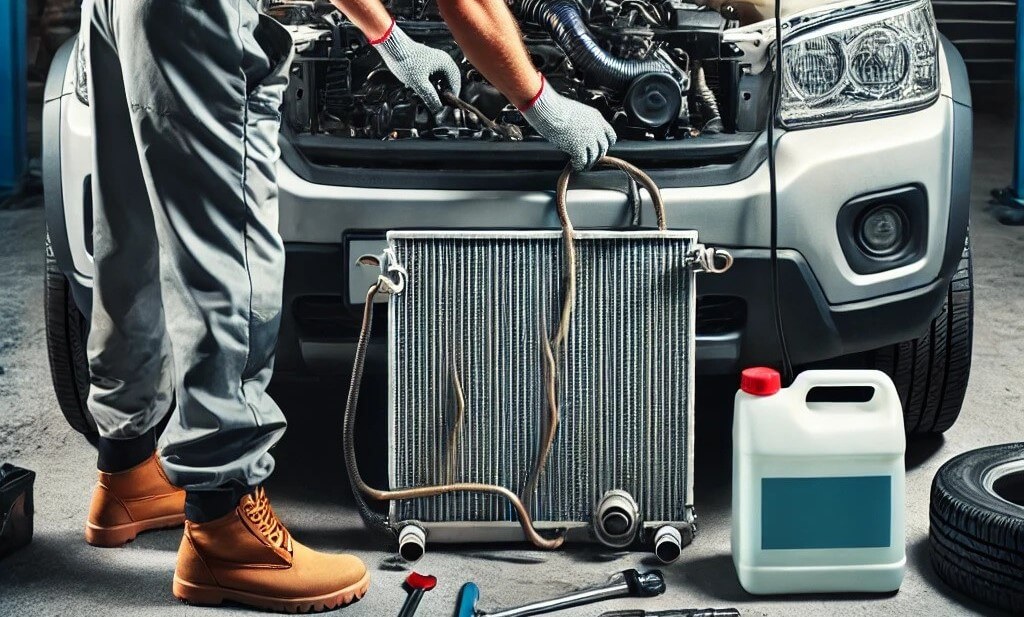
The radiator is a heat exchanger that removes heat from coolant before it returns to the engine. It consists of a network of thin tubes — usually aluminum or copper — with aluminum fins bonded to the outside.
Coolant enters the radiator hot from the engine, flows through the tubes, and exits cooled. Air flowing through the grille and radiator fins absorbs the heat. Modern radiators are crossflow designs (coolant flows horizontally) or downflow designs (coolant flows vertically). Crossflow radiators are more efficient and fit better in modern low-hood vehicles.
Inside the tubes, turbulence generators called turbulators disrupt laminar flow, ensuring coolant mixes continuously and transfers heat more efficiently to the tube walls.
The Radiator Fan (Airflow When You Need It)
At highway speeds, ram air through the grille provides enough airflow. At idle or low speed, the electric radiator fan pulls air through the radiator. The fan is controlled by a temperature switch or the engine computer, typically activating around 200 degrees Fahrenheit.
Some trucks and older cars use mechanical fans with a viscous clutch that slips at high RPM to reduce noise and drag. The clutch contains silicone fluid that thickens with heat, engaging the fan when needed and freewheeling when not.
A failed fan motor, blown fuse, or faulty temperature switch causes overheating in traffic that clears up on the highway — a classic diagnostic clue.
The Radiator Cap (Why Pressure Matters)
The radiator cap is the system’s pressure regulator and safety valve. It maintains pressure in the cooling system, which raises the coolant’s boiling point and prevents steam pockets that would stop heat transfer.
Here’s the physics: water boils at 212 degrees Fahrenheit at sea level. A 50/50 mix of antifreeze and water boils at about 223 degrees. But under pressure, the boiling point rises by roughly 3 degrees Fahrenheit for every pound per square inch (psi). A standard 15-psi radiator cap raises the boiling point by 45 degrees, to about 268 degrees Fahrenheit.
This pressure allows the engine to run hotter — and more efficiently — without boiling over. The cap also has a vacuum valve that opens when the engine cools, preventing collapse of hoses and allowing coolant to be drawn back from the overflow tank.
Never remove a hot radiator cap. The sudden pressure release can spray boiling coolant and cause severe burns.
The Heater Core (Cabin Heat Is Engine Heat)
The heater core is a small radiator mounted inside the dashboard. Hot coolant flows through it, and a blower fan pushes cabin air across the fins. The air absorbs heat and warms the interior.
The heater core is part of the cooling system, not a separate system. When you turn on the heater, you’re actually helping cool the engine slightly by adding another heat exchanger. In an overheating emergency, turning the heater to full blast and the fan to high can help draw heat away from the engine — a useful temporary measure.
A leaking heater core causes sweet-smelling fog on the windshield, wet carpets, and coolant loss with no visible external leak.
The Overflow/Expansion Tank (Where Excess Goes)
As coolant heats, it expands. The overflow tank — also called an expansion tank or reservoir — catches the excess that would otherwise vent to the ground. When the engine cools, a vacuum draws the coolant back into the radiator.
Modern sealed systems use a pressurized expansion tank as part of the system, not just an overflow catch. The tank maintains the proper coolant level and allows for thermal expansion without air entering the system.
Why Pressure Matters: The Pressure Cooker Principle
Your kitchen pressure cooker works on the same principle as your car’s cooling system. Seal water in a pot, heat it, and pressure builds. That pressure raises the boiling point, allowing food to cook hotter and faster.
In your car, the radiator cap seals the system. As coolant heats and expands, pressure builds to the cap’s rated limit — typically 15 to 16 psi for most vehicles, though some modern cars use up to 22 psi. At 22 psi, the boiling point rises to over 285 degrees Fahrenheit.
Higher pressure means higher boiling point, which means higher operating temperature, which means greater temperature difference between coolant and ambient air — and more efficient heat transfer.
But there’s a limit. Too much pressure blows hoses, ruptures the radiator, or damages gaskets. The radiator cap is designed to be the system’s weak point, venting excess pressure safely to the overflow tank rather than letting something else fail.
Altitude matters too. At 5,000 feet above sea level, atmospheric pressure is lower and water boils at 203 degrees instead of 212. The cooling system has less ambient pressure working against it, so the pressure cap’s effect is slightly reduced. This is why engines may run hotter in the mountains.
Coolant Types: Green, Orange, Yellow, and Blue
Not all coolants are the same. Using the wrong type — or mixing types — can cause sludge, corrosion, and cooling system failure.
Table
| Type | Color | Technology | Service Life | Best For |
|---|---|---|---|---|
| IAT | Green | Inorganic silicates/phosphates | 2–3 years / 30,000 miles | Older vehicles, cast iron engines |
| OAT | Orange | Organic acids only | 5–10 years / 100,000+ miles | Modern vehicles, aluminum engines |
| HOAT | Yellow | Hybrid (organic + some silicates) | 5 years / 100,000+ miles | Ford, Chrysler, European vehicles |
| P-HOAT | Pink/Blue | Phosphated hybrid | 5 years / 100,000+ miles | Asian vehicles (Toyota, Honda, Subaru) |
| Si-HOAT | Purple | Silicated hybrid | 5 years / 100,000+ miles | European vehicles (BMW, VW, Mercedes) |
IAT (Inorganic Additive Technology) is the traditional green coolant. It contains silicates and phosphates that protect cast iron and copper components. It works well but degrades quickly — the additives deplete in 2 to 3 years. Silicates can also form scale in aluminum engines.
OAT (Organic Acid Technology) was introduced by GM as Dexcool in the mid-1990s. It uses organic acids for corrosion protection without silicates or phosphates. It lasts much longer but can cause gasket damage in systems not designed for it. The infamous “Dexcool sludge” was usually caused by mixing OAT with IAT, not by OAT itself.
HOAT (Hybrid Organic Acid Technology) combines the best of both worlds — long life with added silicate protection for aluminum. Most modern vehicles use some form of HOAT.
Never mix coolant types. Mixing IAT and OAT creates a chemical reaction that produces brown sludge, reduces corrosion protection, and can clog the radiator. If you’re unsure what’s in your system, flush it completely before switching types.
Always use distilled or deionized water when mixing coolant. Tap water contains minerals that cause scale and corrosion.

Warning Signs Your Cooling System Is Failing
Cooling system problems don’t hide. They announce themselves with distinct symptoms that worsen over time.
Temperature Gauge in the Red Zone
This is your first and most obvious warning. Modern gauges are calibrated so that the middle of the range is normal operating temperature — usually 180 to 220 degrees Fahrenheit. When the needle climbs toward the red zone or the temperature warning light comes on, the system is no longer maintaining safe temperatures.
Steam or Smoke From Under the Hood
White steam rising from under the hood means coolant is boiling and escaping — usually from a leak, a failed radiator cap, or severe overheating. Dark smoke suggests burning oil or plastic, which is a different problem entirely. Either way, stop immediately.
Sweet Syrupy Smell
Coolant has a distinctive sweet, syrupy odor. If you smell it inside or outside the car, you have a leak. Check under the car for puddles, inspect hoses for wetness, and look for crusty white or green residue around connections — dried coolant leaves a telltale stain.
Coolant Puddles Under the Car
A bright green, orange, or pink puddle under the engine bay is a coolant leak. Common sources include radiator hoses, the water pump weep hole, the radiator itself, and the heater core. A leaking head gasket can also push coolant into the oil or combustion chambers, though this won’t leave external puddles.
Heater Blows Cold Air
If the cabin heater blows cold when the engine is warm, you may have low coolant, a stuck-open thermostat, or a clogged heater core. The heater core is the first place to lose flow when coolant level drops because it’s physically higher than the engine.
Engine Running Rough or Losing Power
Severe overheating causes the engine computer to enter “limp mode” — a protective state that reduces power to prevent damage. You may also hear knocking or pinging as hot spots in the combustion chamber cause premature ignition of the air-fuel mixture.
Emergency Guide: What to Do When Your Car Overheats
If your temperature gauge spikes or steam appears, act fast. Every minute of overheating increases the risk of warped cylinder heads, blown head gaskets, or complete engine failure.
Do this immediately:
- Turn off the air conditioning. The A/C condenser adds heat load in front of the radiator.
- Turn on the heater to full blast. This routes coolant through the heater core and adds another heat exchanger to help cool the engine.
- Pull over safely as soon as possible. Turn off the engine and let it idle for 30 seconds to allow coolant circulation to stop gradually.
- Open the hood from inside the car if possible. Do not touch the hood itself — it may be extremely hot.
- Wait at least 30 minutes before opening the radiator cap or touching any components. Boiling coolant under pressure can cause severe burns.
Do NOT do this:
- Do not open the radiator cap while hot. Pressure release can spray boiling coolant.
- Do not add cold water to a hot engine. The thermal shock can crack the cylinder head or block.
- Do not continue driving with the temperature gauge in the red. A few miles can destroy the engine.
- Do not pour water into the overflow tank if you don’t know the coolant type. Mixing incompatible coolants causes sludge.
When to call a tow:
- If coolant is leaking rapidly and you can’t identify the source
- If the engine won’t restart after cooling
- If you see coolant in the oil (milky dipstick) or white exhaust smoke (head gasket failure)
- If you’re unsure of the problem and far from help

Can You Maintain the Cooling System Yourself?
Some cooling system maintenance is genuinely DIY-friendly. Other jobs require expertise and special tools.
DIY-friendly:
- Checking and topping off coolant in the overflow tank
- Inspecting hoses for cracks, swelling, or soft spots
- Checking the radiator cap seal and spring
- Pressure-washing debris from the radiator fins
- Replacing the thermostat (on most vehicles)
- Flushing the cooling system with a garden hose and flush kit
Mechanic territory:
- Pressure testing for hidden leaks
- Replacing the water pump (often requires timing belt removal)
- Replacing the radiator (may require AC condenser removal)
- Diagnosing head gasket failure
- Repairing heater core leaks (requires dashboard removal)
Tools you’ll need for DIY: Socket set, screwdrivers, pliers, drain pan, distilled water, correct coolant type, hose clamp pliers, and a cooling system pressure tester (available for loan at most auto parts stores).
Safety note: Coolant is toxic to humans and pets. It has a sweet taste that attracts animals, but even small amounts can be fatal. Always collect drained coolant in a sealed container and recycle it properly. Never pour it down drains or onto the ground.
How Much Does Cooling System Work Cost?
Table
| Service | DIY Cost | Professional Cost |
|---|---|---|
| Coolant top-off | $15–$30 | $25–$50 |
| Cooling system flush | $30–$60 (kit + coolant) | $100–$200 |
| Thermostat replacement | $20–$60 (part) | $150–$350 |
| Radiator hose replacement | $20–$80 (part) | $100–$300 |
| Water pump replacement | $50–$200 (part) | $300–$750 |
| Radiator replacement | $150–$400 (part) | $400–$900 |
| Heater core replacement | $50–$150 (part) | $500–$1,200 |
| Head gasket repair | N/A | $1,500–$3,000+ |
Costs vary dramatically by vehicle. A simple four-cylinder economy car has an accessible thermostat and inexpensive radiator. A luxury SUV with a rear heater, complex hose routing, and buried water pump can cost three times as much. Head gasket repair is the nightmare scenario — it requires removing the cylinder head, machining it flat, and replacing the gasket, often costing more than the car is worth on older vehicles.
FAQs About – How the Car Engine Cooling System Works
What does the cooling system do?
The cooling system maintains the engine at its optimal operating temperature by circulating coolant through the engine block and radiator, transferring heat from combustion and friction into the atmosphere.
How does a radiator work?
A radiator works as a heat exchanger. Hot coolant flows through thin tubes with aluminum fins. Air passing through the fins absorbs heat from the coolant, cooling it before it returns to the engine.
What does a thermostat do in a car?
The thermostat is a temperature-controlled valve that blocks coolant from reaching the radiator until the engine warms up. Once warm, it opens to allow coolant flow to the radiator for cooling, maintaining steady operating temperature.
How does a water pump work?
The water pump is a centrifugal pump driven by the engine belt. An impeller inside spins, flinging coolant outward and creating suction that draws cooled coolant from the radiator and pushes it through the engine.
Why is the cooling system pressurized?
Pressure raises the boiling point of coolant. A 15-psi radiator cap increases the boiling point from 223°F to about 268°F, allowing the engine to run hotter and more efficiently without boiling over.
The Bottom Line
Your cooling system is the silent guardian of your engine. It manages thousands of degrees of combustion heat, maintains precise operating temperature across all conditions, and does it all with simple physics — conduction, convection, and a bit of pressure.
The key components are straightforward: the water pump moves coolant, the thermostat controls temperature, the radiator sheds heat, and the radiator cap maintains pressure. Coolant does double duty as a heat transfer medium and corrosion protector. The heater core even warms your cabin using engine heat that would otherwise be wasted.
When the system fails, it fails loudly — steam, warning lights, and temperature gauges give you clear signals. The critical mistake is ignoring them. A $20 thermostat or $30 hose can become a $3,000 head gasket job if you keep driving while overheating.
Quick Summary:
- The cooling system maintains 180–220°F operating temperature by circulating coolant
- Heat path: combustion chamber → engine block → coolant → radiator → ambient air
- Key components: water pump, thermostat, radiator, radiator cap, fan, heater core, overflow tank
- Pressure raises boiling point: 15 psi cap = ~268°F boiling point for 50/50 coolant
- Coolant types: IAT (green, 2–3 years), OAT (orange, 5–10 years), HOAT (yellow, 5+ years)
- Warning signs: red temperature gauge, steam, sweet smell, coolant puddles, cold heater
- Emergency: pull over, turn off engine, wait 30 minutes, never open hot cap
- Maintenance costs: flush $100–$200, thermostat $150–$350, water pump $300–$750, head gasket $1,500–$3,000+
Check your coolant level monthly, inspect hoses for wear at every oil change, and address temperature warnings immediately. A few minutes of prevention saves hours of expensive repairs — and keeps you from standing on the roadside watching your car steam.