
This article was updated in June 2, 2026 with new products and information by Mark S. Taylor
You turn on the heat and something smells sweet — almost like candy or maple syrup, but with a slightly chemical edge. Or you notice a faint film on the inside of the windshield that keeps coming back no matter how many times you clean it. Or the passenger floor carpet feels damp and there’s no obvious reason why.
All of these point to the same problem: coolant is getting into the passenger cabin. And while the sweet smell seems harmless, it isn’t something to ignore.
This guide covers every cause of coolant smell inside the car, the health risks you need to know about, how to find the source yourself, and what it costs to fix — from the cheapest check to the most involved repair.
Contents
- 1 Is Coolant Smell Inside the Car Dangerous?
- 2 What Does Coolant Smell Like Inside a Car?
- 3 Why the Smell Is Stronger When Heat Is On
- 4 6 Causes of Coolant Smell Inside the Car Cabin
- 5 The Windshield Film — The First Sign Most Drivers Miss
- 6 How to Confirm It Is Coolant and Find the Source
- 7 Heater Core Bypass — The Temporary Fix
- 8 Is It Safe to Drive With Coolant Smell in the Cabin?
- 9 Repair Cost Summary
- 10 FAQs About Coolant Smell Inside Car Cabin
- 10.1 Why does my car smell like coolant inside when the heat is on?
- 10.2 Is coolant smell inside a car dangerous?
- 10.3 Can a heater core leak without making the floor wet?
- 10.4 How do I know if my heater core is leaking?
- 10.5 How much does heater core replacement cost?
- 10.6 Can I use a stop-leak product to fix a heater core leak?
- 11 The Bottom Line
Is Coolant Smell Inside the Car Dangerous?
Yes — take it seriously.
Most automotive coolant contains ethylene glycol — a compound that is toxic to humans and animals when ingested or inhaled in significant concentrations. Ethylene glycol vapor inside a closed car cabin raises legitimate health concerns, particularly for children, elderly passengers, and anyone with respiratory conditions.
Short-term exposure to low concentrations of coolant vapor — an occasional brief whiff — is unlikely to cause acute harm in healthy adults. But regular daily exposure in a closed cabin, particularly during long commutes in winter with the heat running, means breathing coolant vapor for hours at a time.
Symptoms of ethylene glycol vapor exposure include headache, dizziness, nausea, and eye or throat irritation. These symptoms are easy to dismiss as tiredness or a cold — which is why coolant smell in the cabin often goes unaddressed for weeks or months.
Children and pets are significantly more vulnerable. A child riding daily in a car with a leaking heater core is exposed to cumulative coolant vapor at a level that deserves urgent attention.
The practical guidance: Don’t wait. Open windows when driving if you smell coolant, and prioritize finding and fixing the source. In the meantime, avoid running the heat on recirculation mode — fresh air mode dilutes any cabin contamination more effectively.
What Does Coolant Smell Like Inside a Car?
Identifying the smell correctly is the first diagnostic step.
Coolant has a distinctive sweet smell — often described as similar to maple syrup, candy, or a slightly chemical sweetness. It’s noticeably different from gasoline, burning oil, or exhaust. Many drivers describe it as pleasant at first — which is why it gets ignored longer than it should.
Variations in the smell:
- Sweet and slightly chemical — fresh coolant vapor, most common with a small heater core leak
- Sweet and slightly burnt — coolant that has contacted a hot engine component outside the cabin
- Stale, musty sweetness — coolant that has soaked into carpet or foam insulation and is evaporating slowly
- Sharp chemical smell — coolant that has degraded or mixed with other fluids
If the sweet smell appears specifically when the heat or defrost is turned on and diminishes when you switch to AC or outside air only — coolant is almost certainly the source and the heater core is the most likely location.

Why the Smell Is Stronger When Heat Is On
This is one of the most important diagnostic clues — and almost no online guides explain it.
The heater core is a small heat exchanger mounted inside the dashboard. Hot coolant from the engine circulates through it. When you turn the heat on, the blower motor forces cabin air across the heater core fins, which warms the air and sends it into the cabin. If the heater core has any leak — even a pinhole that produces vapor rather than liquid — the moving air picks up coolant vapor from the hot core surface and carries it directly into the cabin through the vents.
When you switch to AC, cold refrigerant rather than hot coolant is the heat exchange medium. The heater core is bypassed or has no hot coolant flowing through it at high pressure. Any pinhole leak is less active, and the blower is moving air across a cooler surface — producing less vapor. The smell diminishes or disappears entirely.
The diagnostic rule: Sweet smell with heat on, no smell with AC only = heater core is the most probable cause. Sweet smell regardless of heat or AC setting = coolant is entering the HVAC system from somewhere other than the heater core itself — possibly an external leak near the fresh air intake.
6 Causes of Coolant Smell Inside the Car Cabin
1. Leaking Heater Core — Liquid Leak
This is the most common cause by a significant margin.
The heater core develops pinhole leaks or seam failures over time from corrosion, electrolysis, or physical vibration damage. When the leak is large enough to produce liquid coolant rather than just vapor, coolant drips or seeps from the heater core housing into the HVAC box beneath the dashboard.
From there it follows two paths: it soaks into the cabin air flowing through the HVAC box — creating strong coolant vapor that exits the vents — and it slowly drains onto the passenger floor through the HVAC housing drain or by direct seepage.
What it feels like and looks like:
- Sweet smell from the vents — strongest with heat on
- Wet or damp passenger side floor carpet
- Coolant level dropping without visible external leak
- Fogged windshield from the inside
- Oily film on the interior windshield glass
- Possible coolant staining on the carpet — white or crystalline residue after it dries
The wet floor test: Press firmly on the passenger floor carpet. If it feels damp, squishy, or you can wring coolant from it — you have a liquid heater core leak. The carpet absorbs coolant that has pooled inside the HVAC housing.
Urgency: High. A liquid-leaking heater core causes ongoing coolant loss, health risk from vapor, and potential electrical damage if coolant reaches wiring beneath the carpet.
Repair cost: $500–$1,200 (heater core replacement — labor intensive due to full dashboard removal on most vehicles)
2. Leaking Heater Core — Vapor Only (No Wet Floor)
This is the scenario that confuses most drivers and that almost no guide covers.
A very small heater core leak — a pinhole perforation or a microscopic seam failure — may not produce enough liquid coolant to wet the carpet. Instead, hot coolant under pressure heats the leak point and the coolant exits as vapor rather than liquid. The vapor is then picked up by the blower and distributed through the vents.
What makes this hard to find:
- No wet floor
- No visible coolant dripping
- Coolant level may drop only slowly — a few millimeters per week
- The HVAC housing looks dry when inspected
What does appear:
- Persistent sweet smell from the vents when heat is on
- A very thin oily or slightly greasy film on the interior windshield that returns within days of cleaning
- Possible slight fogging of the windshield from inside on cold mornings
This film is the key diagnostic clue. Clean the interior windshield thoroughly with glass cleaner. If a thin, slightly oily film returns within 3–5 days — particularly along the bottom edge of the windshield near the defroster vents — coolant vapor from the heater core is condensing on the glass. Run your fingertip across the film — it should feel very slightly slick and smell faintly sweet.
Urgency: High. Even without a wet floor, coolant vapor is being breathed by occupants continuously.
Repair cost: $500–$1,200 (heater core replacement)
3. Coolant Leak Near the HVAC Fresh Air Intake
Every car has a fresh air intake — typically located at the base of the windshield under the cowl panel — that draws outside air into the HVAC system. If there is a coolant leak anywhere near this intake, the escaping coolant vapor or steam gets drawn directly into the cabin air supply.
Common leak sources near the intake area:
- Upper radiator hose connections
- Thermostat housing on some engine layouts
- Heater hose connections at the firewall
- Any fitting or connection on the top of the engine near the cowl area
What distinguishes this from a heater core leak: The smell appears even when the heat is off and the fan is on fresh air mode — because outside air containing coolant vapor is being drawn in. It may also be present when the car is first started cold, before the heater core reaches operating temperature.
How to check: With the engine running and warm, open the hood and look for steam, wetness, or white residue near the firewall and cowl area. Any coolant seeping near the fresh air intake area will be drawn into the cabin.
Urgency: Medium-high. The coolant leak itself needs repair regardless of the cabin smell.
Repair cost: $50–$600 depending on the specific leak source (hose, gasket, or fitting)
4. Contaminated Cabin Air Filter
The cabin air filter cleans the air entering the HVAC system from outside. On vehicles where a heater core vapor leak has been present for weeks or months, the cabin air filter can become saturated with coolant residue. Even after the heater core leak is repaired, the contaminated filter continues releasing coolant smell into the cabin.
What it feels like: Sweet smell that persists even after the heater core has been repaired or inspected and found to be functioning. The smell may be weaker than before the repair but doesn’t fully disappear.
Where the filter is: Most cabin air filters are accessible behind the glove box or under the dashboard. Consult the owner’s manual for the exact location.
How to check: Remove the cabin air filter and smell it directly. A filter contaminated with coolant vapor will have a distinct sweet smell. It may also appear slightly discolored or have a faint oily residue.
The fix: Replace the cabin air filter — a simple DIY task. A new filter costs $15–$40 depending on the vehicle.
Urgency: Low once the source is repaired. But if the filter is contaminated, replacing it is essential — a saturated filter continues exposing occupants to coolant residue even after the leak is fixed.
Repair cost: $15–$40 (DIY filter replacement)
5. Heater Hose Leaking Near the Firewall
Two heater hoses run through the firewall — one carries hot coolant from the engine into the heater core, and one returns cooled coolant back to the engine. These hoses pass through rubber grommets in the firewall. When the hoses develop cracks or the firewall grommets deteriorate, coolant can seep along the hose and into the cabin through the grommet gap.
What it feels like: A coolant smell that comes from low in the dashboard rather than from the vents specifically. It may be more noticeable on the passenger side near the floor. The smell can appear even without the heat being on because the hoses carry coolant whenever the engine is running.
How to check: From inside the car, look under the passenger side dashboard where the heater hoses enter through the firewall. Any wetness, crystalline white residue, or coolant staining around the grommet indicates a seeping hose connection.
From outside: With the engine off and cool, inspect the heater hose connections at the firewall. Squeeze the hoses — brittle, hardened, or cracked rubber indicates age-related failure. Look for coolant residue or dried white staining around the grommet.
Urgency: Medium-high. A leaking heater hose can fail completely and cause rapid coolant loss and overheating.
Repair cost: $80–$250 (heater hose replacement, parts and labor)
6. Residual Smell After Coolant System Work
If the vehicle recently had cooling system service — a coolant flush, hose replacement, heater core repair, or thermostat replacement — and a sweet smell appeared shortly afterward, spilled coolant is likely the cause.
Coolant that drips onto engine components during service — particularly on the exhaust manifold, heat shields, or hot engine surfaces — burns off slowly over the first few drives, producing a sweet smell that can enter the cabin through the fresh air intake or simply be noticeable with the windows down.
What it feels like: Sweet smell that appeared after a specific service visit and has been gradually fading. No wet floor, no windshield film, no coolant level drop. The smell is present outside the car as well as inside.
How long it lasts: Typically resolves within 3–5 days of normal driving as spilled coolant burns off the hot engine surfaces. If the smell persists beyond a week after cooling system service, ask the shop to inspect for a coolant leak that may have been introduced during the service.
Urgency: Low if improving. Medium if not improving after one week.
Repair cost: $0 (burns off naturally) or shop inspection cost if a new leak is suspected
The Windshield Film — The First Sign Most Drivers Miss
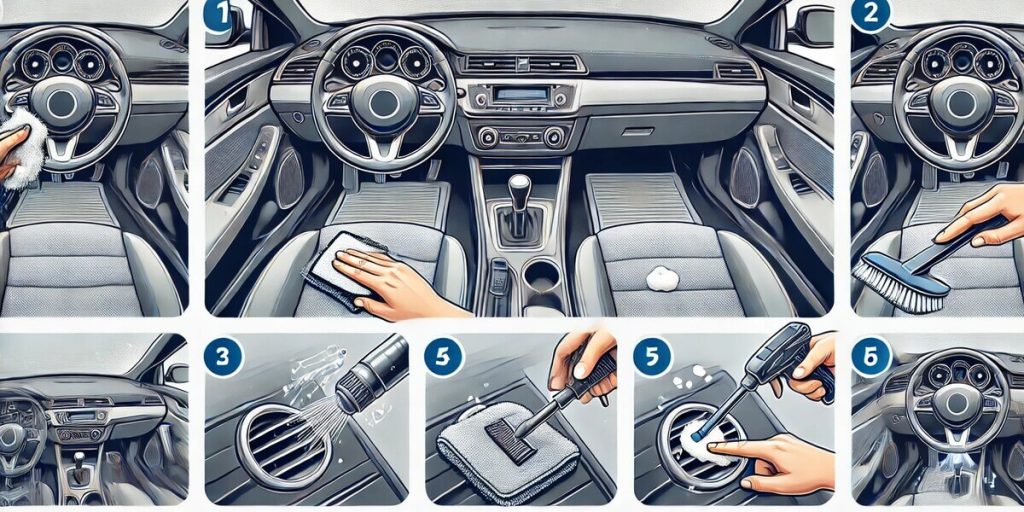
Before the smell becomes obvious, before the carpet gets wet, there is often one earlier sign that almost every driver overlooks: a thin, slightly oily film on the inside of the windshield.
Coolant vapor from a small heater core leak is carried through the vents and into the cabin. As the warm vapor contacts the cooler windshield glass, it condenses into a microscopically thin film. This film has several distinctive properties:
- It is slightly slick to the touch — not just dusty like normal interior film
- It has a faint sweet smell when you put your face close to the glass
- It causes the windshield to fog more easily from the inside in cold or humid weather
- It is more prominent along the bottom edge of the windshield near the defroster vent outlets
- It returns within days of cleaning, even with good glass cleaner
The test: Clean the interior windshield completely. Wait 3–5 days without cleaning it again. Examine the glass in sunlight or with a flashlight held at an angle. A coolant film appears as an irregular, slightly greasy haze rather than the uniform dust film of normal interior condensation.
Run your fingertip across a suspicious area. Coolant film leaves a very faintly slick residue that isn’t present on normal dusty glass. This test has identified countless heater core leaks before any other symptom was obvious enough to prompt a diagnosis.
How to Confirm It Is Coolant and Find the Source
Work through these steps in order before spending money at a shop:
- Identify the smell pattern. Does the sweet smell appear only when the heat is on? Only when first starting cold? Regardless of heat or AC setting? This narrows the cause significantly as described earlier.
- Check the windshield interior. Clean it completely and check for the return of an oily film within 3–5 days. Film on the lower windshield area = heater core vapor leak.
- Check the passenger floor. Press firmly on the passenger side floor carpet. Any dampness, squishiness, or sweet smell from the carpet confirms a liquid heater core leak.
- Check coolant level. Check the coolant reservoir level and mark it with a piece of tape. Check again after 3–5 days of normal driving without topping up. Any drop indicates coolant is going somewhere internally.
- Inspect the cabin air filter. Remove and smell the filter. If it smells of coolant, the leak has been ongoing long enough to saturate the filter.
- Inspect heater hoses at the firewall. Look inside the car under the passenger dashboard for any wetness or residue around where the heater hoses enter through the firewall.
- Inspect under the hood near the firewall. Look for coolant seepage, steam, or white residue near the firewall, heater hose connections, and the fresh air intake cowl area.

Heater Core Bypass — The Temporary Fix
If the heater core is confirmed as leaking and full replacement is not immediately possible — due to cost, parts availability, or scheduling — a heater core bypass is a viable temporary solution.
What it is: The two heater hoses that run to the heater core are disconnected at the firewall and connected to each other with a bypass fitting. Coolant no longer flows through the heater core at all — the heater core is effectively removed from the cooling circuit without physically removing it.
What it does: Immediately eliminates coolant smell in the cabin, stops coolant loss from the heater core leak, and prevents further carpet damage. The cooling system functions normally because the heater core is a small component that, when bypassed, doesn’t significantly affect engine temperature.
What it doesn’t do: You lose cabin heat entirely. The defroster (which uses hot air for glass defrost) also stops working. On vehicles in cold climates, this makes the bypass a genuinely temporary measure rather than a long-term solution.
Cost: $50–$150 (parts and labor for a bypass fitting installation) versus $500–$1,200 for full heater core replacement. In summer months or mild climates, some owners bypass the heater core and postpone full replacement until a more convenient time.
Is It Safe to Drive With Coolant Smell in the Cabin?
| Situation | Safe to Drive? | Action |
|---|---|---|
| Faint smell, heat on, no other symptoms | Short term with windows cracked | Diagnose within a week |
| Sweet smell with windshield film | Caution | Diagnose within a few days |
| Wet passenger floor confirmed | No — health and electrical risk | Fix immediately |
| Strong smell, dizziness or headache | No | Stop driving, ventilate, diagnose immediately |
| Children or pets regularly in car | No | Fix before carrying passengers |
| Coolant level dropping alongside smell | No | Fix immediately — combined leak risk |
| Residual smell after cooling system work, improving | Yes | Monitor for one week |
The key rule: Open the windows whenever the smell is present. The health risk from coolant vapor is real and cumulative. Diluting the cabin air with fresh outside air reduces exposure while you arrange diagnosis and repair.

Repair Cost Summary
| Repair | DIY Friendly? | Average Cost |
|---|---|---|
| Cabin air filter replacement | Yes | $15–$40 |
| Heater hose inspection and clamp tightening | Yes | $0–$30 |
| Heater hose replacement | Intermediate | $80–$250 |
| Cooling system leak inspection (shop) | No | $80–$150 |
| Heater core bypass (temporary) | Intermediate | $50–$150 |
| Heater core replacement — compact car | Mechanic only | $500–$900 |
| Heater core replacement — midsize sedan or SUV | Mechanic only | $700–$1,200 |
| Heater core replacement — truck or large SUV | Mechanic only | $900–$1,500 |
| Carpet and insulation drying and treatment | Mechanic/detailer | $100–$400 |
Note on heater core labor: Heater core replacement is one of the most labor-intensive repairs in automotive service. The heater core is mounted deep inside the dashboard, often requiring complete dashboard removal to access. Labor alone accounts for 70–80% of the total cost on most vehicles. Some vehicles — particularly older trucks and SUVs — have more accessible heater cores that cost less to replace.
FAQs About Coolant Smell Inside Car Cabin
Why does my car smell like coolant inside when the heat is on?
The most common cause is a leaking heater core — the small heat exchanger inside the dashboard that uses hot coolant to warm cabin air. When the heater core develops a leak, the blower motor carries coolant vapor directly from the core through the vents and into the cabin. The smell is strongest when heat is on because hot coolant is actively flowing through the core under pressure, maximizing vapor production.
Is coolant smell inside a car dangerous?
Yes. Most automotive coolant contains ethylene glycol, which is toxic when inhaled regularly. Brief occasional exposure in healthy adults causes minimal risk, but daily exposure during commutes — especially in a closed car in winter with the heat running — causes headache, dizziness, nausea, and eye or throat irritation over time. Children and pets are significantly more vulnerable. Open windows and fix the source promptly.
Can a heater core leak without making the floor wet?
Yes. A very small heater core perforation may produce vapor rather than liquid, particularly when the system is under normal operating pressure and the leak point is hot. The vapor is picked up by the blower and exits through the vents without producing enough liquid to wet the carpet. The windshield interior film is the most reliable early sign of a vapor-only heater core leak.
How do I know if my heater core is leaking?
The clearest signs are a sweet smell from the vents when heat is on, a thin oily film on the interior windshield that returns after cleaning, wet or damp passenger floor carpet, and a gradually dropping coolant level with no external leak. A shop can confirm with a cooling system pressure test — a leaking heater core causes the system to lose pressure with no visible external leak.
How much does heater core replacement cost?
Heater core replacement typically costs $500–$1,200 for most passenger cars and $700–$1,500 for trucks and SUVs. The part itself is usually $100–$300 — the majority of the cost is labor, as the heater core requires full or partial dashboard removal to access on most modern vehicles.
Can I use a stop-leak product to fix a heater core leak?
Stop-leak products are a temporary measure and not recommended as a primary solution for heater core leaks. They can work on very small pinhole leaks for a period of time, but they also risk clogging other cooling system passages including the radiator and water pump. If stop-leak is used, plan for proper heater core replacement at the next opportunity.
The Bottom Line
A coolant smell inside the car cabin is one of those symptoms that’s easy to dismiss — it smells almost pleasant, after all. But the sweet smell means coolant is entering the air you and your passengers breathe every time you drive. The heater core is responsible in the vast majority of cases, and a vapor-only leak with no wet floor is just as real a problem as one that soaks the carpet.
The windshield interior film test is the most underused diagnostic tool available — clean the glass, wait five days, and check if an oily film returns. If it does, you have your answer before spending a dollar at a shop.
Quick Summary:
- Coolant smell inside the cabin is a health concern — ethylene glycol vapor is toxic with regular exposure
- The heater core is the most common cause — both liquid leaks and vapor-only pinhole leaks
- Smell stronger with heat on and absent with AC = heater core is the source
- The interior windshield oily film is the earliest sign of a vapor-only heater core leak
- A wet passenger floor carpet confirms a liquid heater core leak
- A contaminated cabin air filter continues releasing coolant smell even after the source is repaired
- Open windows when the smell is present — dilutes vapor while awaiting repair
- Heater core bypass is a viable temporary fix that eliminates the smell and stops coolant loss
- Full heater core replacement costs $500–$1,500 — labor is 70–80% of the total cost