
This article was updated in August 15, 2026 with new products and information by Mark S. Taylor
Your alternator died. You’re standing at the parts counter — or scrolling on your phone — and you’ve narrowed it down to two options. The Duralast is $250 with a lifetime warranty at AutoZone. The Bosch is $350 and the counter guy says it’s “OE quality.” Now you’re doing the math: $100 difference, both have warranties, and you need the car running by tomorrow.
The real question isn’t which brand is better. It’s which product line within each brand, and what happens when it fails under warranty. A Duralast remanufactured alternator and a Duralast Gold new alternator are not the same thing. A Bosch reman and a Bosch Premium new are not the same thing. And a “lifetime” warranty that only covers the part — not the labor to install it — can turn a $250 alternator into a $500 headache.
In this guide, I’ll break down who actually makes these units, what the warranty really covers, what mechanics see come back failed, and how to buy the right one for your car and your budget. I’ve been installing alternators for 20 years. I’ve seen the same customer twice in six months — and I’ve seen a Bosch go 200,000 miles without a hiccup.
Contents
Who Makes These Alternators?
Here’s the supply chain reality that parts stores don’t advertise.
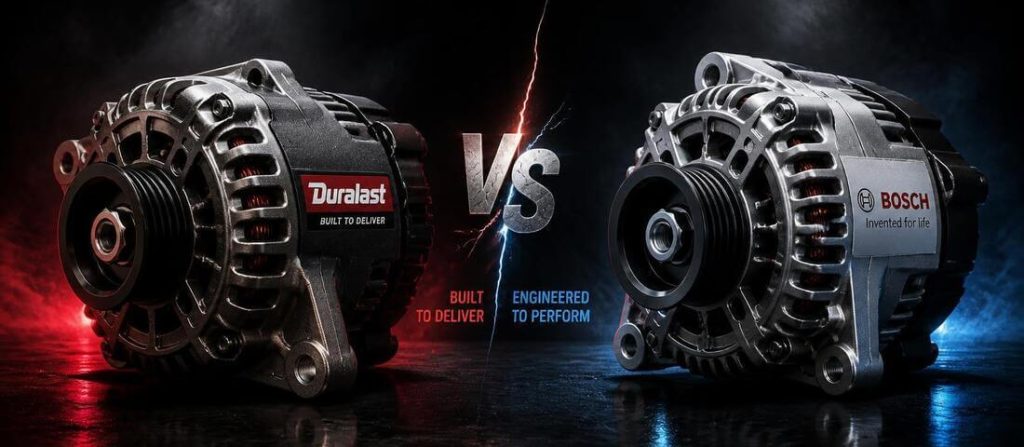
Duralast is AutoZone’s house brand. The remanufactured units are built by third-party rebuilders to AutoZone’s spec. The “Gold” new units are also sourced from overseas manufacturers — mostly China and Mexico — and branded with the Duralast name. AutoZone claims their remans are “triple tested,” and they do offer up to $100 in labor reimbursement if a unit fails under warranty.
Bosch is one of the oldest OE alternator suppliers in the world. They’ve been building charging systems since 1913 and supply OEM equipment to Mercedes, BMW, VW, and many others. Their aftermarket line includes both remanufactured and 100% new units. The remans are built with more new components than typical rebuilds, and the new units are manufactured to the same spec as their OE products.
The uncomfortable truth: Many “new” alternators from both brands come from the same handful of overseas factories. The difference is in the remanufacturing process, the quality of the components that get replaced, and the end-of-line testing. Bosch generally holds their suppliers to a tighter tolerance. Duralast casts a wider net to hit price points.
Duralast Alternator: What You Get
Duralast sells two distinct product lines, and the gap between them is enormous.
Duralast Remanufactured
- Price: $210–$275 plus a $40–$50 refundable core charge
- Warranty: Limited Lifetime at AutoZone (parts only)
- What it is: Your old alternator’s case, pulley, and some internals cleaned up and fitted with new brushes, bearings, and a regulator. The diode pack may or may not be replaced.
- The reality: I see more Duralast remans come back within 12 months than any other brand. The failure modes are consistent — bearing noise, low output from a bad diode, or out-of-the-box grinding. Forum mechanics call them “Dura-doesn’t-last” for a reason. The lifetime warranty is real, but you’re the one doing the R&R when it fails.
- When to buy: Only if you’re broke, the car is easy to work on, and you can afford to do the job twice.
Duralast Gold (New)
- Price: $260–$350 plus core
- Warranty: Limited Lifetime at AutoZone (parts only)
- What it is: A 100% new unit with fresh windings, new bearings, new regulator, and new diode pack. Not a reman.
- The reality: Significantly better track record than the reman line. I’ve seen Gold units last 8–10 years and 150,000 miles. One owner on a Buick forum reported 9 years and 150k on a DLG before his first failure. If you’re buying Duralast, buy Gold.
- When to buy: Daily driver, budget-conscious, easy engine bay access, or you’re doing the work yourself.
Bosch Alternator: What You Get
Bosch also splits into reman and new lines, but the quality floor is higher across the board.
Bosch Remanufactured
- Price: $159–$350 plus core (varies by retailer)
- Warranty: 24 months at some retailers; lifetime at others (Advance Auto, NAPA)
- What it is: A remanufactured unit with more new parts than typical rebuilds. Bosch claims their remans use new bearings, regulators, and diode packs, with the case and stator tested and reused only if they meet spec.
- The reality: Better than Duralast reman, but still a reman. Failures happen — usually regulator or bearing issues after 3–4 years, not 3–4 months. The warranty terms vary wildly by seller. Amazon’s return window is 30 days; after that, you’re calling Bosch directly at 708-786-3504. Advance Auto and NAPA handle lifetime claims in-store.
- When to buy: Mid-range budget, you want better odds than Duralast reman, and you’re buying from a retailer with a real warranty process.
Bosch Premium (New)
- Price: $350–$720 plus core
- Warranty: Lifetime at authorized retailers (Advance Auto, NAPA)
- What it is: 100% new, built to OE spec. This is essentially the same alternator that left the Bosch factory heading for a Mercedes or BMW assembly line.
- The reality: This is the safest bet if you’re paying a shop to install it. A Bosch new unit on a BMW E46 is still going strong at 240,000 miles according to one forum owner. The higher upfront cost pays for itself when you factor in the labor you’d spend on a warranty replacement.
- When to buy: European cars, hard-to-reach alternators, you’re paying a shop $200+ in labor, or you plan to keep the car long-term.
Side-by-Side Comparison
Here’s everything in one view.
| Feature | Duralast Reman | Duralast Gold (New) | Bosch Reman | Bosch New |
|---|---|---|---|---|
| Price range | $210–$275 | $260–$350 | $159–$350 | $350–$720 |
| Core charge | $40–$50 | $40–$50 | $40–$80 | $40–$80 |
| Warranty | Limited Lifetime (parts only) | Limited Lifetime (parts only) | 24 mo–Lifetime (varies by seller) | Lifetime (authorized retailers) |
| Labor reimbursement | Up to $100 | Up to $100 | None (retailer-dependent) | None (retailer-dependent) |
| Origin | Third-party reman / China new | China / Mexico new | Bosch-spec reman / OE new | OE Bosch factory |
| Typical failure mode | Bearing noise, diode failure, grinding | Rare — regulator after 8+ years | Regulator, bearing after 3–4 years | Very rare |
| Mechanic trust level | Low | Moderate | Moderate-High | High |
The warranty trap: Duralast’s “Limited Lifetime” sounds generous, but it’s parts-only. If the alternator fails at 18 months, AutoZone hands you a new box — but you pay the $180–$286 in labor to R&R it yourself, or you pay the shop again. Bosch’s warranty through Advance Auto or NAPA is also parts-only in most cases, but the failure rate is lower, so you’re less likely to need it.
The Hidden Cost of a Warranty Claim
Let’s run the math on a common scenario. You need an alternator for a 2012 Honda Accord. Labor is $200 at your local shop.
Option A: Duralast Reman at $250
- Initial cost: $250 part + $200 labor = $450
- Fails at 18 months. You get a free part under warranty.
- Second install: $200 labor (no labor coverage from AutoZone beyond $100 reimbursement)
- Total cost over 2 years: $550–$650
Option B: Duralast Gold at $300
- Initial cost: $300 part + $200 labor = $500
- Lasts 7 years. No warranty claim.
- Total cost over 7 years: $500
Option C: Bosch New at $400
- Initial cost: $400 part + $200 labor = $600
- Lasts 10+ years. No warranty claim.
- Total cost over 10 years: $600
The lesson: On a vehicle with easy access where you DIY, the Duralast reman is a gamble that might pay off. On a vehicle where you’re paying $200+ in labor, the cheapest option is often the most expensive. The Bosch new or Duralast Gold new is the better value because you pay the labor once, not twice.
What Mechanics Actually See Come Back
I don’t care about brand loyalty. I care about what I see in my bay.
Duralast remanufactured: I see these back within 6–18 months more than any other brand. The pattern is consistent — customer installs it, it works for a while, then the bearing starts whining or the output drops to 12.8 volts. The “triple tested” claim is real at the factory, but remanufacturing is only as good as the core you start with. If the case is warped or the stator has internal shorts, new brushes won’t save it.
Duralast Gold: I rarely see these back. When I do, it’s usually after 8–10 years and the failure is a worn regulator — normal wear, not a defect.
Bosch reman: Occasional failures after 3–4 years. Usually regulator or bearing. The rate is lower than Duralast reman, and the failures are less dramatic. I don’t see out-of-the-box grinding or seized units.
Bosch new: Almost never. I’ve replaced Bosch new alternators that were 15+ years old and the car was being scrapped for other reasons. On modern cars with high electrical loads, the OE-spec regulators hold voltage better under load than aftermarket units.
One more thing: Before you walk out of any parts store with any alternator, have them put it on the test machine. A shocking number of “new” and reman units fail right out of the box. I’ve seen Duralast and Bosch both fail a bench test. The 5 minutes you spend at the counter will save you 2 hours of cursing in your driveway.
Which One Should You Buy? The Verdict Matrix
| Your Situation | Buy This | Why |
|---|---|---|
| Broke, easy DIY, beater car | Duralast Reman | Cheapest upfront. Lifetime warranty covers the part. You’re not out much if it fails. |
| Daily driver, DIY or cheap labor | Duralast Gold (New) | Best value. New internals, lifetime warranty, lower failure rate than reman. |
| Paying a shop $200+ in labor | Bosch New | Pay once for labor. OE quality means you likely never see me again for this problem. |
| European car (BMW, Mercedes, VW) | Bosch New or OE | Bosch is the OE supplier. Fitment and voltage regulation are exact. |
| Hard-to-reach alternator (transverse V6, etc.) | Bosch New | You do not want to do this job twice. The labor savings dwarf the parts difference. |
| Truck or high-output need | Bosch New or Duralast Gold | High electrical loads stress cheap regulators. Buy the better unit. |
FAQs About Duralast vs Bosch Alternator
Is Duralast really that bad?
The remanufactured line has a reputation for early failure that is deserved. The Gold (new) line is a completely different product and performs fine for most daily drivers. If you buy Duralast, buy Gold.
Does Bosch lifetime warranty actually work?
Yes, but the process depends on where you bought it. Advance Auto and NAPA handle lifetime claims in-store. Amazon only handles returns for 30 days; after that, you call Bosch directly at 708-786-3504. Buy from a brick-and-mortar retailer if warranty ease matters to you.
Should I buy remanufactured or new?
New, if you can afford it. Remans are built from used cores with unknown histories. A new unit starts with a fresh case, windings, and components. The price gap is often only $50–$100, and the peace of mind is worth it.
What is a core charge?
A refundable deposit — usually $40–$80 — that you get back when you return your old alternator. The old unit is rebuilt and resold. Don’t throw your old alternator in the trash; it’s worth money.
Will a shop install a part I bought myself?
Some will, some won’t. Shops make margin on parts. If you bring your own alternator, expect to pay full labor rate and get no warranty on the labor. Some shops refuse outright. Call ahead.
Bottom Line
If you’re doing the work yourself and the alternator is easy to reach, Duralast Gold new is the best value. It’s $50–$100 more than the reman, but the failure rate is dramatically lower and the warranty covers you if something goes wrong.
If you’re paying a shop $180–$300 in labor, buy the Bosch new unit. The $100–$150 premium over Duralast Gold is cheaper than doing the job twice. On European cars, Bosch is often the OE part anyway — buy what the factory bought.
And whatever you buy, have the parts store bench-test it before you leave. A 5-minute test at the counter beats a 2-hour R&R in your driveway when the “new” alternator is dead out of the box.