
This article was updated in August 14, 2026 with new products and information by Mark S. Taylor
You’ve heard the pitch: electric cars need almost no maintenance. No oil changes. No spark plugs. No transmission fluid. Just rotate the tires and fill the washer fluid. But you’ve also heard the counterarguments — EV tires are expensive, battery coolant is a hidden cost, and that 12V battery dies just like any other. So what’s the real number?
Electric cars cost roughly 40–50% less to maintain than comparable gas cars over their lifetime. Consumer Reports puts the lifetime gap at about $4,600 for an EV versus $9,200 for a gas car. The Department of Energy estimates scheduled EV maintenance at about $0.06 per mile versus $0.10 for gasoline. But “less” doesn’t mean “zero.” And the savings can shrink fast if you ignore the maintenance an EV actually still needs.
In this guide, I’ll show you exactly what a gas car needs that an EV doesn’t, what an EV still requires, what you’ll pay per year and per mile, and a 5-year service ledger that tracks every dollar. I’ve been working on both for two decades. The math is real — but so are the gotchas.
Contents
- 1 What Maintenance Does a Gas Car Need That an EV Doesn’t?
- 2 What Maintenance Does an EV Still Need?
- 3 The Real Numbers: Annual and Per-Mile Costs
- 4 5-Year Maintenance Ledger: EV vs. Gas Car
- 5 The Hidden Costs Nobody Talks About
- 6 Total Cost of Ownership: Maintenance + Fuel + Purchase Price
- 7 FAQs About Electric Cars vs Gas Cars Maintenance
- 8 Bottom Line
What Maintenance Does a Gas Car Need That an EV Doesn’t?
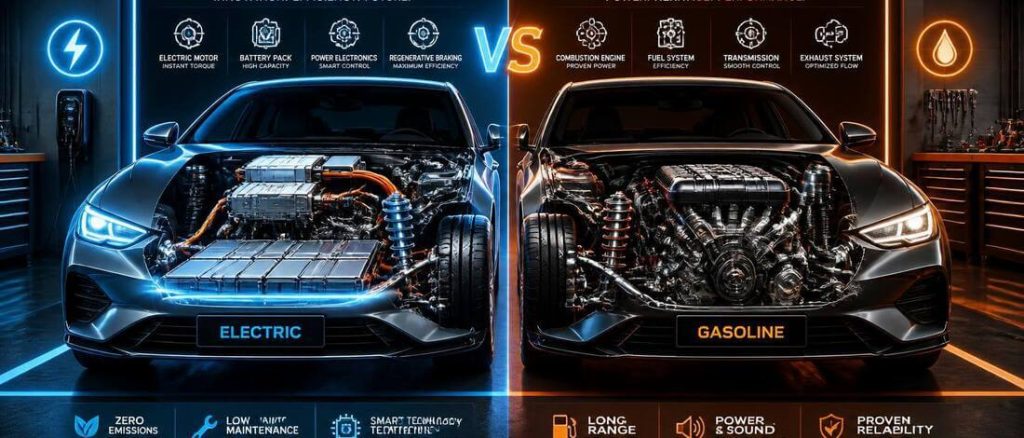
A typical gas engine has roughly 2,000 moving parts. An EV drivetrain has about 20. Every part that moves, heats, or rubs against another part eventually needs service, replacement, or fluid. That’s where the savings start.
Oil changes. Every 5,000–7,500 miles, $50–$80 a pop. Over 100,000 miles, that’s 13–20 oil changes and $650–$1,600 in oil alone.
Transmission fluid. Most automatics need a drain-and-fill every 30,000–60,000 miles at $150–$300. Some CVTs need it even sooner.
Spark plugs. Every 30,000–100,000 miles depending on the plug type. $150–$400 with labor.
Timing belt or chain. Interference engines need belt replacement every 60,000–100,000 miles. $500–$1,200. Miss it and you bend valves.
Serpentine belt and tensioner. Every 50,000–100,000 miles. $150–$350.
Engine air filter. Every 15,000–30,000 miles. $20–$50.
Fuel system. Injector cleaning, fuel filter replacement, carbon buildup on intake valves. $100–$400 over time.
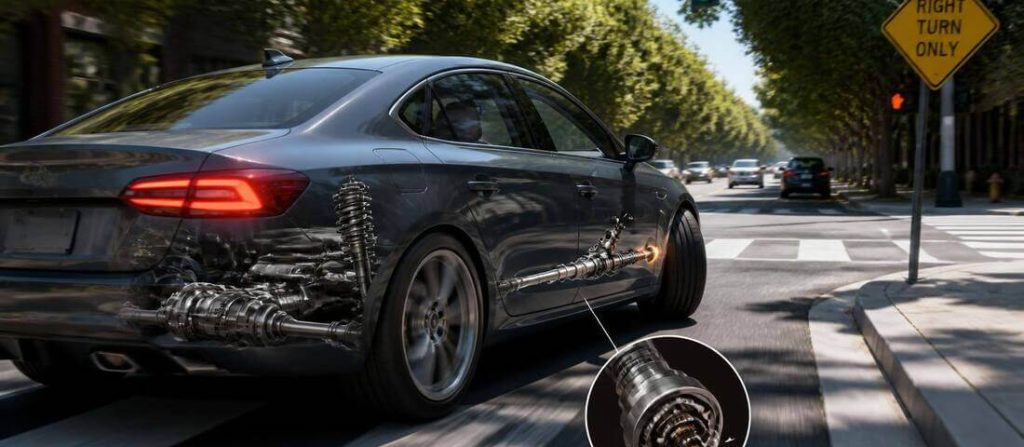
Exhaust system. Catalytic converters, oxygen sensors, mufflers. $200–$1,500 as the car ages.
Coolant flush. Every 50,000–100,000 miles. $100–$200.
An EV has none of these. The motor doesn’t burn oil. There’s no transmission with clutch packs. No spark plugs to foul. No exhaust to rust. The list of eliminated services is long — and so is the list of eliminated failure points.
What Maintenance Does an EV Still Need?
An EV is not maintenance-free. It’s maintenance-different. Here’s what you’re still paying for.
Tire rotation. Every 5,000–7,500 miles. $0–$50 if you bought tires from a shop with free rotation, $25–$75 otherwise. EVs need this more often than gas cars because of the extra weight and instant torque.
Tire replacement. EV tires wear 20% faster and cost 20–30% more than conventional tires. A set of four runs $700–$1,600 installed. Expect 25,000–40,000 miles on performance-oriented models, 40,000–50,000 if you rotate and drive gently.
Brake service. The pads last 60,000+ miles thanks to regenerative braking — versus 25,000–30,000 on a gas car. But the caliper slides can seize from lack of use, especially in humid climates. A seized caliper costs $300–$500 to replace. I recommend an annual brake inspection and caliper lube.
Battery coolant. Every 4–5 years or 50,000–100,000 miles depending on the manufacturer. $400–$600. This is the EV equivalent of a coolant flush, but it requires low-conductivity fluid and often a scan tool to cycle the electric pumps.
12V auxiliary battery. Every 3–5 years. $200–$300. Yes, EVs still have a 12V battery that runs the computers, lights, and locks. When it dies, the car won’t start — even with a full main battery.
Cabin air filter. Every 15,000–30,000 miles. $20–$50 DIY, $50–$100 at a shop. Some EVs use HEPA filters that cost more.
Wiper blades. Every 6–12 months. $30–$80.
Wheel alignment. Every 12,000–24,000 miles or after hitting a pothole. $75–$168. EVs are heavier, so misalignment wears tires faster.
Software updates. Usually free and over-the-air. But some manufacturers charge for map updates or advanced features.
The Real Numbers: Annual and Per-Mile Costs
Here’s what the data actually says.
| Cost Metric | Electric Vehicle | Gas-Powered Vehicle |
|---|---|---|
| Per-mile maintenance | ~$0.06 | ~$0.10 |
| Annual maintenance (12k miles) | $400–$600 | $800–$1,200 |
| 5-year maintenance (60k miles) | $2,000–$3,000 | $4,500–$6,500 |
| Lifetime maintenance (100k miles) | ~$4,600 | ~$9,200 |
Sources: Consumer Reports lifetime survey, U.S. Department of Energy, AAA Your Driving Costs analysis, Edmunds 5-year data.
The per-mile gap is real. At 12,000 miles a year, an EV owner spends roughly $400–$600 on maintenance versus $800–$1,200 for a gas car. That’s $200–$800 in annual savings before you factor in fuel.
But the gap is not uniform. A Chevy Bolt EV costs about $2,800 to maintain over 5 years according to Edmunds. A comparable gas-powered Chevy runs about $4,400. A Tesla Model 3 is even cheaper — many owners report spending under $500 in the first 50,000 miles if they rotate tires and change filters themselves.
The catch: Those numbers assume you rotate tires, keep pressures correct, and don’t drive like you’re launching at every light. Ignore tires, and one early replacement set wipes out a year of savings.
5-Year Maintenance Ledger: EV vs. Gas Car
Here’s what you’ll actually pay, service by service, mile by mile. I’m using 15,000 miles per year — the national average — and mid-range cost estimates for a compact-to-midsize vehicle.
| Service / Milestone | EV Cost | Gas Car Cost |
|---|---|---|
| Year 1 (15k miles) | ||
| Tire rotation (2x) | $0–$100 | $0–$100 |
| Cabin air filter | $0 | $25–$50 |
| Oil change (1–2x) | — | $100–$160 |
| Engine air filter | — | $25–$50 |
| Year 1 total | $0–$100 | $150–$360 |
| Year 2 (30k miles) | ||
| Tire rotation (2x) | $0–$100 | $0–$100 |
| Cabin air filter | $30–$80 | $25–$50 |
| Oil change (2x) | — | $100–$160 |
| Transmission service | — | $150–$300 |
| Spark plugs (some models) | — | $150–$400 |
| Tire replacement (EV early if not rotated) | $700–$1,200 | — |
| Year 2 total | $730–$1,380 | $425–$1,010 |
| Year 3 (45k miles) | ||
| Tire rotation (2x) | $0–$100 | $0–$100 |
| Cabin air filter | $0 | $25–$50 |
| Oil change (2x) | — | $100–$160 |
| Brake inspection / caliper lube | $50–$100 | $50–$100 |
| Year 3 total | $50–$200 | $175–$410 |
| Year 4 (60k miles) | ||
| Tire rotation (2x) | $0–$100 | $0–$100 |
| Cabin air filter | $30–$80 | $25–$50 |
| Oil change (2x) | — | $100–$160 |
| Transmission service | — | $150–$300 |
| Timing belt (some models) | — | $500–$1,200 |
| Battery coolant flush | $400–$600 | — |
| 12V battery replacement | $200–$300 | $150–$250 |
| Year 4 total | $630–$1,080 | $925–$2,060 |
| Year 5 (75k miles) | ||
| Tire rotation (2x) | $0–$100 | $0–$100 |
| Cabin air filter | $0 | $25–$50 |
| Oil change (2x) | — | $100–$160 |
| Tire replacement (EV second set, gas first) | $700–$1,200 | $500–$800 |
| Brake pad replacement (gas car) | — | $200–$400 |
| Year 5 total | $700–$1,300 | $825–$1,510 |
| 5-year cumulative | $2,110–$4,060 | $2,500–$5,350 |
The pattern: In Year 1, the EV wins easily. In Year 2, the EV can pull ahead if tires need early replacement. By Year 4, the gas car’s timing belt and transmission service create a big spike. By Year 5, the cumulative gap is usually $500–$1,500 in the EV’s favor — wider if the gas car needs major engine service, narrower if the EV needs two sets of tires.
The tire variable is everything. A gas car owner who rotates tires and drives gently might not replace them until 60,000 miles. An EV owner who never rotates might need two sets in 75,000 miles. That $1,200–$2,400 tire bill is the single biggest variable in the EV maintenance equation.
The Hidden Costs Nobody Talks About
EV maintenance savings are real, but they’re not magic. Here are the costs that EV evangelists leave out of the brochure.
Tire premium. EV tires cost 20–30% more than conventional tires and wear 20% faster. Over 100,000 miles, an EV owner might buy three sets versus two for a gas car. The extra set costs $700–$1,200. That’s not nothing.
Battery coolant. Every 4–5 years, $400–$600. Gas cars need coolant too — but it’s cheaper and more widely available. EV coolant must be low-conductivity for the battery loop, and some dealers charge $800+ for the service.
12V battery. It dies just like any other car’s battery. $200–$300 every 3–5 years. Some EVs are harder on the 12V because it cycles more frequently.
Brake caliper corrosion. Regenerative braking means the pads barely wear. But in humid or salty climates, the caliper pins and slides can rust from disuse. I’ve seen EVs need $400 caliper replacements at 40,000 miles because the pads never moved enough to keep the hardware free.
Collision repair. EVs are heavier and have more expensive parts. A 2023 study found EV collision repairs average $950 more than gas cars — largely due to Tesla repair costs. Non-Tesla EVs averaged $269 more. This isn’t maintenance, but it affects total ownership cost.
Insurance. EVs often cost more to insure because of higher repair costs and specialized parts. That can offset $200–$400 of your annual maintenance savings.
Total Cost of Ownership: Maintenance + Fuel + Purchase Price
Maintenance is only one slice of the pie. Here’s how it fits with fuel and purchase price over 7 years.
| Cost Category (7 years, 84k miles) | EV | Gas Car |
|---|---|---|
| Maintenance | $3,200–$4,500 | $6,000–$8,500 |
| Fuel / electricity | $3,600–$4,800 | $11,000–$14,000 |
| Purchase price (avg. new) | $53,000–$55,000 | $48,000–$50,000 |
| Tax credit (if eligible) | –$7,500 | $0 |
| Net 7-year cost | $52,300–$56,800 | $65,000–$72,500 |
Sources: Atlas Public Policy 2025 analysis (NRDC-supported), KBB average transaction prices, EIA fuel price data, DOE electricity cost data.
Atlas Public Policy compared five best-selling 2024 gas models against their closest EV counterparts. EVs were cheaper to own over 7 years in four of five segments — compact SUV, midsize SUV, sedan, and compact sedan. The only exception was full-size pickup, where the F-150 Lightning’s purchase price gap was too wide for fuel and maintenance savings to close.
The bottom line: Even with the tire premium and battery coolant, most EV owners save $6,000–$10,000 over 7 years compared to a comparable gas car. The maintenance savings are about $2,500–$3,500 of that total. Fuel savings are the bigger chunk.
FAQs About Electric Cars vs Gas Cars Maintenance
Do electric cars need oil changes?
No. Electric motors don’t use engine oil. There’s no crankcase, no oil pump, no oil filter. The only fluid that resembles oil is in the reduction gear — a single-speed gearbox — and it’s typically sealed for life.
How often does an EV need service?
Most manufacturers recommend a multi-point inspection every 7,500–15,000 miles. Tesla doesn’t have a fixed schedule — it alerts you when something needs attention. But you should still rotate tires every 5,000–7,500 miles, check brake calipers annually, and replace the cabin filter every 15,000–30,000 miles.
Do EV brake pads really last forever?
Not forever, but much longer. Regenerative braking does 80–90% of the slowing. Many EV owners report original brake pads at 100,000+ miles. But the calipers can seize from lack of use. Have them inspected and lubricated annually — especially if you live where road salt is used.
What is the most expensive maintenance item on an EV?
Tires. A set of four EV-specific tires costs $700–$1,600 and may only last 30,000–40,000 miles if not rotated. Battery coolant is second at $400–$600 every 4–5 years. Everything else is minor.
Does an EV battery need maintenance?
The main high-voltage battery pack is maintenance-free. You can’t service it yourself. But the battery coolant needs flushing periodically to maintain thermal management. That’s a $400–$600 service, not a battery replacement.
Bottom Line
Electric cars cost less to maintain than gas cars. The gap is roughly 40–50% over the life of the vehicle — about $4,600 versus $9,200 according to Consumer Reports. At $0.06 per mile versus $0.10, the savings add up fast.
But it’s not zero. Budget $400–$600 per year for an EV. Rotate your tires every 5,000–7,500 miles so you don’t burn through a $1,200 set at 25,000 miles. Replace the 12V battery before it strands you. And don’t ignore the brake calipers just because the pads last forever.
Do those three things, and you’ll spend half what your neighbor with the gas Camry spends — and you’ll never sit in a Jiffy Lube waiting room again. That’s the real win.