
This article was updated in July 21, 2026 with new products and information by Mark S. Taylor
Your hybrid’s manual says the transmission fluid is “lifetime,” your dealer wants $300 to change it, and some guy on a forum swears it saved his transmission. So which is it?
Here’s the straight answer: yes, changing your hybrid transmission fluid is worth doing, most owners should do it somewhere between 60,000 and 100,000 miles, and it should be a simple drain-and-fill — not a high-pressure flush. The “lifetime” label refers to the fluid’s design life under lab conditions, not the life of your car. Real-world fleets tell a clearer story: Toyota hybrid taxis that get periodic fluid changes routinely clear 300,000 to 500,000 miles with no transaxle trouble.
This guide settles the debate, explains why a hybrid transmission fluid change isn’t the same as a CVT or a regular automatic, and shows you when to change the fluid, how it’s done, and what it should cost.
Contents
- 1 What “Hybrid Transmission” Actually Means (eCVT)
- 2 Do You Really Need to Change It? (The “Lifetime Fluid” Myth)
- 3 Signs Your Hybrid Transmission Fluid Needs Changing
- 4 How Often Should You Change It? (Interval Guide)
- 5 How to Check and Change Hybrid Transmission Fluid
- 6 What Happens If You Never Change It?
- 7 Cost Breakdown
- 8 DIY vs. Mechanic
- 9 How to Prevent Problems Between Changes
- 10 FAQs About Hybrid Transmission Fluid Change
- 10.1 Do hybrid cars really need a transmission fluid change if the fluid is “lifetime”?
- 10.2 How often should I change hybrid (eCVT) transmission fluid?
- 10.3 Should I get a flush or a drain-and-fill on my hybrid?
- 10.4 Is it ever too late to change high-mileage hybrid fluid?
- 10.5 What about the rear fluid on an AWD hybrid?
- 11 Bottom Line
What “Hybrid Transmission” Actually Means (eCVT)
Most hybrids don’t have a conventional transmission at all. They use an eCVT — an electronically controlled continuously variable transaxle. Instead of gears and clutch packs that swap ratios, it uses a planetary gearset and two electric motor-generators to blend engine and electric power smoothly.
That design detail matters for fluid. A regular automatic has friction clutch packs and a torque converter that shed material and cook the fluid over time. An eCVT has none of that. There are no clutch packs wearing away, so the fluid stays cleaner longer than in a normal automatic.
But — and this is the part the “lifetime” crowd skips — the eCVT still has gears, bearings, and those spinning motor-generators. They produce fine metal wear that ends up suspended in the fluid, and the fluid still breaks down under heat over many years. Cleaner longer is not the same as clean forever.
One more thing worth clearing up: an eCVT is not the belt-and-pulley CVT you’ll find in some non-hybrid economy cars. They share three letters and nothing else. Service advice for one does not apply to the other.
Do You Really Need to Change It? (The “Lifetime Fluid” Myth)
This is where owners get stuck, so let’s resolve it. Manufacturers like Toyota label the transaxle fluid “lifetime” or “fill-for-life.” Technically true — under normal conditions the fluid can last a very long time, and the box is designed to be low-maintenance. That’s why the manual doesn’t schedule a change.
Here’s the catch. “Lifetime” is defined by the engineers as the design service life, which is often tied to the warranty period, not the 200,000-mile life many hybrid owners actually get out of these cars. Fluid that’s fine at 100,000 miles is not necessarily fine at 180,000.
The most convincing evidence isn’t a brochure — it’s the fleets. High-mileage Toyota hybrid taxis that receive periodic drain-and-fills are famous for running past half a million miles with healthy transaxles. Owners also report a specific win: a whine that showed up around 50–55 mph that disappeared after a fluid change. That’s not marketing; that’s a symptom that resolved.
So the honest position: it’s not strictly required, but a periodic change is cheap insurance against a repair that can cost thousands. Given the stakes, most owners come out ahead changing it.

Signs Your Hybrid Transmission Fluid Needs Changing
Since there’s no scheduled interval in many manuals, you’re partly going by condition and mileage. Watch for these:
A whine or hum around 50–55 mph. The classic tell. Multiple owners report a speed-related whine that vanished after a fresh fluid change. If yours started and you’re at higher mileage, that’s your cue.
You’re past 60,000 miles on the original fluid. Not an emergency, but the window where the first change pays off most.
Dark or cloudy fluid on the drain plug. Fresh transaxle fluid is bright red. Dark, brown, or murky fluid means it’s done its job and then some.
Heavy metal flakes on the magnetic drain plug. A little fine glitter is normal, especially on a first change. Larger flakes warrant a closer look.
Severe-service driving. Constant towing, mountain grades, extreme heat, or heavy stop-and-go all age the fluid faster and pull the interval in.
None of these mean your transaxle is failing. They mean the fluid has earned a change.
How Often Should You Change It? (Interval Guide)
There’s no single number, because manufacturers officially say “lifetime” while experienced techs recommend a proactive schedule. Here’s how the real-world guidance shakes out:
| Driving type | Recommended change interval |
|---|---|
| First (initial) change | Around 60,000 miles — do this one for sure |
| Normal driving, after first change | Every 90,000–100,000 miles |
| Severe service (towing, heat, mountains) | Every 30,000–60,000 miles |
| Time-based backstop | Every 6–9 years, whichever comes first |
The single most important one is the first change, around 60,000 miles. As the transaxle beds in, the original fluid collects the most break-in debris. Flush that out once and the system tends to stay cleaner, which is why owners find intervals can stretch afterward. Always check your specific owner’s manual, since fluid type and access vary by make and model.

How to Check and Change Hybrid Transmission Fluid
This is a drain-and-fill, and on many hybrids it’s a legitimate driveway job. The method matters as much as the mileage, so read the warning at the end of this section before you let anyone touch it.
Warm the transaxle briefly and park level. Fluid drains better warm, and a level car is essential for setting the correct fill amount.
Locate the fill plug first, and loosen it before you drain. This is the golden rule of any drain-and-fill: confirm you can open the fill plug before you empty the unit, or you can be stuck with no way to refill.
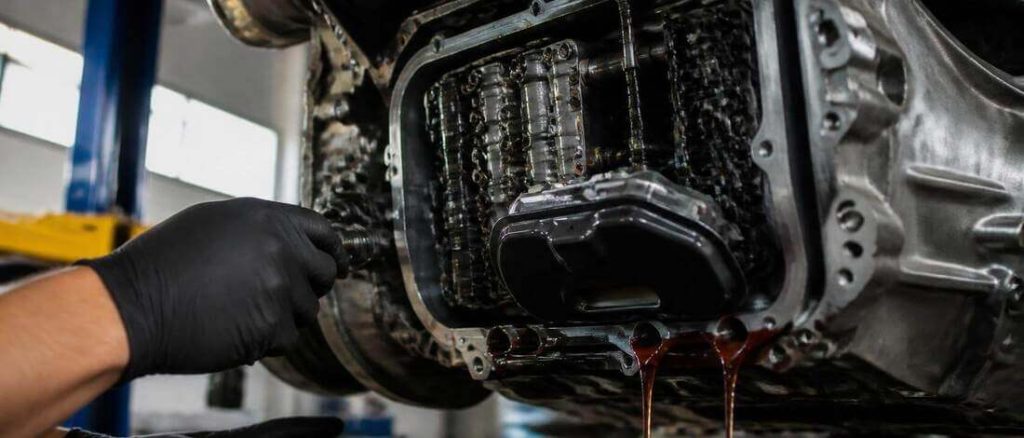
Remove the drain plug and measure what comes out. Catch it in a marked container. Most hybrid transaxles hold roughly 4 to 4.5 quarts. A little fine metal glitter is normal.
Reinstall the drain plug to spec. Use a new gasket/crush washer and don’t overtighten.
Refill with the exact manufacturer-specified fluid, using a hand pump. Add the same amount you drained, pumping it in through the fill hole until it just begins to trickle back out at the correct level.
Perform the fill-level check the right way. Newer hybrids (for example, the 2025 Camry) require a specific temperature or maintenance-mode procedure to verify the level. Skipping it risks an over- or under-fill, so follow your model’s routine.
The one warning that matters most: do not let a shop run a high-pressure flush machine on your hybrid transaxle. The correct service is a gravity/pump drain-and-fill (repeated two or three times if you want to refresh more of the fluid). If a shop insists on a pressure “flush,” find another shop.
What Happens If You Never Change It?
You might be fine. Plenty of hybrids go 150,000 miles on original fluid without drama, and that’s exactly why the “lifetime” label survives. But you’re playing an odds game with an expensive part.
As transaxle fluid ages, it loses its ability to shed heat and protect the gears, bearings, and motor-generators. Heat is the enemy in a hybrid drive unit, and degraded fluid lets temperatures climb and wear accelerate. The failure isn’t sudden like a snapped belt — it’s slow wear that shows up as noise first, then bigger problems later.
Here’s the math that makes the decision easy. A drain-and-fill costs you somewhere between fifty dollars and a few hundred. A failed hybrid transaxle can run $8,000 to $11,000 to replace. When a cheap, occasional service protects a five-figure component, skipping it to save a couple hundred dollars is a bad trade.

Cost Breakdown
The good news: this is one of the cheaper services on a hybrid, as long as you don’t get talked into the wrong version of it.
| Option | What you get | Typical cost |
|---|---|---|
| DIY drain-and-fill | Fluid, gasket, hand pump | $50–$120 |
| Independent shop | Drain-and-fill, correct fluid | $150–$270 |
| Dealership | Drain-and-fill, OEM fluid | $250–$344 |
| AWD rear unit (add-on) | Rear motor/diff fluid | $100–$150 |
| “Flush” upsell (avoid) | Machine pressure exchange | $400–$726 |
RepairPal puts a typical Toyota transmission fluid change around $257–$331, which lines up with dealer drain-and-fill pricing. Forum owners consistently report DIY around $50 in fluid plus a cheap hand pump. The number to walk away from is a $700-plus “flush” quote — that’s both the wrong method and the wrong price for a hybrid transaxle.
If you have an all-wheel-drive hybrid, remember the rear electric-motor or differential unit is a separate service. Owners often find that rear fluid is dirtier than the front, so it’s worth doing at the same time.
DIY vs. Mechanic
On a lot of hybrids, this is an honest weekend job: two plugs, a measured refill, and the right fluid. What decides it for you is whether you can verify the fill level correctly and get the specified fluid.
You’ll need the exact manufacturer fluid (don’t substitute), a hand pump, a torque wrench, a new gasket or crush washer, and a way to catch and measure the old fluid.
| Do it yourself if… | Let a mechanic do it if… |
|---|---|
| You can open the fill plug first | The fill plug is seized or over-torqued |
| You have the exact specified fluid | Your model needs a scan-tool level check you can’t do |
| You’re comfortable measuring drain/fill | You’d rather not get under the car |
| You can follow the temperature/level routine | You want the rear AWD unit done too |
The trap for DIYers isn’t the draining — it’s the fill level. Newer hybrids want a specific temperature or maintenance-mode check to confirm the level, and getting that wrong is worse than leaving the old fluid in. If you can’t complete that step, hand it to a shop that does hybrid work and specifically ask for a drain-and-fill.

How to Prevent Problems Between Changes
Don’t skip the first change. Around 60,000 miles is the one that clears the most break-in debris.
Match the interval to how you drive. Tow, climb mountains, or sit in summer traffic? Change it sooner.
Always use the specified fluid. The wrong fluid in a hybrid transaxle can cause the very problems you’re trying to prevent.
Do the rear AWD unit too. If you have all-wheel drive, don’t forget the rear fluid.
Address a new whine early. A speed-related hum is your cheapest warning; act on it before it becomes wear.
FAQs About Hybrid Transmission Fluid Change
Do hybrid cars really need a transmission fluid change if the fluid is “lifetime”?
“Lifetime” refers to the fluid’s design service life, not the full life of a car that may run 200,000 miles. It’s not strictly required, but a periodic drain-and-fill — especially a first change around 60,000 miles — is inexpensive insurance against a transaxle repair that can cost $8,000 to $11,000.
How often should I change hybrid (eCVT) transmission fluid?
The first change around 60,000 miles is the important one. After that, roughly every 90,000–100,000 miles for normal driving, or every 30,000–60,000 miles for severe service like towing or extreme heat. Check your owner’s manual for your specific model.
Should I get a flush or a drain-and-fill on my hybrid?
Drain-and-fill. A high-pressure flush machine is the wrong method for a hybrid transaxle. If you want to refresh more of the fluid, do two or three drain-and-fills rather than a pressure flush. Decline any shop that insists on machine-flushing your hybrid.
Is it ever too late to change high-mileage hybrid fluid?
Rarely. Even at high mileage, a straightforward drain-and-fill with the correct fluid is generally safe and beneficial. Stick to a gentle drain-and-fill rather than an aggressive flush, and don’t expect it to reverse existing wear — it protects against future wear.
What about the rear fluid on an AWD hybrid?
All-wheel-drive hybrids have a separate rear electric-motor or differential unit with its own fluid, and it’s often dirtier than the front. Service it at the same time — it usually adds only $100–$150.
Bottom Line
Ignore the “lifetime fluid” label as a reason to do nothing. A hybrid transmission fluid change is cheap, straightforward, and one of the best-value services you can do — especially the first one around 60,000 miles. Do a drain-and-fill with the exact specified fluid, refuse any high-pressure flush, and don’t forget the rear unit if you have all-wheel drive. Whether you DIY for about $50 or pay a shop $150 to $344, you’re protecting a transaxle that costs five figures to replace. That’s an easy call.