
This article was updated in October 4, 2026 with new products and information by Mark S. Taylor
An engine that stalls while driving — as opposed to only at idle or when coming to a stop — has lost one of three things it needs to run: fuel pressure, spark, or a reliable signal telling the engine’s computer where the crankshaft is. The most common culprits are a failing fuel pump, a failing crankshaft position sensor, or an ignition coil losing spark under load. A scan tool pulling stored and pending codes is the fastest way to narrow it down.
Contents
- 1 Engine stalling while driving: what should you do first?
- 2 What happens when an engine stalls?
- 3 When should you tow the vehicle?
- 4 Why does a car stall while driving?
- 5 Common causes of engine stalling while driving
- 5.1 1. Fuel-delivery problems
- 5.2 2. Ignition failure
- 5.3 3. Charging-system or battery-cable problems
- 5.4 4. Throttle-body or idle-air faults
- 5.5 5. Vacuum or intake leaks
- 5.6 6. Sensor or engine-control problems
- 5.7 7. Emissions-system faults
- 5.8 8. Transmission or torque-converter problems
- 5.9 9. Overheating or low oil pressure
- 5.10 10. Internal engine or timing failure
- 6 Does the location or timing of the stall matter?
- 7 How a mechanic should diagnose a stalling problem
- 8 What can you safely check yourself?
- 9 What should you tell the repair shop?
- 10 Can you drive after the engine restarts?
- 11 How much does a stalling problem cost to fix?
- 12 FAQs About Engine Stalling While Driving
- 13 Bottom line
Engine stalling while driving: what should you do first?
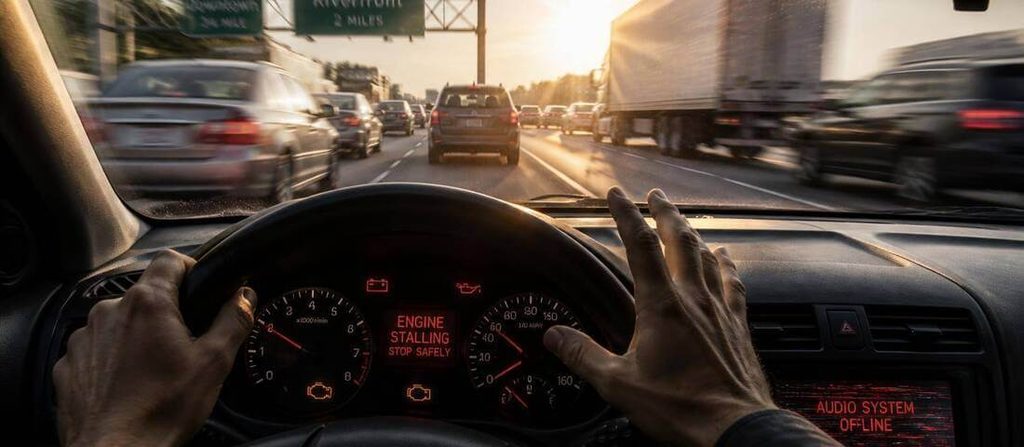
If the engine dies while you are moving, stay calm. Keep the vehicle pointed straight, ease off the accelerator, and slow down gradually. Move toward a safe place away from traffic, then switch on the hazard flashers.
Only try to restart the vehicle after you are out of the traffic path and it is safe to do so. A successful restart does not mean the fault is fixed. The engine can stall again without warning.
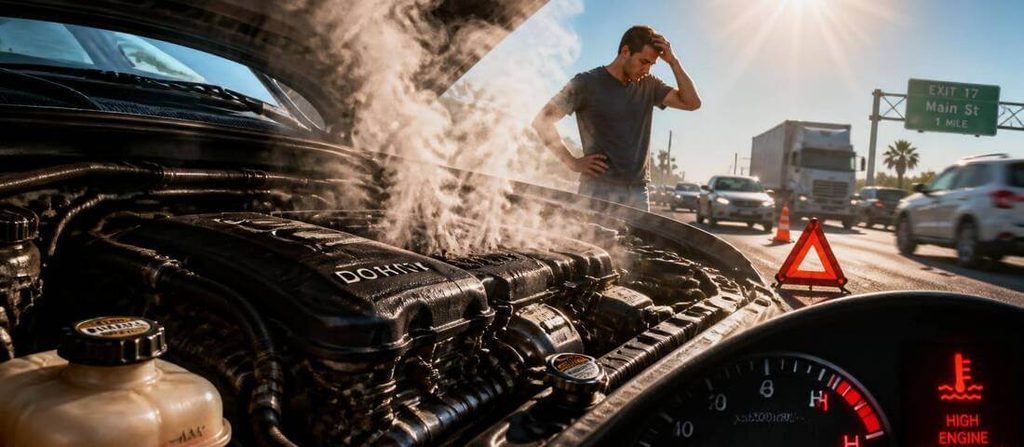
If the oil-pressure light, temperature warning, or charging warning is on, or the vehicle is smoking, misfiring, losing power, or making a new mechanical noise, shut it off and call for a tow. Do not keep driving because the car starts again.
Your own owner’s manual controls the exact emergency procedure for your vehicle. For example, the 2025 Kia owner manual’s stall procedure says to reduce speed gradually, move off the road, turn on the hazard flashers, and try restarting the vehicle. Its instructions are vehicle-specific, so do not treat them as a substitute for your manual.
What happens when an engine stalls?
The engine stops producing power. Depending on the vehicle, steering and braking may feel different because power assistance may be reduced or lost.
You may retain some control, but the vehicle may take more effort to steer or stop. Do not panic and do not turn the ignition off and on repeatedly while the vehicle is moving. Focus first on keeping a straight path and getting out of danger.
If the engine stalls at an intersection, do not push the vehicle into traffic. Use the safest option for the scene, the transmission, and the owner’s manual. If you cannot move the vehicle safely, stay buckled if remaining inside is safer, turn on the hazards, and call emergency or roadside assistance as needed.
When should you tow the vehicle?
A stall that happens once still deserves attention. A repeat stall should be treated as a tow-in problem, especially when any of these signs are present:
- A red oil-pressure warning or low-oil-pressure message
- A temperature warning, overheating, or steam
- A battery or charging-system warning
- Smoke, a fuel smell, or a visible fluid leak
- A deep knock, loud mechanical noise, or rapidly worsening sound
- Severe shaking, a flashing check-engine light, or major power loss
- The engine cranks but will not restart
- The vehicle stalls again after restarting
- Steering or braking feels abnormal
- The stall happened in traffic and the cause is unknown
A light may stay off even when a serious fault is present. Do not use the dashboard alone to decide that the car is safe.
Why does a car stall while driving?
An engine needs the right amount of air, fuel, spark, compression, timing, and electrical control. A failure in any of those systems can stop combustion.
The same symptom can come from different parts. A car that stalls during acceleration may have a fuel-delivery problem, but it could also have an ignition, sensor, transmission, or engine-control fault. That is why replacing the first part that comes to mind is a bad diagnostic plan.
The RepairPal guide to engine stalling groups common causes into air delivery, fuel delivery, sensors, vacuum leaks, ignition, emissions, charging, engine problems, and control modules. The guide was published in 2018, so use it for broad diagnostic categories rather than current vehicle-specific advice.
Common causes of engine stalling while driving
1. Fuel-delivery problems
A weak fuel pump, restricted filter or line, faulty pressure regulator, or wiring problem can starve the engine. The stall may feel like the vehicle ran out of fuel, even when the gauge shows fuel in the tank.
You may notice hesitation, loss of power under load, hard starting, or a stall that happens after the vehicle has been running for a while. These clues can point toward fuel delivery, but they do not prove a bad pump.
Fuel-system testing involves gasoline pressure and electrical checks. Do not open fuel lines or bypass a pump circuit at home. Have a qualified technician test the system.
2. Ignition failure
The engine needs a timed spark. A failed ignition coil, ignition module, wiring fault, ignition switch, or crankshaft or camshaft position sensor can interrupt that spark or the timing signal.
A crankshaft or camshaft sensor may fail intermittently. The engine may stall, restart after a short wait, and then fail again later. That restart pattern is a clue, not proof of a sensor failure.
A scan tool may show a related code, but a code does not automatically identify the failed part. The circuit and the component still need to be tested.
3. Charging-system or battery-cable problems
The alternator supplies electrical power while the engine runs and keeps the battery charged. A failing alternator, loose battery connection, damaged ground cable, or broken belt can cause voltage to drop and the engine to shut down.
A battery or charging warning may appear first. You may also see dim lights, electrical glitches, slow cranking, or several warning lights at once.
Do not assume the battery is the cause because the vehicle will not restart. A technician must test the battery, alternator, cables, grounds, and charging circuit as a system.
4. Throttle-body or idle-air faults
A restricted or malfunctioning throttle body can interrupt airflow. Some vehicles use a separate idle-air control system; others use an electronic throttle body to manage idle speed.
This type of problem is more likely when the engine stalls as you slow down, stop, turn on the air conditioner, or shift into gear. Rough idle and hesitation may appear before the stall.
Cleaning a throttle body is not a universal fix. Electronic throttle systems may need inspection, relearn procedures, wiring tests, or replacement based on the vehicle’s service information.
5. Vacuum or intake leaks
A large air leak after the airflow sensor can upset the air-fuel mixture. The engine may run lean, surge, idle poorly, or stall.
Look for a pattern of rough running rather than one isolated stall. A vacuum leak can also trigger fuel-trim or mixture codes, but the code still needs to be matched to a physical test.
Do not spray flammable chemicals around a running engine to hunt for a leak. A shop can use a safer, vehicle-appropriate test method.
6. Sensor or engine-control problems
Modern engines use data from sensors such as the mass airflow, manifold-pressure, throttle-position, coolant-temperature, crankshaft-position, and camshaft-position sensors. The engine-control module uses that data to control fuel, ignition, and airflow.
A bad sensor is only one possibility. Wiring damage, poor grounds, connector corrosion, a power-supply fault, or a control-module problem can create the same code or symptom.
The best diagnosis checks the sensor signal and the circuit. Replacing a sensor because it has a code can waste money if the wiring is the real problem.
7. Emissions-system faults
A valve that stays open when it should close can disturb the air-fuel mixture and cause stalling. A restricted catalytic converter can also limit exhaust flow and reduce engine power.
You may notice rough running, poor acceleration, unusual exhaust heat, or a check-engine light. The vehicle needs testing before anyone condemns the converter or another emissions part.
Do not remove emissions equipment or keep driving if the vehicle is losing power or overheating.
8. Transmission or torque-converter problems
An automatic transmission can load the engine too heavily if the torque converter does not release correctly. The engine may stall as you slow down or come to a stop, similar to a manual-transmission vehicle stopping without the clutch being pressed.
This problem can look like an engine fault. The technician needs to compare engine data, transmission behavior, and the exact moment of the stall.
A transmission-related stall may require a transmission specialist or dealer, especially on a vehicle with a complex electronically controlled transmission.
9. Overheating or low oil pressure
Severe overheating can cause an engine to lose power or shut down. Low oil pressure can damage moving parts and may be accompanied by ticking, tapping, or knocking.
If the temperature or oil-pressure warning appears, stop driving as soon as it is safe. Do not open a hot cooling system. Do not restart the engine repeatedly to see whether the warning disappears.
These are tow-in conditions unless a qualified technician gives vehicle-specific advice after inspection.
10. Internal engine or timing failure
Low compression, a damaged timing component, or internal mechanical failure can stop the engine or make it impossible to restart.
Warning signs can include a deep knock, unusual cranking speed, metal noise, low oil pressure, sudden loss of power, or a stall followed by a no-start condition.
Do not authorize a rebuild or engine replacement based only on the word “stall.” Ask what testing supports the conclusion. Compression, leak-down, timing, oil-pressure, or internal inspection may be needed.
Does the location or timing of the stall matter?
Yes. The condition can help a technician choose the next test, but it cannot identify the failed part by itself.
| When the stall happens | Systems a technician may consider | Useful details to record |
|---|---|---|
| At highway speed | Fuel delivery, ignition, charging, sensors, engine control | Speed, warning lights, whether power faded or stopped suddenly |
| During acceleration | Fuel pressure, ignition, airflow, transmission load | Fuel level, engine temperature, hesitation, misfire |
| When slowing or stopping | Throttle, idle-air, vacuum, torque converter, control system | Whether it happens with the air conditioner on or in gear |
| Only when hot | Heat-sensitive sensor, fuel, ignition, charging, cooling | Warm-up time and time before restart |
| After refueling | Fuel delivery or fuel-vapor system | Fuel type, fill-up timing, hard start or odor |
| With battery light | Alternator, belt, battery cables, grounds | Dim lights, electrical faults, restart behavior |
| With oil or temperature light | Lubrication or cooling system | Warning sequence, noise, smoke, fluid level |
Write down the conditions while they are fresh. An intermittent stall is much easier to diagnose when the shop knows exactly when it happens.
How a mechanic should diagnose a stalling problem
A sound diagnostic process usually follows the evidence instead of starting with a part.
Step 1: Confirm the complaint
The technician asks when the stall occurs and tries to reproduce it safely. A short recording can help if the problem is intermittent.
Step 2: Check warning data and stored codes
The shop scans the vehicle and reviews stored codes, pending codes, freeze-frame data, and live readings when available. A scan is a starting point, not a verdict.
Step 3: Check basic power and fluid conditions
The technician may check battery voltage, cable connections, grounds, fuel level, oil level, coolant level when safe, and visible leaks. The exact checks depend on the vehicle.
Step 4: Test the suspected system
Fuel-pressure testing, charging tests, ignition-signal checks, throttle or airflow tests, vacuum-leak testing, and compression testing may be used. Not every vehicle needs every test.
Step 5: Confirm the failed component
Before recommending a part, the shop should explain what failed and what evidence supports that finding. Ask whether the proposed repair is confirmed or only a possibility.
Step 6: Check for recalls and technical information
Use the vehicle identification number to check the manufacturer’s recall information and the official government recall service. If you find a possible match, contact the manufacturer or dealer and describe the stall exactly.
A recall does not prove it caused your stall. It tells you to investigate a known safety or reliability issue for that vehicle.
What can you safely check yourself?
Only perform checks that do not put you near traffic, fuel, hot coolant, or moving parts.
- Read the owner’s manual emergency section.
- Check whether the oil level is dangerously low, using the manual’s procedure.
- Note warning lights and messages.
- Look for obvious leaks after the engine is cool.
- Record the speed, temperature, load, and time before the stall.
- Note whether the engine cranked normally afterward.
- Record whether the vehicle restarted immediately or only after cooling.
- Photograph warning messages or fluid spots from a safe position.
Do not open a hot radiator or coolant reservoir. Do not reach near fans, belts, pulleys, or exposed electrical connections. Do not bypass the fuel pump, ignition, or safety systems. Do not clear codes before a shop has recorded them.
What should you tell the repair shop?
Give the shop a short, factual report:
- Year, make, model, engine, and transmission
- Mileage
- Exact speed when it stalled
- Whether the vehicle was hot or cold
- Whether you were accelerating, cruising, braking, or stopping
- Warning lights or messages
- Whether the engine restarted
- How long it took to restart
- Recent repairs, fuel, oil changes, or battery work
- Any smoke, smell, leak, shaking, noise, or power loss
Ask the shop:
- Did you reproduce the stall?
- What codes and freeze-frame data were found?
- Which system are you testing first, and why?
- What result would confirm or rule out the suspected part?
- Is this a diagnostic fee or a repair estimate?
- What happens if the vehicle stalls again after the repair?
- Is the vehicle safe to drive, or do you recommend towing?
- Are there known recalls or service bulletins for this vehicle?
A good technician may not have an answer immediately. That is normal with intermittent faults. A weak diagnosis is different: it names a part without explaining the test.
Can you drive after the engine restarts?
Do not assume so. If the stall happened once with no warning signs, the vehicle may restart and move to a safer location. That is not permission for normal driving.
Tow the vehicle after a repeat stall or when any warning, leak, overheating, severe misfire, power loss, unusual noise, or no-start condition is present.
If the engine restarts and the car must be moved a short distance, use the owner’s manual, avoid traffic when possible, and stop immediately if the warning returns or the engine runs poorly. A professional inspection should follow.
How much does a stalling problem cost to fix?
There is no responsible universal price for engine stalling while driving. A diagnostic visit is not the same as the repair, and the possible repairs range from a wiring or connection problem to fuel-system, charging, transmission, or internal-engine work.
Ask for these items separately:
- Diagnostic charge
- Towing charge, if needed
- Confirmed failed part
- Labor
- Related parts or fluids
- Programming or relearn work
- Taxes and shop fees
- Warranty coverage
Do not approve a fuel pump, sensor, alternator, throttle body, transmission, or engine replacement only because it is a common cause. The vehicle needs evidence.
FAQs About Engine Stalling While Driving
What should I do if my engine stalls while driving?
Keep the vehicle straight, reduce speed gradually, move off the road when safe, turn on the hazard flashers, and attempt a restart only after you are out of the traffic path. Follow your owner’s manual. Tow the vehicle if it will not restart or if warning lights, smoke, overheating, leaks, severe misfire, power loss, or unusual noise are present.
Can a car stall while driving and then restart?
Yes. Heat-sensitive sensors, fuel-delivery faults, ignition problems, electrical faults, and control-system issues can be intermittent. A restart does not prove the problem is gone. Record the conditions and arrange diagnosis before normal driving resumes.
Is a stalled engine dangerous?
It can be. The engine stops producing power, and steering or braking may feel different if power assistance is reduced. The main danger is losing control or being left in a traffic lane. Move to safety first, then diagnose the cause.
Does a stall mean the fuel pump is bad?
No. A fuel pump is one possibility, but ignition, charging, sensors, throttle, vacuum, transmission, overheating, and internal engine problems can cause similar symptoms. Fuel pressure and the pump circuit should be tested before replacement.
Why does my car stall when I stop?
Possible causes include a throttle or idle-air fault, vacuum leak, torque-converter problem, fuel issue, sensor fault, or engine-control problem. The exact pattern matters, so note whether the stall occurs when braking, shifting into gear, turning on the air conditioner, or slowing from speed.
Bottom line
Engine stalling while driving is a safety problem before it is a repair question. Keep the vehicle straight, slow down gradually, move out of traffic, turn on the hazards, and restart only when safe.
Do not keep driving after a repeat stall or a stall with an oil-pressure warning, temperature warning, charging warning, smoke, leak, severe misfire, power loss, or unusual noise. A restart is only a temporary change in symptoms.
The right repair starts with the right evidence. Give the technician the exact conditions, preserve the warning codes, and ask what test confirms the proposed repair before approving parts.