
This article was updated in March 19, 2026 with new products and information by Mark S. Taylor
The BMW M3. The Porsche 911. The Honda Civic Type R. These are three of the most celebrated sports cars in the world — and they all use MacPherson struts at the front. So why does everyone say double wishbone is ‘better’? The truth is, both are good engineering solutions to different problems. The idea that double wishbone is always better is a myth. It ignores packaging, cost, and safety. Engineering execution matters more than design type. We will preview the full comparison: what each system does differently, where each wins, real cost data, and a practical framework for choosing.
Contents
- 1 The #1 Rule Before Reading Any Comparison
- 2 MacPherson Suspension — How It Works
- 3 Double Wishbone Suspension — How It Works
- 4 Side-by-Side Comparison — Every Key Dimension
- 5 Where MacPherson Struts Win
- 6 Where Double Wishbone Wins
- 7 The EV Resurgence of Double Wishbone
- 8 MacPherson vs. Double Wishbone — Real-World Vehicle Examples
- 9 Repair Cost Comparison
- 10 Which Should You Choose? — Decision Guide by Use Case
- 11 FAQs About MacPherson Suspension vs Double Wishbone
- 12 Bottom Line — The Honest Summary
The #1 Rule Before Reading Any Comparison
A well-engineered MacPherson strut beats a poorly engineered double wishbone every time. This is the most important thing to understand.
Alibaba’s suspension engineering expert states this directly. He says a well-tuned strut can outperform a poorly valved wishbone any day. The BMW M3 and Porsche 911 use MacPherson struts. They are benchmarks for handling. Grassroots Motorsports confirms that a bad double wishbone design is easy to mess up. BMW achieved greatness with a strut.
Takeaway: Judge the engineering, not the design name. A great MacPherson achieves 95% of the performance for 60% of the cost. The gap between a great strut and a great wishbone is small. The gap between a great strut and a bad wishbone is huge.
MacPherson Suspension — How It Works
The MacPherson strut is a simple design that combines the shock and spring into one unit. Earle S. MacPherson invented it in the 1940s.
The design uses a single lower control arm. This arm connects the wheel to the chassis. The strut assembly runs vertically. It goes from the wheel hub up to the engine bay. The strut acts as the upper steering pivot. This simplicity is its strength. It reduces part count. It saves space. This makes it ideal for front-wheel-drive cars.
Components:
- Lower control arm.
- Strut assembly (damper + spring).
- Strut tower mount.
- Strut bearing.
MacPherson Strut Variants — Not All Are Created Equal
A Kia Rio strut and a BMW 5-Series strut share a name, but not the same engineering. They are fundamentally different.
BMW and Porsche use a special variant. It separates the lower arm into two links. This creates a two-point lower connection. It allows better camber control. It mimics some benefits of a double wishbone. When you hear a BMW M3 uses struts, know that it is a high-end version. BMW spends money on engineering that budget brands cannot.
Double Wishbone Suspension — How It Works
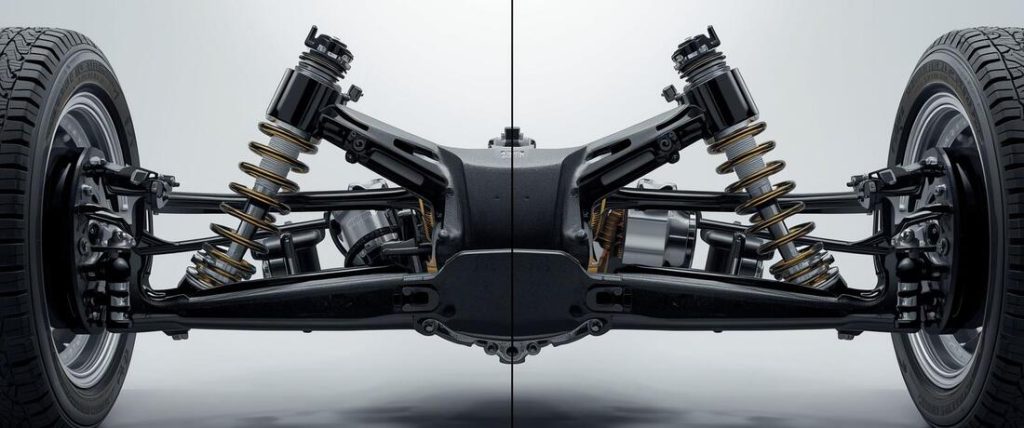
Double wishbone suspension uses two A-shaped arms to control wheel movement precisely. This design offers superior geometry control.
Two control arms connect the wheel hub to the chassis. One is on top. One is on bottom. The spring and shock mount to the lower arm. This creates a “four-bar linkage.” Engineers can tune wheel movement very precisely. The upper arm is usually shorter. This is the SLA design (Short Long Arm). It forces the wheel to tilt inward as the suspension compresses. This keeps the tire flat on the road during turns.
Components:
- Upper control arm (UCA).
- Lower control arm (LCA).
- Coil spring and shock absorber.
- Ball joints and bushings.
Side-by-Side Comparison — Every Key Dimension
Here is the direct comparison of how these systems stack up.
| Dimension | MacPherson Strut | Double Wishbone |
|---|---|---|
| Camber control | Limited — goes positive at full compression | Superior — gains negative camber |
| Roll center control | Limited — constrained by geometry | Precise — tunable via arm angles |
| Anti-dive / anti-squat | Possible but constrained | Excellent — fully independent |
| NVH (noise/vibration) | Higher — forces go to body | Lower — better isolation |
| Packaging (space) | ✅ Excellent — no upper arm | ❌ Poor — needs lateral space |
| Center of gravity | Higher — tall vertical tower | Lower — allows lower hood |
| Unsprung weight | Lower — fewer parts | Higher — more parts |
| Part count | Low — ~4 parts per corner | High — ~8 parts per corner |
| Manufacturing cost | Low — simple assembly | High — complex parts |
| Repair cost (parts) | $80–$150 per strut | $220–$480 per upper arm |
| FWD compatibility | ✅ Ideal — fits transverse engines | ❌ Difficult — space conflict |
| Crash safety | ✅ Tower acts as crumple zone | ❌ Needs extra structure |
| Typical application | Economy cars, FWD, crossovers | Sports cars, luxury, supercars |

Where MacPherson Struts Win
1. Packaging and FWD Compatibility — The Decisive Advantage
Over 70% of front-wheel-drive cars use MacPherson struts because they fit the space. It is a packaging decision.
Transverse engines sit sideways. They take up the horizontal space where a double wishbone upper arm would go. The strut runs vertically. It fits neatly next to the engine. Honda confirmed this. When they switched the Civic to struts, it was to save space. Without this design, economy cars would need to be wider.
2. Lower Manufacturing and Ownership Cost
MacPherson struts are much cheaper to build and repair than double wishbones. This keeps car prices down.
A strut part costs $80–$150. A double wishbone arm costs $220–$480. Over 10 years, the maintenance difference is huge. Alibaba data shows a $1,200–$2,500 difference in total ownership cost. For a $22,000 car, this saving is vital.
3. Lower Unsprung Weight
The strut design has fewer parts, which reduces the weight the wheel has to carry. This improves ride quality.
Lower unsprung weight means the wheel reacts faster to bumps. It follows the road better. For daily driving, this means a smoother ride. Double wishbones can match this with aluminum arms. But for normal cars, the strut is naturally lighter.
4. Crash Safety — The Hidden MacPherson Advantage
The strut tower is designed to crumple and absorb energy in a crash. This is a safety feature often ignored.
The strut tower is part of the car’s body structure. In a frontal crash, it acts as a crumple zone. It absorbs energy safely. Double wishbone systems do not have this specific structural member. They need other heavy parts to manage crash forces. 7Zap’s technical comparison confirms the tower acts as a deformation zone.
Where Double Wishbone Wins
1. Camber Control During Cornering — The Primary Performance Advantage
Double wishbone keeps the tire flat on the road when you turn hard. This provides maximum grip.
In a turn, the car body rolls. A MacPherson strut lets the wheel lean outward. This reduces grip. A double wishbone forces the wheel to lean inward. This keeps the tire patch flat. Jalopnik notes that double A-arm architecture is the best for maintaining ideal camber. If you want to learn more, check our article on the advantages of double wishbone suspension.
2. Superior Geometry Tuning Flexibility
Engineers can adjust many factors independently to perfect the handling. This allows for precise tuning.
Engineers can change arm lengths to alter camber, roll center, and anti-dive. Changing one does not hurt the others. An Alibaba expert explains that MacPherson asks one part to do too much. Double wishbone gives engineers a canvas. This freedom is essential for race cars.
3. Lower Center of Gravity and Low-Car Compatibility
The design allows for lower hood lines and lower ride heights. This helps performance.
Double wishbones use horizontal space. They do not need a tall tower in the engine bay. This lets engineers lower the engine. It improves the center of gravity. Supercars like the Ferrari and Ford GT need this. They cannot use tall strut towers.
4. Better NVH Isolation
The design separates forces, which reduces noise and vibration in the cabin. This improves comfort.
The upper arm handles side forces. The lower arm handles vertical forces. The shock absorber is isolated. A strut combines all these forces in one part. This sends more vibration to the body. PartsAvatar confirms that MacPherson struts transmit more noise and harshness. This is why luxury cars often use double wishbone.
5. Modification and Lowering Compatibility
It is much easier to lower a car with double wishbone suspension without ruining the geometry. This matters for enthusiasts.
Lowering a MacPherson car changes camber drastically. You need camber plates to fix it. Double wishbone designs handle lowering better. The upper arm pivot maintains control. If you plan to modify your car, double wishbone is more forgiving.
The EV Resurgence of Double Wishbone
Electric cars are bringing back double wishbone suspensions because they have more space. The engine is gone.
Gas cars use transverse engines. They block the space for the upper arm. EVs have batteries under the floor. The front is open. This is why the Tesla Model 3 and Model S use double wishbones. They are not just for performance. They use them because they can. 7Zap predicts engineers are revisiting this design for EVs. The MacPherson dominance might fade as EVs take over.
MacPherson vs. Double Wishbone — Real-World Vehicle Examples
Here are the cars that use each system in the real world.
| Use Case | MacPherson Examples | Double Wishbone Examples |
|---|---|---|
| Economy / daily driver | Toyota Corolla, Honda Civic | Tesla Model 3 (front) |
| Mainstream crossover | Toyota RAV4, Honda CR-V | Acura RDX (front) |
| Sports sedan | BMW M3, Porsche 911 | Subaru WRX STI (rear only) |
| Sports car | Honda Civic Type R | Mazda MX-5 Miata, Honda S2000 |
| Luxury | Mercedes-Benz C-Class | Lexus LC 500, Bentley Bentayga |
| Supercar | N/A | Ferrari, Lamborghini, Ford GT |
| Race car | None chosen for pure performance | Formula 1, endurance racing |
Repair Cost Comparison
Here is the estimated cost to repair and maintain these systems.
| Service | MacPherson Strut | Double Wishbone |
|---|---|---|
| Damper/strut unit (parts) | $80 – $150 | N/A |
| Upper control arm (parts) | N/A | $220 – $480 |
| Lower control arm (parts) | $80 – $200 | $150 – $350 |
| Ball joint (per joint) | 1–2 per corner | 2–4 per corner |
| Bushing replacement | $50 – $150 | $100 – $300 |
| Alignment | $75 – $150 | $75 – $150 |
| Full replacement (installed) | $400 – $900 per axle | $600 – $1,500 per axle |
| 10-year total cost | $1,200–$2,500 less | Higher by same amount |
If you hear strange noises, check our guide on symptoms of bad shocks or struts to diagnose the issue.
Which Should You Choose? — Decision Guide by Use Case
Use this guide to decide which suspension fits your needs.
| Your Situation | Best Choice | Why |
|---|---|---|
| Budget daily driver | MacPherson | Engineering quality matters more than type. |
| FWD car | MacPherson | Packaging makes double wishbone rare. |
| Performance/sports car | Double Wishbone | Camber control matters at the limit. |
| Luxury vehicle | Double Wishbone | Better NVH isolation and comfort. |
| EV buyer | Check specs | Many use double wishbone due to space. |
| Planning to lower car | Double Wishbone | Maintains geometry better. |
| Track use | Double Wishbone | Adjustability affects lap times. |
| Safety-focused family car | MacPherson | Strut tower crash advantage. |
| Budget under $30K | MacPherson | Virtually universal in this segment. |
FAQs About MacPherson Suspension vs Double Wishbone
Why do most cars use MacPherson struts instead of double wishbone?
Most cars use MacPherson struts because they fit well in front-wheel-drive cars. The transverse engine takes up the space a double wishbone arm needs. Struts use vertical space instead. They are also cheaper. A strut costs $80–$150. A wishbone arm costs over $200. This saves money on the car price and repairs.
How much more does double wishbone cost to maintain?
Double wishbone costs about $1,200 to $2,500 more over 10 years. This is due to more parts. There are more ball joints and bushings to replace. The control arms themselves are more expensive. Premium cars with this suspension usually target buyers with higher budgets.
Does MacPherson strut cause more tire wear?
Yes, in hard cornering. The strut lets the wheel lean outward. This wears the outer edge of the tire. Double wishbone keeps the tire flat. It wears tires more evenly. For normal daily driving, the difference is small. If you see uneven wear, read our guide on inner tire wear cause.
Can I upgrade a MacPherson car to double wishbone?
No, not practically. The mounting points are different. You would need to cut and weld the chassis. It is not a viable upgrade. If you want better handling, buy quality coilovers. Add camber plates. This extracts the most performance from your existing design. We explain the differences in what is the difference between shocks, struts, and coilovers.
Why are electric vehicles more likely to have double wishbone?
Electric vehicles do not have large engines in the front. The space is free. This allows engineers to use the wider double wishbone setup. The packaging penalty is gone. This is why Tesla Model 3 and Model S use this design.
Bottom Line — The Honest Summary
Double wishbone is better for performance, but MacPherson is better for most cars. Here is the summary.
Double wishbone is geometrically superior. It controls camber better. It isolates noise better. This is why race cars and supercars use it. MacPherson struts are practical. They are cheaper, lighter, and safer in crashes. They fit in almost any engine bay.
When double wishbone is worth seeking:
- Sports cars and luxury vehicles.
- Cars you plan to modify or lower.
- Track use where geometry matters.
When MacPherson is perfectly fine:
- Daily commuting.
- Budget cars where value matters.
- FWD vehicles where alternatives are rare.
Golden rule: Do not buy a car just for its suspension type. Buy it for how well it is engineered. The best MacPherson car often beats the worst double wishbone car. Great engineers make any design work well.
Quick Summary:
- MacPherson struts are cheaper and easier to package in FWD cars.
- Double wishbone offers superior camber control and handling tuning.
- Engineering quality matters more than the specific suspension design.
- EVs are adopting double wishbone more often due to extra space.
- Double wishbone maintenance costs significantly more over 10 years.
- MacPherson struts offer a crash safety advantage via the strut tower.
- Choose double wishbone for track use; choose MacPherson for daily value.