
This article was updated in August 31, 2026 with new products and information by Mark S. Taylor
A steering angle sensor, often called a SAS, measures the steering wheel or steering shaft’s rotational position. The vehicle’s electronic stability-control system uses this information to determine where the driver intends to steer.
When the steering-angle signal is missing, inaccurate, or incorrectly calibrated, the vehicle may illuminate ABS, traction-control, or ESC warning lights.
But there’s an important catch:
A steering-angle sensor warning doesn’t automatically mean the sensor needs to be replaced.
The sensor may simply need calibration after alignment or steering-related work, or the problem may involve wiring, connectors, installation, or another component in the ABS/ESC system. Manufacturer service information specifically shows that steering-angle calibration can be required after steering linkage, steering gear, alignment, or related repairs.
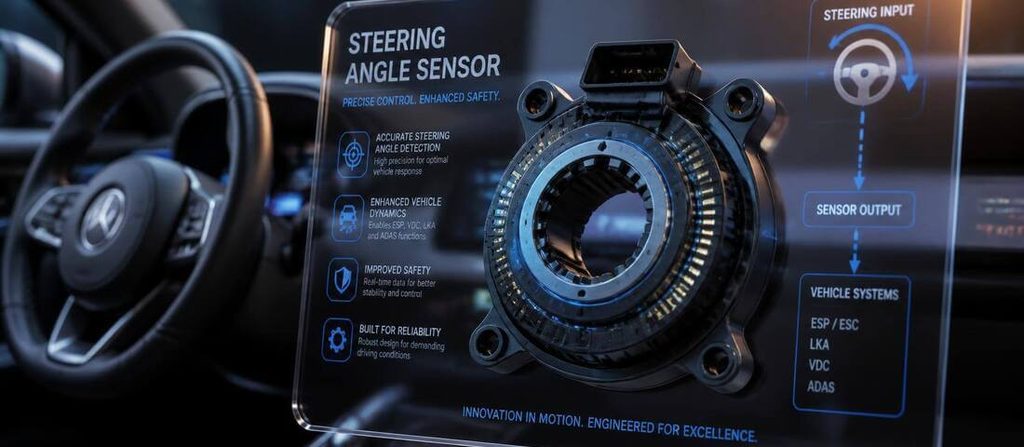
Common steering angle sensor symptoms include:
- ABS warning light
- Traction-control or ESC warning light
- Stability-control system malfunction
- Incorrect steering-angle readings
- Steering wheel/steering-angle value not centered
- Steering-angle sensor calibration failure
- Multiple ABS/ESC or communication faults
Before replacing the sensor, scan the ABS/ESC system, check whether the steering angle is correctly centered, inspect related wiring and connectors, and determine whether the vehicle requires a zero-point calibration.
Contents
- 1 What Is a Steering Angle Sensor?
- 2 7 Steering Angle Sensor Symptoms
- 2.1 1. ABS Warning Light
- 2.2 2. Traction Control or ESC Warning Light
- 2.3 3. The Steering Angle Reading Is Off Center
- 2.4 Important:
- 2.5 4. Stability Control Behaves Unexpectedly
- 2.6 5. The Sensor Won’t Calibrate
- 2.7 6. Steering Angle Doesn’t Change Correctly
- 2.8 7. Multiple Chassis or Communication Faults
- 3 Bad Steering Angle Sensor vs Calibration Problem
- 4 What Causes Steering Angle Sensor Problems?
- 5 How to Test a Steering Angle Sensor
- 6 How to Calibrate a Steering Angle Sensor
- 7 When Does a Steering Angle Sensor Need Calibration?
- 8 Can You Drive With a Bad Steering Angle Sensor?
- 9 Steering Angle Sensor vs Wheel Speed Sensor
- 10 Common Diagnostic Mistakes
- 10.1 Mistake 1: Replacing the sensor before checking calibration
- 10.2 Mistake 2: Ignoring wheel alignment
- 10.3 Mistake 3: Using a basic OBD2 scanner
- 10.4 Mistake 4: Assuming 0° is always the specification
- 10.5 Mistake 5: Ignoring the steering wheel position
- 10.6 Mistake 6: Ignoring wiring
- 10.7 Mistake 7: Calibrating without following the manufacturer procedure
- 11 FAQs About Steering Angle Sensor Symptoms
- 11.1 What are the symptoms of a bad steering angle sensor?
- 11.2 Can a bad steering angle sensor cause the ABS light to come on?
- 11.3 Can a bad steering angle sensor cause the traction control light to come on?
- 11.4 Does a steering angle sensor need calibration after an alignment?
- 11.5 How do I know if my steering angle sensor needs calibration?
What Is a Steering Angle Sensor?
The steering angle sensor measures the position and rotation of the steering system.
In modern vehicles, the information can be used by systems such as:
- Electronic stability control
- Traction control
- ABS-related functions
- Electric power steering on some vehicles
- Advanced driver-assistance systems on some vehicles
HELLA describes steering-angle sensing as measuring the angular position of the steering shaft and emphasizes the need for highly accurate measurements.
In simple terms:
The sensor tells the vehicle where you are steering.
The stability-control system can then compare the driver’s steering input with other vehicle-motion information.
7 Steering Angle Sensor Symptoms
1. ABS Warning Light
An ABS warning can appear when the ABS/ESC system detects a problem involving steering-angle information.
However, an ABS light alone doesn’t identify the steering-angle sensor as the failed component.
ABS systems also depend on:
- Wheel-speed sensors
- Brake-pressure information
- Control modules
- Wiring
- Communication networks
- Other chassis sensors
HELLA notes that ABS sensor faults can affect multiple vehicle systems, which is why fault-code diagnosis is important rather than replacing parts based solely on a warning light.
2. Traction Control or ESC Warning Light
This is one of the strongest clues.
You may see:
- Traction-control light
- ESC light
- Stability-control warning
- “Service ESC”
- “Stability Control Disabled”
- Similar manufacturer-specific messages
Why?
The stability-control system needs to know:
Where is the driver steering?
It can then compare that steering input with vehicle movement.
If the steering-angle information is missing or implausible, the system may disable or limit certain stability-control functions.
A manufacturer diagnostic document shows an invalid or uncalibrated steering-angle signal resulting in an ESC warning and ESC being switched off.
3. The Steering Angle Reading Is Off Center
This is more useful diagnostically than simply saying:
“The steering wheel feels weird.”
The steering wheel may appear physically centered, but a scan tool could show an incorrect steering-angle value.
For example, a vehicle-specific service procedure may expect the steering angle to be approximately zero degrees when the front wheels and steering wheel are centered. A 2025 FCA service bulletin, for example, specifies checking the SAS value with the steering centered and gives 0° ± 0.5° for that particular application.
Important:
That is not a universal specification.
Your article should never tell every vehicle owner that 0° ± 0.5° is the universal SAS specification.
Use the manufacturer’s specification for the exact vehicle.
4. Stability Control Behaves Unexpectedly
A faulty or incorrectly calibrated steering-angle signal can cause the stability-control system to behave incorrectly or disable itself.
Possible symptoms may include:
- ESC intervention at unexpected times
- Traction control activating unexpectedly
- Stability-control system unavailable
- Warning lights appearing during driving
Don’t assume the SAS is definitely responsible.
Wheel-speed sensor faults and other chassis problems can also affect ABS/ESC operation.
If the vehicle is actively braking individual wheels or behaving unpredictably, stop treating the problem as a simple warning-light issue.
It needs professional diagnosis.
5. The Sensor Won’t Calibrate
A failed calibration is a major clue—but again, not automatic proof of sensor failure.
Possible causes include:
- Steering wheel not centered
- Front wheels not straight
- Incorrect steering-wheel installation
- Wheel alignment problem
- Sensor installation problem
- Wiring/communication fault
- Sensor failure
- Related ABS/ESC module issue
HELLA documents cases where steering-angle calibration cannot be completed and points technicians toward sensor centering and subsequent diagnostic calibration.
6. Steering Angle Doesn’t Change Correctly
A scan tool can display the steering-angle value.
As the steering wheel moves:
Left → angle should change
Right → angle should change in the opposite direction
The value should also respond appropriately as the steering wheel rotates.
A manufacturer diagnostic procedure, for example, checks that the steering-angle value changes correctly when the wheel is turned left and right and verifies the expected approximate angular relationship.
If the value:
- Stays frozen
- Jumps
- Changes in the wrong direction
- Doesn’t return correctly
- Shows an obviously implausible value
then further diagnosis is warranted.
7. Multiple Chassis or Communication Faults
Modern vehicles communicate sensor data between modules over vehicle networks.
A steering-angle fault may therefore appear alongside:
- ABS codes
- ESC codes
- EPS codes
- CAN communication codes
- Other chassis-control faults
Don’t replace the steering-angle sensor based on one code when multiple modules are reporting communication problems.
A wiring or network problem could be the real cause.

Bad Steering Angle Sensor vs Calibration Problem
This should be the hero diagnostic section.
| Finding | Possible cause |
|---|---|
| Steering angle wrong after alignment | Calibration/zero-point issue |
| Warning appears after steering repair | Calibration or installation |
| Sensor value stuck | Sensor/circuit problem |
| Sensor value changes incorrectly | Sensor/calibration/installation |
| Sensor won’t communicate | Wiring/module/sensor |
| Wheel physically off-center | Alignment/steering geometry |
| Steering wheel centered but scan angle isn’t | Calibration/alignment issue |
| Multiple CAN faults | Communication/wiring/module problem |
The key lesson:
A steering-angle sensor can be perfectly functional but incorrectly calibrated.
That’s an important distinction for the article.
What Causes Steering Angle Sensor Problems?
Incorrect calibration
This is one of the biggest causes after steering or alignment work.
Manufacturer documentation shows that recalibration may be required after:
- Sensor replacement
- Steering linkage work
- Steering gear work
- Steering-related repairs
- Wheel alignment
- Certain accident repairs
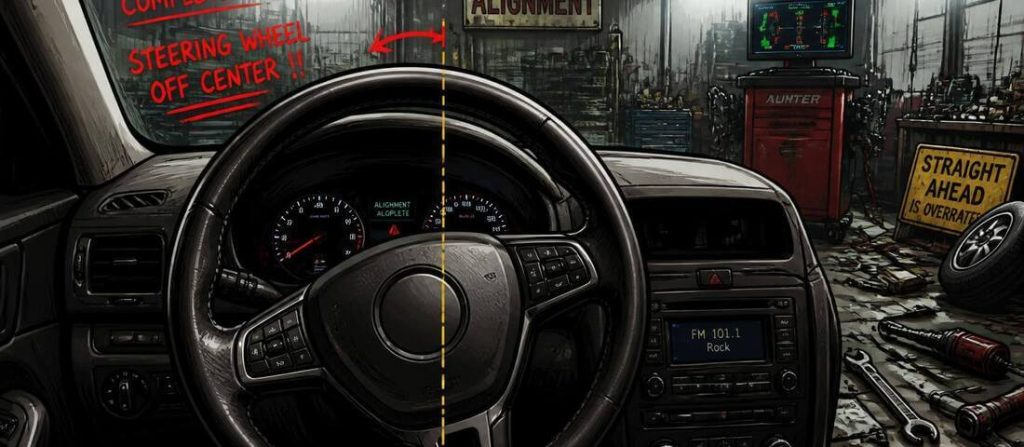
Steering wheel installed off center
If the steering wheel or steering column was reassembled incorrectly, the sensor’s zero position may no longer correspond to straight-ahead travel.
Wheel alignment problem
An alignment adjustment can change the relationship between steering-wheel position and straight-ahead wheel direction.
Some manufacturers explicitly require steering-angle calibration after alignment work.
Damaged wiring
Look for:
- Broken wires
- Chafing
- Corrosion
- Loose terminals
- Connector damage
Sensor failure
The internal sensing components can fail or become inaccurate.
HELLA identifies inaccurate steering-angle data as a possible result of sensor wear or incorrect installation.
Accident or steering-column damage
A collision can damage the sensor, steering assembly, or its mounting position.
How to Test a Steering Angle Sensor
This is where The Car Buzz should demonstrate real diagnostic expertise.
Step 1 — Scan the ABS/ESC system
A generic engine-code scanner may not be enough.
You need a diagnostic tool capable of accessing the appropriate chassis modules.
Look for:
- SAS-related DTCs
- ABS codes
- ESC codes
- EPS codes
- Communication codes
Step 2 — Check the steering wheel position
Park the vehicle on a level surface.
Check:
- Steering wheel centered
- Front wheels straight
- Tires properly positioned
- No obvious steering/suspension damage
Don’t begin calibration with the steering wheel visibly off-center.
Step 3 — Read the steering angle with a scan tool
Look at the live-data value.
With the vehicle positioned according to the manufacturer’s procedure, the value should be within the specified zero-point range.
Don’t use one universal angle specification.
A 2025 FCA procedure specifies 0° ± 0.5° for one particular application, demonstrating why vehicle-specific specifications matter.
Step 4 — Turn the steering wheel slowly
Watch the scan-tool data.
The value should:
- Change smoothly
- Change in the correct direction
- Respond to steering input
- Return appropriately
If the reading doesn’t match the steering input, investigate the sensor, mounting, calibration and wiring.

How to Calibrate a Steering Angle Sensor
This is where you need to be careful with generic advice.
There is no universal SAS calibration procedure.
Some vehicles perform a zero-point calibration through a scan tool.
Others may perform a learning procedure during a controlled drive.
Some require both.
For example, one Toyota procedure performs steering-angle zero-point calibration by driving straight at more than 7 mph for five seconds under a specific service procedure.
Another manufacturer procedure uses a scan tool’s special-function menu to learn the neutral position with the steering wheel and tires aligned straight ahead.
Therefore:
Always follow the manufacturer’s calibration procedure for the exact vehicle.
Don’t publish a universal “turn the wheel left, right, center and drive 100 feet” procedure as though it applies to every car.
When Does a Steering Angle Sensor Need Calibration?
Potential situations include:
- Steering-angle sensor replacement
- Wheel alignment
- Steering-column work
- Steering gear replacement
- Steering linkage repair
- Steering-wheel removal
- Certain suspension repairs
- Accident damage
The exact requirements vary by vehicle.
Manufacturer documentation explicitly lists steering-linkage/gear repairs and alignment among situations that may require SAS recalibration.
Can You Drive With a Bad Steering Angle Sensor?
This is a safety-critical section.
If the steering-angle sensor or its calibration is incorrect, the stability-control system may not function properly.
One manufacturer warning specifically states that failure to properly recalibrate a steering-angle sensor can cause the yaw-control system not to function correctly and may result in loss of vehicle control.
Don’t tell readers:
“You can safely drive with the light on.”
Instead:
If the ABS/ESC warning is active, assume that one or more stability-control functions may be unavailable until the system is diagnosed. Avoid aggressive driving and have the vehicle inspected promptly.
If the vehicle is steering abnormally, braking unexpectedly, or losing stability-control function, don’t continue driving it normally.
Steering Angle Sensor vs Wheel Speed Sensor
This is a useful comparison because readers commonly confuse them.
| Steering Angle Sensor | Wheel Speed Sensor |
|---|---|
| Measures steering position | Measures wheel rotation |
| Tracks driver steering input | Tracks individual wheel speed |
| Used by ESC/ABS-related systems | Critical ABS/traction/ESC input |
| Often mounted around steering column | Mounted near wheel hub/knuckle |
| Can require calibration | Usually requires correct sensor/encoder installation |
A failed wheel-speed sensor can also illuminate ABS/traction-control warnings, so don’t assume every chassis warning is a SAS problem.
Common Diagnostic Mistakes
Mistake 1: Replacing the sensor before checking calibration
A calibration problem doesn’t necessarily require a new sensor.
Mistake 2: Ignoring wheel alignment
Alignment can change the steering-angle relationship.
Mistake 3: Using a basic OBD2 scanner
Engine-code scanners may not access the ABS/ESC module.
Mistake 4: Assuming 0° is always the specification
Vehicle-specific calibration tolerances differ.
Mistake 5: Ignoring the steering wheel position
An off-center steering wheel can make a sensor appear incorrectly calibrated.
Mistake 6: Ignoring wiring
A connector or CAN communication problem can mimic sensor failure.
Mistake 7: Calibrating without following the manufacturer procedure
Some vehicles require special scan-tool functions or a specific drive cycle.
FAQs About Steering Angle Sensor Symptoms
What are the symptoms of a bad steering angle sensor?
Common symptoms include ABS, traction-control or ESC warning lights, incorrect steering-angle readings, stability-control faults, calibration failures, and steering-angle data that doesn’t respond correctly to steering input.
Can a bad steering angle sensor cause the ABS light to come on?
Yes. A steering-angle fault can cause ABS/ESC-related warnings on vehicles that use the sensor as part of their chassis-control systems. However, an ABS light alone doesn’t prove the SAS is bad.
Can a bad steering angle sensor cause the traction control light to come on?
Yes. A faulty or incorrectly calibrated steering-angle signal can cause the stability/traction-control system to report a fault or disable certain functions.
Does a steering angle sensor need calibration after an alignment?
On some vehicles, yes. Manufacturer procedures can require steering-angle calibration after wheel-alignment work. Always follow the procedure for the specific vehicle.
How do I know if my steering angle sensor needs calibration?
A scan tool can show whether the steering-angle value is centered correctly and whether calibration-related faults are stored. If the steering wheel and front wheels are straight but the reported angle is outside the vehicle’s specification, calibration may be required.