
This article was updated in August 9, 2026 with new products and information by Mark S. Taylor
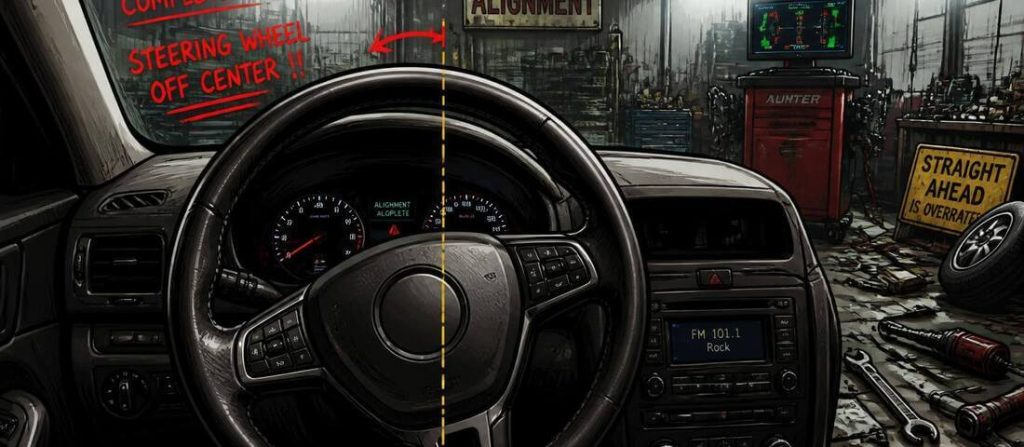
You just paid $120 for a four-wheel alignment. The shop handed you a printout covered in reassuring green boxes, you grabbed your keys, and pulled out of the parking lot. But the moment you hit a straight stretch of road, the annoyance sets in: your car is driving perfectly straight, but your steering wheel is cocked 15 degrees to the left.
Did the shop rip you off? Are your brand new tires going to be shredded by next Tuesday?
Here is the mechanic-level truth: your vehicle’s alignment is probably fine, but the technician doing the job got sloppy. The alignment machine might say your tires are pointed perfectly straight, but if the tech didn’t ensure the steering wheel was dead-center before they locked down the adjustments, you drive home with a crooked wheel.
It is incredibly frustrating, but it is also completely fixable. Let’s break down exactly why this happened, whether your car is safe to drive, and how to get that wheel sitting level again.
Contents
- 1 Vehicle Pull vs. Off-Center Steering: Know the Difference
- 2 Why Shops Give Your Car Back With a Crooked Wheel
- 3 Will Driving Like This Ruin My Tires?
- 4 How to Fix an Off-Center Steering Wheel
- 5 Don’t Forget the Steering Angle Sensor (SAS)
- 6 Repair Cost Breakdown
- 7 Prevention Tips
- 8 FAQs About Steering Wheel Off Center After Alignment
- 8.1 Will a crooked steering wheel ruin my tires?
- 8.2 Can I just take the steering wheel off and move it to center it?
- 8.3 The shop told me the steering wheel is crooked because of the “road crown.” Is that true?
- 8.4 Why did my traction control light come on after an alignment?
- 8.5 How much should a shop charge to center my steering wheel?
- 9 The Verdict
Vehicle Pull vs. Off-Center Steering: Know the Difference
Before we blame the alignment shop, we need to determine if you actually have a bad alignment or just an off-center steering wheel. These are two different problems requiring different fixes.
Test 1: The Let-Go Test Find a flat, straight, uncrowded road. Get up to cruising speed and briefly take your hands off the wheel.
- If the car continues to track reasonably straight (even if the steering wheel sits crooked while you do it), your total toe alignment is likely correct. The wheels are parallel, but the steering wheel wasn’t centered to match them.
- If the car immediately dives for the ditch or the oncoming lane when you let go, you have a vehicle pull. Your alignment is actually off, or you have a failing suspension component like a bad ball joint or a dragging brake caliper.
The Road Crown Factor Keep in mind that most roads are slightly crowned in the center so rain runs off into the gutters. If you are driving in the right lane, the car may naturally want to drift right, requiring you to hold the steering wheel slightly left to compensate. This is normal. A true off-center wheel will be crooked even on perfectly flat pavement, like an empty parking lot.
Why Shops Give Your Car Back With a Crooked Wheel
If your car passes the “Let-Go Test,” you might be wondering how a professional alignment shop could miss a steering wheel that looks like it’s turning a corner when you’re going straight.
It usually comes down to three things:
- Failing to Lock the Wheel On-Center: During an alignment, the technician places a spring-loaded tool between the driver’s seat and the steering wheel to lock it dead-center. If they eyeball it poorly, or if the tool slips while they are under the car cranking on the tie rods with a heavy wrench, the wheel moves. The tech sets the wheels perfectly straight to match a slightly crooked steering wheel.
- Relying Only on the Screen: Modern computerized alignment racks are incredibly accurate. A technician can stare at the screen, get all the numbers perfectly into the green “spec” range, and never bother to look inside the cabin to verify the steering wheel position.
- Skipping the Test Drive: This is the ultimate sin of flat-rate auto repair. A proper alignment is never finished until the technician drives the car down a flat road to verify the steering wheel is level. If they are rushing to beat the clock, they skip the test drive, and you become the quality control tester.
Will Driving Like This Ruin My Tires?
This is the first question every driver asks, and the answer usually brings a sigh of relief: Probably not.
If your car drives straight and doesn’t pull, it means your “total toe” setting is likely correct. Total toe is the relationship between the two front tires. If they are parallel to each other, they will roll smoothly down the highway without scrubbing the rubber off the tread.
The issue is your “individual toe.” Both tires are pointed slightly to the right, so to keep the car going straight, you have to hold the steering wheel slightly to the left. The tires are happy, but your OCD is triggered.
While it won’t immediately destroy your tires, you shouldn’t ignore it forever. On modern cars, driving with a crooked steering wheel can cause electronic issues (which we will cover below), so it still needs to be corrected.

How to Fix an Off-Center Steering Wheel
You have two main paths to get your steering wheel straight again. But first, let’s address a dangerous myth: Do not try to remove the steering wheel and move it over a few splines.
Back in the 1970s, mechanics could just unbolt a steering wheel, pull it off the column, rotate it a few notches, and bolt it back on. If you try that on a modern car, you will damage the clockspring (the coiled wire that connects your steering wheel electronics to the car) and potentially trigger an airbag deployment. The fix happens under the car, not in the cabin.
Option 1: The “Take It Back” Method (Highly Recommended)
If you just paid for an alignment and the wheel is crooked, take it back. Do not attempt to fix it yourself, and do not accept excuses from the service writer.
In the auto repair industry, this is called a “comeback.” Shops hate comebacks, but any reputable business will pull your car right back into the bay and fix it for free.
When you return to the shop:
- Be polite but firm: “The car tracks straight, but the steering wheel is off-center to the left. I need the tie rods adjusted to center the wheel.”
- Refuse extra charges: You already paid for the alignment. Centering the steering wheel is part of that job.
- Demand a test drive: Ask that the technician test drive the vehicle after the adjustment to verify it is fixed.
Option 2: The DIY Tie-Rod Adjustment (For Experienced Wrenches)
If the shop is closed, you live far away, or you just prefer to do things yourself, you can center the steering wheel by adjusting the tie rod ends.
Tools Required: Open-end wrenches (sizes vary by vehicle, typically 13mm to 22mm) and penetrating oil.
The Golden Rule: To fix a crooked steering wheel without ruining your alignment, you must adjust both tie rods equally and in the exact same direction relative to the chassis. Whatever you do to one side, you must do the exact opposite to the other side to maintain your total toe.
Step-by-Step:
- Identify the direction: Figure out which way the steering wheel is crooked when driving straight. If the wheel is turned to the left (counter-clockwise), it means your front tires are currently pointed slightly to the right when the steering wheel is dead-center.
- Mark your starting point: Park on a flat surface with the steering wheel locked perfectly straight. Crawl under the front of the car. Use a paint pen or a piece of tape to mark the current position of the tie rod adjusting sleeves. This is crucial so you know exactly how far you have turned them.
- Adjust the tie rods: You need to point the tires further to the left to match the centered steering wheel.
- Loosen the jam nuts on both inner tie rods.
- You will need to lengthen the left (driver’s side) tie rod and shorten the right (passenger side) tie rod.
- Turn the left tie rod out exactly one-quarter (1/4) of a turn.
- Turn the right tie rod in exactly one-quarter (1/4) of a turn.
- Tighten and Test: Snug the jam nuts back down. Take the car for a short test drive. If it’s better but still slightly off, repeat the process with smaller adjustments (1/8 of a turn).
Note: If you get confused and turn both tie rods “in” or both tie rods “out,” you will ruin your total toe, your car will handle terribly, and you will destroy your tires.

Don’t Forget the Steering Angle Sensor (SAS)
Here is a detail that both DIYers and bad alignment shops frequently miss. Almost every vehicle built after 2010 uses Electronic Power Steering (EPS) and features a Steering Angle Sensor (SAS).
This sensor tells the car’s computer exactly where the steering wheel is pointed. The computer uses this data to operate the stability control, traction control, and lane-keep assist systems.
If your alignment is adjusted so the front wheels are straight, but the SAS thinks the steering wheel is turned 10 degrees to the left, the computer gets confused. It might assume you are sliding sideways on an icy road and aggressively apply the brakes to one wheel, or illuminate the traction control warning light.
A professional alignment always includes plugging a scan tool into the OBD-II port and resetting the SAS to zero degrees once the steering wheel is physically straight. If your traction control light comes on after an alignment, the shop forgot this step.
Repair Cost Breakdown
If you are returning to the shop that just did the alignment, the cost to center the steering wheel should be $0.00. It is warranty work.
If you bought a used car with a crooked steering wheel, or hit a massive pothole and knocked things out of whack, you will need to pay for a standard alignment.
| Service | Expected Cost Range | Why You Might Need It |
|---|---|---|
| Comeback Adjustment | $0 | Shop failed to center wheel during recent alignment. |
| Standard 4-Wheel Alignment | $80 – $150 | Wheel is crooked from normal wear, or steering components were recently replaced. |
| SAS Calibration Only | $50 – $100 | Wheel is physically straight, but traction control light is on after DIY suspension work. |
| Tie Rod Replacement (per side) | $150 – $350 | Shop cannot align the car because the tie rod ends are seized with rust or worn out. |

Prevention Tips
You can’t always control the quality of the technician working on your car, but you can protect yourself before you hand over your credit card.
- Ask for the printout: Always request the “before and after” alignment printout. While it doesn’t guarantee a straight steering wheel, it proves the shop actually put the car on the rack and made adjustments.
- The Parking Lot Test: Before leaving the shop, drive the car around the block. If the wheel is crooked, do not go home. Turn right back into the service drive and hand them the keys. It is much harder for a shop to deny a problem when you haven’t even left their zip code.
- Fix worn parts first: A shop cannot properly align a car with worn-out ball joints or loose tie rod ends. If they tell you a part needs replacing before they can do the alignment, ask them to physically show you the loose part while the car is on the lift.
FAQs About Steering Wheel Off Center After Alignment
Will a crooked steering wheel ruin my tires?
If the vehicle tracks straight when you let go of the wheel, your “total toe” is likely correct, and your tires will not wear unevenly. However, if the car pulls to one side and the wheel is crooked, your alignment is out of spec and will destroy the tire tread quickly.
Can I just take the steering wheel off and move it to center it?
No. Removing a modern steering wheel to re-spline it can damage the airbag system and the clockspring. The steering wheel must be centered by adjusting the tie rods under the vehicle.
The shop told me the steering wheel is crooked because of the “road crown.” Is that true?
Only partially. Roads are sloped for drainage, which may require you to hold the wheel slightly off-center to counter the slope. However, if the steering wheel is crooked while driving in the center lane of a flat highway, or in an empty parking lot, it is an alignment error, not road crown.
Why did my traction control light come on after an alignment?
The shop likely failed to recalibrate the Steering Angle Sensor (SAS). The car’s computer thinks the steering wheel is turned when it isn’t, confusing the stability control system. The shop needs to reset the sensor with a scan tool.
How much should a shop charge to center my steering wheel?
If they recently performed an alignment, they should fix it for free. If you are taking it to a new shop, you will have to pay for a standard four-wheel alignment, which typically costs $80 to $150.
The Verdict
A perfectly straight steering wheel is the hallmark of a proper alignment. If you drive away from a shop and the wheel is cocked to one side while the car goes straight, the technician rushed the job and skipped the test drive. While it probably won’t destroy your tires immediately, you shouldn’t have to live with it. Take the car back, ask them politely to finish the job you paid for, and don’t let them tell you it’s “just the road crown.”