
This article was updated in March 25, 2026 with new products and information by Mark S. Taylor
There’s an unexplained vibration under your truck floor. Or a growling noise that changes with speed but not with steering. You’ve had the tires balanced twice and it’s still there. This is a classic pattern of a failing carrier bearing — and it affects millions of trucks and SUVs on American roads that most drivers don’t even know have one. A bad carrier bearing can produce a variety of unusual noises depending on severity. It might start with a whining or growling noise, similar to that of faulty wheel bearings, especially at higher speeds. As it worsens, the sound can become a grinding or loud clunking noise, and you might even feel vibrations in the floorboard or steering wheel. FRAM warns that these symptoms should not be ignored. This guide covers 8 symptoms of a bad carrier bearing, the free coasting test to help diagnose it, and what it will cost to fix.

Contents
- 1 Does Your Vehicle Even Have a Carrier Bearing? (Check This First)
- 2 What the Carrier Bearing Is and What Can Fail
- 3 The Free Coasting Test — The Fastest Diagnostic Tool
- 4 8 Symptoms of a Bad Carrier Bearing
- 4.1 1. Growling, Howling, or Whining Noise Under the Vehicle
- 4.2 2. Vibration Under the Floor — Speed-Specific Pattern
- 4.3 3. Clunking When Accelerating, Shifting, or Lifting Off Throttle
- 4.4 4. Burning Rubber Smell — The Early Warning Sign Most People Miss
- 4.5 5. Shuddering Under Acceleration — Especially From a Stop
- 4.6 6. Visible Rubber Deterioration, Cracking, or Excessive Play
- 4.7 7. Drivetrain Misalignment — Car Handling Affected
- 4.8 8. Complete Driveshaft Failure — The Danger of Ignoring It
- 5 Carrier Bearing vs. U-Joint vs. Wheel Bearing — Disambiguation Table
- 6 The Non-Serviceable Driveshaft Warning
- 7 Is It Safe to Drive With a Bad Carrier Bearing?
- 8 Carrier Bearing Replacement Cost
- 9 FAQs About Symptoms of a Bad Carrier Bearing
- 10 Bottom Line — What to Do Right Now
Does Your Vehicle Even Have a Carrier Bearing? (Check This First)
Not all vehicles have a carrier bearing; it depends on the driveshaft length. If you drive a small car, you likely do not have one.
The driveshaft sits between the transmission and the differential. On longer vehicles, the driveshaft is two pieces. It needs a support in the middle. That support is the carrier bearing. Car Mods Australia notes that extended wheelbase vehicles use this setup.
Vehicles that typically have carrier bearings:
| Has a Carrier Bearing | Usually Does NOT Have a Carrier Bearing |
|---|---|
| Extended/crew-cab trucks (F-150, Silverado, Ram, Tacoma) | Compact cars (Honda Civic, Toyota Corolla) |
| Full-size SUVs (Tahoe, Suburban, Expedition) | Front-wheel-drive vehicles (most sedans and crossovers) |
| Full-size vans (Transit, Express) | Short-wheelbase RWD vehicles |
| Long-wheelbase AWD sedans (Dodge Charger AWD) | 4-cylinder short-wheelbase trucks |
If you drive a compact car or FWD crossover, you likely do not have this part. If you drive a full-size truck, read on.
What the Carrier Bearing Is and What Can Fail
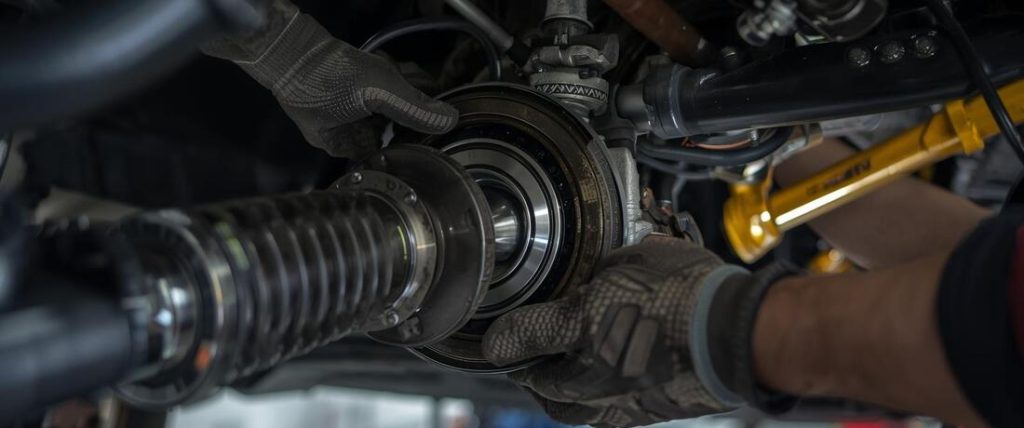
The carrier bearing is a rubber-mounted bearing that holds up the middle of a long driveshaft. It bolts to the vehicle’s chassis.
BobIsTheOilGuy explains that it allows the driveshaft to rotate smoothly while the suspension moves. There are two parts inside that can fail:
| Component | What It Does | How It Fails |
|---|---|---|
| Rubber isolator | Absorbs vibration; allows slight movement | Cracks, hardens, or collapses from age/heat. This is the most common failure. |
| Ball bearing inside | Allows smooth rotation | Wears out, dries up, or corrodes. This causes grinding. |
A carrier bearing rarely fails instantly. Symptoms appear slowly and get worse over time.
The Free Coasting Test — The Fastest Diagnostic Tool
You can tell if it’s the carrier bearing by seeing if the noise changes when you coast. This test is free and takes one minute.
Drive at 30–45 mph. Lift your foot completely off the gas. Listen and feel carefully.
Interpret results:
| Condition | What You Feel/Hear | Most Likely Cause |
|---|---|---|
| Vibration/noise worse when coasting | Rumble increases when you slow down | Rubber isolator worn. The driveshaft wobbles more without load. |
| Vibration worse under power | Shudder or clunk on acceleration | Bearing itself worn. It wobbles under torque. |
| Noise constant at speed | Steady growl centered under vehicle | Could be carrier bearing or a wheel bearing. |
| Noise changes when turning | Noise shifts left or right | Likely a wheel bearing, not the carrier bearing. |
A Quora forum expert confirms you get vibration when slowing down if the carrier bearing is bad. Under acceleration, the load holds it steady.
8 Symptoms of a Bad Carrier Bearing
1. Growling, Howling, or Whining Noise Under the Vehicle
A bad carrier bearing often makes a howling or squealing noise when you speed up. The noise might quiet down as you go faster.
Westwood Honda notes that worn bearings cause rumbling or whirring sounds above 20 mph. The key is the location. Wheel bearing noise comes from a corner of the car. Carrier bearing noise comes from the center. It stays in the middle of the floor.
2. Vibration Under the Floor — Speed-Specific Pattern
You will feel a vibration in the floor or center console at specific speeds. It often happens between 20–45 mph.
BobIsTheOilGuy states that unusual vibrations are a common sign. You feel it most on the center console or shifter. This happens because the driveshaft wobbles at a specific resonance speed. It might smooth out at highway speeds. If you feel shaking elsewhere, check our guide on symptoms of bad shocks or struts.
3. Clunking When Accelerating, Shifting, or Lifting Off Throttle
A clunking noise when you hit the gas or shift gears indicates play in the driveshaft. This sounds like a metal knock.
Jroneturbo explains that the driveshaft moves too much when the bearing wears out. It clunks as the drivetrain loads and unloads. People often confuse this with a bad U-joint. The two problems can happen at the same time. If you have shifting issues, check our article on symptoms of a bad transmission valve body to rule that out.
4. Burning Rubber Smell — The Early Warning Sign Most People Miss
A burning rubber smell often appears before the noise or vibration gets bad. This is a valuable early warning.
HTSaves notes that the rubber isolator heats up from friction. It smells like a slipping belt. If you smell this and don’t have a loose belt, check the carrier bearing. This happens after off-roading or heavy use.
5. Shuddering Under Acceleration — Especially From a Stop
The truck may shudder or jerk when you start moving from a stop. This feels like a stutter in the driveline.
Westwood Honda explains that the driveshaft flexes incorrectly when the bearing fails. This causes vibration. It feels like a transmission issue. However, transmission shudder is usually smoother. Carrier bearing shudder feels more directional or rhythmic.
6. Visible Rubber Deterioration, Cracking, or Excessive Play
You can often see the damage if you look under the truck. The rubber will look cracked or pushed out.
Car Mods Australia advises checking the rubber seal. If the rubber is loose or protruding, replace the bearing. You can also push on the driveshaft. If it moves up and down more than 1/8 inch, the bearing is worn.
7. Drivetrain Misalignment — Car Handling Affected
A worn bearing can make the driveshaft sag, which hurts handling. The car may feel unstable.
BobIsTheOilGuy warns that misalignment stresses the transmission and differential. The vibrations can affect steering. If the steering feels loose, look at our guide on signs of car suspension issues.
8. Complete Driveshaft Failure — The Danger of Ignoring It
Ignoring the signs can lead to the driveshaft breaking off and hitting the ground. This is dangerous.
FRAM warns that a driveshaft can break and cause a sudden loss of control. It can smash into the chassis or the ground. This turns a small repair into a major accident.
The progressive failure sequence:
| Stage | What You Experience | Action |
|---|---|---|
| Stage 1 | Slight growl; maybe burning smell. | Book inspection within 2 weeks. |
| Stage 2 | Vibration at speed; clunking. | Book this week; avoid long trips. |
| Stage 3 | Severe shudder; violent vibration. | Stop and tow. Risk of chassis damage. |
| Stage 4 | Sudden loss of drive. | Tow only. Major damage likely. |
Carrier Bearing vs. U-Joint vs. Wheel Bearing — Disambiguation Table
Use this table to tell the difference between similar noises. Car Mods Australia suggests checking U-joints too, as they often fail together.
| Diagnostic Feature | Carrier Bearing | U-Joint | Wheel Bearing |
|---|---|---|---|
| Noise location | Center under floor | Center under vehicle | One corner of vehicle |
| Changes when turning? | ❌ No | ❌ No | ✅ Yes (changes with turn) |
| Speed-specific vibration? | ✅ Yes (20–45 mph) | ✅ Yes (rhythmic click) | ✅ Yes (increases with speed) |
| Clunk on acceleration? | ✅ Yes | ✅ Yes (binding) | ❌ No |
| Worse coasting vs. power? | ✅ Worse coasting | ❌ Worse under load | ❌ Constant |
| Burning rubber smell? | ✅ Yes (early sign) | ❌ No | ❌ No |
The Non-Serviceable Driveshaft Warning
Some cars require you to replace the whole driveshaft because you cannot change just the bearing. This costs much more.
Kelley Blue Book notes that some Dodge and Chrysler models have integrated bearings. You cannot press the old one out. You must buy a whole new driveshaft assembly. Always ask your shop if the bearing is serviceable on your car.
Is It Safe to Drive With a Bad Carrier Bearing?
It is risky to drive with a bad bearing because it can damage other parts. FRAM warns it can hurt the differential and transmission.
| Symptom Level | Safe to Drive? | Action |
|---|---|---|
| Slight growl | ⚠️ Short term | Book inspection within 2 weeks. |
| Persistent vibration | ⚠️ Caution | Avoid highway trips; book this week. |
| Clunking + vibration | ❌ Not recommended | Cascading damage risk; book urgently. |
| Severe shudder/grinding | ❌ Not safe | Risk of driveshaft hitting chassis; tow it. |

Carrier Bearing Replacement Cost
Replacing a carrier bearing typically costs between $150 and $450 installed. TurboPACS provides this estimate.
| Service | Estimated US Cost |
|---|---|
| Carrier bearing (parts only) | $30 – $150 |
| Carrier bearing replacement (installed) | $150 – $450 |
| Driveshaft replacement (if non-serviceable) | $600 – $1,600 |
| U-joint replacement (recommended at same time) | Add $80 – $200 |
Always inspect the U-joints during this job. They often wear out together.
FAQs About Symptoms of a Bad Carrier Bearing
How do I know if it’s the carrier bearing or the U-joint?
The location helps. Carrier bearing noise is centered under the floor. A U-joint noise is similar but often gets worse under load (accelerating). The carrier bearing often gets worse when coasting. A U-joint often clicks rhythmically.
Can I drive with a bad carrier bearing?
Driving is risky. It causes vibrations and can damage the differential. If the vibration is severe, stop driving. The driveshaft could fall off and cause an accident.
How much does carrier bearing replacement cost?
The cost is usually $150 to $450 for parts and labor. If your car requires a full driveshaft replacement, the cost jumps to $600–$1,600. Ask your mechanic if the bearing is serviceable.
What does a bad carrier bearing sound like?
It starts as a whine or growl at 20 mph. It sounds like a wheel bearing but comes from the center of the car. As it gets worse, it turns into a grinding or clunking noise.
How long does a carrier bearing last?
They usually last 75,000 to 150,000 miles. Lifted trucks or those driven off-road often see shorter life spans due to angle changes.
Bottom Line — What to Do Right Now
Follow this action guide based on the symptoms you have right now.
- Growling noise centered under the floor: Do the coasting test. Inspect the rubber isolator for cracks.
- Burning rubber smell: Check the carrier bearing bracket immediately. This is your cheapest chance to fix it.
- Vibration at 20–35 mph: This is the classic speed band. Check the bearing and U-joints together.
- Dodge Charger/Challenger/300: Ask if your bearing is serviceable before approving work. You might need a whole shaft.
- Severe shuddering: Stop driving. Tow the truck to a shop.
Golden rule: The burning rubber smell is the best early warning. Catch it there for a $200 fix. Wait until violent vibration, and you risk a $1,500 driveshaft replacement or a crash.
Quick Summary:
- Not all cars have a carrier bearing; check your driveshaft.
- The noise is centered under the car, unlike wheel bearings.
- Vibration often happens between 20–45 mph.
- A burning rubber smell is an early warning sign.
- Do the “coasting test” to see if noise changes without the gas pedal.
- Some cars need a whole new driveshaft, not just a bearing.
- Ignoring it can cause the driveshaft to break and hit the ground.