
This article was updated in May 24, 2026 with new products and information by Mark S. Taylor
If your shift position sensor isn’t working properly, your car is probably doing one of three things right now: it won’t shift out of Park, it’s stuck in one gear with the Check Engine Light blazing, or the dash shows you’re in “Drive” when you’re actually in “Park.” The good news: this is almost always a $100–$300 sensor or wiring fix — not a transmission rebuild. The bad news: until it’s fixed, your car may strand you or lock itself in limp mode.
I’ve spent 20 years as an ASE-certified master technician, and I’ve seen shift position sensors misdiagnosed as “needs a new transmission” more times than I can count. In this guide, you’ll learn what this sensor actually does, how to test it yourself in 3 minutes, what it’ll cost, and how to safely drive your car if it’s stuck in limp mode.

Contents
- 1 What Is a Shift Position Sensor? (And Why the Names Are Confusing)
- 2 The Top Symptoms (What You’ll Actually Feel)
- 3 The 3-Minute Field Tests (Before You Pay for a Diagnostic)
- 4 Common Causes (It’s Not Always the Sensor)
- 5 Repair Cost Breakdown (2026 Estimates)
- 6 Can You Drive It? Limp Mode Strategy
- 7 DIY Replacement: Is It Realistic?
- 8 FAQs About Shift Position Sensor Not Working Properly
- 8.1 Is a shift position sensor the same as a neutral safety switch?
- 8.2 Can I drive with a bad shift position sensor?
- 8.3 How much does it cost to replace a shift position sensor?
- 8.4 Can a bad shift position sensor cause transmission damage?
- 8.5 Why does my car start in Neutral but not Park?
- 8.6 Do I need to program a new shift position sensor?
- 9 The Bottom Line
What Is a Shift Position Sensor? (And Why the Names Are Confusing)
The part you’re dealing with has at least four names depending on your vehicle’s age and manufacturer. Here’s the evolution:
Table
| Name | Era | What It Does | Vehicles |
|---|---|---|---|
| Neutral Safety Switch (NSS) | 1960s–1990s | Simple switch: prevents starting unless in Park/Neutral; turns on reverse lights | Older American cars, classic vehicles |
| Inhibitor Switch | 1980s–2000s | Same as NSS, but Asian manufacturer term (Toyota, Honda, Nissan, Kia) | Most Japanese and Korean vehicles |
| Transmission Range Sensor (TRS) | 1990s–present | Multi-function digital sensor: tells PCM exact gear position, controls starter interlock, reverse lights, shift timing | Most modern automatics |
| Shift Position Sensor | 2000s–present | Often used interchangeably with TRS; sometimes refers to the sensor inside the transmission (internal) vs. on the outside (external) | European and some domestic vehicles |
The mechanic’s rule: If your car is 1995 or older, you probably have a simple neutral safety switch with 2–4 wires. If it’s 1996 or newer, you almost certainly have a digital transmission range sensor with 6–10 wires sending data to the PCM. The symptoms are similar, but the diagnostic approach differs.
Why it matters: A simple NSS can often be adjusted. A digital TRS usually must be replaced (though sometimes it just needs recalibration). Knowing which you have saves time and money at the shop.
The Top Symptoms (What You’ll Actually Feel)
1. Car Won’t Move Out of Park
This is the most common and most frustrating symptom. You press the brake, move the shifter, and nothing happens. Or the shifter moves freely but the transmission stays in Park.
Why it happens: The TRS tells the PCM what gear you’ve selected. If the sensor fails or sends no signal, the PCM doesn’t know you’ve shifted out of Park. The shift interlock solenoid stays engaged, locking the shifter. In some vehicles, the PCM also commands the transmission to stay in Park electronically.
The mechanic’s test: If your brake lights work but the shifter won’t move, the problem is likely the shift interlock system — which gets its signal from the TRS. If the brake lights don’t work either, check the brake light switch first.
2. PRNDL Display Shows the Wrong Gear
You shift to “Drive” but the dash still shows “P” or “N.” Or you shift to “Reverse” and the dash shows “D.” This is the fastest diagnostic clue that the sensor is lying to the computer.
Why it happens: The TRS sends a voltage signal to the PCM for each gear position. A failing sensor may send the wrong voltage or no voltage at all. The PCM displays whatever it last saw — or defaults to a safe position.
The mechanic’s test: Sit in the car with the engine running. Shift slowly through every gear while watching the dash display. If the display lags, jumps, or shows wrong positions, the TRS is failing. This test takes 10 seconds and requires no tools.
3. Transmission Shifts Into the Wrong Gear
You’re cruising at 55 mph and the transmission suddenly downshifts to 2nd gear. Or you accelerate from a stop and it starts in 3rd instead of 1st.
Why it happens: The PCM uses TRS data to command shift timing and gear selection. If the sensor tells the PCM you’re in “L” (Low) when you’re actually in “D,” the PCM holds lower gears and revs the engine. If it thinks you’re in “N” (Neutral), it may refuse to shift at all.
4. Limp Mode (Locked in a Single Gear)
Many modern vehicles detect TRS failure and activate limp mode — usually locking the transmission in 2nd gear or 3rd gear to protect itself. The Check Engine Light comes on, and the car won’t shift no matter what you do with the shifter.
Why it happens: The PCM detects an implausible signal from the TRS (e.g., voltage for “P” and “D” simultaneously, or no signal at all). Rather than risk catastrophic shifting errors, the PCM defaults to a single safe gear and stores a code.
What it feels like: The car accelerates slowly from a stop because it’s starting in 2nd gear. It won’t upshift on the highway. The engine revs high but speed doesn’t increase. The CEL is on solid or flashing.
5. No-Start Condition (Especially in Park)
You turn the key and hear a click — or nothing at all — but the car starts fine in Neutral. Or it starts in “Drive” or “Reverse” (dangerous).
Why it happens: The TRS includes the neutral safety function. If the sensor doesn’t detect “Park” or “Neutral,” it won’t allow the starter to engage. A misaligned or failing sensor may not make contact in Park but still work in Neutral. Conversely, a failed sensor may allow starting in any gear — a serious safety hazard.
6. Reverse Lights Not Working (Or On in Wrong Gear)
Your reverse lights don’t come on when you shift to Reverse. Or they stay on when you’re in Drive.
Why it happens: The TRS controls the reverse light circuit. A failing sensor sends the wrong signal to the body control module (BCM), which controls the lights.
The mechanic’s test: This is actually a great diagnostic shortcut. If your reverse lights are erratic, the TRS is almost certainly the cause — before you even scan for codes.
The 3-Minute Field Tests (Before You Pay for a Diagnostic)
Before you spend $100–$150 on a shop diagnostic fee, run these tests:
Test 1: The PRNDL Wiggle Test (10 seconds) With the engine running, shift slowly from Park through every gear. Watch the dash display. Does it match the shifter position instantly? Does it lag? Does it show wrong gears? Any mismatch = TRS failure.
Test 2: The Reverse Light Test (10 seconds) Have a friend stand behind the car. Shift to Reverse — do the lights come on? Shift to Drive — do they go off? Shift back to Reverse — do they come on immediately? Erratic behavior = TRS failure.
Test 3: The No-Start Position Test (20 seconds) Try starting the car in Park. Then try Neutral. Then try Drive (foot on brake, be ready). If it starts in Drive or Reverse, the neutral safety function has failed completely — tow it, don’t drive it. If it only starts in Neutral, the sensor is misaligned or worn.
Test 4: The Code Scan (1 minute) If you have an OBD-II scanner, check for codes. The big ones are:
- P0705 — Transmission Range Sensor Circuit Malfunction
- P0706 — Transmission Range Sensor Circuit Range/Performance
- P0700 — Transmission Control System Malfunction (general, needs deeper scan)
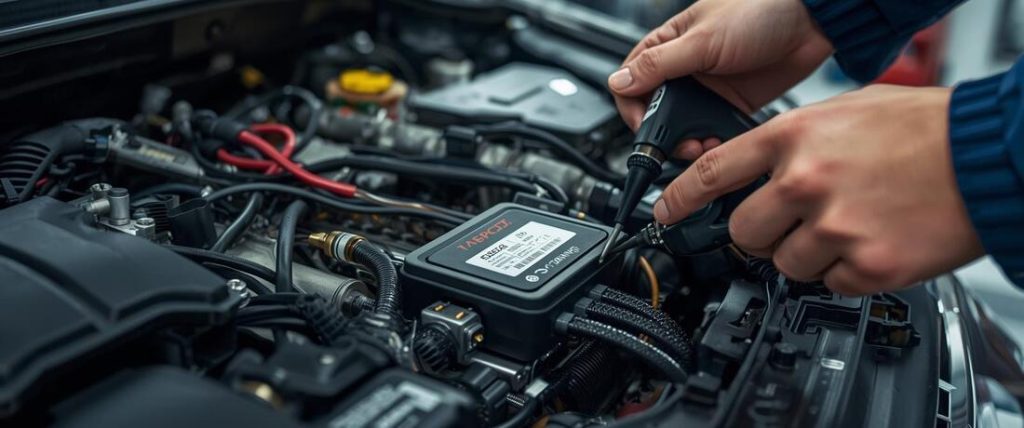
Test 5: The Visual Inspection (30 seconds) Pop the hood. Find the TRS on the transmission (usually on the driver’s side, where the shift cable connects). Look for:
- Corroded or loose connector
- Damaged wiring
- Fluid leaks around the sensor
- Physical damage from road debris
If the connector is green with corrosion, clean it with electrical contact cleaner before you replace the sensor. I’ve fixed “failed” sensors with a $5 can of cleaner.
Common Causes (It’s Not Always the Sensor)
Before you buy a new sensor, rule these out:
Wiring harness damage: Rodents, heat, vibration, or previous collision repair can damage the wires between the TRS and PCM. A sensor that tests good at the connector may not be getting power or ground.
Corroded connector: The TRS lives in a harsh environment — heat, vibration, road salt, and transmission fluid vapors. The electrical connector corrodes over time. Clean it first.
Shift linkage misalignment: If the shift cable or linkage is out of adjustment, the TRS may read correctly but the transmission is actually in a different gear. This mimics sensor failure. Adjustment is cheaper than replacement.
Low transmission fluid: Extremely low fluid can cause erratic shifting that feels like sensor failure. Check the dipstick first.
TCM failure: In rare cases, the transmission control module itself is corrupting the TRS signal. This requires professional diagnosis with a scan tool that can read live data.
Repair Cost Breakdown (2026 Estimates)
Table
| Repair | Parts | Labor | Total Cost | DIY Possible? |
|---|---|---|---|---|
| TRS sensor (external, most common) | $40–$120 (aftermarket) / $120–$280 (OEM) | $80–$150 | $120–$400 | Yes — usually 30–60 min |
| TRS sensor (internal, in transmission) | $60–$150 | $250–$500 (pan drop/valve body) | $350–$650 | No — shop required |
| Neutral safety switch (older vehicle) | $30–$80 | $60–$100 | $90–$180 | Yes — often adjustable |
| Wiring harness repair | $20–$80 | $100–$200 | $120–$280 | Sometimes — if accessible |
| Shift linkage adjustment | $0–$50 | $80–$150 | $80–$200 | Sometimes — specs needed |
| Diagnostic fee | N/A | $80–$150 | $80–$150 | N/A — but you can skip it with the tests above |
| Transmission control module reflash | $0–$100 | $150–$300 | $150–$400 | No — dealer/shop only |
Cost factors that move the needle:
- Vehicle make: European sensors (BMW, Mercedes, VW) often cost 2–3x more than domestic or Asian sensors
- Location: External sensors on top of the transmission are easy; sensors buried under the air intake or behind the engine cost more in labor
- OEM vs. aftermarket: Dorman, Standard Motor Products, and NTK make quality aftermarket TRS units for 40–60% less than dealer parts. For most daily drivers, aftermarket is fine.
Money-saving tip: If you have a P0705 or P0706 code and the sensor is external, buy the aftermarket sensor for $60 and swap it yourself in 30 minutes. Even if you’re wrong, you’re out $60 — not $150 for a diagnostic plus $300 for shop labor.
Can You Drive It? Limp Mode Strategy
Table
| Severity | Symptom | Can You Drive? | Action |
|---|---|---|---|
| 🟢 Soon | PRNDL display slightly off, occasional harsh shift, CEL on solid | Yes — short trips | Schedule within a week; scan codes |
| 🟡 Carefully | Limp mode (locked in 2nd/3rd), starts in wrong gear, no-start in Park | Short trips to shop only; avoid highways | Drive directly to shop; max 35 mph |
| 🔴 Tow Now | Starts in Drive/Reverse, no neutral safety function, transmission shifts randomly | No — tow it | Immediate repair; safety hazard |
Driving in limp mode: If your car is locked in 2nd gear, you can usually drive it slowly to the shop. Limp mode is designed to protect the transmission — not damage it. Keep speed under 40 mph, avoid steep hills, and don’t tow anything. The high RPMs at highway speed will overheat the transmission fluid.
The mechanic’s rule: Limp mode won’t hurt your transmission for a 10-mile trip to the shop. Ignoring limp mode and driving 200 miles on the interstate will.

DIY Replacement: Is It Realistic?
Table
| Sensor Type | Difficulty | Tools Needed | Time | Worth DIY? |
|---|---|---|---|---|
| External TRS (mounted outside transmission) | 2/5 | Socket set, screwdriver, multimeter | 30–60 min | Yes — saves $150+ in labor |
| Internal TRS (inside transmission pan) | 4/5 | Full socket set, torque wrench, transmission fluid, gasket | 2–4 hours | No — shop recommended |
| Neutral safety switch (older vehicle) | 2/5 | Wrenches, multimeter | 30–45 min | Yes — often adjustable |
The mechanic’s honest take: External TRS replacement is genuinely easy on most vehicles. The sensor bolts to the side of the transmission, has one electrical connector, and usually one or two bolts. The hardest part is often reaching it past the air intake or exhaust heat shield. Internal sensors require dropping the transmission pan, draining fluid, and sometimes removing the valve body — that’s shop territory.
Critical note: Some TRS units require calibration after installation. The PCM needs to learn the voltage ranges for each gear position. This requires a scan tool with bidirectional control — not a basic code reader. If you replace the sensor and still have issues, it may need calibration at a shop or dealer.
FAQs About Shift Position Sensor Not Working Properly
Is a shift position sensor the same as a neutral safety switch?
Sort of — but not exactly. A neutral safety switch (older vehicles) has one job: prevent starting unless you’re in Park or Neutral. A modern transmission range sensor (TRS) does that plus tells the PCM exactly what gear you’re in for shift timing, reverse lights, and limp mode decisions. Think of the TRS as a neutral safety switch with a college degree.
Can I drive with a bad shift position sensor?
It depends on the symptom. If the PRNDL display is slightly off but the car shifts normally, you can drive short distances. If the car is in limp mode (locked in one gear), drive slowly and directly to the shop. If the car starts in Drive or Reverse, tow it — that’s a safety hazard.
How much does it cost to replace a shift position sensor?
External sensors run $120–$400 installed. Internal sensors run $350–$650 because the transmission pan must be dropped. Aftermarket sensors cost $40–$120; OEM sensors cost $120–$280. Labor is usually $80–$150 for external, $250–$500 for internal.
Can a bad shift position sensor cause transmission damage?
Not directly — the sensor itself doesn’t touch the gears or clutches. However, if the sensor causes erratic shifting (e.g., downshifting to 1st at highway speed), that mechanical shock can stress the transmission. Limp mode exists specifically to prevent this by locking the transmission in a safe gear.
Why does my car start in Neutral but not Park?
The TRS contact for “Park” is worn or misaligned, but the “Neutral” contact still works. This is common as the sensor ages. You can usually drive by starting in Neutral, but the sensor needs replacement soon — the Neutral contact will wear next.
Do I need to program a new shift position sensor?
Some vehicles require calibration after TRS replacement — especially European makes (BMW, Mercedes, VW) and some newer domestics. The PCM learns the voltage output of the sensor for each gear position. A basic OBD-II scanner can’t do this; you need a professional scan tool with bidirectional capabilities.
The Bottom Line
A shift position sensor that’s not working properly is annoying, potentially dangerous, and often misdiagnosed — but it’s rarely expensive. Most external sensors are $100–$300 fixes that take less than an hour. The key is confirming the sensor with the PRNDL wiggle test and code scan before a shop talks you into a $2,000 valve body replacement.
Here’s your action plan: Run the 3-minute field tests. If the PRNDL display doesn’t match the shifter, or you have codes P0705/P0706, and the sensor is external, replace it yourself or have a shop do it for under $400. If the sensor is internal, or the problem persists after replacement, get professional diagnosis for wiring or TCM issues.
Don’t let a $60 sensor strand you or scare you into a transmission rebuild. Test it, confirm it, fix it, and drive on.