
This article was updated in July 23, 2026 with new products and information by Mark S. Taylor
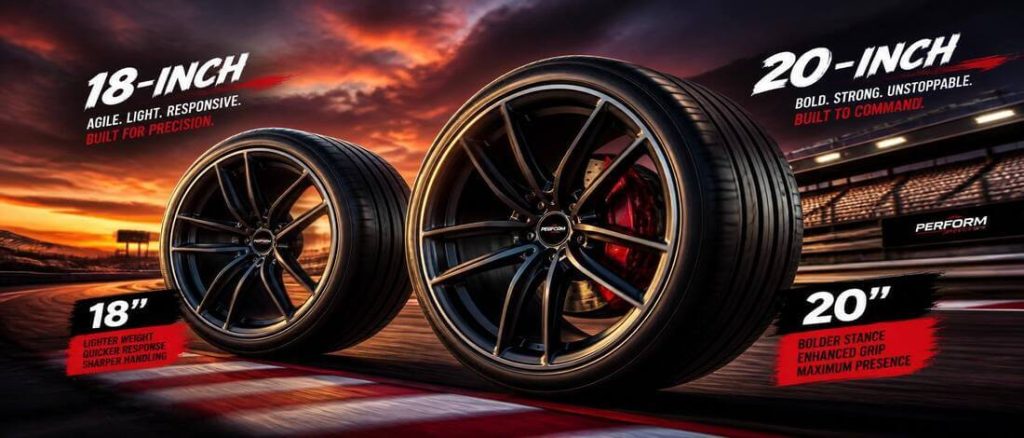
Standing at the dealership or scrolling a wheel shop, you’ve probably hit the same fork in the road: stick with 18-inch wheels or step up to 20s. They change how your car looks, but they also change how it rides, handles, sounds, and even what it costs to keep on the road.
Here’s the short version: 18-inch wheels give you a smoother ride, better fuel economy, and lower costs, while 20-inch wheels give you a more aggressive look and sharper handling feel — at the expense of comfort and money. Almost every difference between them comes down to two things: how much tire sidewall you have, and how much the wheels weigh.
This guide breaks down each trade-off and why it happens, covers the fitment details most articles skip (like keeping your speedometer accurate), puts real numbers to the cost difference, and ends with a simple way to pick the right size for how you actually drive.
Contents
- 1 What “18 vs 20-Inch” Actually Means
- 2 The Key Differences at a Glance
- 3 Ride Comfort and Noise
- 4 Handling and Performance
- 5 Fuel Economy
- 6 Durability and Road Hazards
- 7 Cost Comparison
- 8 Can You Switch From 18 to 20 (or Back)?
- 9 How to Choose the Right Size for You
- 10 FAQs About 18 vs 20-Inch Wheels: What’s the Difference?
- 11 Bottom Line
What “18 vs 20-Inch” Actually Means
First, let’s clear up the most common confusion. The “18-inch” or “20-inch” number refers to the diameter of the metal wheel (the rim) — not the tire. A 20-inch wheel is simply two inches taller in rim diameter than an 18-inch wheel.
Here’s the part that matters: when you go up in wheel size the smart way, you keep the overall tire diameter the same by using a tire with a shorter sidewall. This is called plus-sizing. So a 20-inch setup uses a lower-profile tire — less rubber between the rim and the road — while an 18-inch setup uses a taller sidewall. The whole wheel-and-tire package ends up roughly the same height, which keeps your speedometer accurate and your car’s gearing unchanged.
That single fact — bigger rim means shorter sidewall — is the root of nearly everything else. Comfort, handling, noise, durability, and cost all flow from how much sidewall cushion you have and how much the bigger wheel weighs. Keep that in mind and the rest of this comparison makes sense.
The Key Differences at a Glance
Here’s how the two sizes stack up across the things that actually matter:
| Factor | 18-Inch Wheels | 20-Inch Wheels |
|---|---|---|
| Ride comfort | Smoother — more sidewall cushion | Firmer — you feel more of the road |
| Handling feel | Slightly softer, more relaxed | Sharper, more responsive steering |
| Road noise | Quieter | More noise and vibration |
| Fuel economy | Usually a touch better | Usually slightly worse |
| Acceleration & braking | Lighter, a bit quicker to respond | Heavier, marginally slower |
| Wheel/tire durability | Better — sidewall protects the rim | More prone to pothole/curb damage |
| Off-road/rough roads | Better suited | Less forgiving |
| Cost (wheels + tires) | Lower upfront and over time | Higher upfront and over time |
| Appearance | Balanced, understated | Aggressive, premium, “fills” the arch |
Notice the pattern. The 18s win on comfort, efficiency, durability, and cost; the 20s win on looks and handling sharpness. There’s no single “better” size — it’s a genuine trade-off, and the right answer depends on what you value. The next sections explain the why behind each row.
Ride Comfort and Noise
If comfort is high on your list, 18s have the edge, and it’s not a subtle one. The taller sidewall on an 18-inch tire has more rubber and air to flex and compress, so it acts like an extra shock absorber. Bumps, expansion joints, and potholes get softened before they reach the cabin.
Drop to the lower-profile tire on a 20-inch wheel and you lose a chunk of that cushion. There’s simply less sidewall between the rim and the pavement, so more of every road imperfection transmits straight into the car. On rough or broken roads, that difference is easy to feel.
Noise follows the same logic. Less sidewall and a stiffer tire tend to transmit more road roar and vibration into the cabin, so 20s are usually a bit louder than 18s on coarse surfaces. If most of your driving is commuting on imperfect roads, the 18s will feel calmer and quieter day to day.
Handling and Performance
This is where 20s earn their keep. The shorter, stiffer sidewall flexes less when you turn, so the tire responds more immediately to steering input. That makes the car feel sharper and more planted in corners, which is exactly why performance-minded drivers like the bigger wheels. On dry pavement, 20s can give you more precise, connected steering.
But here’s the myth worth busting: bigger wheels don’t make your car faster. Larger wheels are generally heavier, and that added weight sits where it hurts most — as unsprung, rotating mass out at the corners. Instrumented testing by Car and Driver on upsized wheels found that the extra weight actually hindered acceleration rather than helping it. Heavier wheels also ask a little more of your brakes.
So the honest picture is this: 20s sharpen how the car feels in corners and look the part, but they won’t win you a stoplight drag race, and they add a bit of load to acceleration and braking. If you want engagement and looks, 20s deliver; if you want outright quickness, wheel size isn’t your friend.
Fuel Economy
Bigger wheels usually cost you a little at the pump. Two things are at work: heavier wheels take more energy to spin up, and lower-profile setups can carry slightly higher rolling resistance depending on the tire. The result is that 20-inch setups typically return marginally worse fuel economy than 18s on the same vehicle.
The difference isn’t dramatic — you’re not going to halve your MPG — but over years of driving it adds up alongside the pricier tires. If squeezing the most miles out of every gallon matters to you, the lighter 18-inch package is the efficiency-friendly choice.
Durability and Road Hazards
This is a real-world category that gets overlooked, and it favors the 18s. More sidewall doesn’t just cushion your ride — it protects your wheels. Here’s how the two compare when the road fights back:
Pothole and curb damage. With an 18-inch tire, the taller sidewall absorbs impacts that would otherwise reach the rim. On a 20-inch setup, there’s less rubber between the pothole and the metal, so bent and cracked rims are more common.
Tire blowouts. Low-profile tires have less give, so a hard hit is more likely to pinch or damage the tire against the rim.
Rough and unpaved roads. If you drive gravel, dirt, or badly maintained streets, 18s take the abuse far better. Truck and SUV owners who see any off-pavement use almost universally recommend the smaller wheel.
Repair frequency. More vulnerable rims and tires mean 20-inch owners tend to visit the shop more often for bent-wheel and damaged-tire repairs.
If your commute is a minefield of potholes, or you head off the pavement at all, the extra sidewall of an 18-inch setup is genuine insurance for your wheels and your wallet.
Cost Comparison
Wheel size hits your budget twice: once upfront, and again every time you replace tires or fix damage. Twenties cost more on both counts.
| Cost factor | 18-Inch | 20-Inch |
|---|---|---|
| Wheels (set of 4) | $600–$1,200 | $900–$1,700+ |
| Tires (set of 4) | $500–$900 | $700–$1,400+ |
| Per-tire replacement | $120–$225 | $175–$350+ |
| Pothole/curb repair risk | Lower | Higher (more frequent) |
| Overall cost of ownership | Lower | Higher |
Low-profile 20-inch tires are simply more expensive to buy and replace than taller 18-inch tires, and there are usually fewer budget options. Add the higher odds of bending a rim or ruining a low-profile tire on a pothole, and the 20s carry a meaningfully higher long-term cost. One money-saving tip: if you want factory 18s, look for “take-off” wheel sets — near-new wheels removed from vehicles that were upgraded — which sell used for far less than buying new from a dealer.
Can You Switch From 18 to 20 (or Back)?
In most cases, yes — but do it the right way. Before switching wheel sizes, check these:
Your owner’s manual and factory options. Many vehicles are offered from the factory in both sizes, which is the easiest confirmation that 20s will fit. The manual is your first stop.
Wheel well clearance. The wheel and tire have to clear the fenders and suspension at full steering lock and over bumps. This is why you can’t just bolt on any size.
Overall diameter. Match the new setup’s overall diameter to the original so your speedometer and odometer stay accurate and your gearing is unchanged. A reputable tire shop will size the tire’s sidewall to keep this correct.
TPMS and fitment specs. Bolt pattern, offset, and the tire pressure monitoring sensors all need to match your vehicle.
The takeaway: switching between 18 and 20 is common and usually straightforward, but it’s a job to do with proper fitment specs — not a guess. If in doubt, a good wheel-and-tire shop will confirm what fits your exact vehicle.
How to Choose the Right Size for You
Forget which looks cooler for a second and match the size to how you actually drive:
Daily commuter on real-world roads: Go 18-inch. You’ll get a smoother, quieter ride, better fuel economy, cheaper tires, and fewer pothole headaches. For most people, this is the smart buy.
Performance and sporty driving: Lean 20-inch. If you value sharp steering response and cornering feel on good pavement — and you’re willing to pay for it in comfort and cost — the bigger wheels reward you.
Looks are the priority: Go 20-inch. There’s no denying they fill the wheel arches and give a more aggressive, premium stance. Just go in knowing the ride and cost trade-offs.
Truck for towing or hauling: Usually 18-inch. The taller sidewall and better durability handle loads and rough job-site conditions better, and braking and acceleration stay stronger.
Any off-road, gravel, or pothole-heavy driving: Go 18-inch. The extra sidewall protects your wheels and gives a far more forgiving ride where the pavement is bad or absent.
When comfort, cost, and durability matter most, 18s win. When appearance and on-road sharpness top your list, 20s make sense. There’s no wrong answer — just the one that fits your priorities.
FAQs About 18 vs 20-Inch Wheels: What’s the Difference?
Do 20-inch wheels ride worse than 18-inch?
Generally, yes. A 20-inch wheel uses a lower-profile tire with less sidewall, so there’s less cushion to absorb bumps and potholes. That makes the ride firmer and usually a bit noisier than an 18-inch setup, which has more sidewall to soak up road imperfections. On rough roads the difference is easy to feel.
Do bigger wheels lower fuel economy?
Usually by a small amount. Larger wheels tend to be heavier and can carry slightly more rolling resistance, both of which nudge fuel economy down compared with lighter 18s on the same vehicle. It’s not a huge drop, but it adds up over time along with pricier tires.
Are 20-inch tires more expensive than 18-inch?
Yes. Low-profile 20-inch tires cost more to buy and replace, often $175–$350+ each versus roughly $120–$225 for many 18-inch tires, and there are typically fewer budget options. They’re also more prone to pothole and curb damage, which raises long-term cost.
Can I put 20-inch wheels on a car that came with 18s?
Often yes, especially if your vehicle was offered with 20s from the factory. You need to confirm wheel well clearance, keep the overall tire diameter the same so the speedometer stays accurate, and match the bolt pattern, offset, and TPMS. Check your owner’s manual and have a reputable tire shop confirm fitment.
Which is better for towing — 18 or 20-inch?
For towing and hauling, 18-inch wheels are usually the better pick. The taller sidewall and greater durability handle heavy loads and rough conditions better, and the lighter wheels keep braking and acceleration stronger. Twenties can tow, but 18s are the more practical workhorse choice.
Bottom Line
The 18-versus-20 decision comes down to what you want your car to do. Choose 18-inch wheels if you value a smooth, quiet ride, better fuel economy, tougher wheels, and lower costs — the right call for most daily drivers, truck owners, and anyone on rough roads. Choose 20-inch wheels if you want an aggressive look and sharper handling feel on good pavement and you’re willing to trade some comfort and money for it. Both are valid; just buy for how you drive, not only for how it looks in the showroom.