
This article was updated in August 26, 2026 with new products and information by Mark S. Taylor
Choosing between a hybrid vehicle and a conventional gasoline car is one of the most common dilemmas for modern car shoppers. While hybrids promise superior fuel economy and fewer trips to the pump, they also carry a higher initial price tag.
Hybrid cars combine a gas engine with an electric motor to deliver 40–55 mpg, extended brake life, and strong resale value, but cost $1,500–$3,500 more upfront. Traditional gas cars cost less to buy and are simpler to repair, but consume significantly more fuel over time.

Contents
- 1 Quick Comparison: Hybrid vs. Gas Cars at a Glance
- 2 Pros and Cons of Hybrid Cars
- 3 Pros and Cons of Gasoline-Only Cars
- 4 Real-World Payback Comparison (Assuming Gas at $3.50/Gallon)
- 5 5-Year Total Cost of Ownership (60,000 Miles)
- 6 Maintenance and Long-Term Reliability: Separating Myth from Fact
- 7 City vs. Highway Driving Dynamics
- 8 FAQs About
- 8.1 Q1: Do hybrid batteries frequently fail after the warranty ends?
- 8.2 Q2: Do hybrid cars require special oil changes or maintenance?
- 8.3 Q3: Can a hybrid run if the high-voltage battery dies completely?
- 8.4 Q4: Is a hybrid worth it if I mostly drive on the highway?
- 8.5 Q5: Do hybrid cars cost more to insure than gas cars?
- 9 Technician Verdict
Quick Comparison: Hybrid vs. Gas Cars at a Glance
| Feature / Metric | Traditional Hybrid (HEV) | Standard Gasoline Car (ICE) |
| Average Fuel Economy | 40 – 55 MPG Combined | 25 – 33 MPG Combined |
| City Driving Efficiency | Exceptional (Electric assist + regen braking) | Lower (Continuous idling + fuel burn in traffic) |
| Initial Purchase Price | $1,500 – $3,500 Higher | Base MSRP (Lowest entry cost) |
| Brake Pad Service Life | 80,000 – 120,000+ Miles | 30,000 – 60,000 Miles |
| Refueling Method | 5-Minute Fill-up (Standard Gas Pump) | 5-Minute Fill-up (Standard Gas Pump) |
| Transmission Type | Planetary Electronic CVT (e-CVT) | 6-to-10 Speed Automatic / Dual-Clutch |
| 3-to-5 Year Resale Value | Higher Retained Value (58%–66%) | Moderate Retained Value (50%–58%) |
Pros and Cons of Hybrid Cars
Advantages of Hybrid Cars
- Significant Fuel Savings in City Traffic: In stop-and-go driving, electric motors handle low-speed acceleration while regenerative braking recovers kinetic energy. This allows vehicles like the Toyota RAV4 Hybrid or Ford Maverick Hybrid to achieve 39 to 42 MPG in the city compared to 23 to 27 MPG for gas-only models.
- Extended Brake Life: Regenerative braking performs the majority of routine deceleration by converting kinetic energy into electrical power. This reduces friction pad wear, allowing brake pads and rotors to last two to three times longer than on conventional gas vehicles.
- Elimination of Common Wear Components: Full hybrids do not have traditional 12V starter motors, alternators, or accessory drive belts. The high-voltage motor-generator cranks the engine seamlessly, eliminating several common failure points found in aging gas vehicles.
- Higher Resale Value: Pre-owned hybrids command higher market prices and sell faster than gas equivalents because used-car buyers prioritize fuel efficiency and low operating costs.
Disadvantages of Hybrid Cars
- Higher Initial Purchase Price: Hybrid trims typically cost $1,500 to $3,500 more than comparable non-hybrid trims.
- Battery Replacement Risk Beyond Warranty: While hybrid battery packs are federally warrantied for 8 years or 100,000 miles (10 years/150,000 miles in CARB states), replacing an out-of-warranty traction battery costs between $2,000 and $5,000.
- Added Curb Weight: Carrying a high-voltage battery pack and electric motor adds 200 to 400 pounds of curb weight, slightly reducing maximum payload capacity in compact trucks and crossovers (Edmorse Ford).

Pros and Cons of Gasoline-Only Cars
Advantages of Gasoline Cars
- Lowest Initial Upfront Cost: Standard gas models provide the lowest barrier to entry, making them ideal for budget-conscious buyers who want to minimize loan amounts or lease payments.
- Widespread Independent Repair Access: Every automotive repair shop in the country can diagnose and repair a traditional gas powertrain without requiring specialized high-voltage training or safety equipment.
- Comparable Highway Fuel Economy: On open flat highways at 75 mph, modern turbocharged gas engines cruise with high thermal efficiency. The fuel economy gap between gas and hybrid models narrows significantly during long highway road trips.
Disadvantages of Gasoline Cars
- Poor Fuel Economy in Heavy Traffic: Conventional gas engines waste substantial fuel idling at stoplights and burning gas during repetitive low-speed acceleration.
- Higher Brake and Mechanical Wear: Traditional friction brakes absorb 100% of stopping energy, requiring pad and rotor replacements every 30,000 to 50,000 miles.
- Faster Depreciation: As consumer preference shifts toward electrified vehicles, non-hybrid gas vehicles tend to lose resale value faster on the secondary market (Clean Fleet Report).
Real-World Payback Comparison (Assuming Gas at $3.50/Gallon)
| Vehicle Comparison | Price Premium | Gas Model MPG | Hybrid Model MPG | Annual Fuel Savings (15k mi/yr) | Payback Time (Years) |
| Toyota RAV4 (Gas vs. Hybrid) | $1,750 | 30 Combined (27/35) | 40 Combined (41/38) | $438 / year | 4.0 Years (60,000 mi) |
| Ford Maverick (EcoBoost vs. Hybrid) | $1,500 | 25 Combined (23/30) | 37 Combined (42/33) | $682 / year | 2.2 Years (33,000 mi) |
| Honda CR-V (Gas vs. Hybrid) | $2,400 | 30 Combined (28/34) | 40 Combined (43/36) | $438 / year | 5.4 Years (82,000 mi) |
| Toyota Camry (Previous Gas vs. New Hybrid) | $1,800 | 32 Combined (28/39) | 51 Combined (53/50) | $610 / year | 2.9 Years (44,000 mi) |
Data grounded in EPA FuelEconomy.gov ratings and market pricing analysis.
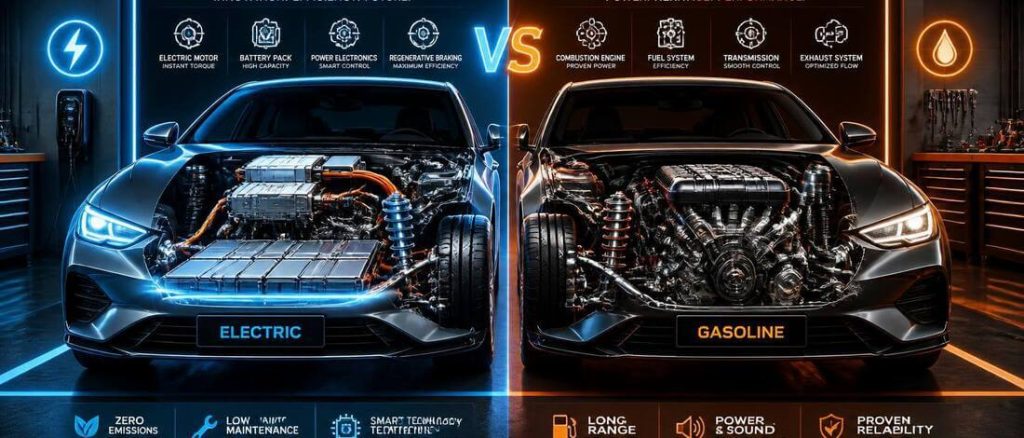
5-Year Total Cost of Ownership (60,000 Miles)
| Ownership Cost Factor | Standard Gas Crossover | Hybrid Crossover | Financial Advantage |
| Purchase Price (MSRP) | $31,500 | $33,250 | Gas saves $1,750 upfront |
| 5-Year Fuel Cost (@ $3.50/gal) | $7,000 (30 mpg) | $5,250 (40 mpg) | Hybrid saves $1,750 in fuel |
| Brake Pad & Rotor Maintenance | $650 (1–2 replacements) | $0 (Pads still good) | Hybrid saves $650 in maintenance |
| Routine Oil & Fluid Service | $750 | $750 | Even (Similar service intervals) |
| 5-Year Insurance Premiums | $6,800 | $7,000 | Gas saves $200 |
| Estimated Value at Year 5 (Resale) | $15,750 (50% retention) | $18,285 (55% retention) | Hybrid yields $2,535 more on resale |
| Net 5-Year Cost of Ownership | $29,100 | $26,215 | Hybrid saves $2,885 overall |
Maintenance and Long-Term Reliability: Separating Myth from Fact
Myth 1: “Hybrids are twice as complex, so they break twice as often.”
- The Reality: Major reliability indices, including Consumer Reports surveys, consistently rank traditional hybrids among the most reliable vehicles on the road (Integrity Auto). Hybrid engines operate under less thermal stress because the electric motor assists during high-load acceleration.
Myth 2: “Hybrid transmissions are unreliable CVTs.”
- The Reality: Most full hybrids (such as Toyota and Ford systems) use an electronic continuously variable transmission (e-CVT). Unlike troublesome belt-and-pulley CVTs, an e-CVT uses a robust planetary gear set with two electric motor-generators. There are no shifting clutches, torque converters, or steel push-belts to wear out.
City vs. Highway Driving Dynamics
- In the City (Clear Hybrid Win): Stoplights, stop signs, and traffic jams give hybrids a massive advantage. The engine shuts off while idling, restarts seamlessly, and captures deceleration energy that gas cars waste as heat.
- On the Highway (Narrower Gap): At sustained speeds of 70 to 80 mph, a hybrid runs almost exclusively on its gasoline engine. While the hybrid still benefits from Atkinson-cycle engine tuning, the efficiency advantage drops from a 50% improvement in town to a 15–20% improvement on the open interstate.
FAQs About
Q1: Do hybrid batteries frequently fail after the warranty ends?
No, modern hybrid battery packs are engineered to last the life of the vehicle, routinely reaching 150,000 to 200,000 miles without major capacity loss. Federal law mandates an 8-year/100,000-mile battery warranty (10 years/150,000 miles in California CARB states), ensuring long-term protection (Toyota of Whittier).
Q2: Do hybrid cars require special oil changes or maintenance?
No, traditional hybrids use standard synthetic motor oil and follow the same 5,000-to-10,000-mile oil change intervals as standard gasoline cars. In fact, because the engine cycles off when coasting or stopped, the internal combustion engine experiences fewer total operating hours over its lifespan.
Q3: Can a hybrid run if the high-voltage battery dies completely?
No, a full hybrid cannot operate on gasoline alone if the high-voltage traction battery suffers a complete electrical failure. The high-voltage battery is required to start the gas engine, power the electronic transmission control, and operate the vehicle’s electrical systems.
Q4: Is a hybrid worth it if I mostly drive on the highway?
A hybrid still provides 15% to 20% better highway fuel economy than a non-hybrid, but your payback timeline will be longer than a city commuter’s. If you drive over 15,000 highway miles annually, the fuel savings and higher resale value still make a hybrid financially advantageous.
Q5: Do hybrid cars cost more to insure than gas cars?
Hybrid auto insurance is generally comparable to or slightly higher (roughly 3% to 5%) than gas car insurance. The slight difference reflects the marginally higher vehicle purchase price and replacement cost of specialized electronic parts in front-end collision repairs.
Technician Verdict
- Buy a Hybrid if: You drive more than 12,000 miles per year, commute through urban or suburban traffic, or plan to keep the vehicle for 4 or more years. The fuel savings and superior resale value will more than offset the initial price premium.
- Buy a Gas Car if: You drive under 7,000 miles per year, strictly do long-distance rural highway driving, or need the lowest possible upfront purchase price on a tight budget.