
This article was updated in November 17, 2026 with new products and information by Mark S. Taylor
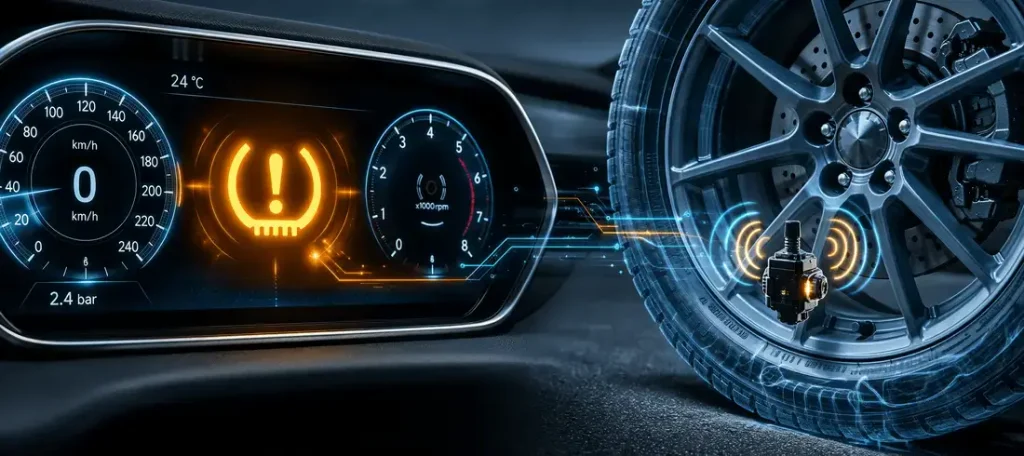
A tire-pressure warning light can mean two different things. A steady light usually points to low tire pressure. A light that flashes for about a minute and then stays on can indicate a fault in the Tire Pressure Monitoring System (TPMS).
Check the actual tire pressure before trying to reset anything. The warning light is not a substitute for a pressure gauge, and a TPMS malfunction can leave you without a reliable warning if a tire loses air.

Quick answer: A solid TPMS light flashing usually means one or more tires have reached the low-pressure warning threshold. A light that flashes for about 60–90 seconds and then stays on can indicate a system malfunction on vehicles using a combined warning indicator. Check every tire manually before deciding what to do next.
The exact warning strategy depends on the vehicle. Some models use a separate TPMS malfunction light or dashboard message.
Contents
- 1 1. What Does a Solid TPMS Light Mean?
- 2 2. What Does a TPMS Light That Flashes and Then Stays On Mean?
- 3 3. Solid vs Flashing TPMS Light: What Is the Difference?
- 4 4. Why Does the TPMS Light Come On in Cold Weather?
- 5 5. What Should You Do When the TPMS Light Comes On?
- 6 6. Direct TPMS vs Indirect TPMS
- 7 7. Why Does the TPMS Light Stay On After Adding Air?
- 8 8. Does Every TPMS Light Need a Reset?
- 9 9. When Is It Unsafe to Keep Driving?
- 10 FAQs About TPMS Light Flashing: Solid vs. Flashing Warning Explained
- 11 The Bottom Line
1. What Does a Solid TPMS Light Mean?
A steady TPMS warning usually means the system has detected a tire with significantly low pressure.
The warning does not tell you the exact pressure in every tire. Some vehicles display individual tire pressures, while others only show the warning symbol.
The federal TPMS warning threshold
Federal Motor Vehicle Safety Standard (FMVSS) No. 138 defines when a TPMS must warn the driver. The warning must illuminate when one or more tires reach the higher of these two thresholds:
- 25% below the vehicle manufacturer’s recommended cold inflation pressure.
- The applicable minimum activation pressure listed in the regulation for that tire type.
The standard also requires the warning within 20 minutes under its specified test conditions. This is a regulatory detection requirement, not a recommended operating pressure or a reason to delay adding air.
You should maintain the pressure listed on the Tire and Loading Information Label, usually located on the driver’s door area, or in the owner’s manual. Do not use the maximum pressure printed on the tire sidewall as your normal target.
You can read the requirements in 49 CFR § 571.138, Standard No. 138.
Why a tire can look normal
A tire can be underinflated without looking flat. The sidewall may still appear normal even when the pressure is low enough to affect handling, heat buildup, and tire life.
Use an accurate pressure gauge. Check all tires rather than assuming the warning identifies the only tire that needs attention.
2. What Does a TPMS Light That Flashes and Then Stays On Mean?
A flashing warning followed by steady illumination can indicate a TPMS system malfunction.
For vehicles that use a combined low-pressure and malfunction telltale, FMVSS No. 138 specifies a flashing period of at least 60 seconds and no more than 90 seconds after the ignition is switched on when a qualifying malfunction is detected. The light then stays on while the malfunction remains.
Some vehicles use a separate malfunction indicator instead. The owner’s manual explains which warning strategy applies to your vehicle.
What can cause a TPMS malfunction?
Possible fault areas include:
- A tire-pressure sensor or transmitter problem.
- A sensor ID that has not been registered after service.
- An incompatible replacement wheel or tire set.
- Damage during tire or wheel work.
- A communication, receiver, wiring, or control-system problem.
These are possible causes, not a parts-replacement list. A flashing light does not prove that a particular sensor has failed.
A scan tool with TPMS diagnostic capability may be needed to read system faults and sensor information. The technician may also need to check sensor IDs, compatibility, and communication with the vehicle.
Why the warning still matters
A TPMS malfunction can affect the system’s ability to detect or report low pressure. You may not receive a reliable warning if a tire loses air.
Check tire pressures manually until the system is repaired. Do not assume the tires are safe just because they look properly inflated.

3. Solid vs Flashing TPMS Light: What Is the Difference?
Use this table as a starting point. The exact warning behavior varies by vehicle.
| Warning behavior | What it may indicate | What to do first |
|---|---|---|
| Light stays on steadily | One or more tires have reached the low-pressure warning threshold | Check all tire pressures with a gauge |
| Light appears on a cold morning, then turns off | Pressure may have fallen below the warning threshold while cold | Check pressure when the tires are cold |
| Light flashes at startup, then stays on | A TPMS malfunction on vehicles using a combined indicator | Check pressures manually and arrange system diagnosis |
| Light stays on after adding air | Pressure may still be low, a tire may be leaking, or the system may need initialization or diagnosis | Recheck pressure and consult the owner’s manual |
| Separate TPMS warning or dashboard message | A system-specific fault or pressure condition | Follow the vehicle’s warning message and manual |
Do not use the table as a substitute for the owner’s manual. A vehicle may use a separate malfunction indicator or a different dashboard message.
4. Why Does the TPMS Light Come On in Cold Weather?
Tire pressure changes with temperature. When the air inside a tire gets colder, its pressure decreases.
A tire that is already close to the TPMS warning threshold may trigger the light after a cold night. After driving, the tires warm up and pressure can rise enough for the warning to turn off.
That does not mean the warning was false.
The pressure may still be below the vehicle manufacturer’s recommended cold pressure. Check it with a gauge after the vehicle has been parked long enough for the tires to cool.
What to do when the warning appears on a cold morning
- Park in a safe place.
- Inspect the tires for visible damage.
- Check all tire pressures with an accurate gauge.
- Compare the readings with the driver’s door placard.
- Inflate any low tire to the specified cold pressure.
- Recheck the warning after following the owner’s manual instructions.
Do not ignore a warning just because it disappears after driving. A tire that repeatedly triggers the light may have a slow leak or another pressure problem.
NHTSA also recommends checking tire pressure monthly when the tires are cold, even when the TPMS light is off. Its TireWise guidance explains the difference between direct and indirect systems, cold-weather warnings, and malfunction indicators.

5. What Should You Do When the TPMS Light Comes On?
Follow this sequence before attempting a reset.
Step 1: Reduce speed and find a safe place to stop
If the vehicle pulls, vibrates, or a tire looks damaged, stop as soon as it is safe. Avoid continuing at highway speed with a suspected tire problem.
Step 2: Inspect the tires
Look for:
- A visibly flat or badly deflated tire.
- A puncture or object in the tread.
- A bulge or blister.
- A deep cut or exposed cords.
- Signs of a rapid air leak.
Do not remove an embedded object. A tire professional should inspect it and determine whether repair is possible.
Step 3: Measure all tire pressures
Use an accurate gauge. Check every tire, including the spare if your vehicle’s TPMS monitors it.
Do not rely on appearance or assume the tire with the lowest pressure is the only problem.
Step 4: Use the correct pressure specification
Find the recommended cold pressure on the driver’s door placard or in the owner’s manual.
Some vehicles specify different pressures for the front and rear tires. Follow the values for your vehicle and tire configuration.
Step 5: Inflate or repair the tire
If a tire is low but otherwise safe to inflate, bring it to the specified pressure. If it has a puncture, damage, or a rapid leak, arrange proper inspection and repair.
Do not continue driving on a tire that is losing air quickly.
Step 6: Recheck the warning
After correcting the pressure, give the system time to update according to the owner’s manual.
If the light remains on, check whether the vehicle requires a specific initialization procedure. If the light flashes and stays on, arrange a TPMS system inspection.
Step 7: Arrange diagnosis if the warning returns
A recurring warning may involve a leak, sensor registration, sensor communication, or another system fault.
The next step should be based on testing, not automatic sensor replacement.
6. Direct TPMS vs Indirect TPMS
Not every vehicle measures tire pressure in the same way. The two common designs are direct TPMS and indirect TPMS.
| Feature | Direct TPMS | Indirect TPMS |
|---|---|---|
| How it works | Uses pressure sensors located in the tires | Uses wheel-speed information and other vehicle sensors |
| Measures pressure directly? | Yes, through tire-mounted sensors | No, it estimates underinflation from vehicle data |
| Individual pressure display | May display pressure for each tire, depending on the vehicle | Often does not display actual pressure readings |
| Common service needs | Sensor, transmitter, battery, ID registration, or communication diagnosis | Initialization or calibration, depending on the vehicle |
| After tire or wheel service | May require sensor ID registration or relearn | May require initialization after pressure adjustment or service |
Direct TPMS
A direct system uses pressure sensors installed in the tires. The sensors send information to a receiver or control system in the vehicle.
Depending on the design, the driver may see individual tire pressure readings on the dashboard. Sensor batteries, transmitters, and ID registration can become service issues.
A sensor may also be damaged during tire removal or installation if the technician does not follow the correct procedure.
Indirect TPMS
An indirect system uses wheel-speed information and other vehicle sensors to estimate whether a tire is underinflated.
It does not measure pressure at each tire with a pressure sensor in the same way a direct system does. Some indirect systems need initialization after pressure adjustments or tire service.
Follow the exact instructions in the owner’s manual. Do not assume that a vehicle uses direct sensors just because it has a TPMS warning light.
NHTSA explains both system types in its TPMS information.
7. Why Does the TPMS Light Stay On After Adding Air?
Adding air does not always make the warning disappear immediately. Several conditions may explain why the light remains on.
| Possible reason | What may be happening | Next check |
|---|---|---|
| Pressure is still too low | One tire may not have reached the specified cold pressure | Measure all tires again |
| Slow leak | Pressure drops again after inflation | Recheck pressure and inspect for a leak |
| Tires were checked warm | The reading may not reflect the correct cold-pressure target | Recheck when the tires are cold |
| Initialization required | The vehicle needs a specific reference-setting procedure | Follow the owner’s manual |
| Sensor or communication fault | The system cannot read or report sensor information correctly | Arrange TPMS diagnosis |
| Replacement wheel set | Sensors may be incompatible or their IDs may not be registered | Check sensor compatibility and registration |
Do not keep pressing a reset button to make the warning disappear. Correct the tire pressures first, then follow the vehicle’s procedure.
A Toyota example: initialization must follow pressure correction
Toyota’s 2019 RAV4 owner’s manual provides a useful model-specific example. It instructs owners to adjust the tires to the specified cold inflation pressure before initializing the tire-pressure warning system.
The system uses the current pressure as its reference. Initializing before correcting the pressure can create an incorrect baseline.
That procedure is not universal. Another make or model may use a different process, require sensor ID registration, or relearn automatically.
See the 2019 Toyota RAV4 owner’s manual for the model-specific instructions.
8. Does Every TPMS Light Need a Reset?
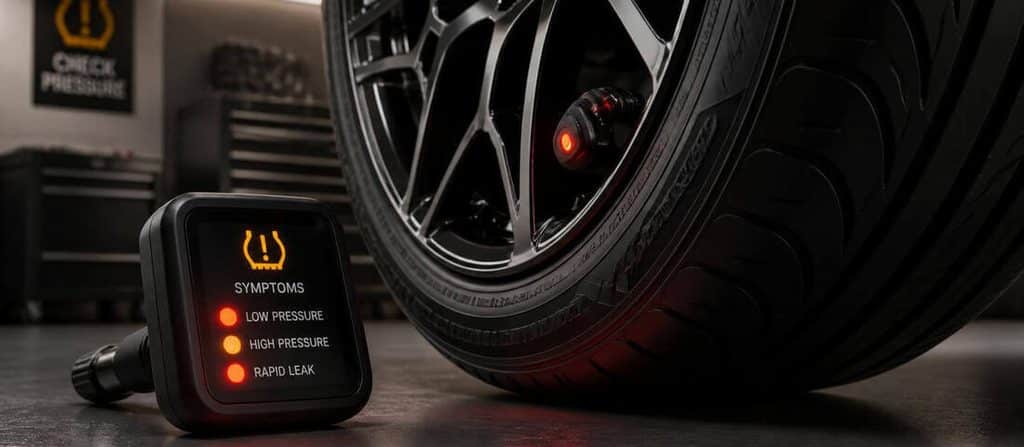
No. Some vehicles clear the low-pressure warning after the pressure is corrected and the vehicle is driven. Others have a manual initialization procedure.
Sensor replacement or a second set of wheels may require ID registration or a relearn procedure.
Before attempting a reset, check the owner’s manual for:
- Whether the system uses direct or indirect monitoring.
- Whether it has a manual reset or initialization menu.
- Whether sensor IDs must be registered after replacement.
- Whether the spare tire is monitored.
- How long the system may need to relearn.
Do not use a generic internet reset sequence unless it matches the exact year, make, model, and TPMS system.
If the warning continues after the correct procedure, a technician may need to inspect the system with a compatible diagnostic tool.
9. When Is It Unsafe to Keep Driving?
Stop in a safe place if a tire is visibly flat, loses pressure rapidly, or shows a bulge, serious cut, or other structural damage.
A significantly underinflated tire can overheat and fail. It can also affect steering, handling, and stopping distance.
If the vehicle pulls sharply, becomes difficult to control, or vibrates suddenly, do not try to drive to a repair shop on a damaged tire. Use the spare if the vehicle’s instructions allow it, or arrange roadside assistance.
A flashing TPMS light followed by steady illumination is a different warning from a simple low-pressure alert. However, you still need to check every tire manually because the system may not be able to report low pressure correctly.
Continue manual pressure checks until the malfunction is repaired.
FAQs About TPMS Light Flashing: Solid vs. Flashing Warning Explained
Can I drive with the TPMS light on?
First check tire pressures and inspect for damage. A steady light may mean a tire is significantly underinflated, while a flashing-then-steady light may indicate a system fault. Do not assume the vehicle is safe simply because it still drives normally. Stop if a tire is flat, damaged, or losing air quickly.
Does a flashing TPMS light mean a bad sensor?
It can indicate a TPMS malfunction, but it does not identify the failed part. A sensor, unregistered ID, incompatible wheel, wiring, receiver, or another system fault may be involved. Check pressures manually, then use the vehicle’s diagnostic procedure before replacing a sensor.
Why does my TPMS light turn off after driving?
Cold temperatures can lower tire pressure enough to trigger a warning. Driving warms the tires and can raise pressure, causing the light to turn off. Check the tires when cold and inflate them to the vehicle placard specification. A warning that disappears is still a reason to inspect pressure.
Should I reset TPMS before adding air?
No. Correct the tire pressure first. Some vehicles use the current pressure as the reference during initialization. Toyota’s owner’s manual warns that initializing before adjusting to the specified cold pressure can create an incorrect reference. Follow the exact procedure for your vehicle.
Does TPMS monitor the spare tire?
It depends on the vehicle. Some systems monitor a full-size spare, while others do not monitor a compact spare. Check the owner’s manual for your vehicle’s setup. Do not assume the spare is included in the warning system.
The Bottom Line
A solid TPMS light usually calls for a tire-pressure check. A light that flashes and then stays on can point to a monitoring-system fault.
Check every tire with a gauge, use the vehicle’s recommended cold pressure, and inspect for damage. If the warning remains after pressure is corrected, follow the exact owner’s manual procedure or arrange a TPMS diagnosis.
Do not replace sensors or ignore the warning based on the lamp alone.