
This article was updated in November 16, 2026 with new products and information by Mark S. Taylor
You walk into an auto-parts store because your car needs a new battery. Several batteries look almost identical. One has 600 CCA, another has 750 CCA, and a third carries an AGM label.
The biggest number may look like the best choice. But cold-cranking amps are only one part of the decision. A battery can have strong starting power and still be wrong for your vehicle because its case is too large, its terminals are in the wrong positions, or its battery type does not match the manufacturer’s requirements.


Contents
- 1 1. Find the correct battery specification first
- 2 2. What does car battery group size mean?
- 3 3. What are cold cranking amps (CCA)?
- 4 4. CCA vs. CA: What is the difference?
- 5 5. What is reserve capacity (RC)?
- 6 6. Should you choose flooded, AGM, or EFB?
- 7 7. Check terminal position, hold-downs, and venting
- 8 8. Does a new car battery need registration or a reset?
- 9 9. Car battery buying checklist
- 10 10. Car battery safety matters
- 11 FAQs About How to Choose a Car Battery: Size, CCA & Type
- 11.1 What is the most important number when buying a car battery?
- 11.2 Can I use a battery with more CCA than the original?
- 11.3 Is reserve capacity the same as amp-hours?
- 11.4 Do all start-stop cars need AGM batteries?
- 11.5 Does every car need battery registration after replacement?
- 11.6 Should I buy the battery with the highest CCA?
- 12 The bottom line
How do you choose the right car battery?
Choose a replacement that matches your vehicle’s required group size, battery technology, terminal layout, and electrical specifications. Check CCA and reserve capacity or amp-hours when specified. Also confirm any battery sensor reset or registration procedure. Start with the owner’s manual, original battery label, or a VIN-specific parts lookup.
1. Find the correct battery specification first
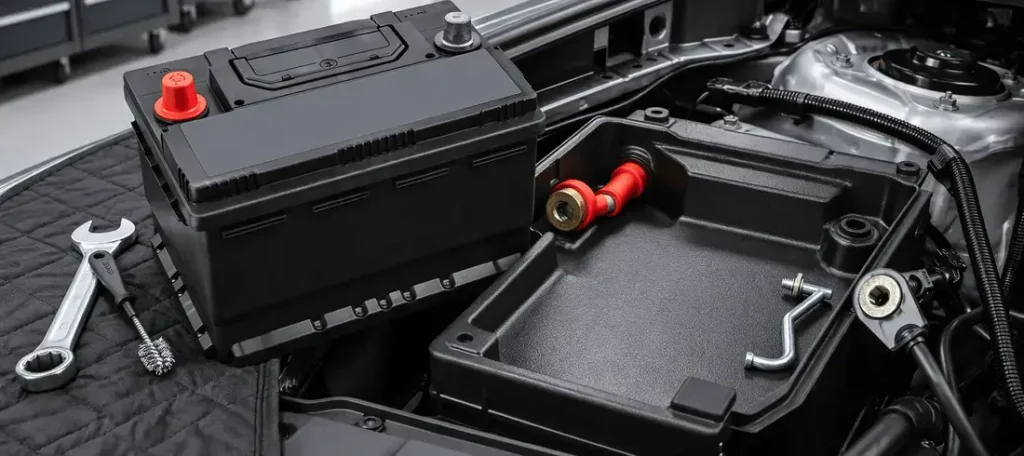
Before comparing brands, prices, or warranty periods, identify what your vehicle requires.
Check these sources:
- The owner’s manual.
- The label on the original-equipment battery, if it is readable.
- The manufacturer’s parts catalog or VIN-specific fitment information.
- A qualified battery supplier or repair shop that can verify the application.
Use the vehicle’s full details, including model year, make, model, engine, trim, market, and factory equipment.
A model name alone may not be enough. Two versions of the same vehicle can use different battery sizes or technologies.
Do not automatically copy the specifications from the battery currently installed. A previous owner may have fitted a battery that physically fits but does not meet the vehicle’s electrical or installation requirements.
If the battery has already been tested and you want to confirm whether it needs replacement, read our guide on how to load test a car battery. Testing battery condition and choosing a replacement are two separate decisions.


2. What does car battery group size mean?
The battery group number identifies a standardized physical size and configuration. In the BCI system, it helps describe the case dimensions, terminal arrangement, and hold-down design.
You may see group numbers such as:
- Group 24
- Group 24F
- Group 35
- Group 48
- Group 65
- Group 94R
The number does not measure starting power. It helps identify a battery that can fit and connect correctly.
Group size matters because the battery must:
- Fit the battery tray or compartment.
- Sit securely under the correct hold-down.
- Place the positive and negative terminals where the cables can reach safely.
- Provide enough clearance from nearby metal parts.
- Allow the original heat shield or insulation to be reinstalled.
- Support the required vent connection, where equipped.
A battery with the wrong terminal layout can create a short-circuit risk if a terminal or cable contacts nearby metal. A battery that is not secured correctly can move, damage its case, or strain the cables.
Do not choose a different group size just because it fits inside the battery tray. Use another size only when the manufacturer or a qualified fitment source approves it for your exact vehicle.
Some imported vehicles use European or Asian battery sizing standards. Their batteries may not follow the same group-number system used for many North American applications. Confirm the dimensions and terminal configuration rather than relying on a similar-looking label.

3. What are cold cranking amps (CCA)?
Cold cranking amps measure a battery’s ability to deliver high current during a cold start.
The Battery Council International (BCI) definition uses a standardized test at 0°F. A fully charged 12-volt battery must deliver its rated current for 30 seconds while maintaining at least 7.2 volts. This is equivalent to the BCI threshold of 1.2 volts per cell for a six-cell battery.
In practical terms, CCA tells you how much starting current the battery can supply under a standardized cold-weather test.
How many CCA do you need?
Use the minimum or recommended CCA specified for your vehicle. Do not guess based only on engine size or choose a number from a generic online chart.
Starting demand depends on engine design, starter requirements, temperature, and the manufacturer’s electrical specification.
A replacement battery that meets or exceeds the required CCA may be suitable if its other specifications also match. A high CCA number cannot compensate for the wrong case size, terminal layout, battery technology, or mounting arrangement.
Is a higher CCA battery always better?
Not by itself.
If two batteries have the correct physical size, terminal layout, technology, and approved fitment, a higher CCA rating may offer additional cold-start capacity. However, CCA is only one part of the specification.
Do not buy a battery with a higher CCA rating if it has the wrong terminals, dimensions, hold-down, venting, or chemistry.
4. CCA vs. CA: What is the difference?
CCA and CA both describe cranking performance, but they use different test temperatures.
| Rating | Test temperature | What it measures |
|---|---|---|
| CCA | 0°F | Starting-current capability in a cold test |
| CA | 32°F | Starting-current capability at a warmer test temperature |
The warmer test can produce a higher rating for the same battery. That is why a large CA figure does not automatically mean a battery is stronger in cold weather than another battery with a lower CCA figure.
Compare like with like. When shopping in the United States for cold-weather starting performance, use the CCA rating and your vehicle manufacturer’s requirement.

5. What is reserve capacity (RC)?
Reserve capacity measures how long a fully charged battery can support a specified electrical load if the charging system stops supplying power.
The BCI test uses a fully charged battery at 80°F. The battery supplies a continuous 25-amp load until its voltage reaches the specified test limit. The result is expressed in minutes.
For example, a battery with a higher RC rating can maintain that standardized load for longer than one with a lower rating.
Reserve capacity and CCA answer different questions. CCA measures cold-starting performance, while RC measures how long the battery can supply a defined load.
Reserve capacity vs. amp-hours
Amp-hours (Ah) measure the amount of electrical charge a battery can deliver over a stated discharge period. The test rate and conditions matter.
| Rating | What it tells you |
|---|---|
| CCA | Current available during a standardized cold-start test |
| RC | Minutes a battery can deliver a specified 25-amp load |
| Ah | Capacity measured over a defined discharge period |
Do not convert reserve capacity into amp-hours using a simple universal formula. The tests use different discharge conditions.
If your vehicle manufacturer specifies an RC or Ah requirement, meet it. If the manufacturer does not publish a minimum, use a battery listed for the exact application instead of inventing a target.
6. Should you choose flooded, AGM, or EFB?
Battery technology matters because the vehicle’s charging system and electrical demands are designed around a particular battery type.
Flooded lead-acid batteries
A conventional flooded lead-acid battery uses liquid electrolyte. It is common in vehicles without advanced start-stop requirements.
Many modern flooded batteries are maintenance-free. Their case dimensions, terminal arrangement, and venting still need to match the vehicle.
AGM batteries
Absorbent Glass Mat (AGM) batteries hold electrolyte in a fiberglass mat. They are used in many vehicles with higher electrical demands and in some start-stop applications.
AGM is not automatically the best replacement for every car. The vehicle must support the battery type, and the replacement must meet the correct physical and electrical specifications.
EFB batteries
Enhanced Flooded Batteries (EFB) are designed for applications that need greater cycling capability than a conventional flooded battery.
Some start-stop vehicles specify EFB. Others use AGM or another approved battery design.
Do not assume that every start-stop vehicle needs an AGM battery. Check the original battery label and the manufacturer’s approved replacement options.
Can you replace an AGM battery with a regular flooded battery?
Do not make this change unless the vehicle manufacturer specifically approves it.
AAA explains that vehicle charging systems are optimized for particular battery types and recommends replacing the battery with the same type originally installed.
An AGM-to-flooded change may fail to meet the vehicle’s charging or cycling requirements. A change from flooded to AGM also needs approval for the exact application.
For a deeper explanation of the differences, read The Car Buzz guide to AGM vs. lead-acid batteries.
7. Check terminal position, hold-downs, and venting
Two batteries can share a similar group number or look almost identical but still have important differences.
Before purchase, confirm:
- Positive and negative terminal positions.
- Terminal post or terminal-block style.
- Cable reach and routing.
- Hold-down design and location.
- Battery height and nearby clearance.
- Heat shield or insulation requirements.
- Vent-tube connection, if equipped.
Some batteries are installed in the trunk or passenger compartment and use a vent tube. The tube directs battery gases away from the vehicle interior.
Ford’s owner information warns that the vent tube must be correctly reconnected on vehicles equipped with one. Do not leave it disconnected or improvise a substitute.
A battery that fits the tray but has the wrong terminal position, mounting arrangement, or vent connection is not a correct replacement.
8. Does a new car battery need registration or a reset?
Sometimes.
Some vehicles use a battery sensor or battery-management system (BMS) to monitor battery condition and charging behavior. After replacement, the vehicle may require a reset, relearn, or battery registration procedure.
Ford’s owner information for a specific application instructs the owner to reset the battery sensor after installing a new battery. This is a Ford-specific example, not a universal procedure.
Other vehicles may use different steps or require a scan tool. Some do not require a separate registration procedure.
Before buying the battery, ask the installer:
- Does this vehicle require battery registration?
- Does it require a battery sensor reset?
- Is a scan tool needed?
- Does the vehicle need a relearn or sleep period after replacement?
Do not copy a reset procedure from another model. If the battery is under a seat, in the trunk, part of a multiple-battery setup, or near high-voltage components, use a qualified technician and the manufacturer’s procedure.

9. Car battery buying checklist
Before paying for a replacement, confirm every relevant item.
| Item to verify | What to check |
|---|---|
| Vehicle application | Exact year, make, model, engine, trim, and market |
| Group size | Correct case dimensions and configuration |
| Terminal layout | Correct terminal type and polarity |
| Mounting | Correct hold-down and clearance |
| Battery technology | Flooded, AGM, EFB, or another specified design |
| CCA | Meets the vehicle’s requirement |
| RC or Ah | Meets the manufacturer’s specification, if specified |
| Heat protection | Original heat shield or insulation can be refitted |
| Venting | Correct vent-tube connection, if equipped |
| Battery management | Reset or registration requirements are known |
| Product condition | Date code and warranty terms are checked |
| Old battery | Recycling and core-return requirements are understood |
If a supplier cannot confirm the fitment and battery type for your exact vehicle, pause the purchase and verify it first.
Also check the warranty conditions. A longer warranty does not make an incorrectly specified battery suitable for your vehicle.
10. Car battery safety matters
Lead-acid batteries contain sulfuric acid and can release explosive gases. Ford’s owner information warns drivers to keep flames and sparks away, provide proper ventilation, and protect their eyes when working near a battery.
Follow these precautions:
- Do not smoke or create sparks near a battery.
- Keep metal tools from bridging the terminals.
- Do not reverse battery polarity.
- Avoid contact with battery acid.
- Do not work around a swollen, cracked, leaking, smoking, or unusually hot battery.
- Follow the vehicle manufacturer’s disconnect and installation procedure.
If your vehicle has orange high-voltage cables, a hybrid or EV high-voltage system, multiple battery units, or a battery installation procedure you do not understand, stop and use a qualified technician. Do not touch high-voltage components.
If the battery keeps losing charge after replacement, do not keep buying batteries without finding the cause. Read our guide to why a car battery keeps dying overnight. A repeated drain may require a separate electrical diagnosis.
FAQs About How to Choose a Car Battery: Size, CCA & Type
What is the most important number when buying a car battery?
There is no single number that overrides the rest. Start with the correct group size and battery technology, then confirm CCA and any required reserve-capacity or amp-hour specification. The vehicle manufacturer’s requirements control the final choice.
Can I use a battery with more CCA than the original?
It may be acceptable if the replacement also matches the correct group size, chemistry, terminal layout, hold-down, venting, and manufacturer requirements. A higher CCA number alone does not prove that the battery is compatible.
Is reserve capacity the same as amp-hours?
No. Reserve capacity measures minutes under a specified 25-amp test. Amp-hours measure capacity under a different discharge rate and time period. They are related concepts, but they are not interchangeable through a universal conversion.
Do all start-stop cars need AGM batteries?
No. Some start-stop vehicles specify AGM, while others use EFB or another approved design. Check the original battery label and the manufacturer’s replacement specification before choosing a different type.
Does every car need battery registration after replacement?
No. Requirements vary. Some vehicles need a battery sensor reset or registration, while others do not. Check the owner’s manual or factory service information for the exact vehicle.
Should I buy the battery with the highest CCA?
Not automatically. A battery with more CCA can still be unsuitable if its case size, terminals, hold-down, chemistry, or venting does not match the vehicle. Confirm fitment and the full specification first.
The bottom line
The right car battery is not simply the one with the biggest CCA number or the lowest price. It is the battery that matches the vehicle’s physical fit, electrical requirements, battery technology, and installation procedure.
Start with the owner’s manual or a VIN-specific specification. Confirm group size, terminal position, CCA, reserve capacity, and battery type. Then check whether the vehicle needs a battery sensor reset or registration.
Choose the correct specification first. Compare brands and warranties second.