
This article was updated in November 16, 2026 with new products and information by Mark S. Taylor
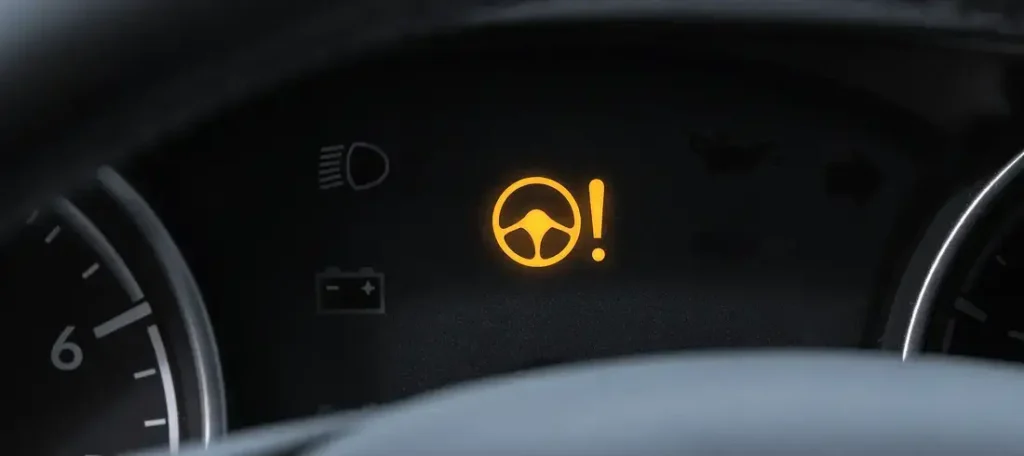
You start your car and see a steering-wheel symbol or an EPS message on the dashboard. The steering may feel normal at first, or it may suddenly take more effort to turn. Either way, the warning deserves attention because the system may have reduced or stopped its steering assistance.
Answer Capsule: An EPS warning means the electric power-steering system has detected a fault or entered a protective mode. Steering effort may increase, especially at low speed. Follow your owner’s manual, slow down, and stop in a safe place if steering feels unusually heavy or unpredictable. The warning alone does not identify a failed part.
Contents
- 1 What Does the EPS Warning Light Mean?
- 2 What Should You Do When the EPS Light Comes On?
- 3 EPS vs Hydraulic vs Electro-Hydraulic Steering
- 4 Why Might the EPS Warning Light Come On?
- 5 What Can You Safely Check Yourself?
- 6 How Should a Technician Diagnose an EPS Warning?
- 7 Can You Drive with the EPS Warning Light On?
- 8 FAQs About EPS Warning Light
- 9 The Bottom Line
What Does the EPS Warning Light Mean?
EPS stands for electric power steering. The system uses an electric motor and control electronics to help the driver turn the steering wheel. Sensors and the steering control unit determine how much assistance is needed.
When the system detects a problem, it may illuminate a warning light, display a message, reduce assistance, or switch off some or all assist functions. The exact response depends on the vehicle.
The symbol and color can vary. Some dashboards show a steering wheel with an exclamation mark, while others display “EPS,” “Power Steering,” or a text warning. Check your owner’s manual for the exact meaning on your specific car.
An EPS warning is not the same as proof that the steering rack, motor, or control module has failed. The system needs diagnosis before a part is replaced.
What Should You Do When the EPS Light Comes On?
Treat a change in steering effort as a safety issue.
- Keep both hands on the wheel and reduce speed smoothly.
- Avoid sudden turns, hard maneuvers, and unnecessary driving.
- Move to a safe location when you can do so without creating another hazard.
- Read the dashboard message and follow the owner’s manual.
- If steering is very heavy, intermittent, or difficult to control, stop and arrange a tow.
Manufacturer instructions can differ. Mazda’s owner’s manual, for example, tells the driver to stop in a safe place and switch the vehicle power off. If the warning remains after restarting, Mazda advises contacting an authorized dealer. Kia’s owner’s manual warns that failed EPS assistance can require much more steering force and directs the driver to pull over safely and have the system inspected.
A restart may be part of a manufacturer’s specific response, but it is not a repair. Do not keep restarting the vehicle and continue driving if the steering remains abnormal.

EPS vs Hydraulic vs Electro-Hydraulic Steering
The type of steering system matters because the diagnostic checks differ.
| System | How assistance is produced | Fluid reservoir? |
| Hydraulic power steering | An engine-driven or belt-driven pump supplies hydraulic pressure | Usually yes |
| Electric power steering (EPS) | An electric motor supplies steering assistance under electronic control | No hydraulic steering fluid in a pure EPS system |
| Electro-hydraulic power steering (EHPS) | An electric motor drives a hydraulic pump | Yes, because steering assistance remains hydraulic |
Do not add fluid just because a steering warning appears. First confirm your system type and the correct fluid specification. A pure EPS system has no power-steering-fluid reservoir to top up, whereas an EHPS system may still have one.
To explore system design differences further, check out our guide on Electric vs Hydraulic Power Steering. (For context on older hydraulic pumps, read our Symptoms of a Bad Power Steering Pump guide, and for sensor inputs, see Steering Angle Sensor Symptoms.)
Why Might the EPS Warning Light Come On?
The warning can have several causes. The light alone cannot rank them or identify a failed component.
Low 12-volt system voltage
Electric steering assistance depends on the vehicle’s electrical system. A weak battery, poor connection, charging fault, or unstable power supply can affect steering assistance on some vehicles.
Kia’s owner’s manual notes that low charging-system voltage can increase steering effort. It also warns that steering operation may be temporarily affected after a jump-start while battery voltage stabilizes.
That does not mean every EPS warning is caused by the battery. A technician should test the battery, charging system, power supply, and grounds before recommending replacement.
Temporary protective operation
Some steering systems limit assistance to protect the motor or electronics when they are subjected to repeated high demand while the vehicle is stationary or moving very slowly.
Mazda’s owner’s manual states that repeated, forceful steering-wheel movement while stopped or at very low speed can place the system into a protective mode. It notes that the system can return to normal after a few minutes on that vehicle.
Do not deliberately repeat this maneuver to test the system. Protective behavior and recovery conditions are strictly vehicle-specific.
Sensor, motor, controller, wiring, or communication fault
The EPS system relies on sensors, wiring, power and ground circuits, a control unit, and an electric motor. A problem in one of these areas can trigger a warning or reduce assistance.
Possible areas for professional diagnosis include:
- Steering torque or position signals
- EPS motor operation
- Control-module power and ground
- Fuses, terminals, connectors, and wiring
- Communication between steering and other vehicle modules
- Software or calibration requirements specified by the manufacturer
These are diagnostic categories, not a list of parts to replace. A warning light does not prove that the motor or steering rack is defective.
A vehicle-specific recall or service campaign
Some steering problems affect only certain model years, production ranges, or VINs. A warning light does not automatically mean your vehicle is part of a recall.
Use the NHTSA recall lookup to check for unrepaired safety recalls by VIN. The lookup does not show every non-safety service campaign, so contact the manufacturer or dealer if you suspect a known issue.
What Can You Safely Check Yourself?
Keep owner checks limited to observations that do not require disassembly or electrical probing:
- Record the exact warning message and any other lights that appeared.
- Note whether steering effort changed immediately or only at low speed.
- Record whether the warning followed a jump-start, battery replacement, repair, or very low battery condition.
- Check your owner’s manual to identify your steering system type.
- If your vehicle has a hydraulic or electro-hydraulic system, look for an obvious fluid leak from a safe standing position. Do not crawl under an unsupported vehicle.
- Check whether a charging-system warning is also displayed.
Do not disconnect the battery to try to erase the warning. Do not probe steering connectors, remove the steering column, or work near airbags or SRS wiring. Steering-column and airbag work must follow OEM safety procedures and should be handled by a qualified technician.
How Should a Technician Diagnose an EPS Warning?
A proper diagnosis starts with the vehicle’s exact system architecture and stored data.
- Scan the steering system: The technician should use a scan tool that can communicate with the EPS or power-steering control module. An engine-only code reader may not access the relevant chassis module. Save current and history codes plus freeze-frame data before clearing anything.
- Test the 12-volt supply and charging system: Check battery condition, charging-system operation, voltage drop, power feeds, and grounds using the manufacturer’s procedure.
- Inspect wiring and connectors: Follow the wiring diagram for the exact vehicle. Check relevant fuses, connectors, terminals, grounds, and harness routing.
- Check live data and follow the OEM diagnostic tree: The manufacturer may specify tests for steering torque, steering angle, motor current, module communication, or calibration. A Ford service manual example for select EPAS systems directs technicians to investigate wiring, terminals, charging systems, and power-steering control modules for voltage-related faults.
- Verify the repair: After a confirmed repair, the technician should complete the manufacturer’s verification procedure and any required calibration or programming.

Can You Drive with the EPS Warning Light On?
There is no safe universal yes-or-no answer. Some vehicles may retain mechanical steering while losing electric assistance, but the wheel can require much more effort. That can make low-speed turns, emergency maneuvers, and parking difficult.
Stop in a safe place and arrange professional help if:
- The steering suddenly becomes very heavy.
- Assistance cuts in and out.
- The wheel binds, jerks, or behaves unpredictably.
- A red steering warning or a stop message appears.
- The vehicle also shows a charging-system or other serious warning.
- You cannot confidently control the vehicle.
If the warning clears after the exact restart procedure in your owner’s manual and steering feels normal, do not treat that as proof that the fault is repaired. Arrange diagnosis if it returns or if your manual directs you to a dealer.
FAQs About EPS Warning Light
What does the EPS light mean on a car?
It means the electric power-steering system has detected a fault or entered a protective state. Steering assistance may be reduced or unavailable. Follow your owner’s manual and have recurring warnings diagnosed by a professional.
Can a weak battery cause the EPS light to come on?
Low 12-volt system voltage can affect electric steering on some vehicles. A weak battery, poor connection, or charging fault is one possible cause, but the warning does not prove the battery is bad. Test the electrical system before replacing parts.
Does electric power steering use fluid?
A pure EPS system uses an electric motor and does not use hydraulic steering fluid. An electro-hydraulic system uses an electric motor to drive a hydraulic pump and may still have a fluid reservoir. Check your owner’s manual before adding anything.
Can I drive with the EPS light on?
Do not assume it is safe. Steering may become much heavier if assistance is reduced or lost. Follow the vehicle’s instructions, stop if steering feels abnormal, and arrange a tow if you cannot control the vehicle confidently.
Does the EPS warning mean I need a new steering rack?
No. The warning may involve voltage, wiring, connectors, sensors, communication, software, a motor, or a control unit. A technician should retrieve the EPS codes and follow the vehicle-specific diagnostic procedure before recommending a rack.
The Bottom Line
An EPS warning means the steering-assistance system needs attention. Steering effort may increase, and the exact response depends on the vehicle. Stop safely if steering feels heavy or unpredictable, follow your owner’s manual, and have the EPS module and electrical supply tested before replacing parts.