
This article was updated in June 20, 2026 with new products and information by Mark S. Taylor
If you had your serpentine belt replaced and the chirping noise is still there — the belt wasn’t the problem. The alternator pulley was. And if your mechanic is quoting you for a complete alternator replacement because of a noise, it’s worth asking whether they tested the pulley specifically. On most vehicles, the pulley is a separate wear item that costs $25–$80 in parts. The alternator costs $150–$400 on top of that.
This article covers the six symptoms of a bad alternator pulley, how to identify which type of pulley your car has, two tests you can run in your driveway before calling anyone, and a clear framework for deciding whether you need just the pulley or the whole unit.
Contents
- 1 What Does the Alternator Pulley Do?
- 2 The 6 Symptoms of a Bad Alternator Pulley
- 2.1 1. Chirping or Fluttering Noise Specifically During Deceleration
- 2.2 2. Squealing on Cold Start That Disappears After Warm-Up
- 2.3 3. Serpentine Belt Flutter or Tensioner Arm Oscillation at Idle
- 2.4 4. Visible Pulley Wobble With Engine Running
- 2.5 5. Premature or Unusual Serpentine Belt Wear
- 2.6 6. Flickering Lights or Unstable Voltage at Idle
- 3 What Type of Pulley Does Your Car Have?
- 4 How to Test Your Alternator Pulley at Home
- 5 Do You Need Just the Pulley or the Whole Alternator?
- 6 Can You Drive with a Bad Alternator Pulley?
- 7 Alternator Pulley Replacement Cost
- 8 FAQs About Bad Alternator Pulley Symptoms
- 8.1 Q: Can a bad alternator pulley damage the serpentine belt?
- 8.2 Q: What does a bad alternator pulley sound like?
- 8.3 Q: Can I replace just the alternator pulley or does the whole alternator have to come out?
- 8.4 Q: How long do alternator pulleys last?
- 8.5 Q: What happens if I install the wrong type of alternator pulley?
- 9 The Bottom Line
What Does the Alternator Pulley Do?
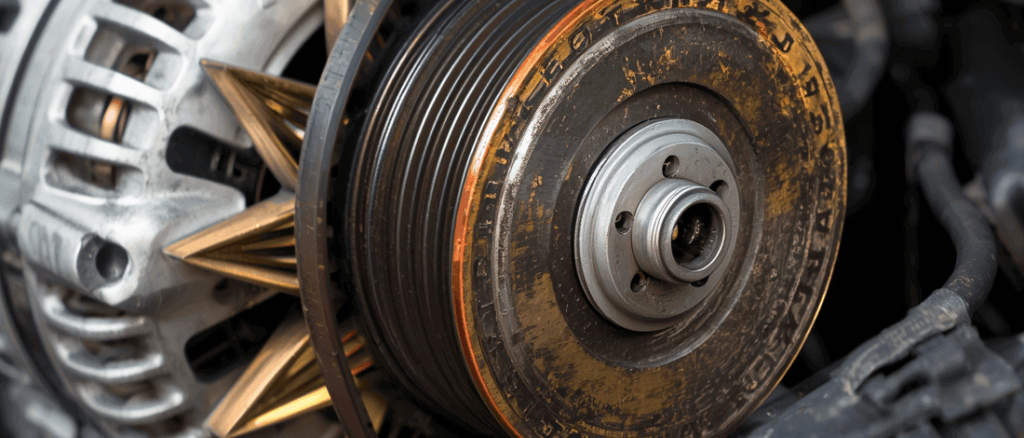
The alternator pulley sits on the nose of the alternator shaft and connects it to the serpentine belt. As the engine runs, the belt spins the pulley, which spins the alternator’s rotor, which generates the electrical power your car runs on. Simple concept — but the pulley itself has gotten significantly more complex over the past 25 years.
There are three types:
| Pulley Type | How It Works | Typical Vehicles |
|---|---|---|
| Solid pulley | Fixed — spins at exact belt speed, always | Older vehicles, pre-2000s |
| OAP (Overrunning Alternator Pulley) | One-way clutch — freewheels when belt slows, locks when belt drives | Many late-model vehicles |
| OAD (Overrunning Alternator Decoupler) | One-way clutch + torsion spring — freewheels AND absorbs vibration | Most modern vehicles, 2010+ |
The OAP and OAD exist because of a real engineering problem. Modern engines — especially four-cylinders and diesel engines — generate significant torsional vibration pulses through the belt drive system every time a cylinder fires. Without a way to absorb those pulses, the belt would whip and flutter, wearing out prematurely. The OAP’s one-way clutch lets the alternator freewheel during deceleration events so the belt doesn’t have to jerk the alternator rotor to a sudden stop. The OAD goes further — its internal torsion spring absorbs vibration spikes before they reach the rotor at all.
Both types have a limited lifespan because of how hard their internal clutch mechanisms work. Most OAP and OAD pulleys last between 60,000 and 100,000 miles — roughly the same interval as a timing belt on many vehicles.

The 6 Symptoms of a Bad Alternator Pulley
1. Chirping or Fluttering Noise Specifically During Deceleration
This is the diagnostic fingerprint of OAP and OAD failure — and it’s the symptom that separates a pulley problem from almost everything else.
When the engine decelerates — releasing the throttle, coming to a stop, or shifting into neutral — the belt slows down before the alternator rotor does. The OAP or OAD’s job is to let the rotor freewheel past the belt during that moment, isolating it from the sudden deceleration. When the clutch wears out, it can no longer freewheel smoothly. The belt and rotor fight each other for a fraction of a second. That fight produces a chirp, flutter, or brief rattle — specifically during the deceleration event.
If the noise is most noticeable when you release the throttle, pull into a parking spot, or come to a stop — and it disappears during steady acceleration and highway cruising — that’s a pulley clutch telling you it’s done.
2. Squealing on Cold Start That Disappears After Warm-Up
A seized alternator pulley — one that has locked in both directions and can no longer freewheel at all — forces the belt to drag the alternator rotor to a stop every time the engine decelerates. That constant resistance glazes the inside of the belt’s ribs and causes belt slip.
Cold mornings make this worse because the belt is stiffer and less pliable. The result is a squealing or screaming noise on start-up that often fades or disappears after the engine warms up and the belt softens and expands slightly.
Drivers frequently dismiss this because it goes away. It goes away because the belt warmed up — not because the problem resolved. The underlying seized pulley is still there, still glazing the belt ribs, and still working toward a belt failure.
3. Serpentine Belt Flutter or Tensioner Arm Oscillation at Idle
Look at your serpentine belt with the engine running at idle. A healthy belt runs smooth and taut. If you see the belt vibrating, flapping, or moving in a wave-like pattern — or if the tensioner arm is swinging visibly rather than holding steady — the accessory drive system is absorbing abnormal torsional pulses.
A seized OAP or OAD transmits every engine vibration spike directly into the belt instead of absorbing or freewheeling through them. The tensioner tries to compensate by swinging, but it wasn’t designed to handle that constant input. The result is belt flutter and accelerated tensioner wear on top of the pulley problem.
If you see belt flutter or tensioner movement at idle, inspect the alternator pulley before replacing the tensioner. The tensioner is often the collateral damage, not the root cause.
4. Visible Pulley Wobble With Engine Running
Stand safely to the side of the engine bay with the engine at idle and watch the alternator pulley face-on. The outer rim should trace a perfectly straight, steady circular path. If you see any lateral wobble — the rim appearing to weave or move side to side — the pulley’s bearing is failing.
A worn bearing allows the pulley to run eccentrically, which means belt contact is uneven across every rotation. That uneven contact accelerates belt wear, generates heat, and eventually causes the pulley to run so eccentrically that it starts throwing the belt.
This is one of the easier symptoms to catch early with a visual check — but most drivers never look.
5. Premature or Unusual Serpentine Belt Wear
If you replaced your serpentine belt recently — within the last 20,000–30,000 miles — and it’s already showing signs of wear, the belt is not the problem. A failing alternator pulley is the most likely explanation.
Specific wear patterns to look for: fraying on one edge of the belt (from a pulley running out of alignment due to bearing failure), glazing or hardening of the ribbed inner surface (from belt slip caused by a seized pulley), or unusual cracking that’s concentrated near the alternator contact area.
Run your hand along the back of the belt with the engine off. It should feel smooth and slightly flexible. If one area feels stiff, glazed, or unusually smooth compared to the rest, that section has been slipping against a problematic surface.
6. Flickering Lights or Unstable Voltage at Idle
This one catches people off guard because it looks like an alternator output problem — which it is, indirectly.
A seized OAP or OAD forces the alternator rotor to stop and start abruptly with every deceleration event instead of freewheeling smoothly. That abrupt load cycling causes momentary voltage spikes and drops in the alternator’s output. At idle — where the alternator is already working at the lower end of its output range — those fluctuations can manifest as flickering dashboard lights, headlights that pulse slightly, or a voltage reading that won’t hold steady.
If your voltage tests fine at 2,000 RPM but shows instability at idle specifically, and no other charging system component tests as faulty, run the spin test on the alternator pulley before condemning the alternator itself.
What Type of Pulley Does Your Car Have?
Before you order a part or ask for a quote, you need to know which pulley type your vehicle has. Installing the wrong type causes problems that can end up costing more than the original repair.
Here’s how to identify what you’re working with:
Solid pulley: No cap, no housing — just a plain metal grooved wheel bolted to the alternator shaft. These are found on older vehicles, typically pre-2000. They spin exactly with the belt at all times.
OAP (overrunning alternator pulley): Has a plastic cap or plug covering the center bore. Beneath that cap is a one-way roller clutch. If you can see or feel a plastic insert in the center of the pulley, this is what you have.
OAD (overrunning alternator decoupler): Has a more substantial center housing — larger and more prominent than an OAP cap. Inside is a one-way clutch plus a torsion spring that absorbs vibration. Most vehicles manufactured after roughly 2008–2010 use an OAD. The housing is typically larger and more mechanically complex looking than a simple OAP cap.
The wrong replacement type causes real damage. Installing a solid pulley or OAP where an OAD is specified removes the vibration damping the belt system was designed around. The belt flutters more, the tensioner works harder, and premature wear follows within months. Always match the replacement type exactly to what came out. Your alternator’s part number or the vehicle’s service manual specifies which type is correct.
How to Test Your Alternator Pulley at Home
Two tests. Engine off. Neither requires special tools to perform — though removing the belt first gives better results.
The Spin Test
With the engine off and the serpentine belt either removed or slack enough to rotate the pulley independently, grip the alternator pulley firmly and spin it by hand.
Spin it in the freewheeling direction (typically counterclockwise when viewed from the front): it should rotate smoothly and freely with minimal resistance — like a fishing reel.
Now spin it in the opposite direction (clockwise): it should lock firmly and not rotate. You should feel a solid catch.
Results:
- Freewheels one way, locks the other = healthy clutch
- Locks in both directions = seized clutch — the pulley has lost its overrunning function
- Freewheels in both directions = spun-out clutch — the pulley is no longer driving the alternator
Either failure mode — seized or spun-out — means the pulley needs replacing.
The Wobble Test
With the engine off and the belt removed, grip the pulley and try to move it laterally — side to side, perpendicular to the shaft. Any play or movement here indicates bearing failure. A healthy bearing has zero perceptible lateral play.
Also try rocking the pulley slightly toward and away from the alternator body. Again, no movement should be detectable. Any play in either direction means the bearing is worn.
A pulley that fails the wobble test needs replacement regardless of what the spin test shows — a bearing that’s running loose will eventually fail catastrophically and throw the belt.

Do You Need Just the Pulley or the Whole Alternator?
This is where the real money decision lives, and it’s where most drivers get steered wrong.
| Condition | Likely Repair |
|---|---|
| Charging voltage 13.5–14.5V ✅, only symptom is noise or belt flutter | Pulley only — alternator internals are fine |
| Charging voltage low, battery dying, lights flickering | Full alternator — internals damaged |
| Pulley failed recently, alternator already has high mileage (100k+) | Consider full alternator — proactive replacement while it’s apart |
| Pulley seized for extended period, belt shows heat damage | Full alternator — heat from belt slip damages brushes, diodes, bearings |
| Fresh alternator, only noise complaint | Pulley only — no reason to pull a new alternator |
The logic is straightforward: if the alternator is charging correctly and the only complaint is a noise or belt wear pattern that traces to the pulley, the pulley alone is the repair. The alternator internals — rotor, stator, diodes, brushes, voltage regulator — don’t care that the pulley is worn as long as it was still driving them.
Where things change is when a seized pulley has been generating heat and vibration for an extended period. Belt slip creates heat. Heat damages the alternator’s diodes and brush pack. If the pulley has been seized for months and the belt shows glazing and heat discoloration, the alternator likely took damage too — even if it’s still technically charging. In that scenario, replacing the pulley and leaving the old alternator means you’re replacing one wear item while leaving a compromised unit in place.
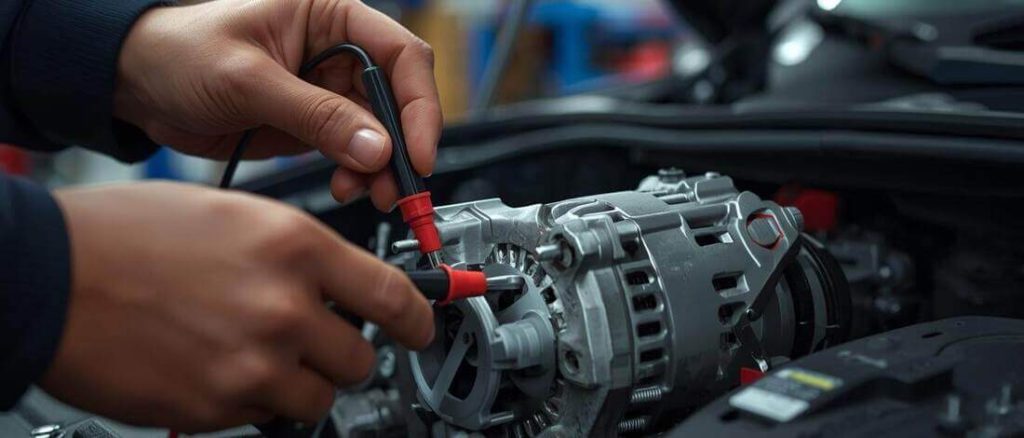
The right test before making this call: with the engine running, check charging voltage at the battery terminals. If it reads 13.5–14.5V steadily, the alternator’s output is fine and the pulley is the only repair needed. If it reads below 13.5V or fluctuates, budget for the full alternator.

Can You Drive with a Bad Alternator Pulley?
The answer depends entirely on the failure mode and how far along it is.
Early-stage chirp or flutter (clutch wearing but still functional): You have a window — days to weeks depending on how hard you drive the car. The pulley is still doing its job imperfectly. Get it scheduled, don’t delay, but you don’t need to call a tow truck.
Seized pulley with belt squealing and glazing: The clock is running. A glazed belt that’s been slipping has significantly reduced friction. You may not notice anything dramatic right up until the belt snaps — and when it snaps, you lose the alternator, power steering pump, and water pump simultaneously. Engine temperature rises fast without the water pump. Don’t drive this more than necessary, and don’t take it on a long highway trip.
Wobbling pulley with visible lateral movement: Same urgency as a seized pulley. A bearing that’s running with lateral play will fail — it’s a question of when. When it fails, the pulley can bind, the belt can jump, and the consequences are the same as a snapped belt.
If your belt is already showing visible cracking, glazing, or edge fraying alongside any of these symptoms — park it. Driving on a compromised belt to save a tow bill can turn into an engine repair bill.
Alternator Pulley Replacement Cost
Understanding the cost split between pulley-only and full alternator replacement is what separates an informed repair decision from an expensive mistake.
| Repair Scenario | Parts Cost | Labor | Total Estimate |
|---|---|---|---|
| OAP pulley only | $25–$60 | $100–$200 (1–2 hrs) | $125–$260 |
| OAD pulley only | $40–$120 | $100–$250 (1–2 hrs) | $140–$370 |
| Pulley + serpentine belt (same visit) | $60–$180 | $120–$250 | $180–$430 |
| Full alternator replacement (independent shop) | $150–$400 | $100–$300 (1–2.5 hrs) | $350–$700 |
| Full alternator — European or tight engine bay | $250–$600 | $200–$500 (2–4 hrs) | $450–$1,100 |
A few things worth knowing before you approve any quote:
The OAD pulley requires a special spanner socket tool to remove without damaging the alternator housing. Most drivers don’t own this tool — but O’Reilly Auto Parts offers it as a free loaner (ask for the EverTough 67004 alternator repair kit). If you’re comfortable with basic mechanical work, this makes an OAD pulley swap a realistic DIY job.
If the shop has the belt off for the pulley job, replacing the serpentine belt at the same visit makes economic sense. You’re already paying for the labor to access the system — the belt itself costs $30–$80 in parts. Doing it separately later means paying for that labor twice.
Any shop quoting you a full alternator because of a noise complaint without first checking whether the pulley is the source is jumping to the more expensive repair. Ask them directly: “Did you test the charging voltage, and did you perform a spin test on the pulley?” If they can’t answer both with yes, get a second opinion.
FAQs About Bad Alternator Pulley Symptoms
Q: Can a bad alternator pulley damage the serpentine belt?
Yes — and it’s one of the most common ways a serpentine belt fails prematurely. A seized pulley causes the belt to slip over the alternator’s grooves rather than rolling cleanly with them, generating heat and glazing the belt’s ribbed surface. A wobbling pulley (bearing failure) creates uneven contact that frays the belt’s edge over time. If your serpentine belt is wearing faster than expected or showing glazing and edge fraying, the alternator pulley is the first component to inspect.
Q: What does a bad alternator pulley sound like?
The most diagnostic sound is a chirp or flutter specifically during engine deceleration — releasing the throttle or coming to a stop. That sound is the OAP or OAD clutch failing to freewheel smoothly. A seized pulley produces squealing during cold starts that tends to fade once the belt warms up. A bearing failure produces a more constant grinding or metallic whirring from the alternator area that doesn’t change much with engine speed changes.
Q: Can I replace just the alternator pulley or does the whole alternator have to come out?
On most vehicles the pulley is replaced with the alternator in place — the belt comes off, the pulley is unthreaded from the alternator shaft using a special tool, and the new pulley is torqued on. The alternator itself doesn’t need to be removed for a pulley-only replacement in most cases. If the alternator needs to come out for access reasons specific to the vehicle, that adds labor time but doesn’t change the part cost.
Q: How long do alternator pulleys last?
Solid pulleys essentially last the life of the alternator — they have no moving internal parts to wear out. OAP and OAD pulleys are wear items with an internal clutch mechanism. Most last 60,000–100,000 miles under normal conditions. Hard driving, stop-and-go traffic, and high electrical loads (subwoofers, auxiliary lighting, constant phone charging) accelerate wear because they increase the frequency and severity of the deceleration events the clutch has to absorb.
Q: What happens if I install the wrong type of alternator pulley?
Installing a solid pulley or OAP where an OAD is specified removes the torsional damping the belt drive system was engineered around. The result is increased belt vibration, accelerated tensioner wear, and premature belt failure. Depending on the vehicle, it may also increase noise and harshness at idle and during deceleration. The repair might feel complete initially — but you’ll be back for a belt and tensioner sooner than you should be. Always match the replacement pulley type exactly to the original specification.
The Bottom Line
The alternator pulley is a wear item that most drivers don’t know exists — and most shops don’t check before recommending a full alternator replacement.
If you’re hearing a chirp during deceleration, seeing belt flutter at idle, or replacing serpentine belts faster than you should be — run the spin test before you approve any repair. It takes two minutes and no tools. A pulley that fails the test costs $25–$120 in parts. A full alternator costs three to eight times more.
If the charging system is healthy — voltage steady at 13.5–14.5V — and the only symptom is noise or belt wear, the pulley is your repair. If voltage is low or the battery is suffering, the alternator internals have likely taken damage from the failed pulley and the whole unit needs to come out.
Either way, the diagnosis starts with the pulley. Don’t skip that step.