
This article was updated in October 2, 2026 with new products and information by Mark S. Taylor
A rhythmic ticking or clicking sound coming from your engine bay can be as harmless as a modern fuel system doing its job, or as serious as impending internal engine failure.
Before assuming the worst—or ignoring a sound that could ruin an engine—you need to know what you are listening to, whether it is safe to drive, and how a professional technician isolates the root cause before replacing parts.
Contents
- 1 Does an engine tick need a professional inspection?
- 2 What is an engine-ticking inspection?
- 3 Why a ticking noise is hard to diagnose
- 4 What a professional checks first
- 5 Tests that may be needed
- 6 How much does a professional engine-noise inspection cost?
- 7 Inspection cost versus repair cost
- 8 Questions to ask the shop
- 9 Signs of a weak inspection
- 10 When should you tow the vehicle?
- 11 What you can do before the inspection
- 12 Professional inspection or dealership diagnosis?
- 13 FAQs About Engine Ticking Professional Inspections
- 13.1 Is an engine-ticking inspection worth paying for?
- 13.2 Can a mechanic identify the problem just by listening?
- 13.3 How much does engine-noise diagnosis cost?
- 13.4 Should I approve a lifter replacement if the engine is ticking?
- 13.5 What if the shop cannot reproduce the noise?
- 13.6 Can a ticking engine still be driven?
- 13.7 Is a professional inspection the same as a full engine teardown?
- 13.8 Can low oil cause engine ticking even if the oil light is off?
- 14 Bottom line
Does an engine tick need a professional inspection?
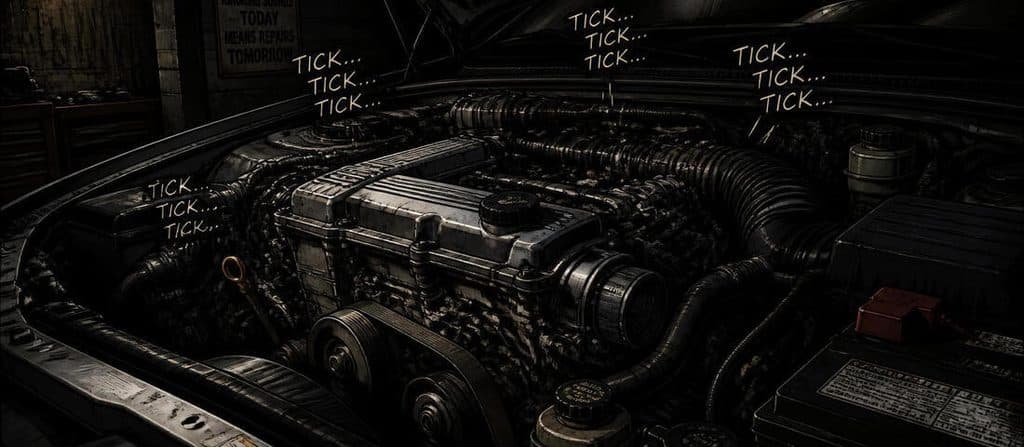
Sometimes an engine tick is normal. Direct-injection fuel injectors can make a light, fast clicking sound at idle. A purge valve or another emissions component may also make a regular tick.
A new, loud, uneven, or worsening noise is different. It can point to low oil, low oil pressure, a worn lifter, an exhaust leak, a timing problem, a belt-driven accessory, or internal engine damage.
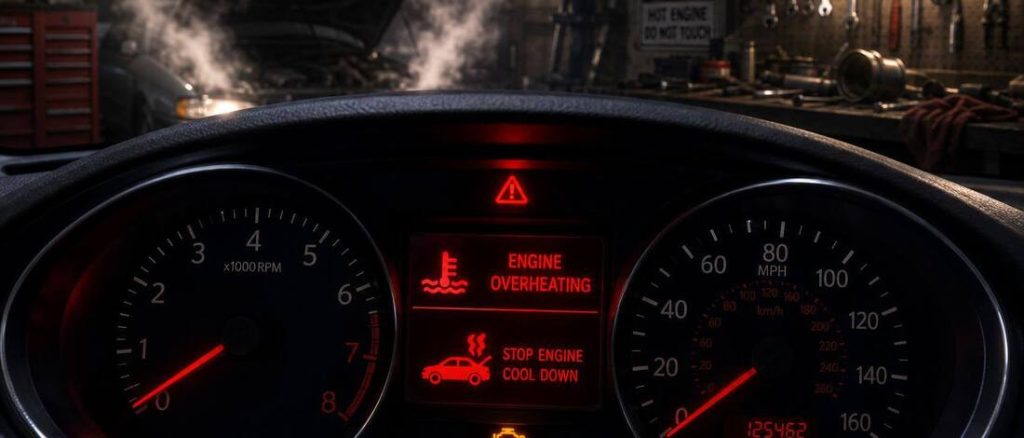
If the oil-pressure warning light is on, the noise is deep or getting worse, or the engine is losing power, shut it off and have it towed. Do not drive to the shop just because the car still starts.
A professional inspection should do more than listen for a few seconds and name a part. It should reproduce the noise, record when it happens, rule out urgent problems, and support any repair recommendation with a test or clear finding. That is the difference between diagnosis and parts swapping.
What is an engine-ticking inspection?
An engine-ticking inspection is a diagnostic service used to find the source and urgency of an unusual engine noise. The shop may call it a noise diagnosis, engine diagnostic, inspection, or mechanical inspection. The name matters less than what the service includes.
A proper inspection usually begins with your description of the noise. The technician needs to know whether it happens:
- Only at idle
- During a cold start
- After the engine warms up
- Under acceleration or load
- With the air conditioner running
- At one engine speed or across the RPM range
- Every time or only occasionally
- After an oil change, repair, or warning light
That information helps the technician reproduce the problem. If the noise is random, the inspection may take longer because the vehicle must be driven or monitored until the sound appears.
RepairPal explains that noise diagnosis may include reproducing the condition, scan-tool data, monitoring engine or transmission conditions, and visual inspection. See its Noise Diagnosis Cost Estimate.
Why a ticking noise is hard to diagnose
A tick is a description, not a diagnosis. Several unrelated problems can create a similar sound.
A light tick from the top of the engine may come from fuel injectors or valvetrain parts. A sharp tick near the exhaust manifold may be escaping exhaust gas. A sound at the front of the engine may come from a belt, tensioner, pulley, water pump, alternator, or timing component.
Sound also travels through metal and plastic. The noise may seem to come from the valve cover even when the source is lower in the engine or at the front cover.
Temperature and engine speed make the problem harder. A small exhaust leak may change as metal heats up. A valvetrain noise may change as oil pressure and temperature change. A loose pulley may become louder when an accessory load changes.
That is why a professional does not need to guess from one description. The job is to narrow the possibilities with repeatable clues and targeted tests.

What a professional checks first
1. The symptom history
The inspection should start with questions, not a parts catalog.
Tell the technician when the tick began, whether it is getting louder, and what happened before it appeared. Mention an oil change, low-oil warning, overheating event, repair, accident, or long period without maintenance.
Bring a short recording if the sound is intermittent. Record it from a safe position with the hood closed when possible. Do not place a phone or camera near belts, fans, pulleys, or hot exhaust parts.
Useful details include:
- Cold or warm engine
- Idle or driving
- Light tick or deep knock
- Steady or irregular rhythm
- Faster with engine speed or unchanged
- Warning lights
- Oil smell or exhaust smell
- Rough running or loss of power
This may sound basic, but it saves time. A technician cannot test a condition that no one can describe or reproduce.
2. Oil level and oil condition
Low oil is one of the first things a technician checks because it is common and can become expensive quickly.
The inspection may include checking the oil level, looking for leaks, and reviewing the oil’s condition. Low oil can make valvetrain parts noisy. It can also point to an external leak, internal oil consumption, or neglected maintenance.
Adding oil may restore the level, but it does not prove the engine is healthy. If the oil level dropped, the next question is why.
Do not add a random oil grade or additive. The correct oil specification depends on the vehicle. Use the owner’s manual or vehicle-specific service information.
3. Warning lights and scan data
The shop may scan the vehicle for diagnostic trouble codes and review live data. Codes can reveal a related misfire, sensor fault, timing problem, or other condition.
A scan does not automatically identify the noisy part. A code is a clue that must be matched with the vehicle’s symptoms and test results.
For example, a timing-related code and a ticking sound may point toward a timing-system problem. They do not prove that replacing one timing component will solve everything. The technician still needs to confirm the finding.
4. Visual inspection
With the engine off and at a safe temperature, the technician may inspect for:
- Oil leaks
- Damaged wiring
- Loose brackets or shields
- Exhaust soot near a manifold or flange
- Damaged fan blades or shrouds
- Belt or pulley damage
- Loose covers or fasteners
- Evidence of recent work
A visual inspection can find an obvious problem quickly. It cannot rule out an internal engine fault by itself.
5. Sound location and operating conditions
The technician may listen from several safe points around the engine bay. A professional listening tool can help narrow the source, but it does not replace testing.
The sound may be checked at idle, during a controlled increase in engine speed, and with certain accessories switched on or off. The exact procedure depends on the vehicle and the noise.
Do not assume a shop should rev the engine hard just to make the noise louder. The test should be controlled and appropriate for the vehicle’s condition.
Tests that may be needed
A professional inspection does not always require every test below. The right test depends on the symptoms.
Mechanical oil-pressure test
If the oil-pressure warning is on, the oil level is correct but the engine is ticking, or the noise suggests poor lubrication, a technician may measure actual oil pressure with a mechanical gauge.
This helps separate a true pressure problem from a faulty pressure sensor or warning system. The result must be compared with the vehicle manufacturer’s specification. There is no universal oil-pressure number that fits every engine.
Firestone says that proper diagnosis of suspected oil-pump trouble requires professional lubrication-system testing, including mechanical oil-pressure testing. See Firestone’s oil-pump symptom guide.
Exhaust leak inspection
An exhaust manifold leak can make a sharp ticking sound, especially during a cold start or under load. A technician may inspect the manifold, gasket, studs, flanges, and nearby components for soot, damage, or escaping gas.
An exhaust leak is not harmless if fumes can reach the passenger compartment. Tell the shop if you smell exhaust inside the car or near the engine bay.
Do not touch the manifold or try to tighten hot fasteners. Exhaust parts can remain hot long after the engine stops, and the correct tightening procedure varies by vehicle.
Belt and accessory inspection
A belt tensioner, idler pulley, alternator, water pump, or air-conditioning compressor can create a ticking, chirping, grinding, or rattling noise.
A technician may inspect the belt system and isolate accessory noise using vehicle-appropriate procedures. Removing a drive belt and running an engine is not a safe general-purpose DIY test. Some vehicles depend on the belt to drive the water pump or other critical equipment.
Keep hands, clothing, hair, and tools away from moving parts. Let a professional handle tests that require the engine to run with components exposed or removed.
Valvetrain or timing inspection
If the noise seems to come from the top of the engine, the technician may investigate lifters, lash adjusters, rocker arms, camshafts, or other valvetrain parts.
A noise from the front of the engine may lead to a timing-chain, guide, or tensioner inspection. The engine design determines which parts are present and how they should be tested.
A shop should not recommend a major timing or valvetrain repair only because the sound “sounds like” one part. Ask what test or inspection supports the recommendation.
Internal engine testing
A deep knock, low oil pressure, metal in the oil, severe misfire, or worsening noise may require more advanced testing. Depending on the vehicle, this could include compression testing, leak-down testing, oil analysis, or further inspection after a component is removed.
Teardown should not be the first response to every tick. It may be necessary when the evidence points to internal damage, but the shop should explain what it expects to learn and what authorization is required before disassembly.
How much does a professional engine-noise inspection cost?
RepairPal’s Noise Diagnosis Cost Estimate, updated September 3, 2026, lists an average noise-diagnosis range of 125–125–183. RepairPal says that range excludes taxes and fees, varies by location, and does not include related repairs.
Treat that figure as a benchmark, not a guaranteed quote for your car. The final diagnostic charge can change with the vehicle, shop rate, time needed to reproduce the noise, test equipment, and whether a second problem is found.
A simple, repeatable idle tick may take less time to identify than a noise that appears only during a cold start, uphill acceleration, or a specific driving condition. Intermittent noises can require more time because the technician has to recreate the event.
The inspection fee is separate from the repair cost. A shop may find that the noise is normal and no repair is needed. It may also find a problem that requires a small part, a large repair, or further testing before a price is possible.
Inspection cost versus repair cost
Do not confuse these three charges:
| Charge | What it means | What you should expect |
|---|---|---|
| Diagnostic inspection | Time spent identifying the source or narrowing the cause | A description of the test and findings |
| Repair estimate | Expected cost to correct a confirmed or strongly supported fault | Parts, labor, related work, and exclusions |
| Repair invoice | Final charge for completed work | Labor and parts actually installed, plus approved extras |
A diagnostic fee is not wasted money if it prevents you from replacing the wrong part. It becomes frustrating when the shop cannot explain what it tested or jumps directly to an expensive repair without evidence.
Ask whether the diagnostic fee is credited toward the repair. Some shops offer that arrangement, while others charge diagnosis separately. Get the policy in writing before authorizing work.
Questions to ask the shop
You do not need to challenge every technical detail. You do need a clear explanation before approving a major repair.
Ask:
- Did you reproduce the noise?
- Where did you isolate the sound?
- When does it happen—cold, hot, idle, acceleration, or under load?
- What test supports the suspected failure?
- Was actual oil pressure measured, if oil pressure is part of the concern?
- Did you rule out normal injector or purge-valve operation?
- Could an exhaust leak, belt, pulley, or heat shield create the same sound?
- What parts are confirmed bad, and what parts are only possible?
- What damage could occur if I wait?
- What happens if the noise remains after the repair?
- Is the diagnostic fee separate from the repair estimate?
- What warranty applies to the repair?
A good shop may not have an instant answer. That is fine. A complicated noise can take time. The problem is not uncertainty; the problem is presenting a guess as a confirmed diagnosis.

Signs of a weak inspection
Be cautious when a shop:
- Names a part without reproducing or locating the noise
- Recommends several expensive parts “just in case”
- Cannot explain what test supports the repair
- Gives a universal oil-pressure value without checking vehicle specifications
- Treats every tick as a bad lifter
- Says a warning light is only a sensor without measuring the condition
- Refuses to separate diagnostic work from repair authorization
- Starts teardown without explaining what it expects to confirm
A credential can be useful. RepairPal recommends certified shops and, where possible, ASE-certified or factory-trained technicians. But a credential does not prove that one specific part failed. The inspection still needs evidence.
When should you tow the vehicle?
Have the vehicle towed instead of driving it when you notice:
- A red oil-pressure light or low-pressure message
- Oil too low to register on the dipstick
- A deep knock rather than a light tick
- A noise that is rapidly getting louder
- Severe shaking, misfire, stalling, or power loss
- Smoke or a major oil leak
- Overheating
- Burning oil or exhaust fumes entering the cabin
- A new noise after an oil-pressure warning or major repair
A stable, light tick with no warning lights or drivability symptoms may not require an emergency tow. It still deserves professional attention if it is new or different from the vehicle’s normal sound.
Do not use the fact that the car still starts as your safety test. Engines can run while damage is building.
What you can do before the inspection
Keep the preparation simple and safe.
- Check the oil level with the engine off and follow the owner’s manual.
- Write down when the noise occurs.
- Note any warning lights or messages.
- Record a short video from a safe position if the noise is intermittent.
- Look for obvious oil spots only when the engine is cool.
- Bring the date and mileage of the last oil change.
- Tell the shop about recent repairs, oil changes, overheating, towing, or heavy use.
- Do not add a random oil grade or additive.
- Do not reach near belts, fans, pulleys, or hot exhaust parts.
- Do not remove parts just to make the noise easier to hear.
The more specific your symptom notes, the less time the technician may spend trying to recreate the complaint.

Professional inspection or dealership diagnosis?
Both an independent shop and a dealer may be able to diagnose an engine tick. The right choice depends on the vehicle and the problem.
An independent shop may be a good choice for a common engine, routine noise diagnosis, oil-pressure testing, exhaust inspection, or accessory problem. Look for a shop that can explain its diagnostic process and provide a written estimate.
A dealer or brand specialist may have an advantage when the vehicle has a complex engine, a known manufacturer issue, a warranty concern, specialized scan data, or a model-specific timing or valvetrain system.
Ask whether the technician has experience with your engine family. “Professional” should mean more than a generic parts recommendation. It should mean the shop has the information and tools needed to test your vehicle correctly.
FAQs About Engine Ticking Professional Inspections
Is an engine-ticking inspection worth paying for?
Usually, yes, when the noise is new, worsening, or paired with a warning light or performance problem. A proper diagnosis can prevent you from paying for parts that do not solve the noise. It can also identify an oil-pressure problem before it causes more damage.
Can a mechanic identify the problem just by listening?
Sometimes a technician can recognize a familiar noise quickly. That is a starting point, not always proof. A reliable diagnosis may require oil-pressure testing, scan data, visual inspection, sound isolation, or another targeted test.
How much does engine-noise diagnosis cost?
RepairPal lists an average noise-diagnosis range of 125–183 as of September 3, 2026. The range excludes taxes and fees, varies by location, and does not include related repairs. Your vehicle and the time needed to reproduce the noise can change the final charge.
Should I approve a lifter replacement if the engine is ticking?
Not without asking what confirmed the lifter failure. A similar noise can come from an injector, exhaust leak, low oil pressure, timing component, pulley, or another part. Ask for the test result and the repair scope in writing.
What if the shop cannot reproduce the noise?
Give the shop your recording and detailed conditions. Explain whether it happens cold, hot, at idle, during acceleration, with the air conditioner on, or only after driving. An intermittent noise may require additional diagnostic time. Ask what the next diagnostic step will be before authorizing more work.
Can a ticking engine still be driven?
It depends on the symptoms. Do not drive with an oil-pressure warning, deep knock, major oil leak, severe misfire, overheating, loss of power, or rapidly worsening noise. A light, stable sound without warning signs may be less urgent, but a technician should assess a new noise.
Is a professional inspection the same as a full engine teardown?
No. A normal inspection starts with symptom history, reproduction, visual checks, scan data, and targeted tests. Teardown is a later step that may be considered if the evidence points to internal damage and you authorize further work.
Can low oil cause engine ticking even if the oil light is off?
Yes. The oil level can be low before a warning appears. A warning light is not the only way to identify a lubrication problem. Check the oil level according to the owner’s manual and have the vehicle inspected if the tick is new or persistent.
Bottom line
A professional engine-ticking inspection should give you more than a guess. It should identify when the noise happens, reproduce it when possible, narrow its source, check for urgent oil or engine problems, and explain the evidence behind the repair recommendation.
RepairPal’s current noise-diagnosis benchmark is 125–125–183, before taxes and fees, with location and related repairs excluded. Use it as a reference, not a promised price.
Do not approve expensive parts because a sound “seems like” a lifter or timing chain. Ask what was tested, what failed, and what the shop will do if the noise remains. Proof comes before parts.