
This article was updated in November 15, 2026 with new products and information by Mark S. Taylor
A brake rotor can look smooth through the wheel spokes and still be too thin for continued service. It may have worn down over thousands of stops without developing an obvious crack or deep groove.
That is why brake technicians measure rotor thickness instead of judging it by appearance alone. Many rotors have a minimum-thickness marking stamped, cast, or etched into the metal. It may read MIN TH, followed by a value in millimeters or inches.
That number is a service limit. It is not a target to ignore.

Contents
- 1 What is minimum brake rotor thickness?
- 2 1. What does MIN TH mean on a brake rotor?
- 3 2. Where do you find the minimum-thickness marking?
- 4 3. How is brake rotor thickness measured?
- 5 4. Minimum thickness, new thickness, and machining thickness are different
- 6 5. What is brake rotor thickness variation?
- 7 6. What is lateral runout, and how is it different?
- 8 7. What damage can make a rotor unserviceable?
- 9 8. Can a brake rotor be resurfaced?
- 10 9. Should brake rotors be replaced in pairs?
- 11 10. Can you check rotor thickness at home?
- 12 When should you stop driving?
- 13 FAQs About Minimum Brake Rotor Thickness
- 13.1 What does MIN TH mean on a brake rotor?
- 13.2 How many places should a brake rotor be measured?
- 13.3 Can a rotor be above MIN TH and still need replacement?
- 13.4 Is minimum thickness the same as the resurfacing limit?
- 13.5 Can I use a generic brake rotor thickness chart?
- 13.6 Should both brake rotors be replaced at the same time?
- 14 The bottom line
What is minimum brake rotor thickness?
Minimum brake rotor thickness is the lowest thickness allowed by the rotor or vehicle manufacturer’s service specification. The value may be marked on the rotor as MIN TH or listed in the factory service information.
A technician measures the friction surface at multiple points with a suitable brake rotor micrometer or gauge. The lowest valid measurement is compared with the correct specification for that rotor.
There is no single minimum thickness that applies to every car, truck, rotor size, or brake package.
1. What does MIN TH mean on a brake rotor?
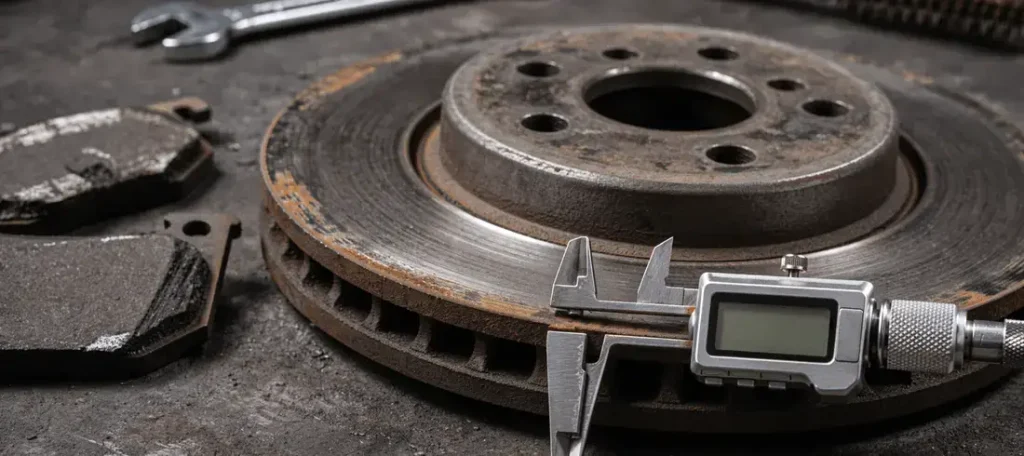
MIN TH means minimum thickness.
A brake rotor loses material as the brake pads press against its friction surfaces. As the rotor becomes thinner, it has less material available to absorb and dissipate heat. Its thickness also contributes to the disc’s mechanical strength.
Brembo explains that excessive rotor wear reduces heat-dissipation capacity and mechanical strength. Reduced thickness can contribute to thermal damage and affect braking performance.
The minimum-thickness specification is the lower service limit for that rotor. If the rotor does not meet the applicable limit, it should not be returned to service.

2. Where do you find the minimum-thickness marking?
Look for a marking on the rotor’s hub or hat area, or another location identified by the rotor manufacturer.
It may appear in formats such as:
- MIN TH
- MIN TH 22 mm
- MIN 0.866 in
The exact location and format vary. Volkswagen’s U.S. service bulletin 46-19-02 says the minimum allowed thickness for its covered applications is cast, stamped, or laser-etched into the rotor hub.
If corrosion makes the marking difficult to read, do not guess. Use the correct factory service information for the vehicle and the exact rotor part number.
A generic thickness chart from another vehicle is not a safe substitute.
3. How is brake rotor thickness measured?
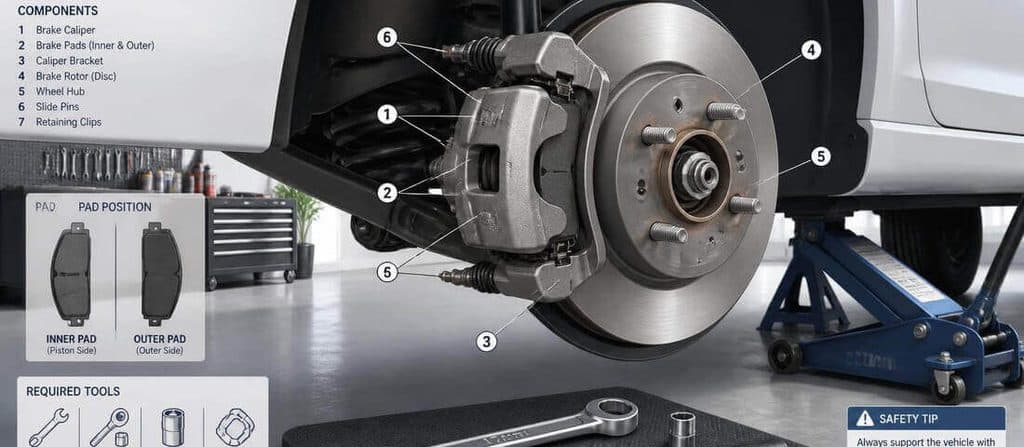
A proper thickness check uses a suitable brake rotor micrometer or gauge. A visual inspection or ordinary ruler cannot establish whether a rotor meets its service limit.
A qualified technician generally follows the manufacturer’s procedure:
- Access the rotor using the vehicle’s service procedure.
- Inspect both friction surfaces for damage.
- Select a suitable measuring tool.
- Take measurements at multiple points around the rotor.
- Keep the measuring position consistent at each point.
- Compare the lowest valid measurement with the correct service specification.
Brembo’s general guide recommends measurements at four or more points and says to use the lowest reading.
Volkswagen’s U.S. bulletin provides a vehicle-specific example. It calls for four measurements at the same distance from the rotor’s outer circumference.
The required number of points and the measurement distance can vary by manufacturer. The service procedure for the exact vehicle takes priority.
Why use the lowest measurement?
A rotor may not wear evenly. One section can be thinner than another.
If the technician averages the readings, a thin area could be hidden by thicker readings elsewhere. The lowest valid measurement is therefore important when checking the minimum service limit.
A single measurement cannot establish the thickness of the entire rotor.
4. Minimum thickness, new thickness, and machining thickness are different
These terms are easy to confuse, but they describe different service conditions.
| Term | What it means |
|---|---|
| New or nominal thickness | The specified thickness of a new rotor |
| Minimum or discard thickness | The lowest allowed service thickness |
| Minimum thickness after machining | The minimum thickness that must remain after an approved resurfacing operation, when the manufacturer provides a separate limit |
Some service information lists more than one limit. A rotor may be above its discard thickness but still lack enough material for resurfacing.
Volkswagen’s U.S. service bulletin 46-19-02 requires the rotor measurement to exceed the applicable minimum after machining for the covered vehicles. This illustrates why the final measurement matters.
Never assume a rotor can be machined simply because it is still above its discard limit. The exact service information and rotor manufacturer’s instructions determine whether machining is permitted.
5. What is brake rotor thickness variation?
Thickness variation, often called disc thickness variation (DTV), is the difference between the thickest and thinnest measurements around the rotor.
It is not the same as minimum rotor thickness.
A rotor may remain above its minimum thickness but still have enough variation to cause brake pedal pulsation or vibration.
To check DTV, a technician takes measurements at the same radial distance from the rotor’s outer edge and compares the readings.
Saab’s 2010 9-5 service information describes taking measurements at four or more evenly spaced points. The difference between the highest and lowest readings gives the amount of thickness variation.
The allowable variation is vehicle-specific. Do not apply one manufacturer’s limit to another brake system.
6. What is lateral runout, and how is it different?
Lateral runout is the amount the rotor moves from side to side as it rotates. A technician generally measures it with a dial indicator using the manufacturer’s procedure.
Thickness variation and lateral runout are separate checks:
- Thickness variation: Compares the rotor’s thickness at several points.
- Lateral runout: Measures side-to-side movement as the rotor turns.
A rotor can pass one check and fail another.
Saab’s 2010 9-5 service information treats these as separate measurements. It also describes checking thickness variation before assembled lateral runout.
A technician may inspect the hub mounting surface, wheel-bearing condition, and installation factors when investigating brake vibration.
Do not assume every brake pedal pulsation means the rotor is simply “warped.” The actual measurements and vehicle-specific procedure matter.
7. What damage can make a rotor unserviceable?
Thickness is not the only inspection point.
A rotor may need replacement because of:
- Visible cracks.
- Severe blue or purple discoloration from heat.
- Raised hard spots or other heat-related surface damage.
- Deep scoring or damage to the friction surface.
- Heavy corrosion that affects the braking surface.
- Thickness below the applicable service limit.
- Thickness variation or runout outside the vehicle’s specification.
Volkswagen’s U.S. service bulletin identifies severe discoloration, high-heat surface damage, and visible cracks as conditions that make the covered rotors unserviceable.
A smooth-looking rotor is not automatically safe. A damaged rotor is not automatically repairable by machining.
8. Can a brake rotor be resurfaced?
Sometimes, but not on every vehicle or rotor.
Resurfacing removes a small amount of material to restore the friction surface. The rotor must remain above the applicable minimum after machining, and the manufacturer must allow the procedure.
A qualified shop should check:
- Whether the OEM permits machining.
- The minimum thickness before machining.
- The minimum thickness after machining, if separately specified.
- Surface condition and heat damage.
- Thickness variation and runout.
- The correct machining and post-machining inspection procedure.
If the rotor cannot remain above the required limit after machining, it must be replaced.
Do not approve resurfacing based only on a statement that the rotor “has enough metal left.” Ask for the measured thickness and the service specification used.
9. Should brake rotors be replaced in pairs?
Follow the vehicle manufacturer’s procedure and the rotor manufacturer’s instructions.
Some manufacturers specify replacing rotors as a pair on the same axle. Brembo’s guidance also calls for replacing both sides when one rotor in the pair falls below its minimum. Volkswagen’s bulletin gives a pair-replacement instruction for the applications covered by that bulletin.
That does not mean every vehicle has identical replacement rules. The exact axle, brake package, rotor design, and service information control the decision.
If a shop recommends replacing only one rotor, ask which manufacturer procedure supports that choice.
10. Can you check rotor thickness at home?
You may be able to see the rotor surface through the wheel spokes, but that does not provide a reliable thickness measurement.
A proper measurement may require wheel removal and access to the rotor friction surfaces. It also requires a suitable measuring tool and the correct service specification.
Wheel removal, lifting, caliper removal, and brake reassembly involve safety-critical work. These tasks require approved lifting points, correctly rated support equipment, and vehicle-specific procedures.
Never work under a vehicle supported only by a jack.
If you are not trained and equipped to inspect the brake assembly, have a qualified technician measure it.

When should you stop driving?
Arrange a brake inspection if you suspect a rotor is below specification or if braking performance has changed.
Stop in a safe location and arrange professional help if you experience:
- Severe grinding during braking.
- A major change in brake pedal feel.
- Strong pulling during braking.
- A brake warning accompanied by abnormal braking behavior.
- A noticeable loss of braking performance.
Do not rely on a visual check to decide that the brakes are safe. A rotor below its service limit should not remain in use.
FAQs About Minimum Brake Rotor Thickness
What does MIN TH mean on a brake rotor?
MIN TH means minimum thickness. It identifies the lower thickness limit for that rotor. The marking may be stamped, cast, or etched into the metal. Compare the measured thickness with the correct specification for the exact rotor and vehicle.
How many places should a brake rotor be measured?
The procedure varies by manufacturer. Brembo’s general guide calls for at least four measurement points. A Volkswagen U.S. service bulletin also uses four points at the same distance from the rotor edge for the covered applications. Follow the exact service procedure.
Can a rotor be above MIN TH and still need replacement?
Yes. A rotor can be above its minimum thickness but still fail inspection because of cracks, severe heat damage, excessive thickness variation, runout, or other defects. Thickness is only one part of a complete rotor inspection.
Is minimum thickness the same as the resurfacing limit?
Not always. Some service information distinguishes the minimum thickness after machining from the discard limit. A rotor may be above its discard limit but still lack enough material for approved resurfacing. Check the exact OEM procedure before machining.
Can I use a generic brake rotor thickness chart?
No. Rotor dimensions and service limits vary by vehicle, axle, brake package, and rotor design. Use the marking on the exact rotor or factory service information for the correct part.
Should both brake rotors be replaced at the same time?
Follow the vehicle and rotor manufacturer’s instructions. Some service procedures require replacing rotors in pairs on the same axle. Do not assume that a rule for one vehicle applies to every vehicle.
The bottom line
Minimum brake rotor thickness is a measured service limit, not a visual guess. The MIN TH marking or exact OEM specification tells the technician how thin the rotor is allowed to become.
The correct inspection uses multiple measurements, compares the lowest reading with the right specification, and checks for other damage.
Do not rely on a generic thickness chart or approve machining without the required post-machining measurement. When the rotor’s condition or service limit is uncertain, have a qualified brake technician inspect it.