
This article was updated in June 5, 2026 with new products and information by Mark S. Taylor
You switch the AC on and wait for cool air. Instead you get warm air — or barely cool air that only works when you’re moving. You look under the hood and the radiator fan is sitting completely still. Nothing is spinning.
This is a problem with two consequences happening at once. First, your AC doesn’t cool properly because the condenser needs airflow to reject heat. Second, your engine is at risk of overheating at idle because the same fan that cools the condenser also cools the radiator.
The good news is that the cooling fan circuit is one of the more straightforward electrical systems to diagnose — and most causes are fixable without major expense. This guide covers every reason the fan won’t run when the AC is on, how to test each component yourself, and what it costs to fix.
Contents
- 1 Why the Radiator Fan Must Run When the AC Is On
- 2 Condenser Fan vs Radiator Fan — Are They the Same?
- 3 How the AC Triggers the Cooling Fan
- 4 8 Causes of the Radiator Fan Not Turning On With AC
- 5 How to Test the Cooling Fan System at Home
- 6 AC Works at Highway Speed But Not at Idle — Why
- 7 Is It Safe to Drive With the Cooling Fan Not Working?
- 8 Repair Cost Summary
- 9 FAQs About Radiator Fan Not Turning On With AC
- 9.1 Should the radiator fan run when the AC is on?
- 9.2 Why does my AC only work at highway speed and not at idle?
- 9.3 Can a blown fuse cause the AC not to cool?
- 9.4 How do I test if my cooling fan motor is bad?
- 9.5 Can low refrigerant cause the cooling fan not to run?
- 9.6 How much does it cost to fix a cooling fan that won’t run with AC?
- 10 The Bottom Line
Why the Radiator Fan Must Run When the AC Is On
Here’s the physics that makes this so important.
When your car is moving at highway speed, air rams through the grille and passes through the condenser and radiator at high velocity. This natural airflow is sufficient to cool both the AC condenser and the engine coolant — the electric fan doesn’t need to run at all because moving air does the job.
When the car is stationary or moving slowly — idling at a red light, sitting in traffic, parking — there is no ram airflow. Zero. The condenser and radiator are surrounded by hot, stagnant engine bay air. Without the electric cooling fan forcing air through these heat exchangers, heat builds up rapidly.
For the AC system this means the refrigerant in the condenser can’t reject its heat. High-side pressure climbs, the compressor overloads, and AC performance collapses. For the engine it means coolant temperature rises unchecked toward the danger zone.
This is why the cooling fan is wired to run whenever the AC compressor is engaged — not just when the engine temperature rises. The AC imposes a heat rejection demand that requires forced airflow the moment the compressor turns on, regardless of engine temperature.
The pattern that confirms the fan is the problem: AC blows cold on the highway but blows warm at a stop or in slow traffic. The fan is either not running or not running at the correct speed.

Condenser Fan vs Radiator Fan — Are They the Same?
It depends on the vehicle.
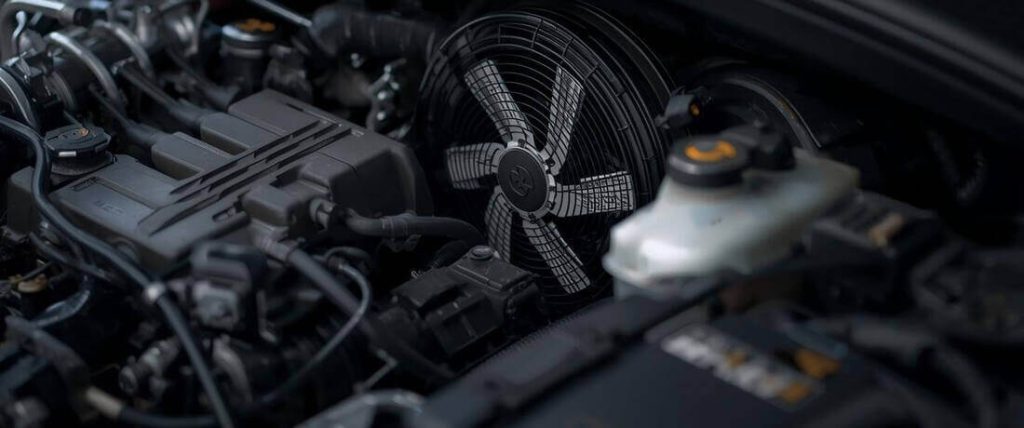
Single fan setup (most common on smaller vehicles): One electric fan is mounted in front of the radiator with a shroud. This single fan serves double duty — it cools the radiator for engine cooling and cools the AC condenser for AC performance. When the AC is on, this fan runs. When the engine temperature reaches threshold, this fan also runs.
Dual fan setup (common on larger vehicles and many modern cars): Two separate fans are mounted side by side. One cools the radiator and is triggered by engine coolant temperature. The other — the condenser fan — is mounted in front of the AC condenser and is triggered primarily by the AC system. On many dual-fan setups both fans run when the AC is on, since the condenser and radiator are stacked and both benefit from airflow.
Why this matters for diagnosis: On a single-fan car, a failed fan means both the AC and engine cooling are compromised. On a dual-fan car, you need to determine which fan isn’t running — the condenser fan (AC not cold, engine fine) or the radiator fan (AC may work but engine overheats).
Check your owner’s manual or vehicle service data to confirm your specific setup before beginning diagnosis.
How the AC Triggers the Cooling Fan
Most drivers assume the cooling fan only runs based on engine temperature. This is half true — and missing the other half causes a lot of misdiagnosis.
The cooling fan has two separate trigger mechanisms:
Trigger 1 — Engine temperature: When coolant temperature rises above approximately 200–220°F, the PCM commands the fan on to protect the engine. This is the temperature-based trigger most people know about.
Trigger 2 — AC system pressure: When the AC compressor clutch engages, the AC high-pressure side pressure rises. The AC high pressure switch — a sensor mounted on the high-pressure line — sends a signal when pressure reaches a threshold (typically 150–200 PSI). This signal tells the PCM to command the cooling fan on, independently of engine temperature.
On most modern vehicles, the PCM processes both signals and commands the fan accordingly. On some older vehicles, the AC pressure switch routes power directly to the fan relay, bypassing the PCM entirely.
Why this matters: If the fan runs perfectly when the engine is hot but refuses to run when the AC is on — the temperature-based trigger works but the AC-pressure-based trigger has failed. This points specifically to the AC pressure switch, the AC signal path to the PCM, or a PCM output fault — not the fan motor or relay itself.

8 Causes of the Radiator Fan Not Turning On With AC
1. Failed Fan Relay
This is the most common cause and the first thing to check.
The cooling fan relay is an electrically operated switch that routes battery power to the fan motor when commanded by the PCM or the AC pressure switch. Most vehicles have a dedicated fan relay — sometimes two, for low-speed and high-speed fan operation — located in the engine bay fuse/relay box.
When the relay fails — either the coil that activates the switch burns out, or the switch contacts corrode and won’t pass current — the fan receives no power regardless of what the PCM commands. The PCM thinks the fan is running. The fan is not running.
What it feels like: Fan completely inoperative when AC is on. AC blows warm at idle. Engine may also run slightly hotter than normal at idle. No unusual sounds — the fan simply does nothing.
How to test: Locate the fan relay in the fuse box (check owner’s manual for the exact position). Swap it with an identical relay from another position in the same box — the horn relay is often the same type. If the fan starts working, the original relay was faulty.
Alternative test: With the engine running and AC on, use a test light or multimeter to check for 12V at the relay output terminal. No voltage at the output with voltage present at the input confirms a failed relay switch contact.
Urgency: High. A failed fan relay means no cooling fan at idle — AC performance collapse and overheating risk.
Repair cost: $10–$30 (relay replacement — one of the cheapest fixes in automotive repair)
2. Blown Fuse
Before replacing any component, check the fuse. The cooling fan circuit is protected by one or more fuses — typically a high-amperage fuse (20–40A) in the main fuse box or underhood power distribution center.
A blown fuse completely cuts power to the fan circuit. The fan motor, relay, and everything downstream receive no power regardless of their condition.
What causes a fuse to blow: A momentary short circuit in the fan wiring, a failing fan motor drawing excessive current as its bearings seize, or simply age and heat cycling degrading the fuse element over time.
Important: A fuse that blows repeatedly after replacement indicates an underlying fault — usually a short circuit in the wiring or a motor drawing excessive current. Do not keep replacing fuses without finding the root cause.
How to check: Pull the cooling fan fuse and inspect the element visually. A blown fuse has a visibly broken wire inside. Confirm with a multimeter set to continuity — a good fuse reads continuity, a blown one doesn’t.
Urgency: High. Same consequences as a failed relay — no fan means AC failure and overheating risk at idle.
Repair cost: $1–$5 (fuse replacement) — but investigate why the fuse blew if it blows again
3. Failed Fan Motor
The fan motor is an electric DC motor that spins the fan blades. Over time the motor’s internal brushes wear, bearings corrode, and windings develop open circuits. A failed motor doesn’t spin regardless of how much power the circuit provides.
How to distinguish a failed motor from a circuit fault: The most useful test is the spin-by-hand test. With the engine off and all power disconnected, reach in and try to spin the fan blades by hand. They should spin freely with minimal resistance. If the blades are stiff, hard to turn, or completely locked — the motor bearings have seized and the motor needs replacement.
If the blades spin freely by hand but the motor won’t run electrically, the motor has an electrical failure — open winding or failed brushes — rather than mechanical seizure.
The jumper wire test: With the fan motor connector accessible and the engine off, use a jumper wire to connect the motor directly to battery positive and battery negative, bypassing the relay and all control circuits. If the motor runs on direct battery power, the motor is fine and the fault is in the control circuit. If the motor doesn’t run on direct battery power — it’s failed.
What it sounds like when failing: A motor that is seizing progressively may produce a grinding or buzzing sound when the fan tries to start, followed by no rotation. A motor that has failed completely produces silence.
Urgency: High. A seized or failed motor provides zero cooling at idle.
Repair cost: $150–$400 (fan motor or fan assembly replacement, parts and labor)
4. Faulty Fan Control Module
On many modern vehicles — particularly European makes and newer Japanese and domestic vehicles — the cooling fan is not simply on/off. It is variable speed, controlled by a dedicated fan control module (also called a fan speed controller or fan resistor module). The PCM sends a signal to this module specifying the desired fan speed, and the module regulates voltage to the motor accordingly.
When this module fails, the fan may:
- Not run at all
- Run only at full speed (the module is bypassed internally)
- Run only at low speed (cannot reach high speed)
- Run intermittently
Why this is AC-specific: The AC system often commands a different fan speed than the temperature-based cooling request. If the module handles speed transitions incorrectly, the fan may run adequately for engine cooling but fail to reach the speed needed for AC condenser cooling.
What it feels like: AC works partially — cools at idle but not as cold as it should be. Fan audibly runs but sounds different from before. Overheating may not occur because the fan is running at some speed, but AC performance is degraded.
Diagnosis: A scan tool with live data can show what speed the PCM is commanding vs what the fan is actually producing. A discrepancy confirms the control module.
Urgency: Medium-high. The AC and potentially cooling performance are compromised.
Repair cost: $100–$350 (fan control module replacement, parts and labor)
5. Failed AC High Pressure Switch
As described in the system overview, the AC high pressure switch sends the signal that triggers fan operation when the AC is engaged. This switch is mounted on the high-pressure refrigerant line and monitors refrigerant pressure continuously.
When the switch fails — either electrically open (sends no signal) or stuck closed (sends constant signal regardless of pressure) — the fan trigger from the AC system is disrupted.
A failed open switch: The PCM never receives the AC fan trigger signal. The fan doesn’t run when the AC is on — even though everything else in the fan circuit is working perfectly. Engine temperature-based fan operation still works normally.
What it feels like: AC doesn’t cool at idle, fan not running, but if the engine gets hot enough the fan does eventually come on — confirming the motor and relay work. The fan only fails to run in response to AC engagement.
How to test: With a multimeter, check the switch for continuity with the AC on and system pressure above the trigger threshold. An open circuit across the switch terminals with the AC running confirms a failed switch.
Urgency: High. AC condenser may overheat and excessive high-side pressure can trigger the AC system’s high pressure cutoff, disabling the compressor entirely.
Repair cost: $50–$200 (AC pressure switch replacement, parts and labor)
6. Low AC Refrigerant
This is one of the most overlooked connections between AC performance and fan operation — and it’s almost never explained in online guides.
The AC high pressure switch triggers the fan when refrigerant pressure rises above a set threshold. If refrigerant is significantly low, system pressure never rises to the trigger threshold — even when the compressor is running. The PCM never receives the fan trigger signal from the pressure switch. The fan doesn’t run.
Additionally, many AC systems have a low-pressure cut-off switch that prevents the compressor from running at all when refrigerant is too low — protecting the compressor from dry operation. If the compressor never runs, pressure never rises, and the fan trigger never fires.
What it feels like: AC blows warm, fan doesn’t run, but the compressor clutch may not be engaging at all. The fan circuit tests perfectly normal — relay works, motor works, fuse is good. The fan simply has no trigger because the AC system can’t generate the pressure needed to trigger it.
How to check: Connect AC manifold gauges to the service ports. Low-side pressure at idle should be 25–45 PSI. High-side should be 150–250 PSI. Significantly low readings confirm refrigerant loss.
Urgency: Medium. Low refrigerant causes no immediate mechanical emergency but the AC system provides no cooling, and a leak allowing refrigerant loss needs to be found and repaired.
Repair cost: $150–$300 (refrigerant recharge) or $200–$800 if a leak is identified and repaired
7. Wiring Fault or Corroded Connector
The cooling fan circuit runs through several feet of wiring, multiple connectors, and ground points. Any break, short, or high-resistance connection in this circuit interrupts fan operation. Corrosion at the fan motor connector — exposed to engine heat, moisture, and road splash — is one of the most common wiring faults on higher-mileage vehicles.
What makes this particularly tricky: A corroded connector may pass just enough current to make the relay click and the fan try to start — but not enough to actually spin the motor under load. The fan may work perfectly in cool dry weather and fail on hot humid days when corrosion resistance increases with temperature.
Common fault locations:
- Fan motor electrical connector — the most common location for corrosion
- Fan relay socket in the fuse box — corroded relay pins cause intermittent contact
- Ground connection for the fan circuit — a poor ground means current can’t complete the circuit even with full supply voltage present
- Wiring harness chafing against a sharp bracket — can cause an intermittent short that blows fuses
How to find it: With the engine running and AC on, wiggle the fan connector and wiring harness. If the fan intermittently starts or the circuit behavior changes with movement — a wiring or connector fault is confirmed. Visually inspect the connector for green or white corrosion on the terminals.
The ground test: Use a multimeter to check voltage between the fan motor negative terminal and a known good chassis ground point. More than 0.3V drop indicates a poor ground connection.
Urgency: Medium-high. Intermittent faults often become permanent failures. Address wiring faults before they strand you with no cooling at idle.
Repair cost: $50–$200 (connector cleaning or replacement) or $150–$400 (wiring harness repair if extensive)
8. PCM/ECU Output Failure
The PCM is the brain that commands the cooling fan. It receives inputs from the coolant temperature sensor, AC pressure switch, and other sensors, then outputs a command signal to the fan relay or fan control module. When the PCM’s fan output circuit fails — a rare but real possibility — the PCM receives all the correct input signals but never sends the command to run the fan.
What it feels like: Fan completely inoperative despite a working relay, fuse, motor, and correct AC system pressure. All the downstream components test correctly. The fault is in the source of the command signal rather than the execution.
How to diagnose: A scan tool with live data can show whether the PCM is commanding fan operation. If the PCM shows it’s commanding the fan and the fan isn’t running — the fault is downstream. If the PCM shows it’s not commanding the fan despite correct input signals — the PCM output circuit has failed.
Note: Before condemning the PCM, ensure all sensors feeding it are working correctly. A failed coolant temperature sensor that reads cool temperatures or a failed AC pressure switch that sends no signal can prevent the PCM from ever commanding the fan — even though the PCM itself is functioning correctly.
Urgency: High. A PCM that can’t command the fan leaves the cooling system without any fan control — both AC performance and engine cooling are compromised.
Repair cost: $0 (software update in some cases) to $500–$1,200 (PCM replacement and programming)
How to Test the Cooling Fan System at Home
Work through this sequence before visiting a shop:
Step 1 — Check the fuse Locate the cooling fan fuse in the owner’s manual. Pull it and inspect visually. Confirm with a multimeter on continuity setting. Replace if blown and retest.
Step 2 — Check the relay Locate the fan relay and swap it with an identical relay from another circuit in the same fuse box. Turn on the AC. If the fan now runs, the original relay was faulty. Replace it for $10–$30.
Step 3 — Direct battery test (jumper wire) Disconnect the fan motor electrical connector. Using jumper wires, connect the motor directly to battery positive (+) and a chassis ground. The fan should spin at full speed on direct battery power. If it runs — the motor is fine and the fault is in the control circuit. If it doesn’t run — the motor has failed.
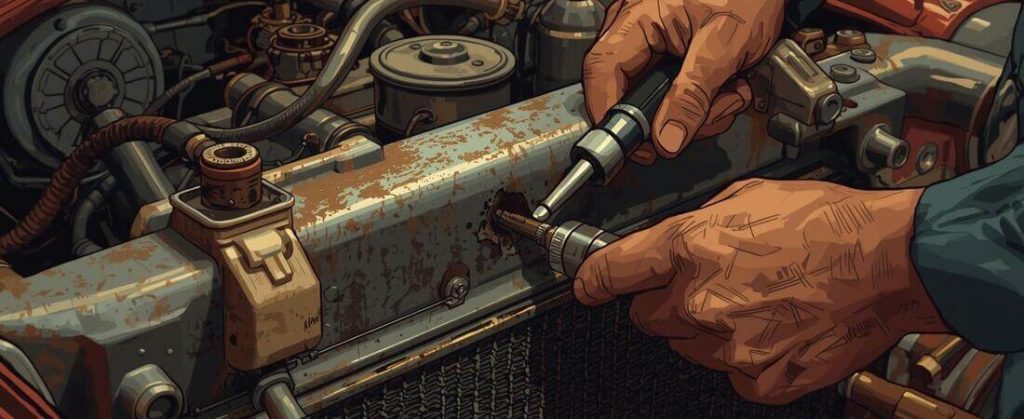
Step 4 — Check the connector Inspect the fan motor connector for corrosion, bent pins, or melted plastic. Clean corroded terminals with electrical contact cleaner and a small brush. Apply dielectric grease before reconnecting.
Step 5 — Check for AC system pressure If the relay and motor test correctly but the fan still won’t run with the AC on, the AC system may not be generating enough pressure to trigger the fan. Turn on the AC and watch whether the compressor clutch engages — the center hub of the compressor pulley should spin with the pulley. If the clutch doesn’t engage, low refrigerant or a failed low-pressure switch is preventing the compressor from running — and without the compressor running, there’s no pressure signal to trigger the fan.
Step 6 — Scan for fault codes Connect an OBD-II scanner and check for codes related to the cooling fan circuit, AC system, or temperature sensors. Codes like P0480, P0481, or P0482 specifically indicate cooling fan circuit faults and point toward the relay, control module, or PCM output.
AC Works at Highway Speed But Not at Idle — Why
This specific pattern confirms the fan as the problem — not the compressor, not the refrigerant level.
At highway speed — typically above 35–40 mph — ram airflow through the grille is sufficient to cool the AC condenser without the electric fan. The AC works because the condenser can reject heat through natural airflow alone. High-side pressure stays within operating range. The compressor runs efficiently. Cool air comes from the vents.
At idle or slow speed — no ram airflow, stagnant hot air in the engine bay — the condenser depends entirely on the electric fan. Without it, high-side pressure climbs. The AC system’s high-pressure protection may cycle the compressor off to prevent damage. Warm air comes from the vents.
This pattern eliminates refrigerant level as the primary cause. Low refrigerant would cause poor AC performance at all speeds — not just at idle. If the AC works well at highway speed but fails only at idle, the fan system is the specific problem.
Is It Safe to Drive With the Cooling Fan Not Working?
| Situation | Safe to Drive? | Action |
|---|---|---|
| Fan not running, mild weather, no AC use | Short term, monitor temp gauge | Diagnose within a week |
| Fan not running, AC off, engine temp rising | No — overheating risk | Fix immediately |
| Fan not running with AC on, hot weather | No — AC collapse and overheat risk | Fix immediately |
| AC only fails at idle, works at speed | Caution — avoid hot weather idle | Diagnose within a few days |
| Fan runs but slowly, AC partially cold | Caution | Check control module and motor |
| Check engine light with fan codes | No | Diagnose before driving in heat |
The key rule: A cooling fan that doesn’t run is not just an AC comfort problem. In hot weather, stationary operation — sitting in traffic, parking with engine running, drive-throughs — can overheat the engine within 10–15 minutes without fan cooling. Don’t ignore this in summer.
Repair Cost Summary
| Repair | DIY Friendly? | Average Cost |
|---|---|---|
| Fuse replacement | Yes | $1–$5 |
| Fan relay replacement | Yes | $10–$30 |
| Fan connector cleaning | Yes | $10–$30 |
| AC pressure switch replacement | Intermediate | $50–$200 |
| AC refrigerant recharge | No | $150–$300 |
| Fan control module replacement | Intermediate | $100–$350 |
| Fan motor replacement | Intermediate | $150–$400 |
| Fan assembly replacement (motor + blades + shroud) | Intermediate | $200–$500 |
| Wiring harness repair | Mechanic recommended | $150–$400 |
| PCM replacement and programming | Mechanic only | $500–$1,200 |
FAQs About Radiator Fan Not Turning On With AC
Should the radiator fan run when the AC is on?
Yes — always, when the car is at idle or moving slowly. The AC condenser requires forced airflow to reject heat when there is no ram airflow from vehicle movement. Most vehicles are designed so the cooling fan runs whenever the AC compressor is engaged, triggered by rising refrigerant pressure through the AC high pressure switch.
Why does my AC only work at highway speed and not at idle?
The electric cooling fan isn’t running. At highway speed, natural ram airflow cools the condenser without the fan. At idle there is no ram airflow and the condenser depends entirely on the electric fan. If the fan doesn’t run, high-side pressure climbs, the compressor cycles off, and AC performance collapses. This speed-dependent AC failure is the clearest symptom of a cooling fan problem.
Can a blown fuse cause the AC not to cool?
Yes, if the blown fuse is the cooling fan fuse. Without the fan running, the condenser cannot reject heat at idle and the AC system pressure climbs until the compressor cuts off on high-pressure protection. Always check the cooling fan fuse when diagnosing poor AC performance at idle.
How do I test if my cooling fan motor is bad?
Disconnect the fan motor connector and connect the motor directly to battery positive and a chassis ground using jumper wires. If the motor runs on direct battery power, it is functioning and the fault is in the control circuit. If it doesn’t run on direct battery power, the motor has failed and needs replacement.
Can low refrigerant cause the cooling fan not to run?
Yes. The AC system’s high pressure switch triggers the cooling fan when refrigerant pressure rises above a threshold. If refrigerant is significantly low, pressure never reaches this threshold and the fan trigger signal is never sent. Additionally, a low-pressure cut-off switch may prevent the compressor from engaging at all, meaning no pressure rise and no fan trigger.
How much does it cost to fix a cooling fan that won’t run with AC?
The cost ranges from $1 for a blown fuse to $1,200 for PCM replacement. The most common repairs are relay replacement at $10–$30, fan motor replacement at $150–$400, and AC pressure switch replacement at $50–$200. Always test the relay and fuse first — these are the cheapest fixes and cover a large percentage of cases.
The Bottom Line
A radiator fan that won’t run when the AC is on is a problem that compounds quickly in hot weather — poor AC performance at idle, rising engine temperature, and potential compressor damage from high-side pressure spikes. Most of the time the fix is inexpensive: a $10 relay, a $5 fuse, or a connector cleaning.
The diagnosis sequence matters more than the repair. Start with the fuse and relay — these are free or nearly free to check and resolve the majority of cases. If those test fine, the jumper wire bypass test tells you definitively whether the motor is good before you buy any parts. A working motor with a failed control circuit costs far less to fix than a failed motor.
Quick Summary:
- The cooling fan must run when AC is on at idle — no fan means no condenser cooling and no AC performance
- AC working at highway speed but not at idle is the clearest symptom of a cooling fan problem
- Start diagnosis with the fuse and relay — these cover the majority of cases for under $30
- A jumper wire bypass test definitively tells you whether the motor is good before buying parts
- Low refrigerant can prevent the fan from triggering because pressure never reaches the switch threshold
- A failed AC high pressure switch breaks the AC-to-fan trigger signal even with a working fan circuit
- Fan control module failure causes speed issues — fan may run but not fast enough for AC cooling
- A corroded connector causes intermittent failure that worsens in hot humid conditions