
This article was updated in July 26, 2026 with new products and information by Mark S. Taylor
A dull thump from the back of the car is one of those noises that’s easy to hear and maddening to place. It could be a worn suspension part, something rolling around in the trunk, a drivetrain component, or a brake issue — and the fix ranges from free to over a thousand dollars. The good news: you can usually narrow it down yourself in a few minutes, and the trick is paying attention to when the thump happens.
A thump sound from the rear of a car is most often a worn rear suspension part — a sway bar end link, a bushing, or a tired shock — but it can also be as simple as a loose spare tire, jack, or cargo shifting in the trunk. The fastest way to tell them apart is to notice when it thumps: over bumps points to suspension or something loose, when braking points to the brakes, and when accelerating points to the rear drivetrain.
Below I’ll walk you through how to route the thump by when it happens, the free checks to try before you spend a cent, how to read the sound, and what each real fix costs.

Contents
- 1 First, Notice When It Thumps
- 2 Check the Free Stuff First
- 3 8 Causes of a Thump From the Rear
- 4 Clunk vs. Thud: What the Sound Tells You
- 5 RWD & AWD: When It’s the Drivetrain
- 6 How to Diagnose It Yourself
- 7 Is It Safe to Drive With a Rear Thump?
- 8 Repair Cost
- 9 DIY vs. Mechanic
- 10 How to Prevent It
- 11 FAQs About Thump Sound From Rear of Car
- 12 Bottom Line
First, Notice When It Thumps
This is the single most useful thing you can do, and it costs nothing. On your next few drives, pay attention to exactly when the thump shows up. Each pattern points to a different part of the car:
Only over bumps or speed bumps: points to the rear suspension (sway bar links or bushings, worn shocks or mounts, tired bushings) — or to something loose in the trunk bouncing on the impact.
When you brake, especially braking gently or rolling to a stop: points to brake hardware (a loose caliper, worn pads, faulty clips) or a worn bushing letting a component shift as the car’s weight moves forward.
When you accelerate, lift off the gas, or shift gears: on a rear- or all-wheel-drive car, points to the rear drivetrain — a U-joint, driveshaft, or differential mount.
In rhythm with wheel speed (speeds up and slows with the car): points to a tire (a flat spot or uneven wear), loose lug nuts, or a wheel bearing.
Random thumps and rattles on rough roads, no clear pattern: points to loose cargo, a loose spare tire or jack, or loose suspension hardware.
Note which one matches, and whether it’s one side or both. That single observation eliminates most of the list before you touch a wrench.
Check the Free Stuff First
Before you let anyone quote you shocks, rule out the things that cost nothing. I’ve traced plenty of “expensive-sounding” rear thumps to a five-second fix:
Empty the trunk and cargo area. A shifting grocery bag, toolbox, or subwoofer can thump exactly like a suspension part. Clear it out and re-drive.
Check the spare tire and jack. A spare that isn’t cinched down, or a loose jack in its well, is one of the most common rear thumps there is. Tighten the hold-down.
Re-check your lug nuts. If the thump started right after a tire rotation, new tires, or any wheel-off service, loose lug nuts can thump — and that’s a safety issue, so tighten them to spec right away.
Think about any recent repair. A bolt that wasn’t torqued properly, or hardware left loose after suspension or brake work, is more common than people admit. If the noise appeared right after a shop visit, that’s a strong lead.
If clearing the trunk, securing the spare, and checking the lug nuts makes the thump disappear, you’ve solved it for free. If it survives all that, move on to the mechanical causes.
8 Causes of a Thump From the Rear
Here are the real culprits, roughly most common first:
Worn sway bar (stabilizer) end links. A leading cause of a rear thump over bumps. When the links wear out, they knock as the suspension moves. Cheap part, easy fix.
Worn sway bar bushings. The rubber bushings that hold the sway bar can dry out and let it move, producing a lower, duller thud over bumps.
A loose spare tire, jack, or cargo. The free one. Anything unsecured in the back thumps on impacts and mimics a suspension problem perfectly.
Worn shocks, struts, or their mounts. As shocks wear, they stop controlling suspension movement and let it crash over bumps. A worn upper mount adds a distinct thump. Often paired with a bouncy ride.
Worn suspension bushings (control arm, trailing arm, subframe). Aging rubber bushings let components shift, causing a thump over bumps and sometimes when braking or accelerating.
Loose or broken suspension hardware. Bolts that have worked loose — often after rough roads or an earlier repair — can knock. Simple to fix once found.
Rear drivetrain (RWD/AWD): U-joint, driveshaft, or differential mount. A worn U-joint, loose driveshaft, or failing diff mount clunks on acceleration, deceleration, or gear changes. Usually a deeper thump from the center-rear.
Brake, tire, or wheel bearing issues. A loose caliper or worn pads can thump when braking; a flat-spotted or unevenly worn tire thumps in rhythm with speed; a failing wheel bearing rumbles and can knock. Loose lug nuts belong here too.
Clunk vs. Thud: What the Sound Tells You
The exact character of the noise is a useful clue, especially for the two most common suspension causes:
A higher-pitched, sharper “clunk” usually points to sway bar end links. When links wear, they make a crisper knock as the bar moves against them over bumps.
A lower-pitched, duller “thud” usually points to sway bar bushings, worn mounts, or tired bushings elsewhere. Worn rubber makes a softer, heavier sound than metal-on-metal links.
A deep, heavy “thunk” from the center-rear on acceleration or shifting points toward the drivetrain (U-joint, driveshaft, diff mount) rather than the suspension.
A hollow, rolling thump that tracks wheel speed points to a tire or wheel bearing, not a joint you’d fix with a bushing.
Getting a feel for pitch and location narrows the part before you’re even under the car. A quick way to help place it: have a helper drive slowly over a bump while you listen, or use a phone to record the sound from inside so you can play it back and focus on whether it’s a sharp clunk or a dull thud.
RWD & AWD: When It’s the Drivetrain
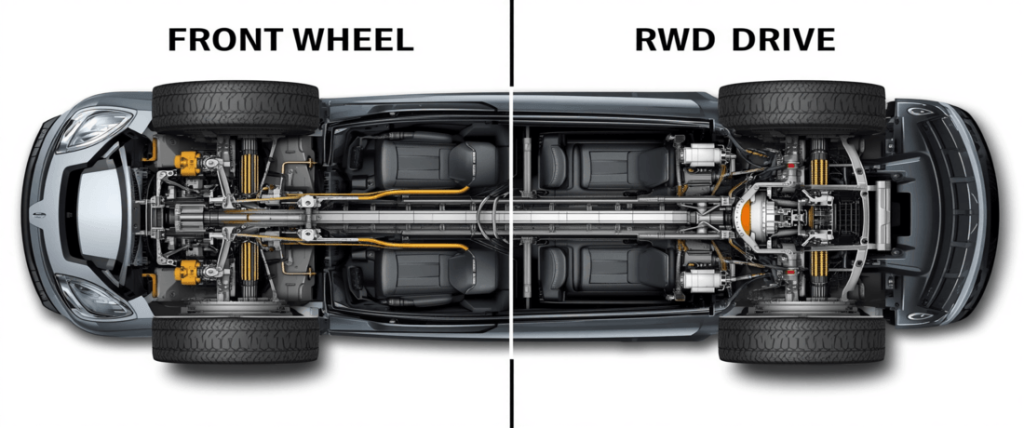
If you drive a rear-wheel-drive or all-wheel-drive vehicle and the thump shows up when you accelerate, lift off the gas, or shift into gear — rather than over bumps — the rear drivetrain is the prime suspect. These parts sit under the center and rear of the car, so the noise often feels like it’s coming from beneath your seat or the trunk.
Watch for these tells:
A clunk when shifting from Park to Drive or Reverse, or when the power changes as you get on and off the throttle, points to a U-joint, a loose driveshaft, or a worn differential mount. The slack in a worn joint takes up with a knock as load reverses.
A deeper, heavier thunk from the center-rear rather than a light knock over bumps. Drivetrain thumps tend to be lower and more solid.
It happens on smooth roads too, not just over bumps — a key difference from a suspension thump, which needs an impact to trigger it.
A rhythmic vibration or howl that grows with speed alongside the thump can point to a failing differential or carrier bearing.
Drivetrain thumps aren’t something to sit on for months. A worn U-joint can eventually fail and drop a driveshaft, so if the noise lines up with acceleration and gear changes, get it inspected rather than waiting for it to worsen.
How to Diagnose It Yourself
Here’s the full sequence to pin down a rear thump:
Note when it happens. Over bumps, when braking, when accelerating or shifting, or in rhythm with speed. This routes you to the right system before you touch anything.
Empty the trunk and secure the spare. Clear all cargo, cinch down the spare tire and jack, and re-drive. If the thump is gone, you’re done.
Check the lug nuts. Especially if the noise started after any wheel-off service. Tighten to spec — this is a safety item, not just a noise fix.
Do the bounce test. With the car parked, push down hard on each rear corner and let go. A clunk as it rebounds points to worn shocks, mounts, or sway bar parts.
Do the wiggle test. With the rear safely raised on stands, grab each sway bar end link and the wheel (at 12 and 6, then 3 and 9 o’clock) and check for play or knocking. Look for torn, greasy, or cracked bushings.
Listen with a helper. Have someone drive slowly over a bump or shift through gears while you listen, or record the sound and play it back to judge clunk versus thud and where it’s loudest.
If you can tell a shop “it thumps only over bumps from the left rear, and there’s play in the sway bar link,” you’ve handed them the diagnosis — and protected yourself from paying for parts you don’t need.

Is It Safe to Drive With a Rear Thump?
It depends entirely on the cause, so use this as your guide:
Loose cargo, spare, or jack: harmless to the car — just secure it so it stops thumping and doesn’t become a projectile.
Loose lug nuts: urgent. Tighten immediately; a wheel that’s working loose is a serious safety risk.
Worn sway bar links or bushings: safe to drive short-term. The car handles a little sloppier in corners, but it’s not an immediate danger — fix it before it wears neighboring parts.
Worn shocks or mounts: drivable, but your ride and braking distances suffer, and it worsens over time. Plan the repair.
Worn suspension bushings or loose hardware: get it inspected soon; loose hardware can worsen quickly on rough roads.
Drivetrain (U-joint, driveshaft, diff mount): don’t sit on it. A failing U-joint can leave you stranded or worse. Get it checked promptly.
Wheel bearing: urgent. A bad bearing can overheat and seize — address it right away.
Rule of thumb: if it’s loose cargo or a sway bar link, you have time. If it’s lug nuts, a wheel bearing, or a drivetrain joint, don’t wait.
Repair Cost
Costs swing enormously with the cause — which is exactly why you diagnose first. Typical ranges:
| Cause / Fix | Typical Cost (parts + labor) |
|---|---|
| Secure loose cargo / spare / jack | $0 |
| Re-torque loose lug nuts | $0–$20 |
| Sway bar end links (pair) | $80–$200 |
| Sway bar bushings (set) | $150–$400 |
| Suspension bushings (control/trailing arm) | $150–$400 per set |
| Control arm (with bushings) | $200–$800 per arm |
| Rear shocks (pair) | $400–$900 |
| Shock or strut assembly (pair, luxury higher) | $1,000–$2,500 |
| Shock / strut mounts | $200–$500 |
| Coil spring (pair) | $200–$500 |
| U-joint | $150–$400 |
| Driveshaft / center support bearing | $300–$1,000+ |
| Differential mount | $200–$500 |
| Brake caliper / hardware | $150–$500 per wheel |
| Wheel bearing | $250–$500 per wheel |
Two things to keep in mind. First, this is why the free checks come first — the difference between the top and bottom of this table is enormous, and the cheapest fixes are among the most common. Second, if a shop quotes you a full shock-and-strut job for a thump that turns out to be a $120 sway bar link, that’s your cue to get a second opinion.
DIY vs. Mechanic
Some of this is genuinely DIY; the bigger jobs aren’t.
Reasonable to DIY:
Emptying the trunk, securing the spare and jack
Checking and torquing lug nuts
The bounce test and, with proper jack stands, the wiggle test
Replacing sway bar end links (often a straightforward bolt-on)
Basic sway bar bushing replacement on many cars
Leave it to a mechanic:
Shocks, struts, and coil springs (spring compression is dangerous)
Control arm and subframe bushing work
U-joints, driveshafts, and differential mounts
Wheel bearings and brake caliper service
Anything you can’t safely reach or that needs an alignment afterward
Honest rule of thumb: the free checks and sway bar links are fair game at home and cover a lot of rear thumps cheaply. Once you’re into shocks, drivetrain, or bearings, that’s shop work with the right tools and a lift.
How to Prevent It
A few habits head off most rear thumps:
Secure your cargo and keep the spare tire and jack properly cinched down.
Torque lug nuts to spec after any tire service, and re-check them after 50–100 miles.
Have your suspension inspected during routine service so worn links and bushings get caught early.
Don’t ignore a small thump — worn parts stress their neighbors, turning a cheap fix into an expensive one.
Ease over rough roads and speed bumps to reduce wear on links, bushings, and shocks.
None of this is expensive, and it keeps the rear end quiet and safe.
FAQs About Thump Sound From Rear of Car
Is a thump from the rear of the car a suspension problem?
Often, but not always. A thump only over bumps usually is suspension — a worn sway bar link or bushing, a tired shock, or a worn mount. But an identical thump can come from a loose spare tire, jack, or cargo in the trunk, so clear those out first. If the thump happens when braking, accelerating, or shifting instead of over bumps, look at the brakes or the rear drivetrain rather than the suspension.
Is it the sway bar links or the shocks?
Listen and test. Worn sway bar links tend to make a higher-pitched clunk over bumps, and you can often feel play when you grab the link with the car safely raised. Worn shocks make a duller thud and a bouncy, poorly controlled ride — push down hard on the rear corner and let go; a clunk or extra bouncing points to shocks or their mounts.
Why does my car only thump when I go over bumps?
Because worn suspension parts and loose items only make noise when the suspension moves or takes an impact. On smooth roads there’s nothing to trigger them. A thump that appears only over bumps points strongly to sway bar links or bushings, worn shocks or mounts, or something loose in the trunk — rather than the drivetrain, which usually thumps on acceleration.
Is it safe to drive with a thumping rear end?
It depends on the cause. Loose cargo and a worn sway bar link give you some time. Loose lug nuts, a bad wheel bearing, or a worn drivetrain joint do not — those can leave you stranded or create a safety risk, so address them right away. When in doubt, have it inspected before a long drive.
How much does it cost to fix a rear thump?
Anywhere from nothing to over a thousand dollars. Securing loose cargo or the spare is free, re-torquing lug nuts is nearly free, and sway bar end links run about $80 to $200 a pair. Shocks, drivetrain parts, and wheel bearings are the pricier end, from a few hundred to well over a thousand depending on the vehicle. Diagnosing it first is how you avoid overpaying.
Bottom Line
Don’t guess at a rear thump — route it. Note when it happens: over bumps points to the suspension or something loose in back, braking points to the brakes, and accelerating or shifting points to the rear drivetrain. Then rule out the free stuff — empty the trunk, secure the spare, check the lug nuts — before you spend a dime. Read the sound, too: a higher clunk leans toward sway bar links, a duller thud toward bushings. Start free, match the part, and you’ll rarely overpay for a noise that’s often cheap to fix.