
This article was updated in May 30, 2026 with new products and information by Mark S. Taylor
If your engine started ticking right after an oil change, it’s usually caused by the wrong oil viscosity, a faulty oil filter, low oil level, or — and this is the one nobody talks about — the fresh oil washed away sludge that was silencing a pre-existing valve train problem. Most ticks are harmless valve lifter noise. A few are warnings of serious damage. This guide will help you tell the difference in under five minutes.
I’ve been turning wrenches for 20 years, and I can tell you this: the phone call I get most often after a quiet Tuesday is “I just got my oil changed and now my engine sounds like a sewing machine.” The good news? About 80% of these calls end with “drive it in tomorrow, it’s probably fine.” The other 20% need immediate attention. Let’s figure out which group you’re in.

Contents
- 1 What Is Engine Ticking After an Oil Change?
- 2 Symptoms and Warning Signs
- 3 Common Causes
- 4 How to Diagnose It
- 5 Can You Drive With It?
- 6 Repair Cost Breakdown
- 7 DIY vs. Mechanic: Should You Fix It Yourself?
- 8 Prevention Tips
- 9 FAQs About Engine Ticking Noise After Oil Change
- 9.1 Q: Is it normal for an engine to tick after an oil change?
- 9.2 Q: Can the wrong oil cause ticking?
- 9.3 Q: Will the ticking go away on its own?
- 9.4 Q: Is the shop responsible if my engine ticks after they changed my oil?
- 9.5 Q: Can I use an oil additive like Lucas or STP to stop the tick?
- 9.6 The Bottom Line
What Is Engine Ticking After an Oil Change?
Your engine’s valve train is a precision dance of metal parts — camshafts, rocker arms, and hydraulic lifters — that open and close your intake and exhaust valves thousands of times per minute. These parts float on a pressurized film of oil. When that oil film gets disrupted, metal taps metal. That’s the tick you hear.
Think of it like this: your valve train is a room full of people walking around in socks on a hardwood floor. The oil is the polish. Fresh, correct oil lets everyone glide silently. The wrong oil — or no oil reaching the top of the engine — is like taking the polish away. Suddenly you hear every footstep.
The critical distinction most articles skip: a tick is valve train noise. A knock is bearing noise. A tick is annoying but usually fixable for a few hundred dollars. A knock means your engine’s bottom end is eating itself and you need to shut it off now. We’ll teach you to hear the difference.
Symptoms and Warning Signs
Not every tick means the same thing. Listen carefully — your ears are the best diagnostic tool you have.
- Tick on cold start that fades in 10–30 seconds: This is almost always an oil filter issue. The filter drained dry while the car sat, and the top of the engine is starved of oil for those first few seconds. Once pressure builds, the tick vanishes. Annoying, but not dangerous.
- Tick at idle that stays constant: Could be wrong viscosity oil, low oil level, or a collapsed lifter. If it doesn’t change with engine temperature, you need to check your oil level immediately.
- Tick that gets louder when you rev the engine: This points to valve train wear — a loose rocker arm, worn lifter, or insufficient oil pressure at higher RPM. Schedule a shop visit within a few days.
- Deep “thock” sound that matches engine speed: This is not a tick. This is rod knock or piston slap. Shut the engine off immediately and call a tow truck. Driving even one more mile can turn a $1,500 repair into a $5,000 engine replacement.
- Tick accompanied by the oil pressure warning light: Pull over. Check oil level. If the level is good and the light is still on, do not restart the engine. You have an oil pressure problem that will destroy bearings in minutes.

Common Causes
1. Wrong Oil Viscosity
This is the big one. Your owner’s manual specifies a viscosity like 5W-30 for a reason. That “W” stands for winter, and the numbers describe how the oil flows when cold and hot. Put in 0W-20 when your engine needs 5W-30, and the oil film gets too thin at operating temperature. The valve train starts tapping.
I see this constantly at my shop. A customer brings in a 2012 Honda Accord that calls for 0W-20. The quick lube shop put in 5W-30 because “it’s thicker and better for older engines.” Now it ticks at idle. The fix? Drain it and put in the right oil. Problem solved in 20 minutes.
2. Oil Filter Without an Anti-Drainback Valve
Here’s the dirty secret of the $5 oil filter: many cheap aftermarket filters lack an anti-drainback valve. This rubber flapper keeps oil in the filter and engine galleries when the car is off. Without it, the oil drains back into the pan overnight. On the next start, the engine runs dry for 10–40 seconds until the pump refills everything.
Toyota and Subaru engines are especially sensitive to this. I’ve had customers install a bargain-bin filter, hear a terrifying tick every morning, swap in an OEM filter, and never hear the noise again. The filter costs $12 instead of $5. Your engine’s top end is worth the extra seven bucks.
3. Low Oil Level or Overfill
It sounds obvious, but it happens more than you’d think. A shop drains the old oil, gets distracted, and underfills by half a quart. Or a DIYer pours in five quarts because “that’s what my truck takes” without checking the dipstick — and overfills by a quart.
Low oil means low pressure. Overfill causes the crankshaft to whip the oil into a foam, which aerates it and kills pressure. Both cause ticking. Check your dipstick. The level should be between the two dots or hash marks. Not at the bottom. Not above the top. Right in the middle.
4. Oil Filter Installed Backwards or Collapsed
Cartridge-style filters — common on European cars like BMW, Mercedes, and VW — can be installed backwards if you’re not paying attention. The oil tries to flow the wrong way through the filter media, pressure drops, and the valve train starves. A collapsed spin-on filter does the same thing by blocking flow entirely.
If you changed your own oil, double-check the filter. If a shop did it, this is one of the few cases where they are genuinely at fault.
5. The “Sludge Release” Phenomenon
This is the cause nobody talks about. You’ve been running conventional oil 2,000 miles past its change interval. The old oil turned to sludge. That sludge was actually cushioning your worn lifters and filling the gaps in your valve train. You put in fresh detergent oil, it dissolves the sludge, and suddenly the wear that was hidden is exposed as a tick.
The oil change didn’t break your engine. It revealed that your engine was already worn. This is especially common on cars with 100,000+ miles that have spotty maintenance histories. The tick was always there — you just couldn’t hear it.
6. Trapped Air Bubbles (Aeration)
If the oil was poured in too fast or the engine was overfilled, air can get whipped into the oil. Aerated oil compresses like a sponge instead of maintaining hydraulic pressure. The lifters can’t pump up properly, and you get a tick. This usually resolves after 20–30 minutes of driving as the air works its way out.
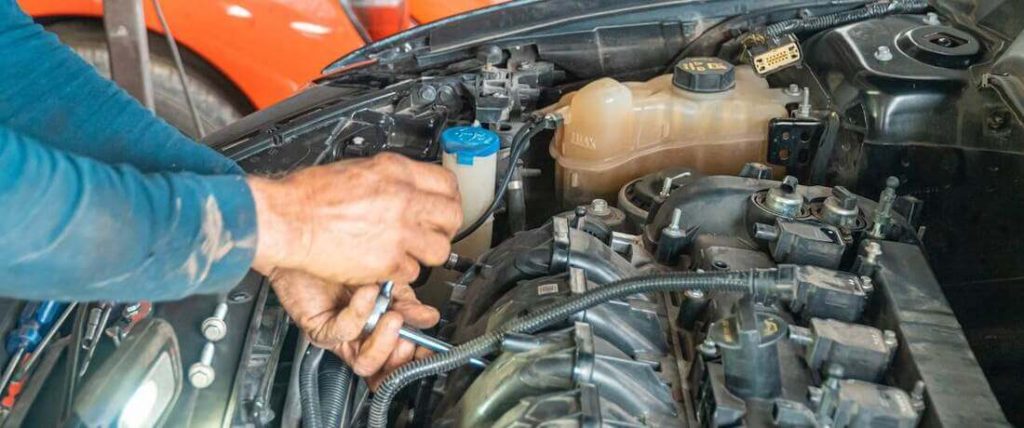
How to Diagnose It
You don’t need a $5,000 scan tool to figure this out. Here’s the same process I use in my bay:
Step 1: Check the Dipstick (30 seconds) Park on level ground. Wait 5 minutes after shutting off. Pull the dipstick, wipe it, reinsert fully, pull again. Is the oil between the marks? Is it the right color — amber to light brown, not milky or foamy? If it’s low, top it off to the full mark with the correct viscosity.
Step 2: The Warm-Up Test (10 minutes) Start the engine cold. Set a timer. Does the tick fade within 30 seconds? If yes, suspect the oil filter anti-drainback valve. If the tick persists, let the engine reach normal operating temperature (about 10 minutes of driving). Does it get better, worse, or stay the same?
- Gets better or goes away: Likely viscosity issue or aeration. Drive another 20 minutes and reassess.
- Stays the same: Possible lifter wear or low oil pressure. Schedule a shop visit.
- Gets worse: Possible valve train wear or bearing issue. Do not continue driving.
Step 3: The Stethoscope Test (5 minutes) A mechanic’s stethoscope costs $15 at any auto parts store. Touch the probe to the valve cover while the engine idles. Is the tick loudest there? That’s valve train noise. Touch it to the oil pan. Loudest there? That’s bottom-end noise — much more serious.
No stethoscope? Use a long screwdriver. Press the handle to your ear, touch the blade to the valve cover. It works almost as well.
Step 4: Check the Oil Pressure (if you have a gauge) At idle, warm, you should see 10–20 PSI on most engines. At 2,000 RPM, 30–60 PSI is normal. If your gauge reads near zero at idle or doesn’t rise with RPM, you have an oil pressure problem. This is not a “wait and see” situation.
Can You Drive With It?
This is the question that keeps people awake at night. Here’s my traffic-light system:
Table
| Condition | Drive or Tow? | Action |
|---|---|---|
| Light tick at idle, no warning lights, fades when warm | GREEN — Drive | Schedule a shop visit within a week. Check oil level daily. |
| Persistent tick, no warning lights, doesn’t change with temperature | YELLOW — Cautious Drive | Drive only to a shop. Avoid highways and hard acceleration. |
| Tick with oil pressure warning light | RED — Stop | Pull over. Check oil level. If level is good, call a tow. |
| Deep knock/thud that matches engine RPM | RED — Stop | Shut off immediately. Do not restart. Tow to shop. |
| Tick that gets louder with RPM + loss of power | RED — Stop | Possible bearing or valve damage. Tow immediately. |
If you’re driving on the highway and you notice a new tick, don’t panic. Safely move to the right lane, reduce speed, and listen. If it’s a light, fast tick and your gauges look normal, you can probably exit and drive to a shop. If it’s a heavy knock or your oil light comes on, pull onto the shoulder and shut it down.
Repair Cost Breakdown
Here’s what you’re actually looking at, based on 2026 national averages:
Table
| Repair | Cost Range | When It’s Needed |
|---|---|---|
| Oil change with correct oil + OEM filter | $40–$100 DIY; $75–$150 shop | Wrong viscosity or cheap filter |
| Oil filter replacement only | $15–$40 DIY | Bad anti-drainback valve |
| Hydraulic lifter replacement (one bank) | $400–$900 | Collapsed or worn lifter |
| Full lifter replacement (V6/V8, both banks) | $800–$1,500 | Multiple failed lifters |
| Valve adjustment | $150–$400 | Out-of-spec valve lash |
| Oil pump replacement | $500–$1,200 | Failed oil pump |
| Engine rebuild / replacement | $3,000–$7,000 | Bearing damage from oil starvation |
The reality: Most post-oil-change ticking costs under $150 to fix. The fear of a four-figure repair bill is usually overblown. The key is diagnosing it correctly before throwing parts at it.
DIY vs. Mechanic: Should You Fix It Yourself?
Table
| Task | DIY? | Skill Level | Tools Needed |
|---|---|---|---|
| Check oil level and top off | Yes | Beginner | None |
| Replace oil filter with OEM part | Yes | Beginner | Oil filter wrench, drain pan |
| Change oil to correct viscosity | Yes | Beginner | Wrench set, drain pan, funnel |
| Diagnose with stethoscope | Yes | Beginner | Mechanic’s stethoscope ($15) |
| Replace hydraulic lifters | No | Advanced | Full tool set, torque wrench, service manual |
| Valve adjustment | Maybe | Intermediate | Feeler gauges, torque wrench, patience |
| Oil pump replacement | No | Advanced | Engine hoist or support, extensive disassembly |
If you changed your own oil and the tick started immediately, retrace your steps. Did you use the right oil? Is the filter tight? Did you fill to the correct level? These are all driveway-fixable problems. If a shop did the work and the tick started before you left the lot, turn around and go back. They may have used the wrong oil, the wrong filter, or underfilled it.
Prevention Tips
The best fix is never needing one. Here’s how to avoid this headache next time:
- Use the oil viscosity in your owner’s manual. Not what the guy at the parts store recommends. Not what your uncle says is “better.” The number printed in the manual is what the engineers designed the engine for.
- Buy an OEM or high-quality aftermarket filter with an anti-drainback valve. Wix, Mobil 1, Bosch, and OEM filters all include this. The $3 no-name special does not. Your engine’s top end will thank you.
- Pre-fill your oil filter before installation. Pour fresh oil into the filter until it’s full, then install it. This prevents the 10–30 seconds of dry startup that causes cold-start ticking.
- Change your oil on schedule. Extended intervals let sludge build up. When you finally change it, the fresh detergent oil strips away that sludge and exposes wear. Regular changes prevent the sludge from forming in the first place.
- Check your oil level weekly. It takes 30 seconds. Low oil is the #1 preventable cause of engine noise, period.
FAQs About Engine Ticking Noise After Oil Change
Q: Is it normal for an engine to tick after an oil change?
A: No, but it’s common — and usually not serious. A brief tick on cold startup (under 30 seconds) often means the oil filter drained dry and the top of the engine needs a moment to refill. A persistent tick points to wrong viscosity, low oil, or a filter problem. Neither is “normal,” but both are usually fixable for cheap.
Q: Can the wrong oil cause ticking?
A: Absolutely. Oil that’s too thin for your engine can’t maintain the hydraulic pressure your lifters need. Oil that’s too thick can’t flow fast enough on cold starts. Both cause ticking. Always use the viscosity specified in your owner’s manual.
Q: Will the ticking go away on its own?
A: Sometimes. If it’s caused by aeration from overfill or a filter that needs to prime, it may fade after 20–30 minutes of driving. If it’s caused by wrong viscosity, it won’t go away until you drain the oil and refill with the correct type. If it’s caused by wear, it will get worse over time.
Q: Is the shop responsible if my engine ticks after they changed my oil?
A: If they used the wrong oil, the wrong filter, underfilled it, or installed the filter backwards, yes — they are liable. Document everything: your receipt, the oil type they used, and when the noise started. If the tick began before you left the lot, return immediately. If it started the next morning, call them and describe the symptoms. Most reputable shops will make it right.
Q: Can I use an oil additive like Lucas or STP to stop the tick?
A: You can, but I don’t recommend it as a permanent fix. Thicker oil or additives can quiet a worn lifter temporarily, but they don’t repair the underlying problem. It’s like taking aspirin for a broken arm — the pain fades, but the bone is still broken. Use additives only as a short-term measure while you schedule proper repairs.
The Bottom Line
A ticking engine after an oil change is scary, but it’s rarely catastrophic. Start with the basics: check your oil level, verify the viscosity matches your owner’s manual, and swap in an OEM filter with an anti-drainback valve. Most ticks resolve for under $150. The ones that don’t — the persistent, worsening ticks — need a mechanic’s stethoscope and a valve train inspection. But even then, you’re usually looking at hundreds, not thousands, to fix it.
The first thing I check when a customer brings in a ticking engine after an oil change? The oil filter brand and the receipt for the oil used. Nine times out of ten, the fix is that simple. Don’t let the noise panic you into a rushed decision — diagnose it methodically, fix it correctly, and your engine will be back to whisper-quiet in no time.