
This article was updated in August 2, 2026 with new products and information by Mark S. Taylor
Your car just coughed up a check engine light, and maybe it feels a bit sluggish. You pulled the code, and yep, it’s screaming “oxygen sensor.” The big question burning in your mind is, “Can I still drive with a bad oxygen sensor?” As a mechanic who’s seen thousands of these, I’ll give you the short answer upfront: Yes, you can drive it, but you shouldn’t, and definitely not for long. It’s not an immediate roadside breakdown, but ignoring it sets you up for a cascade of much more expensive problems that’ll make that little sensor look like pocket change. We’re talking catalytic converters, engine damage, and a whole lot of headaches.
Contents
- 1 What is an Oxygen Sensor (and Why It Matters)?
- 2 Symptoms of a Bad Oxygen Sensor: More Than Just a Light
- 3 Common Causes of O2 Sensor Failure
- 4 How a Mechanic REALLY Diagnoses a Bad Oxygen Sensor (and How You Can Too)
- 5 Can You Drive With a Bad Oxygen Sensor? The Real Risks.
- 6 Oxygen Sensor Repair Cost Breakdown (Parts & Labor)
- 7 DIY vs Mechanic: When to Tackle it Yourself
- 8 Prevention Tips: Keeping Your O2 Sensors Healthy
- 9 FAQ: Can You Drive With a Bad Oxygen Sensor
- 9.1 Q: How long do oxygen sensors typically last?
- 9.2 Q: Can a bad oxygen sensor cause my car to fail an emissions test?
- 9.3 Q: Can a bad O2 sensor cause misfires or rough running?
- 9.4 Q: My scanner shows P0420 or P0430 codes. Is that an O2 sensor problem?
- 9.5 Q: Is it okay to use an aftermarket oxygen sensor?
- 10 TheCarBuzz Verdict: Don’t Drive Blind.
What is an Oxygen Sensor (and Why It Matters)?
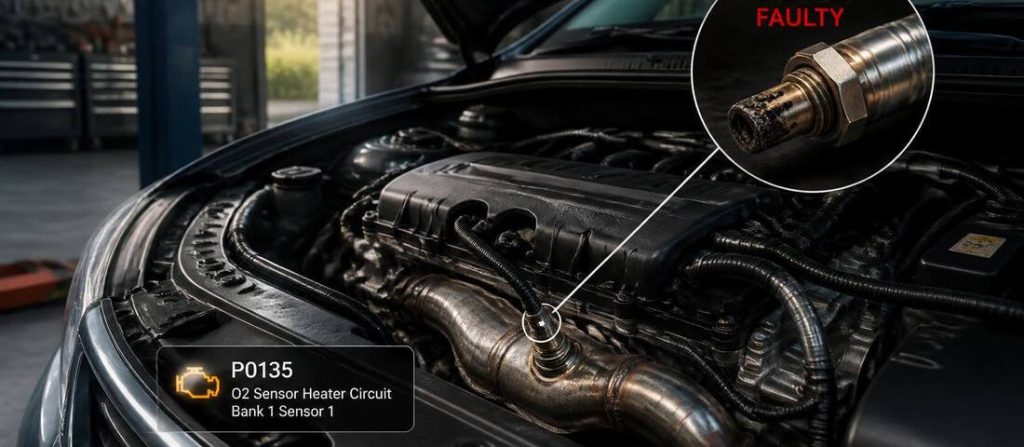
Think of your oxygen sensor, or O2 sensor, as your engine’s personal air-fuel ratio detective. Tucked into your exhaust system, often before and after the catalytic converter, its job is to constantly sniff the exhaust gases. It measures how much unburned oxygen is leaving the engine and sends that information back to your car’s brain, the Engine Control Unit (ECU).
The ECU uses this feedback to adjust how much fuel it injects into the engine. Its goal? To keep the air-fuel mixture just right, a perfect balance for efficient combustion. When the O2 sensor is working correctly, your engine runs smoothly, gets decent gas mileage, and keeps harmful emissions in check. If that sensor goes blind, the ECU starts guessing, and your engine pays the price.
Symptoms of a Bad Oxygen Sensor: More Than Just a Light
That illuminated check engine light (CEL) is almost always the first sign you’ll get, but it’s rarely the only one. If your O2 sensor is truly on the fritz, your car will often start telling you in other ways:
- Decreased Fuel Economy: This is a big one. Without accurate O2 data, the ECU typically defaults to a “rich” mixture, meaning it’s dumping more fuel than necessary into the engine. You’ll notice this at the pump, as your gas mileage can drop significantly, sometimes by 10-40%.
- Rough Engine Idle or Stalling: Especially when the engine is cold, incorrect fuel mixtures can cause the engine to stumble, run unevenly, or even stall out completely at stoplights.
- Engine Hesitation or Surging: During acceleration, you might feel the car struggle to pick up speed smoothly. It could feel like it’s holding back or, conversely, surging unexpectedly as the ECU tries to compensate with bad information.
- Sulfur (Rotten Egg) Smell: This is a critical symptom and not one to ignore. If you smell rotten eggs (like sulfur) from your exhaust, it means your catalytic converter is being overwhelmed by unburned fuel. Your catalytic converter is actively being damaged right now.
- Failed Emissions Test: Because the O2 sensor is vital for emissions control, a failing one will almost certainly cause your vehicle to fail inspection.
Common Causes of O2 Sensor Failure
Oxygen sensors don’t last forever. They’re exposed to extreme heat and exhaust gases day in and day out, which eventually takes its toll. Here’s what usually sends them to the mechanic’s graveyard:
- Age and Mileage: Most O2 sensors are designed to last between 50,000 to 100,000 miles. Beyond that, the sensing element simply wears out or gets fouled.
- Contamination: Exposure to certain chemicals can “poison” an O2 sensor. This includes lead (from old leaded gasoline, though rare now), silicon (from silicone-based sealants or certain coolants), and even oil or antifreeze leaks that burn in the exhaust.
- Heater Circuit Failure: Many O2 sensors have a built-in heater to help them reach operating temperature quickly. This heater circuit can fail independently of the sensor’s ability to read oxygen. If the heater circuit dies, the sensor won’t work correctly until the exhaust is hot enough, leading to issues (and specific diagnostic trouble codes like P0135 or P0141) during cold starts and warm-up.
- Physical Damage: Road debris, impacts, or even improper installation can physically damage the sensor or its wiring.
How a Mechanic REALLY Diagnoses a Bad Oxygen Sensor (and How You Can Too)
When a customer rolls into my shop with a check engine light and a code hinting at an O2 sensor, my first move isn’t to grab a wrench. It’s to grab my OBD-II scan tool and go deeper than just pulling codes. See, a code like P0171 (System Too Lean) might seem like an O2 sensor problem, but often, the sensor is simply reporting what it sees: too much oxygen, meaning a lean condition. The sensor itself might be working perfectly, but it’s telling you about a vacuum leak or a bad Mass Air Flow (MAF) sensor elsewhere.
Here’s what I, and what you, should look for with even a basic scanner that can read live data:
Verify the Code: Confirm the specific DTCs. Is it a sensor performance code (e.g., P0133 – O2 Sensor Circuit Slow Response), a heater circuit code (e.g., P0135 – O2 Sensor Heater Circuit Malfunction), or a fuel trim code (e.g., P0171 – System Too Lean)? The code type points to the issue.
Check Live Data – O2 Sensor Voltage:
- Upstream O2 Sensors (pre-catalytic converter): These should rapidly switch between high (0.7-0.9 volts, rich) and low (0.1-0.3 volts, lean) voltage. A slow or flat line indicates a lazy or dead sensor.
- Downstream O2 Sensors (post-catalytic converter): These should show a relatively steady voltage (around 0.5-0.7 volts) indicating the catalytic converter is working. If it mirrors the upstream sensor, your catalytic converter isn’t doing its job.
Check Live Data – Fuel Trims (STFT and LTFT): This is where many DIYers miss the real problem.
- Short-Term Fuel Trim (STFT): Shows immediate fuel adjustments.
- Long-Term Fuel Trim (LTFT): Shows long-term fuel adjustments the ECU is making.
- If your LTFT is consistently high positive (+10% to +25%), the ECU is adding a lot of fuel because it’s seeing a lean condition. This often points to a vacuum leak, a weak fuel pump, or clogged injectors—not necessarily a bad O2 sensor. The sensor is just reporting the lean condition.
- If your LTFT is consistently high negative (-10% to -25%), the ECU is removing fuel because it’s seeing a rich condition. This could be a leaky injector, high fuel pressure, or a contaminated MAF sensor.
Visual Inspection: Look for exhaust leaks near the sensor, damaged wiring, or obvious physical damage. An exhaust leak before the upstream O2 sensor will pull in outside air and cause the sensor to read lean, triggering P0171, even if the sensor is fine.
The key mechanic insight here is this: the O2 sensor is a measuring device. Often, it’s correctly reporting a problem with another component, not that it’s failed itself. People pay for new O2 sensors they didn’t need because nobody checked the fuel trims or properly looked for vacuum leaks first. Don’t be that person.

Can You Drive With a Bad Oxygen Sensor? The Real Risks.
Alright, back to the big question: can you keep driving with that check engine light on, knowing it’s an oxygen sensor code? The blunt answer is yes, most cars will still move. But it’s like driving with a flat tire: you can, but you’re doing serious damage every mile.
Here’s the breakdown of what happens the longer you put it off:
- Massive Fuel Waste: Your fuel economy will continue to tank. That extra gas you’re burning quickly adds up to more than the cost of a new sensor. It’s literally money going out your exhaust pipe.
- Catalytic Converter Destruction: This is the most notorious and expensive consequence. When the O2 sensor is faulty and your engine runs rich, excess unburned fuel gets dumped into the catalytic converter. The converter is designed to burn off some of these pollutants, but it can only handle so much. The intense heat generated by this process melts the internal structure of the converter, effectively destroying it. A new catalytic converter can cost anywhere from $1,500 to $3,000 or more, making the O2 sensor repair look trivial.
- Engine Damage from Fuel-Contaminated Oil: This is the hidden killer most articles won’t tell you about. When the engine runs constantly rich, not all that extra gasoline burns. Some of it can wash past the piston rings and end up in your engine oil. Gasoline is a terrible lubricant. Fuel-contaminated oil loses its protective qualities, leading to accelerated wear on critical engine components like crankshaft bearings, camshafts, and cylinder walls. Over time, this can lead to premature engine failure, requiring a full engine rebuild or replacement – a bill that runs into thousands.
- Poor Drivability and Performance: The car will continue to run rough, hesitate, and generally feel unresponsive. This isn’t just annoying; compromised performance can be a safety concern when merging onto highways or needing quick acceleration.
- Failed Emissions Tests: You won’t pass your next state inspection, meaning you won’t be able to renew your registration until the issue is fixed.
Ignoring a bad oxygen sensor is never a “save money now” move. It’s a guaranteed “pay a lot more later” decision. The risks are too high, and the potential damage too costly, to put this off for long.
Oxygen Sensor Repair Cost Breakdown (Parts & Labor)
So, what’s this fix going to hit your wallet for? The good news is that the oxygen sensor itself is rarely the most expensive part on your car. The bad news is what happens if you delay.
Here’s a general breakdown for replacing one oxygen sensor, keeping in mind that prices vary wildly by vehicle make, model, and whether it’s an upstream or downstream sensor, as well as your geographic location.
| Cost Component | Range (Estimated) | Notes |
|---|---|---|
| Parts | $40 – $250 | Sensor cost itself. Upstream (pre-cat) sensors tend to be more expensive due to complexity. OEM sensors (e.g., Bosch, Denso, NTK) are generally higher quality but cost more than generic aftermarket options. |
| Labor | $80 – $200 | 1-2 hours of shop time at $80-$100+ per hour. Some sensors are easy to access; others require removing heat shields or other components. |
| Total Repair | $120 – $450 | This is for a single O2 sensor replacement, assuming no other damage. |
If a shop quotes you significantly more than $450 for a single O2 sensor replacement on a standard four-cylinder car, get a second opinion. More complex vehicles, especially luxury models or those with difficult-to-access sensors, might push this range higher, but it’s important to understand why.
Remember that sulfur smell we talked about? If you’ve ignored the O2 sensor for too long and that smell is present, you’re likely looking at a catalytic converter replacement. That’s a repair that typically costs $1,500 to $3,000 or more, depending on your vehicle. That’s ten times the cost of just replacing the sensor. This is why addressing the O2 sensor promptly is crucial.

DIY vs Mechanic: When to Tackle it Yourself
Replacing an oxygen sensor can be a DIY job, but it’s not always as straightforward as it seems. Here’s how to decide:
When to DIY:
- Easy Access: If the sensor is clearly visible and easily reachable with standard tools (often the downstream sensors).
- Basic Tools: You own a jack, jack stands, wrench set, and, ideally, a specialized O2 sensor socket (they’re worth their weight in gold).
- Confidence: You’re comfortable working under your car and understand the risks of seized bolts or stripped threads.
- Confirmed Diagnosis: You’re absolutely sure, through proper diagnostic steps, that the sensor itself is faulty, not just reporting another issue.
When to Call a Mechanic:
- Difficult Access: The sensor is buried deep, requiring removal of other components, or is on a tricky bank of a V6/V8 engine.
- Seized Sensor: The old sensor is rusted solid into the exhaust. Trying to force it out can strip threads in the exhaust pipe, turning a simple job into a nightmare. Mechanics have specialized tools and techniques for this.
- No Diagnostic Tools: You don’t have an OBD-II scanner that can read live data. Guessing is an expensive game.
- Uncertainty: If you’re not 100% sure the O2 sensor is the root cause, a mechanic’s expertise and advanced diagnostic tools will save you money in the long run by preventing unnecessary parts replacements.
- Safety Concerns: Always prioritize your safety. If you’re uncomfortable with the work or don’t have the right equipment, it’s better to let a professional handle it.
A mechanic’s insight: I’ve seen countless DIYers turn a $200 O2 sensor job into a $800 exhaust manifold replacement because they rounded off the sensor head or stripped the threads. Sometimes, saving a few bucks upfront costs you a lot more in the end.
Prevention Tips: Keeping Your O2 Sensors Healthy
While some O2 sensor failures are inevitable due to age, you can take steps to extend their life and prevent premature failure:
- Regular Maintenance: Keep up with your oil changes and engine tune-ups. A well-maintained engine runs cleaner, which is easier on the sensors.
- Address Engine Leaks: Fix oil, coolant, or excessive fuel leaks promptly. These contaminants can get into the exhaust stream and poison the O2 sensor.
- Avoid Fuel Additives with Metals: Be cautious with “fuel system cleaners” that contain metallic compounds (like lead or silicon). These can quickly damage your sensor. If you use an additive, ensure it’s O2 sensor safe.
- Ensure Proper Engine Function: Any issue that causes the engine to run excessively rich or lean (e.g., bad spark plugs, leaky injectors, vacuum leaks) will stress the O2 sensor, making it work harder and fail sooner.
FAQ: Can You Drive With a Bad Oxygen Sensor
Q: How long do oxygen sensors typically last?
A: Most manufacturers design oxygen sensors to last between 50,000 and 100,000 miles, though some can go longer. Regular maintenance can extend their lifespan.
Q: Can a bad oxygen sensor cause my car to fail an emissions test?
A: Absolutely. A faulty oxygen sensor directly impacts your vehicle’s emissions control system. It will almost certainly cause your car to exceed allowable pollutant levels and fail an emissions test.
Q: Can a bad O2 sensor cause misfires or rough running?
A: Yes, it can. If the oxygen sensor is giving inaccurate readings, the ECU will mismanage the air-fuel mixture, leading to misfires, a rough idle, poor acceleration, and general poor engine performance.
Q: My scanner shows P0420 or P0430 codes. Is that an O2 sensor problem?
A: Not directly. P0420 (Catalyst System Efficiency Below Threshold Bank 1) and P0430 (Bank 2) indicate your catalytic converter isn’t working efficiently. This is often caused by a long-term, uncorrected rich condition from a bad upstream O2 sensor, but the codes themselves point to the catalytic converter.
Q: Is it okay to use an aftermarket oxygen sensor?
A: While OEM sensors are generally recommended for reliability and precise calibration, high-quality aftermarket brands like Bosch, Denso, or NTK can be a good, more affordable alternative. Avoid cheap, generic sensors as they often have shorter lifespans and can cause recurring issues.
TheCarBuzz Verdict: Don’t Drive Blind.
Look, I get it. Nobody wants to spend money on car repairs, especially for something as unglamorous as an oxygen sensor. But driving with a bad one isn’t just an annoyance – it’s a ticking time bomb for your engine and your wallet. You’re not “getting by” with a faulty O2 sensor; you’re actively pouring money out the exhaust and inviting catastrophic damage to your catalytic converter and engine internals.
The fix for an oxygen sensor is relatively affordable if you catch it early. The cost of ignoring it? That’s what makes grown mechanics sigh. Take the check engine light seriously, diagnose the problem correctly with the right tools or a trusted professional, and get it fixed. Your car (and your bank account) will thank you for it.