
This article was updated in September 25, 2026 with new products and information by Mark S. Taylor
“Car shaking when stopping” means two different things, and the fix depends on which one you have. If the shake happens while you’re braking, as the car slows down, it’s almost always a brake or wheel problem. If the shake happens after the car has already stopped, at a light or in park, it’s almost always an engine or engine-mount problem. Answer one question to find your path: does the shake happen as you slow down, or once you’re sitting still?
Think of it like two different squeaky doors in the same house. One squeaks when you’re closing it. The other squeaks after it’s already shut. Same word, “squeak,” completely different hinge.

Contents
- 1 Which One Do You Have?
- 2 PATH A: Shaking While Braking (Car Is Still Moving)
- 3 PATH B: Shaking While Stopped or Idling (Car Is Not Moving)
- 4 Common Mistakes (Both Paths)
- 5 Pro Tips
- 6 FAQs About Car Shaking When Stopping
- 6.1 Why does my car shake when I brake but not otherwise?
- 6.2 Why does my car shake when I’m stopped or idling but not while driving?
- 6.3 Is it safe to drive if my car shakes when I brake?
- 6.4 Is it safe to drive if my car shakes when stopped or idling?
- 6.5 How much does it cost to fix a car that shakes when stopping?
- 7 Bottom Line
Which One Do You Have?
| Your situation | Go to |
|---|---|
| The shake happens as you press the brake and the car is slowing down | Path A: Shaking while braking |
| The shake happens once the car is stopped, idling at a light, in park, or in drive with your foot on the brake | Path B: Shaking while stopped or idling |
| It happens in both situations | Read both. Start with Path A, since braking-system causes are more time-sensitive |
PATH A: Shaking While Braking (Car Is Still Moving)
What it usually means
A pulsing or shaking feeling that shows up as you brake, especially in the steering wheel or brake pedal, points to the brake system or the wheels. Brake shops most often trace it to rotors that have worn unevenly, since uneven contact between the pad and rotor makes the pedal and wheel pulse as the car slows.
The 5 usual causes, ranked by how often shops report seeing them
1. Rotor thickness variation (“warped rotors”) — most common Rotors wear unevenly from heat and friction over time, which is often described as “warping.” The pad grips inconsistently, and you feel a pulse in the pedal or wheel, usually worse at highway speeds or on long downhill grades. A light coating of rust after sitting in the rain is normal; deep grooves or a blue-tinted rotor point to heat damage.
2. Worn or uneven brake pads Thin, uneven, or heat-glazed pads can’t grip the rotor smoothly. This often comes with a squeal. Mismatched or cheap pads can also cause the shudder some shops call “brake shudder,” especially right after a recent brake job.
3. Wheel bearing wear A worn wheel bearing lets the wheel move slightly on its hub. Bearings can cause vibration under braking, plus a humming or grinding noise that changes with vehicle speed rather than pedal pressure. Jacking up the wheel and rocking it side to side can reveal play.
4. Wheel alignment or a damaged wheel Misaligned wheels or a bent rim, often from a hard pothole or curb strike, can cause shaking that shows up or worsens under braking. Uneven tire wear is a common side effect.
5. Sticking caliper A caliper that doesn’t release evenly applies inconsistent pressure to the rotor, which can feel like a jerk or pull when you brake. This often comes with a burning smell or the car pulling to one side.
Less common: tire problems (flat spots, a bulge, internal belt separation), contaminated brake fluid, or an ABS fault triggering pulsation when it shouldn’t. A worn sway bar rarely causes front-end shaking under braking on its own, but shops note it can contribute.
Quick self-checks
- Where do you feel it? Steering wheel shaking usually points to the front. A shake felt in the seat or pedal, not the wheel, can point to the rear.
- Speed-dependent or brake-dependent? A shake that scales with vehicle speed, even without braking, leans toward a wheel bearing or tire issue. A shake that only shows up when you press the pedal leans toward rotors or pads.
- Look at the rotor edge (wheels off, or through the spokes) for deep grooves, a blue tint, or an uneven lip.
- Rock each front wheel at the 3 and 9 o’clock positions with the car safely supported, feeling for looseness.
- Check for a burning smell or pulling to one side, which points toward a caliper.
Is it safe to drive?
Brakes are a safety system, not a comfort item. Treat any new or worsening brake pulsation as something to address promptly, not something to monitor for months.
Stop driving and call a tow if:
- The pedal feels soft, sinks to the floor, or stopping distance clearly increases
- You smell burning or see smoke near a wheel
- The car pulls hard to one side under braking
- A wheel visibly wobbles
Drive carefully to a shop soon if:
- The shake is mild, the car stops normally, and nothing else has changed
For general safety information, see NHTSA’s guide to brake safety. (Verify this is the correct current NHTSA page before publishing.)
What it costs
| Repair | Typical U.S. range | Notes |
|---|---|---|
| Pads only, per axle | About $150 to $400 | Some sources report as low as $150 |
| Pads and rotors, per axle | About $300 to $900. One source cites $901 to $1,084 per axle as a higher-end average | Wide range by vehicle and parts tier; get an itemized quote |
| Rotor resurfacing (when within spec) | Lower than full replacement | Not always possible; depends on remaining rotor thickness |
| Wheel bearing, per wheel | About $300 to $500 at an independent shop. Full range across sources: roughly $250 to $900+ | Hub assemblies and AWD vehicles run higher |
| Wheel alignment | About $100 to $160 | Often recommended after bearing or suspension work |
| Caliper | Up to about $130 per caliper for the part; a full repair with pads, rotors, and calipers can run $200 to $800 | Sticking calipers can also cause uneven pad wear, adding cost |
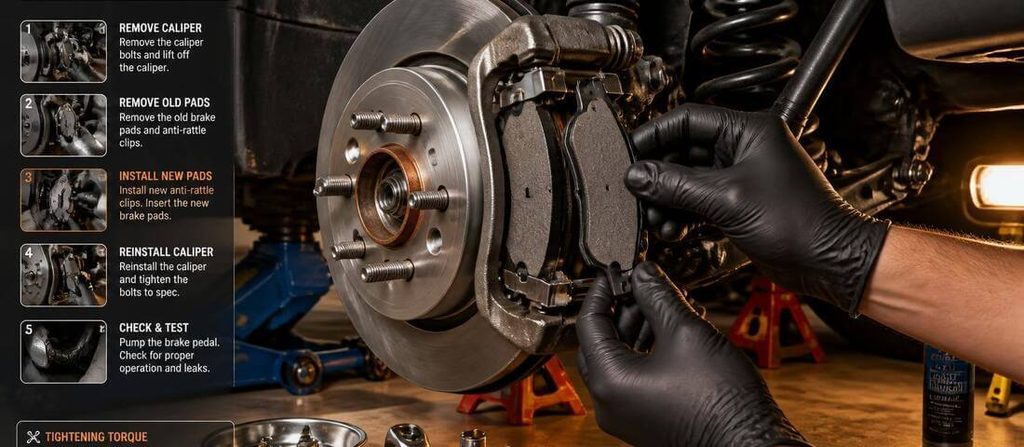
DIY or shop? Pads are a common DIY brake job for an experienced home mechanic with jack stands and a torque wrench. Rotors, calipers, wheel bearings, and anything involving the brake hydraulic system are safety-critical and are best left to a shop unless you have the specific service procedure and tools.

PATH B: Shaking While Stopped or Idling (Car Is Not Moving)
What it usually means
A shake or shudder you feel through the seat, floor, or steering wheel while the car sits still, engine running, points toward the engine, its mounts, or the fuel and air systems, not the brakes or wheels. This is often called a rough idle.
The one-step test that narrows it fast
Shift into neutral. If the shaking noticeably decreases in Neutral, that points strongly toward the engine or transmission mounts. If it doesn’t change, look at the engine’s fuel, air, and ignition side instead.
The 5 usual causes, ranked by how often shops report seeing them
1. Worn or broken engine (motor) mounts Mounts secure the engine and absorb its normal vibration. As the rubber ages, cracks, or separates, that vibration transfers straight into the cabin instead of being damped. Typical signs: shaking that’s worse at idle or right after shifting into gear, and a thud when you put the car in Drive or Reverse. The neutral test above is the classic way to check this at home; a mechanic confirms it visually.
2. Engine misfire Worn spark plugs, a failing ignition coil, or a wiring issue can stop one cylinder from firing cleanly. That throws off the engine’s rhythm, which you feel as a distinct shake or jolt, especially at idle when the engine has the least momentum to smooth it out. This usually, but not always, triggers the check-engine light.
3. Vacuum leak A cracked or loose vacuum line lets in unmetered air, leaning out the fuel mixture and causing an unstable idle, sometimes with the RPM wandering up and down. A hissing or whistling sound near the engine bay at idle is a common tell.
4. Dirty or clogged fuel injectors, or a clogged air intake Uneven fuel delivery to the cylinders causes rough, uneven combustion, felt most at idle. A severely clogged air filter can contribute in the same direction, from the opposite side of the air-fuel mix.
5. Timing belt or chain wear A stretched or worn timing component throws off valve timing, which can cause a rough idle and sometimes a squeal. This is a less common cause than the four above but worth knowing, especially on a higher-mileage vehicle that hasn’t had timing service.
Less common: an idle air control valve problem, a torque converter issue in an automatic transmission that shows up in gear, or a failing accessory (like an AC compressor) adding load the engine can’t smooth out. If the shake gets noticeably worse when you turn on the AC, mention that to your mechanic.
Quick self-checks
- Shift to Neutral and see if the shaking eases.
- Listen for a hiss near the engine bay at idle, a vacuum leak clue.
- Check the check-engine light. If it’s on, or flashing, that’s worth noting for the shop; a flashing light during a misfire is a more urgent signal than a steady one.
- Note when it’s worse: right after startup, with the AC on, or only after driving a while.
- Scan for codes if you have access to a scanner. A code narrows the search; it doesn’t replace a diagnosis. See our guide on reading trouble codes with an OBD-II scanner.
Is it safe to drive?
Usually yes, for a trip to the shop, but don’t ignore it and don’t treat it as purely cosmetic.
Get it looked at soon, but you can usually still drive, if:
- The shake is present at idle or stopped, but the car otherwise drives, accelerates, and brakes normally
- The check-engine light is steady, not flashing
Get it looked at promptly and avoid unnecessary driving if:
- The check-engine light is flashing, which on many vehicles signals an active misfire that can damage the catalytic converter if you keep driving on it
- The shaking is severe, or you notice a burning smell, loss of power, or stalling
What it costs
| Repair | Typical U.S. range | Notes |
|---|---|---|
| Motor/engine mount, per mount | About $250 to $650 for most passenger vehicles. Some sources report a wider $110 to $1,800 span depending on vehicle and mount type | Hydraulic or active mounts and tightly packed engine bays cost more; European brands run higher |
| Spark plugs (misfire-related) | Not priced here | Varies widely by cylinder count and plug type; ask for an itemized quote |
| Vacuum leak diagnosis and repair | Not priced here | Often inexpensive if it’s a single hose; more if it’s a manifold or intake gasket |
| Fuel injector cleaning or replacement | Not priced here | Cleaning is far cheaper than replacement; get a diagnosis first |
| Timing belt/chain service | Not priced here | Often bundled with a water pump; ask your shop for your vehicle’s interval |
DIY or shop? The neutral test, listening for a hiss, and checking the check-engine light are all DIY. Diagnosing and replacing mounts, fixing vacuum leaks, and misfire repair generally need a shop with a scan tool and engine access, though an experienced DIYer can sometimes handle spark plugs.
Common Mistakes (Both Paths)
- Guessing instead of testing. The neutral test (Path B) and the speed-vs-pedal check (Path A) take under a minute and point you toward the right half of this guide.
- Assuming “shaking” always means brakes. A rough idle has nothing to do with your brake system, and brake parts won’t fix it.
- Ignoring a flashing check-engine light. On many vehicles that specifically signals an active misfire, which can get more expensive the longer it’s ignored.
- Replacing all the mounts, or all the rotors, at once without confirming which one is bad.
Pro Tips
- Record a short video with sound while a passenger drives or while you sit at idle. Note the exact moment the shake starts and stops. Shops can act on that fast.
- For Path A, ask the shop to measure rotor thickness and runout before deciding between resurfacing and replacement.
- For Path B, ask the shop to road-test before and after any mount replacement. A second worn mount, or an unrelated misfire, can make a mount job look like it “didn’t fix it.”
FAQs About Car Shaking When Stopping
Why does my car shake when I brake but not otherwise?
This points to the brake system or the wheels: worn or unevenly worn rotors, worn or glazed brake pads, a worn wheel bearing, or a wheel alignment or balance issue. Rotor wear from normal heat and friction is the most commonly reported cause. A shop can confirm it by measuring the rotors and checking for wheel play.
Why does my car shake when I’m stopped or idling but not while driving?
This points to the engine side: worn engine or transmission mounts, a misfire from worn spark plugs or a bad coil, a vacuum leak, or dirty fuel injectors. Shifting into Neutral and seeing if the shake eases is the fastest home test for mounts.
Is it safe to drive if my car shakes when I brake?
Treat it as something to fix soon rather than to watch. Stop driving and call a tow if the pedal feels soft or sinks, you smell burning, the car pulls hard under braking, or a wheel visibly wobbles. A mild shake with normal stopping distance can usually wait for a prompt shop visit rather than an emergency tow.
Is it safe to drive if my car shakes when stopped or idling?
Usually yes, for a trip to the shop, as long as the car otherwise drives and stops normally. Treat a flashing check-engine light differently: on many vehicles it signals an active misfire, and continued driving can risk more expensive damage to the catalytic converter.
How much does it cost to fix a car that shakes when stopping?
It depends entirely on which cause you have. Brake-side fixes commonly run from about $150 for pads alone up to $900 or more for pads and rotors together, plus $300 to $500 per wheel bearing. Engine-side fixes commonly run $250 to $650 per motor mount, with misfire and vacuum-leak repairs priced case by case. Get the cause diagnosed before you get a quote.
Bottom Line
- “Shaking when stopping” is really two different questions. Figure out which one you’re asking first: shaking while braking, or shaking once you’re stopped.
- Braking-side shakes are most often rotors, followed by pads, bearings, alignment, or a caliper. Treat brake symptoms as safety issues, not comfort issues.
- Idle-side shakes are most often engine mounts or a misfire. The neutral test is your fastest free clue.
- A flashing check-engine light during a rough idle is more urgent than a steady one.