
This article was updated in September 13, 2026 with new products and information by Mark S. Taylor
The P0014 code means the engine computer has detected that the “B” camshaft on Bank 1 is too far advanced or that the variable valve timing system isn’t performing as commanded.
On many engines, the “B” camshaft refers to the exhaust camshaft. However, the exact terminology can vary by manufacturer.
The important point is that P0014 does not automatically mean the camshaft position sensor is bad.
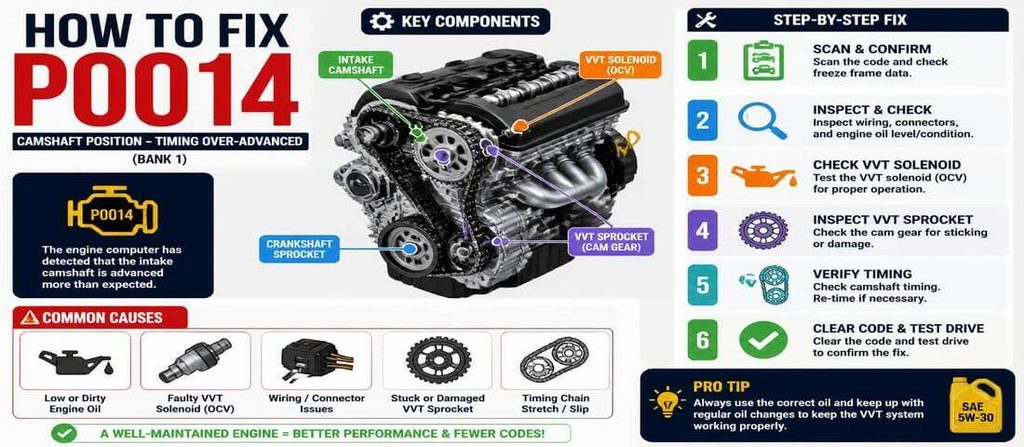
Possible causes include incorrect engine oil level or condition, a sticking VVT control solenoid, restricted oil flow, wiring problems, a camshaft actuator/phaser fault, or incorrect mechanical timing.
Contents
- 1 What Does P0014 Mean?
- 2 P0014 Code Symptoms
- 3 What Causes P0014?
- 4 How to Diagnose P0014
- 5 How to Fix P0014
- 6 Can Low or Dirty Oil Cause P0014?
- 7 Can a Bad VVT Solenoid Cause P0014?
- 8 Can a Timing Chain Cause P0014?
- 9 Can You Drive With P0014?
- 10 P0014 vs. Related Codes
- 11 P0014 Repair Cost
- 12 Common P0014 Diagnostic Mistakes
- 13 FAQs About How to Fix P0014 Code
- 14 Final Verdict
Quick Answer
To fix P0014, start by confirming the code and checking the engine oil level, condition and specified viscosity.
Then inspect the VVT control solenoid, wiring and connectors. If those checks pass, use scan-tool data to compare commanded and actual camshaft position.
If the camshaft remains too far advanced, the problem may be a sticking actuator, restricted oil passage or mechanical timing problem.
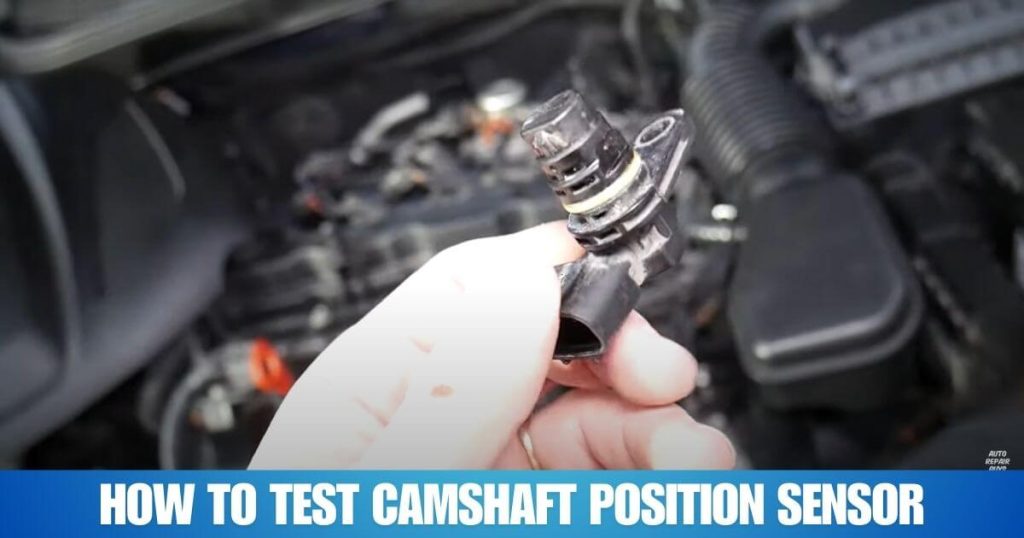
Don’t replace the camshaft position sensor just because P0014 contains the word “camshaft.”
The code identifies a camshaft timing-performance problem. Testing determines which component actually caused it.
What Does P0014 Mean?
P0014 is a generic OBD-II powertrain diagnostic trouble code.
Its standard description is:
“B” Camshaft Position – Timing Over-Advanced or System Performance (Bank 1).
Here’s what the terminology means.
“B” camshaft
On many engines, “B” identifies the exhaust camshaft.
But don’t assume that every manufacturer uses exactly the same naming convention.
Always verify the definition in the service information for the specific engine.
Bank 1
Bank 1 is the side of a multi-bank engine containing cylinder No. 1.
A typical inline four-cylinder engine has only one bank.
A V6 or V8 has two.
Timing over-advanced
The ECM commands the camshaft to a particular position.
It then monitors the camshaft position and compares actual timing with the expected position.
If the camshaft remains too far advanced or the system cannot control it within the expected range, P0014 can set.
A Volkswagen diagnostic specification, for example, defines P0014 using a difference between target and actual camshaft position under specified operating conditions. The exact thresholds are engine-specific and should not be copied to other vehicles.
P0014 Code Symptoms
The symptoms depend on the vehicle and the underlying failure.
Common symptoms include:
- Check Engine Light
- Rough idle
- Hard starting
- Engine hesitation
- Poor acceleration
- Reduced engine performance
- Stalling
- Poor fuel economy
- Engine noise
- Increased emissions
Some vehicles may drive almost normally with only the Check Engine Light illuminated.
Others can develop obvious drivability problems.
OBD-II diagnostic references list hard starting, poor idle and stalling among possible P0014 symptoms.
What Causes P0014?
1. Low engine oil
Many variable valve timing systems use engine oil pressure to move a camshaft actuator.
If the oil level is too low, the VVT system may not operate correctly.
Check the oil level before replacing expensive components.
But don’t simply add oil and forget about it.
If the level is low, find out why.
Possible causes include:
- External oil leak
- Oil consumption
- Recent incorrect service
- Internal engine problem
2. Dirty or incorrect engine oil
Old or contaminated oil can interfere with VVT operation.
Small passages, screens and control valves can be affected by sludge or debris.
Using an incorrect viscosity can also alter the hydraulic behavior of an oil-controlled VVT system.
Use the exact oil specification required by the vehicle manufacturer.
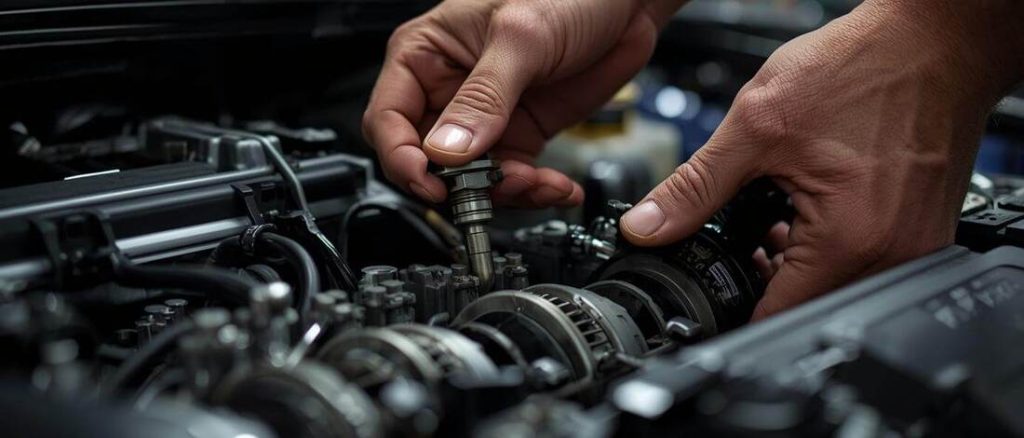
3. Stuck VVT control solenoid
A VVT solenoid, also called an oil-control valve on some engines, regulates oil flow to the camshaft timing actuator.
If it sticks in a position that allows continuous oil flow, the camshaft may remain too far advanced.
This is one of the important P0014 possibilities identified in generic diagnostic references.
4. Restricted oil passages
A functioning solenoid cannot solve an oil-flow problem elsewhere in the system.
Possible restrictions include:
- Sludge
- Debris
- Blocked screens
- Contaminated oil
- Damaged oil passages
This is why replacing the solenoid without testing the rest of the VVT system can result in an expensive non-repair.
5. Wiring or connector problems
The VVT solenoid has an electrical control circuit.
Inspect for:
- Corroded terminals
- Loose pins
- Broken wires
- Damaged insulation
- Oil-soaked connectors
- Poor electrical connections
A manufacturer diagnostic procedure may require checking the electrical integrity of the VVT system before replacing mechanical components. One Volkswagen/Audi technical bulletin, for example, specifically calls for checking VVT electrical connections and pins as part of camshaft-phaser diagnosis.
6. Failed camshaft actuator or phaser
The camshaft actuator, commonly called a phaser, physically changes camshaft timing.
If it sticks or develops an internal mechanical fault, the camshaft may remain advanced even though the control solenoid is functioning.
This is an important distinction:
The solenoid controls oil flow. The phaser uses that oil flow to change camshaft position.
Either component can be responsible.
7. Incorrect mechanical timing
A timing-chain problem can produce P0014.
Potential problems include:
- Incorrect chain installation
- Stretched timing chain
- Failed tensioner
- Damaged guides
- Incorrect camshaft timing
- Camshaft actuator installation problems
This becomes especially suspicious if P0014 appeared after engine or timing-chain work.
8. Manufacturer-specific component or software issue
P0014 is a generic code, but the actual failure can be very vehicle-specific.
A Jaguar/Land Rover bulletin, for example, documents P0014 as an actuator-stuck condition associated with insufficient wear resistance in a VCT solenoid bush and provides a specific VCT-solenoid repair.
That is why checking manufacturer technical service bulletins before replacing parts can save time and money.
How to Diagnose P0014
Don’t start by throwing a new VVT solenoid at the engine.
Use a logical diagnostic sequence.
Step 1: Confirm the code
Connect a capable OBD-II scan tool and record:
- P0014
- Other stored codes
- Pending codes
- Freeze-frame data
- Engine RPM
- Coolant temperature
- Engine load
- Oil temperature if available
Other camshaft or crankshaft codes can significantly change the diagnostic direction.
Pay particular attention to codes such as P0013, P0015, P0016 and P0017.
Step 2: Check engine oil
Check:
- Oil level
- Oil condition
- Correct viscosity
- Correct manufacturer specification
Look for obvious contamination or sludge.
If the oil is significantly overdue or incorrect, service it using the manufacturer’s specified oil and filter.
Then clear the code only after addressing the actual condition and perform the required drive/retest procedure.
An oil change should not be treated as a universal P0014 repair.
Step 3: Check for manufacturer bulletins
Search technical service information for the exact:
- Year
- Make
- Model
- Engine
- VIN range
This is one of the most valuable steps in diagnosing P0014.
Manufacturer documentation demonstrates that P0014 can result from different failures on different engines.
Step 4: Inspect the VVT solenoid
Locate the applicable Bank 1 “B” camshaft control solenoid.
Depending on the engine, it may be called:
- VVT solenoid
- VCT solenoid
- Oil-control valve
- Camshaft timing oil-control valve
Inspect the connector and wiring first.
Then test the solenoid according to the vehicle-specific procedure.
Do not use a resistance specification from a different engine.
Step 5: Check for a stuck solenoid
A solenoid can fail mechanically even when its electrical circuit appears normal.
Depending on the manufacturer’s procedure, testing may involve:
- Electrical resistance
- Power and ground
- Command activation
- Scan-tool actuator testing
- Oil-flow inspection
- Physical inspection
Don’t assume a simple resistance check proves the solenoid is good.
Step 6: Check camshaft live data
This is one of the most useful tests.
On vehicles that provide the information, compare:
Camshaft commanded position vs. actual position.
If the ECM commands the camshaft back toward its base position but the actual position remains advanced, suspect a control, hydraulic or mechanical problem.
The exact expected values and test conditions are vehicle-specific.
Don’t copy a generic “0 degrees” or resistance number from another engine.
Step 7: Check engine oil pressure if required
If the VVT system depends on oil pressure, verify oil pressure according to the manufacturer’s procedure.
Low oil pressure can prevent proper camshaft control.
Possible causes include:
- Low oil
- Wrong viscosity
- Worn engine bearings
- Oil-pump problems
- Restricted oil pickup
- Internal leakage
A new VVT solenoid cannot fix inadequate engine oil pressure.
Step 8: Inspect mechanical timing
If the oil, wiring and VVT control components check out, verify mechanical timing.
Depending on the engine, this may involve checking:
- Timing-chain alignment
- Camshaft timing marks
- Chain tensioner
- Timing-chain guides
- Camshaft actuator position
- Crankshaft-to-camshaft correlation
If P0014 appeared immediately after timing-chain work, this step moves much higher on the priority list.

How to Fix P0014
The repair depends on the actual root cause.
| Confirmed cause | Appropriate repair |
|---|---|
| Low engine oil | Correct level and diagnose oil loss |
| Wrong/contaminated oil | Replace with manufacturer-specified oil/filter |
| Sticking VVT solenoid | Service or replace according to manufacturer procedure |
| Wiring fault | Repair wiring/connectors |
| Restricted oil passage | Clean/repair the affected oil-control system |
| Failed camshaft phaser | Replace the actuator/phaser |
| Incorrect mechanical timing | Correct cam/crank timing |
| Timing-chain problem | Repair chain/tensioner/guides as required |
| Manufacturer software issue | Apply approved software update |
| Required VVT relearn | Perform the specified learning procedure |
Fix #1: Correct the engine oil problem
If testing finds low, contaminated or incorrect oil, correct that problem first.
Use the correct:
- Oil viscosity
- Oil specification
- Filter
Don’t assume thicker oil will fix a VVT problem.
Fix #2: Repair the VVT solenoid
If the solenoid fails the manufacturer’s test, replace or service it according to the service procedure.
Some solenoids may be removable and serviceable relatively easily.
Others are buried in difficult locations.
Do not replace the solenoid solely because P0014 was stored.
Fix #3: Repair the wiring
Repair damaged wiring, terminals or connectors as required.
A poor connection can make a perfectly good VVT component appear faulty.
After repairing the circuit, clear the code and confirm the camshaft follows its commanded position.
Fix #4: Repair the camshaft actuator/phaser
If the phaser is mechanically stuck or damaged, it needs to be repaired or replaced.
This can be significantly more labor-intensive than replacing a solenoid.
One VW/Audi service bulletin involving over-advanced camshaft faults requires checking electrical integrity and oil pressure before moving into camshaft-phaser and solenoid replacement procedures.
That illustrates why diagnosis should come before parts replacement.
Fix #5: Correct mechanical timing
If the timing chain is incorrectly installed or the timing system has excessive wear, the engine must be mechanically corrected.
Depending on the engine, this can involve:
- Timing-chain replacement
- Tensioner replacement
- Guide replacement
- Camshaft timing correction
- Phaser replacement
This is a major repair compared with an oil change or solenoid replacement.

Can Low or Dirty Oil Cause P0014?
Yes, on oil-controlled VVT systems.
Engine oil is often part of the mechanism that changes camshaft timing.
Low oil level can reduce the available oil pressure.
Contaminated oil can restrict small control passages or affect VVT components.
But P0014 should not automatically be treated as an oil-change code.
If the oil is clean, at the correct level and meets the required specification, continue the diagnosis.
Can a Bad VVT Solenoid Cause P0014?
Yes.
A VVT solenoid that sticks or incorrectly controls oil flow can leave the “B” camshaft too far advanced.
But a failed solenoid is only one possible cause.
A stuck camshaft phaser, restricted oil passage, wiring problem or incorrect mechanical timing can produce similar symptoms.
Can a Timing Chain Cause P0014?
Yes.
If the mechanical relationship between the crankshaft and camshaft is incorrect, the ECM can detect camshaft timing outside its expected range.
Suspect this more strongly when:
- P0014 appears with P0016/P0017
- The engine has timing-chain noise
- The engine was recently repaired
- The code returns immediately after replacing a VVT component
Can You Drive With P0014?
It depends on how the engine is running and why the code is present.
A vehicle with only a Check Engine Light and normal operation may be able to reach a repair facility.
But don’t continue driving normally if you have:
- Severe engine noise
- Stalling
- Hard starting
- Major power loss
- No-start condition
- Low oil-pressure warning
- Flashing Check Engine Light
- Severe rough running
A camshaft timing problem can range from a relatively simple control issue to a serious mechanical timing failure.
If the engine is making new timing-chain or camshaft noise, treat that as a higher-priority problem.

P0014 vs. Related Codes
| Code | General meaning |
|---|---|
| P0011 | “A” camshaft timing over-advanced/system performance, Bank 1 |
| P0013 | “B” camshaft actuator circuit, Bank 1 |
| P0014 | “B” camshaft timing over-advanced/system performance, Bank 1 |
| P0015 | “B” camshaft timing over-retarded, Bank 1 |
| P0016 | Crankshaft/camshaft correlation, Bank 1 sensor A |
| P0017 | Crankshaft/camshaft correlation, Bank 1 sensor B |
Manufacturer terminology and exact diagnostic criteria can vary.
For example, Volkswagen documentation identifies P0013 as the exhaust camshaft actuator circuit and P0014 as exhaust camshaft timing over-advanced/system performance on a particular engine.
P0014 Repair Cost
There is no reliable universal P0014 repair price.
The repair could be relatively inexpensive if the cause is:
- Incorrect oil level
- Oil service
- Electrical connection
- Wiring
It can become considerably more expensive if the problem is:
- VVT actuator/phaser
- Timing chain
- Tensioner
- Internal engine timing
Think of P0014 as a diagnostic starting point, not a repair estimate.
A shop should diagnose the cause before quoting the final repair.
Common P0014 Diagnostic Mistakes
Replacing the camshaft sensor
P0014 is not a direct instruction to replace the camshaft sensor.
Replacing the VVT solenoid without testing it
The solenoid is a common suspect, but it isn’t the only possible cause.
Assuming an oil change always fixes it
Oil can cause VVT problems, but a mechanical timing problem won’t disappear because the oil is new.
Ignoring timing-chain work
If the code appeared after a timing-chain repair, verify mechanical timing.
Using generic specifications
VVT systems vary dramatically between engines.
Use vehicle-specific specifications for:
- Oil pressure
- Solenoid resistance
- Voltage
- Camshaft position
- Timing angles
- Relearn procedures
Ignoring technical service bulletins
Some P0014 problems are known manufacturer-specific failures with specific repair procedures.
FAQs About How to Fix P0014 Code
What is the most common fix for P0014?
There is no single fix for every vehicle. Depending on the engine, common repairs can involve correcting oil problems, servicing a VVT solenoid, repairing wiring, replacing a camshaft actuator, or correcting mechanical timing.
Can an oil change fix P0014?
It can if incorrect, contaminated or insufficient oil is causing the VVT system to malfunction. But an oil change will not repair a failed actuator, wiring fault or timing-chain problem.
Does P0014 mean a bad VVT solenoid?
Not necessarily. A stuck or faulty VVT solenoid can cause P0014, but the camshaft actuator, oil passages, wiring and mechanical timing must also be considered.
Does P0014 mean the timing chain is bad?
No. A timing-chain problem is one possible cause, but it is not the only one.
Can low oil cause P0014?
Yes. Oil-controlled VVT systems depend on adequate oil level and pressure to adjust camshaft timing.
Can dirty oil cause P0014?
Yes. Contaminated oil can interfere with VVT oil flow on applicable engines.
Final Verdict
The correct way to fix P0014 is to diagnose why the Bank 1 “B” camshaft is staying too far advanced or failing to respond as commanded.
Start with the basics:
Check the oil → inspect the VVT solenoid and wiring → check live camshaft data → verify oil pressure when required → test the actuator/phaser → verify mechanical timing.
Don’t jump straight to a camshaft sensor or VVT solenoid.
P0014 is a timing-performance code, not a parts-replacement instruction.
And if the code appeared immediately after timing-chain or engine work, move mechanical timing much higher on your diagnostic checklist.
The code tells you where the ECM sees the problem. Testing tells you what actually failed.