
This article was updated in November 13, 2026 with new products and information by Mark S. Taylor
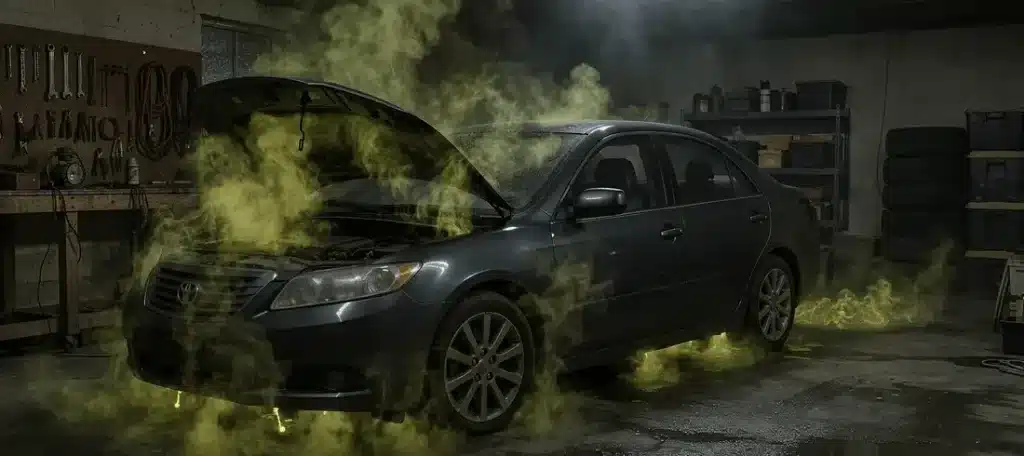
You pull into your driveway after a normal commute, and before you shut the ignition off, you notice a sharp, pungent odor like rotten eggs lingering near the rear of your car. It may be strongest right after hard acceleration or while the vehicle is idling at a traffic light.
Answer Capsule: A rotten-egg exhaust smell is typically caused by sulfur compounds interacting within the exhaust stream. While fuel chemistry or normal catalytic converter reactions can trigger it under specific loads, a persistent odor can also indicate a rich air-fuel mixture, a misfire, or an exhaust leak. Diagnosis must precede parts replacement.
That distinct smell is sulfur. While it is frequently associated with fuel chemistry and the catalytic converter, it does not automatically mean your emissions system has failed. The physical location of the odor, your driving conditions, and secondary dashboard warnings determine your next steps.
Before approving an expensive emissions repair or replacing parts based on intuition, use this guide to locate the odor, understand its root causes, and know when professional service is required.
Contents
First, Find Where the Smell Is Strongest
The physical location of the odor is your most valuable diagnostic clue. Never lean directly over a hot exhaust pipe or reach blindly into a running engine bay to investigate.
If the smell is strongest near the tailpipe
When the odor is concentrated behind the vehicle, the exhaust system is the primary suspect. Minute sulfur compounds naturally present in gasoline can produce a hydrogen-sulfide or rotten-egg odor as exhaust gases pass through the catalytic converter.
Take note of when the smell occurs:
- Briefly after a cold winter start
- Following an extended period of idling
- During hard highway acceleration
- After a long high-speed trip
- Continuously every time the engine runs
A brief odor under a single, specific operating condition is entirely different from a pungent sulfur smell that persists on every drive.
If the smell is strongest inside the cabin
Do not treat an odor inside the passenger compartment as a normal characteristic. Exhaust gases should never breach the cabin sealing boundaries.
Roll down your windows immediately, steer to a safe location, and inspect the vehicle. If anyone in the car feels dizzy, nauseated, weak, or develops a headache, exit the vehicle immediately and get fresh air. Do not continue driving if you suspect exhaust gases are leaking into the cabin.
If the smell is strongest under the hood
If the pungent odor emanates from the engine bay, do not automatically blame the catalytic converter. A qualified technician must inspect the auxiliary charging system, battery condition, fuel lines, and wiring harnesses.
Never touch a hot, leaking, swollen, or smoking component. If you notice visible smoke, electrical melting smells, or fluid leaks, shut the engine down immediately.
4 Possible Causes of a Rotten-Egg Smell
| Potential Cause | Core Mechanism | Typical Driving Condition |
| 1. Fuel Sulfur & Catalyst Chemistry | Trace sulfur in gasoline interacts with precious metals inside the warm catalytic converter. | Cold starts, extended idle, or full-throttle acceleration. |
| 2. Rich Air-Fuel Mixture | Excess fuel enters the exhaust due to sensor or injector failure, overwhelming the catalyst. | Heavy fuel consumption, rough idle, black smoke. |
| 3. Engine Misfire | Unburned fuel dumps directly into hot exhaust pipes, overheating the catalyst. | Flashing check engine light, engine shaking, loss of power. |
| 4. Exhaust Leak | Cracked manifold, rusted flange gasket, or damaged flex pipe routes fumes into cabin/underbody. | Persistent exhaust noise, cabin fumes, visible soot tracks. |
1. Sulfur in gasoline and catalyst operation
Gasoline contains trace sulfur compounds. The catalytic converter’s job is to alter the chemical composition of exhaust gases, and normal sulfur-reduction chemistry can occasionally produce a temporary rotten-egg odor.
For instance, a technical service bulletin issued by Mazda North American Operations (hosted via NHTSA records) documents this exact condition for specified Mazda models and years. It notes that a sulfur odor can occur after a cold start, fast idle, extended idling, or full-throttle acceleration, attributing the scent to fuel sulfur content rather than component failure.
However, that bulletin applies strictly to the listed applications. It is not a universal rule, and a sulfur smell should never be dismissed without checking your specific vehicle make and model.
2. An engine running too rich
An engine running rich delivers more fuel to the combustion chambers than the incoming air can burn efficiently. Root causes often include faulty oxygen sensors, leaking fuel injectors, or incorrect data from mass airflow (MAF) sensors.
Sending excess unburned fuel into the exhaust stream forces the catalytic converter to work overtime, altering internal temperatures and generating distinct chemical odors. Watch for secondary symptoms like reduced fuel economy, a rough idle, hesitation upon acceleration, or a black soot film inside the tailpipe tip. (For related fuel system insights, review our guide on TheCarBuzz Fuel System category.)
3. An engine misfire or emissions-system fault
When a cylinder misfires, unburned air and fuel bypass combustion and enter the exhaust manifold. As this fuel reaches the hot catalytic converter, it ignites internally, causing severe thermal overload and chemical breakdown.
A check engine light that flashes while driving indicates an active, severe misfire that can rapidly melt a catalytic converter. Reduce engine load immediately, pull over safely, and consult your owner’s manual.
4. An exhaust leak or damaged exhaust component
A physical crack or gasket failure anywhere along the exhaust path—from the exhaust manifold down to the tailpipe—can vent un-neutralized gases directly into the undercarriage or pull them into the cabin heating ventilation system.
Exhaust leaks require physical inspection on a lift. Never ignore a leak that allows fumes near the passenger compartment.

Does a Rotten-Egg Smell Mean the Catalytic Converter Is Bad?
No. The smell alone is never enough to condemn a catalytic converter.
While the converter is part of the chemical reaction producing the odor, the underlying fault often lies in fuel quality, engine tuning, or ignition performance. Replacing an expensive catalytic converter without fixing a rich running condition or misfire will simply destroy the replacement part.
Before replacing a converter, a professional shop should evaluate:
- Vehicle make, model year, engine family, and applicable OEM service bulletins
- Whether the odor originates at the tailpipe, engine bay, or cabin
- Engine idle smoothness and overall drivability
- Stored diagnostic trouble codes and pending fault history
- Live fuel-trim and oxygen-sensor switching data
- Ignition system and spark plug condition
- Physical integrity of the exhaust pipes and gaskets
What You Can Safely Check at Home
You can gather valuable diagnostic data without touching hot components or opening fuel lines:
- Record the Location: Note whether the scent is strongest at the tailpipe, under the hood, or inside the cabin.
- Note the Timing: Determine if it happens on cold starts, during idle, under acceleration, or after shutdown.
- Check the Dashboard: Note if a check engine light or message is present.
- Evaluate Drivability: Observe whether the engine idles rough, hesitates, or lacks power.
- Inspect Visually From a Distance: Look for obvious exhaust sagging or rusted pipe hangers.
Safety Warning: Never crawl under a vehicle supported only by a hydraulic jack. Always allow the exhaust system to cool completely before performing any visual underbody checks.
When Should You Stop Driving?
Pull over safely and arrange professional assistance immediately if you experience:
- Exhaust fumes entering the passenger cabin
- A flashing check engine light
- Severe engine misfiring, shuddering, or sudden power loss
- Visible smoke or unusual burning odors under the hood
- A strong, unprovoked liquid gasoline smell or visible puddle
- Anyone in the vehicle feeling dizzy or nauseated
FAQs About Car Smells Like Rotten Eggs?
Can bad gas make a car smell like rotten eggs?
Fuel sulfur compounds can contribute to a sulfur-like exhaust odor under specific driving conditions. A manufacturer technical bulletin documents this for specific Mazda applications. If the odor persists or the engine runs poorly, have the vehicle inspected rather than assuming fuel is the sole cause.
Does a rotten-egg smell mean I need a new catalytic converter?
No. The smell alone cannot confirm catalytic converter failure. Fuel sulfur chemistry, engine-management problems, rich running conditions, misfires, and exhaust leaks can all trigger sulfur odors. Professional diagnosis must precede any parts replacement.
Why does my car smell like sulfur when I accelerate?
Acceleration changes engine load, exhaust gas temperature, and catalyst efficiency. Some OEM documentation notes sulfur odors under hard acceleration or extended idling on specific vehicle applications. If accompanied by a check engine light, arrange professional diagnosis.
Is a rotten-egg smell from the exhaust dangerous?
The odor itself is a warning sign, but exhaust gases entering the passenger cabin pose a serious safety risk due to carbon monoxide exposure. Open your windows immediately, stop in a safe location, and get fresh air if anyone feels unwell.
Can an engine misfire cause a rotten-egg smell?
Yes. A misfire sends unburned fuel into the exhaust stream, which can overheat and damage the catalytic converter while producing harsh chemical odors. The underlying misfire must be corrected immediately to prevent repeat component failure.
The Bottom Line
A rotten-egg smell often points toward sulfur compounds reacting in your exhaust system, but it does not prove your catalytic converter has failed. Fuel composition, engine tuning, emissions management faults, and exhaust leaks all deserve thorough evaluation.
Start by identifying exactly where and when the odor occurs, noting any dashboard warnings. Prioritize a professional diagnostic scan and physical exhaust inspection before committing to an expensive catalytic converter replacement. (For broader troubleshooting topics, visit TheCarBuzz Engine Problems archive.)