
This article was updated in July 11, 2026 with new products and information by Mark S. Taylor
mixing different color coolants won’t destroy your engine in the next five minutes, but it’s not harmless either — and whether you need a flush today or can wait until the next service depends on how much wrong coolant went in and what chemistry you mixed. The color itself isn’t the problem. The chemistry underneath the dye is.
Here’s exactly what happens, how to assess whether your specific situation is urgent, and what goes in the system after the flush.
Contents
- 1 Can You Mix Different Color Coolants?
- 2 Coolant Chemistry 101 — Why Color Is Just the Dye
- 3 The Color-to-Chemistry Chart — What Each Color Actually Means
- 4 What Actually Happens When You Mix Incompatible Coolants
- 5 The Contamination Ratio — How Much Mixing Actually Matters
- 5.1 Below 10% contamination (small top-off with wrong coolant):
- 5.2 10% to 25% contamination (moderate top-off or partial fill with wrong coolant):
- 5.3 Above 25% contamination (large volume addition or system nearly empty when wrong coolant was added):
- 5.4 The distilled water dilution option if an immediate flush isn’t possible:
- 6 The Three Most Dangerous Mixing Scenarios
- 7 The “Universal Coolant” Misconception — What It Actually Means
- 8 How To Tell if Your Coolant Is Already Damaged From Mixing
- 9 What To Do Right Now — Decision Guide by Mixing Scenario
- 10 The Correct Coolant for Your Vehicle — How To Find It and What To Buy
- 11 Coolant Flush Cost — What the Complete Job Should Cost
- 12 How To Prevent Coolant Mixing Problems Going Forward
- 13 FAQs About Can You Mix Different Color Coolant
- 14 Can you mix coolants of the same color from different brands?
- 15 The Expert Verdict
Can You Mix Different Color Coolants?
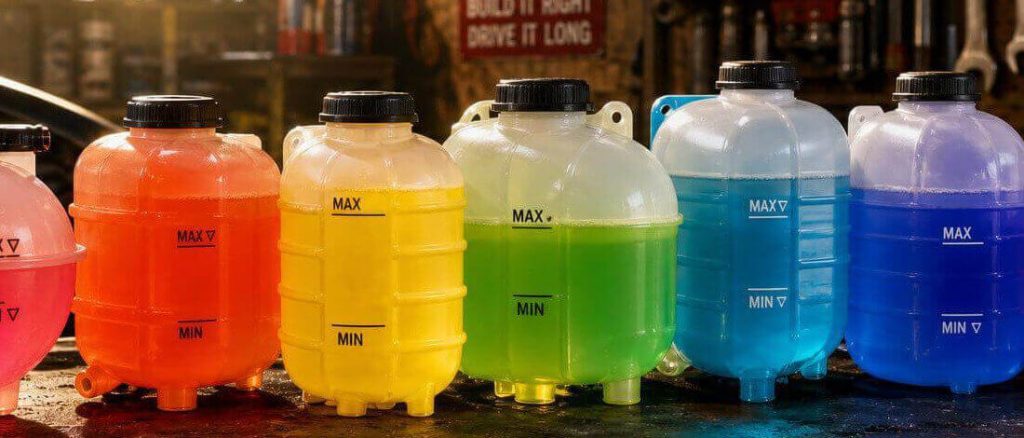
Technically, yes — you can mix them. The coolant won’t explode, the engine won’t seize immediately, and in small quantities the consequences are manageable. But mixing incompatible coolant chemistries degrades the corrosion protection on every metal surface in your cooling system, and in the worst case — mixing green silicate-based coolant with orange OAT-based coolant — produces a gelatinous precipitate that clogs the heater core within weeks to months of mixing.
The critical distinction: coolant color is a dye, not a chemistry indicator. The dye is added by the manufacturer to help identify the product type, but it carries no chemical function. Two coolants of the same color from different manufacturers may use completely different inhibitor packages. Two coolants of different colors from the same manufacturer may be chemically compatible. You cannot determine whether coolants are compatible by color matching — you need to know the inhibitor chemistry of what’s in the system and what you’re adding.
The three inhibitor families and their most common colors in the US market:
- IAT (Inorganic Additive Technology): typically green; the original conventional coolant; silicate and phosphate inhibitors; service life 2 years or 30,000 miles
- OAT (Organic Acid Technology): typically orange (GM Dex-Cool), red (Toyota, Honda), blue (some European), or pink; organic acid carboxylate inhibitors; service life 5 years or 150,000 miles
- HOAT (Hybrid OAT): typically yellow, gold, purple, or blue; combination of silicates and organic acids; service life 5 years or 150,000 miles; the basis for most “universal” coolants
These are not interchangeable. Mixing them introduces competing inhibitor chemistries that can neutralize each other’s protective function and produce chemical byproducts that damage the cooling system.
Coolant Chemistry 101 — Why Color Is Just the Dye
Every automotive coolant starts with the same base: ethylene glycol and water. Ethylene glycol lowers the freezing point of the mixture — a 50/50 blend with water freezes at approximately −34°F. It also raises the boiling point above water’s 212°F — a pressurized 50/50 system boils at approximately 263°F at ambient pressure, and with a 15-PSI radiator cap, that effective boiling point rises to 275 to 285°F. Propylene glycol is used in “non-toxic” or “low-toxicity” formulations at slightly lower freeze protection per unit concentration.
Ethylene glycol protects against freeze and boil. It does not protect metal. That’s the inhibitor’s job.
The cooling system on a modern engine contains at least four distinct metals in direct contact with the coolant: aluminum (heads, block, water pump housing, thermostat housing, intake manifold), cast iron or steel (older blocks, water pump impeller shafts, freeze plugs), copper (some radiator cores, older heater cores), and magnesium (some newer lightweight castings). Each of these metals has a different electrochemical potential. In a conductive liquid like coolant, dissimilar metals in contact generate galvanic corrosion — the less noble metal (aluminum) dissolves sacrificially to protect the more noble metal (copper).
The inhibitor package prevents this. Inhibitors form a molecular protective film on each metal surface, interrupting the electrochemical reaction. Different inhibitor chemistries protect different metals with different mechanisms and different service lives. Per ASTM D3306 and D6210 coolant specifications, each coolant type is tested against specific metal corrosion standards — and passing those tests requires the full, uncontaminated inhibitor package operating at its designed concentration.
When you introduce an incompatible inhibitor into the system, the two chemistries compete for the same metal surface sites. Neither one wins completely. Both are partially displaced. The protection on every metal surface in the system drops below the level either chemistry would provide alone.

The Color-to-Chemistry Chart — What Each Color Actually Means
Use this as a starting point — not a definitive answer. Always verify against the product label, the owner’s manual, or the OEM specification before adding any coolant.
| Color | Typical Chemistry | Common Applications | Service Life |
|---|---|---|---|
| Green | IAT (silicate + phosphate) | Pre-2000 domestic vehicles; some import applications | 2 years / 30,000 miles |
| Orange | OAT (carboxylate, no silicate/phosphate) | GM Dex-Cool (1996+), some Chrysler | 5 years / 150,000 miles |
| Red | OAT or phosphate-HOAT | Toyota (phosphate-free OAT), Honda (phosphate-free OAT), some Korean makes | 3–5 years / 60,000–150,000 miles |
| Blue | OAT or HOAT | European vehicles (VW, BMW, Mercedes), some Korean makes | 3–5 years |
| Yellow / Gold | HOAT (silicate + carboxylate) | Ford, some Chrysler, some European | 5 years / 150,000 miles |
| Purple | HOAT | Some Chrysler/Stellantis applications | 5 years / 150,000 miles |
| Pink | OAT or HOAT | Some import applications, some universal products | 5 years |
The red coolant problem deserves specific attention.
Red coolant appears in both Honda/Acura Type 2 coolant (phosphate-free, silicate-free OAT) and Toyota/Lexus Super Long Life Coolant (which has historically contained phosphate as a corrosion inhibitor for ferrous components). Both are red. They are chemically different. A Honda owner who grabs a red Toyota coolant because “it’s the same color” has introduced phosphate into a Honda system engineered specifically to exclude it — Honda’s aluminum alloys are susceptible to calcium phosphate scale in hard water regions, which is why their specification excludes phosphate. The mix won’t cause instant failure, but it’s not what Honda’s engineering team specified or tested.
The green-into-orange mix is the most dangerous. Green IAT coolant contains silicates. Orange OAT coolant contains carboxylate organic acids. When silicates and carboxylates combine in the same solution under heat, they react to form a white-to-gray gelatinous precipitate. This gel circulates with the coolant and accumulates in the smallest passages in the system — specifically the heater core.
What Actually Happens When You Mix Incompatible Coolants
The failure mode that most articles describe as “corrosion” or “damage” is actually two distinct chemical events happening simultaneously. Understanding both determines what you’ll find wrong with the cooling system and when.
Event 1 — Silicate-OAT Gel Formation
This is the primary failure mode when green coolant is mixed with orange, red, or any OAT-based coolant. Silicate ions (SiO₃²⁻) from the IAT coolant react with the carboxylate organic acids in the OAT coolant under the heat and pressure of a running cooling system. The reaction produces silicic acid gel — a viscous, semi-solid white or gray substance that doesn’t dissolve back into the coolant. It circulates as particles, and it accumulates wherever flow is restricted.
The heater core is the first casualty. The internal passages of a typical automotive heater core are 3 to 5mm in internal diameter — smaller than a pencil. The gel particles accumulate at bends and restrictions in these passages, progressively reducing flow. The radiator tubes are 8 to 15mm in internal diameter — large enough that the same gel particles pass through or accumulate slowly at the ends near the tanks. The water pump passages are 15 to 25mm — essentially unrestricted for gel particle accumulation.
The driver experiences heater core clogging as a gradual reduction in cabin heat. In summer, it’s invisible — the heater isn’t being used. The problem becomes apparent in the first cold weather of fall: the heater blows air that’s warm but not hot, or one side of a dual-zone heater is noticeably cooler than the other. By the time the driver notices, the heater core may be partially blocked enough that a flush won’t clear it — the gel has partially polymerized in the passages and requires chemical treatment or heater core replacement.
Event 2 — Inhibitor Competition and Depletion
When two different inhibitor chemistries are present in the same coolant, they compete for adsorption sites on metal surfaces. Every metal surface in the cooling system has a finite number of sites where inhibitor molecules can attach and form the protective film. When IAT silicates and OAT carboxylates are both present, they compete for the same aluminum oxide surface sites — the silicates bond faster but with lower coverage efficiency, the carboxylates bond more slowly but with higher coverage efficiency.
The result: neither inhibitor forms its designed protective layer. The silicates partially block the carboxylates from covering the surface efficiently. The carboxylates partially displace the silicates before they can form a complete protective layer. The aluminum surfaces in the system — the cylinder head, the water pump housing, the thermostat housing, the heater core end tanks — are inadequately protected from electrochemical corrosion.
Per SAE J1034 coolant performance specifications, properly formulated coolant must maintain corrosion protection on aluminum at elevated temperatures for the duration of its rated service life. A mixed coolant system cannot meet this specification because the competing inhibitor chemistries each reduce the other’s effectiveness — the combined protection is less than either chemistry provides alone, not a sum of both.
The Contamination Ratio — How Much Mixing Actually Matters
This is the number every reader needs and no competitor article provides.
The consequence of mixing incompatible coolants is not a fixed outcome — it’s proportional to the concentration of incompatible chemistry in the system. A cooling system that holds 10 quarts of orange OAT coolant and receives one quart of green IAT coolant has a 10 percent contamination ratio. A system that receives four quarts of green into six quarts of orange has a 40 percent contamination ratio. The chemical activity — gel formation rate, inhibitor depletion rate, pH change — scales with the concentration of incompatible inhibitor in the system.
Below 10% contamination (small top-off with wrong coolant):
The incompatible inhibitor concentration is too low to produce significant gel formation in the short term. The existing inhibitor package continues to dominate the system chemistry. The risk is measurable but not acute — you’ve slightly diluted the protective chemistry and introduced a small amount of competing inhibitor. The correct response: note what you added, monitor the system, and flush with the correct coolant at the next scheduled service interval. Do not delay indefinitely — the contamination ratio will effectively increase as the dominant inhibitor depletes through its normal service life.
10% to 25% contamination (moderate top-off or partial fill with wrong coolant):
The competing inhibitor is present in sufficient concentration to begin meaningful chemical activity. Gel formation from a silicate-OAT mix is possible over weeks to months. Inhibitor depletion on aluminum surfaces is measurable. Schedule a flush within 30 days. Don’t wait for symptoms — the heater core clogging from gel formation is a slow process, and catching it before the gel has partially polymerized in the passages saves $400 to $1,200 in heater core replacement.
Above 25% contamination (large volume addition or system nearly empty when wrong coolant was added):
Flush the system now. At this concentration, the chemical activity between incompatible inhibitors is rapid and the gel formation potential is high. This is particularly true for green-into-orange mixing, which produces silicic acid gel. The longer this system runs, the more gel accumulates in the heater core passages. A flush performed before gel accumulation clears the system completely. A flush performed after significant gel accumulation may not — the gel may have begun to polymerize in the heater core passages and require either chemical treatment or core replacement.
The distilled water dilution option if an immediate flush isn’t possible:
If you’ve added a significant volume of the wrong coolant and cannot get a flush immediately, drain enough coolant from the system to reduce the contamination ratio below 10 percent and replace the drained volume with distilled water. Distilled water only — tap water introduces calcium and magnesium that form mineral scale in the hottest cooling passages. This dilution reduces the concentration of incompatible inhibitor and slows the gel formation rate. It also dilutes the freeze protection — check the refractometer reading afterward and ensure you’re still protected to below your region’s lowest expected temperature.
The Three Most Dangerous Mixing Scenarios
Not all mixing events are equal. These three combinations require the most urgent response.
Scenario 1 — Green IAT Into Orange OAT (The Gel Scenario)
This is the most chemically active mixing event in passenger car cooling systems. Green coolant (silicate-based) into any OAT system (Dex-Cool, Toyota, Honda) initiates silicate-OAT gel formation. The gel forms within hours to days at operating temperature and begins accumulating in the heater core passages within the first few hundred miles of driving. Contamination above 10%: flush within 30 days. Contamination above 25%: flush immediately before driving further.
Scenario 2 — Any Silicate-Containing Coolant Into a Japanese OEM Phosphate-Free System
Honda, Acura, and early Subaru OEM cooling systems specify phosphate-free, silicate-free OAT coolant for a specific engineering reason: Honda’s aluminum alloys combined with hard water mineral content produce calcium phosphate scale when phosphate inhibitors are present. Adding any silicate-containing coolant (green IAT, most HOAT universal coolants) to a Honda or Subaru system introduces silicate inhibitors that the system’s aluminum alloys are not designed to handle. The silicate protection mechanism on Honda’s specific aluminum alloy is less effective than the OAT carboxylate protection it displaces. Flush and refill with Honda-specified coolant (blue Honda Type 2 or equivalent phosphate-free OAT).
Scenario 3 — Dex-Cool Running Low Without Mixing
This deserves inclusion because it’s the most common Dex-Cool “mixing” complaint that wasn’t actually a mixing event. GM’s Dex-Cool (OAT, orange) is susceptible to oxidative gel formation when the coolant level drops low enough to expose a significant air-coolant interface inside the reservoir or expansion tank. The Dex-Cool oxidizes at that interface and forms a brown sludge — completely independent of mixing with another coolant type. This sludge clogs the same heater core passages as silicate-OAT gel and produces the same brown, muddy appearance. Drivers who find brown coolant in a Dex-Cool system often assume they mixed something when they didn’t — the brown sludge is from running the system low on coolant, not from contamination. According to GM Technical Service Bulletins addressing this issue, the correct response is a full machine flush, identification and repair of the coolant loss source, and refill with fresh Dex-Cool or a compatible OAT.

The “Universal Coolant” Misconception — What It Actually Means
The automotive parts counter is full of products labeled “universal,” “all-makes, all-models,” “compatible with all coolant types.” Every driver who has accidentally mixed coolants reaches for one of these products as the solution. Most of the time, it’s not the solution — it’s a second mixing event that adds more incompatible chemistry to a system that already has too much.
Here’s the chemistry behind the label. Most “universal” coolants are HOAT formulations — a combination of silicate inhibitors (for fast-acting metal protection on initial fill) and carboxylate organic acid inhibitors (for long-term aluminum protection). HOAT is designed to work in a wide range of vehicles by providing both the silicate protection that IAT systems rely on and the carboxylate protection that OAT systems rely on.
HOAT universal coolant is:
- Compatible with green IAT systems: yes, in most cases — it contains silicates that supplement the IAT chemistry
- Compatible with orange OAT (Dex-Cool) systems: partially — the silicates in HOAT introduce the same silicate-OAT gel risk as green IAT, though at lower concentration since HOAT has lower silicate content than full IAT
- Compatible with Honda/Acura phosphate-free OAT: no — HOAT contains silicates, which Honda’s specification explicitly prohibits; many HOAT formulations also contain phosphate
- Compatible with Toyota phosphate-based systems: variable — Toyota’s coolant chemistry and the specific HOAT formulation determine compatibility
“Universal” means the manufacturer has designed the product to minimize compatibility risk across the broadest range of vehicles. It does not mean chemically inert in every system. It does not mean safe to mix at any ratio with any existing coolant. Before using any universal coolant as a top-off or replacement, verify that it meets your vehicle’s OEM specification — that specification is in the owner’s manual and usually printed on the reservoir cap or near the cooling system service label under the hood.
How To Tell if Your Coolant Is Already Damaged From Mixing
Five visual and test-based checks you can perform before calling a shop. The results tell you whether you’re dealing with a chemistry problem — manageable with a flush — or a mechanical problem that a flush won’t fix.
Check 1 — Color and Clarity (The First Look)
Remove the reservoir cap when the engine is cold. Look at the coolant color and clarity under a flashlight.
- Clear, bright, original color (green, orange, red, blue, yellow): coolant is in acceptable condition, contamination is low or inhibitors are still functional
- Darker than original but still transparent: mild inhibitor depletion or low-level contamination; test strips will confirm
- Brown or rust-colored but transparent: iron oxide corrosion contamination or inhibitor breakdown products; indicates the system needs a flush but is not necessarily mixing-related
- Brown, opaque, and murky: significant inhibitor breakdown, possible Dex-Cool oxidative gel, or iron corrosion; flush required
- White or gray gel visible: silicate-OAT gel formation confirmed; flush required immediately; heater core may already be partially clogged
- Milky, creamy, or opaque white-brown: oil has entered the coolant or combustion gas is entering the coolant; this is not a mixing problem — this is a head gasket, cracked head, or cracked block problem; do not flush without diagnosing the source first
The milky appearance is the critical differentiator. Brown coolant is a chemistry and maintenance problem. Milky coolant is a structural engine problem. A driver who flushes milky coolant and refills with fresh coolant will have milky coolant again within days — because the source of the contamination is still present and actively introducing oil or combustion gas into the coolant. Find the source first.
Check 2 — The Dipstick Cross-Check
Pull the engine oil dipstick. Look at the oil on the blade.
- Normal amber to dark brown oil: oil hasn’t been contaminated with coolant; head gasket failure may still be present but hasn’t reached the point of coolant-oil mixing
- Gray or milky oil: coolant has entered the oil — a severe head gasket failure or cracked block; immediate shop visit required; do not run the engine
- Foamy oil with bubbles: coolant and oil mixing with combustion gas; engine has multiple communication paths between systems; critical failure
If the dipstick shows any gray or milky oil alongside milky coolant in the reservoir, this is an engine mechanical failure requiring diagnosis and repair — not a coolant service.
Check 3 — pH Test Strips
Dip a coolant test strip into the reservoir or a sample drawn from the radiator petcock. The pH indicator on the strip should read between 8.0 and 11.0 for healthy coolant. A reading below 7.0 indicates the coolant has become acidic — the inhibitors are depleted or have been neutralized by competing chemistry, and the acidic coolant is now actively corroding aluminum surfaces. Per SAE J1034, coolant must maintain pH above 7.0 to prevent acid attack on aluminum components. A pH reading below 7.0 requires an immediate flush regardless of contamination ratio or visual appearance.
Check 4 — Freeze Protection (Refractometer)
Draw a few drops of coolant from the reservoir onto a refractometer prism. Look through the eyepiece — the boundary between the light and dark zones indicates the freeze protection temperature. Target: −34°F for most US climates. If the reading shows protection only to −10°F or 0°F, the coolant has been significantly diluted — either with water (reducing glycol concentration) or with a coolant that was already diluted. Compromised freeze protection means compromised boiling point protection as well — a coolant that freezes at −10°F has a lower boiling point than correctly concentrated coolant, reducing the safety margin before the engine overheats in summer.
Check 5 — Combustion Gas Test (Block Test)
This test is only needed if the coolant is milky or if the level is dropping without any visible external leaks. Available as a block tester kit ($25–$40) at any auto parts store. Draw air from the coolant reservoir through the tester — the blue indicator fluid in the tester turns yellow in the presence of hydrocarbons from combustion gas. A yellow result confirms combustion gas is entering the coolant through a failed head gasket or crack. This is the definitive test that separates a coolant chemistry problem from a head gasket problem before anyone spends money on a flush.

What To Do Right Now — Decision Guide by Mixing Scenario
The action you take depends on what you mixed, how much, and what the visual and test checks above show.
If you added less than 10% of the wrong coolant (small top-off):
You don’t need an emergency flush. Note the date, the quantity added, and the coolant type in the vehicle’s service log. Check the coolant condition with test strips — if pH is above 8.0 and freeze protection is within range, the system chemistry is still functional. Schedule a coolant flush at the next service interval — don’t extend beyond the coolant’s rated service life or 2 years, whichever comes first. Monitor the heater output over the next 30 days — any reduction in heat output is the early indicator of heater core restriction from gel formation.
If you added 10% to 25% of the wrong coolant:
Schedule a flush within 30 days. Don’t drive the vehicle into cold weather without addressing this — if gel formation is occurring, it will clog the heater core most rapidly when the heater is in heavy use during cold weather. Call three shops and get quotes for a coolant machine flush with refill using the correct OEM-spec coolant. $150 to $225 at an independent shop. Book it.
If you added more than 25% of the wrong coolant, or mixed green into any OAT system at any ratio:
Flush the system before driving further if possible. If you’re already driving on it, get the flush scheduled within the week — not the month. Check the heater output immediately: turn the heater on high with the engine at operating temperature and verify the air coming from the vents is genuinely hot (above 140°F to the touch — you can’t hold your hand in front of it for more than a second). Any less-than-fully-hot output indicates the heater core is already restricting.
If the coolant is milky:
Do not flush. The flush will not solve this. A milky coolant indicates oil or combustion gas contamination from a head gasket failure, cracked head, or cracked block. Flushing removes the evidence and leaves the source active. Run the combustion gas block test. Check the oil dipstick. Take the vehicle to a shop for diagnosis before any coolant service. Driving on a blown head gasket with the coolant loss source active will overheat the engine — the consequences of that overheating (warped head, cracked block) dwarf the cost of the head gasket repair itself.
If the coolant is brown and the Dex-Cool system was run low:
This is the Dex-Cool oxidative gel scenario. The brown gel is from Dex-Cool oxidizing at the air-coolant interface when the system was low on coolant — not from mixing. The correct response is a machine flush (a drain-and-refill won’t remove the accumulated gel from passages), identification and repair of the coolant loss source, and refill with Dex-Cool or a compatible OAT. If the heater output was reduced before the top-off, the heater core may already be gel-clogged and require replacement before the flush restores full heater function.
The Correct Coolant for Your Vehicle — How To Find It and What To Buy
The owner’s manual is the authoritative source. Look for the coolant specification in the maintenance section — it will specify the chemistry type (OAT, HOAT, IAT) and often the specific product color or product name. The label on the coolant reservoir cap on most post-2000 vehicles also identifies the required coolant type — look for language like “use only DEX-COOL” or “use only Honda Type 2 blue coolant.”
For vehicles without a clear owner’s manual specification:
- Domestic GM vehicles (1996+): Dex-Cool (OAT, orange) or a compatible OAT that meets GM6277M specification
- Domestic Ford vehicles: HOAT (yellow) meeting Ford specification WSS-M97B51-A1 or later
- Domestic Chrysler/Stellantis: HOAT (purple or orange) meeting MS-9769 specification
- Honda and Acura: phosphate-free, silicate-free OAT — Honda Blue Type 2 or an equivalent meeting Honda’s specification; do not use silicate-containing or phosphate-containing coolants
- Toyota and Lexus: Toyota Super Long Life Coolant (pink/red, phosphate-containing on earlier vehicles; phosphate-free on newer vehicles) — verify by model year in the owner’s manual
- European vehicles (VW, BMW, Mercedes): OAT or HOAT meeting the specific OEM specification (VW TL 774-F or G13, BMW GS94000, Mercedes Benz 326.3) — these specifications differ from US HOAT formulations in inhibitor concentration and additive packages
The distilled water rule:
Always mix coolant concentrate with distilled water — never tap water. The minerals in tap water (calcium, magnesium, chlorides, sulfates) react with phosphate inhibitors to form calcium phosphate scale and react with carboxylate inhibitors to form soaps that reduce inhibitor effectiveness. Distilled water is available at any grocery store for $1 to $2 per gallon. Using it instead of tap water adds zero meaningful cost to the service and eliminates the most common source of scale formation in cooling systems.
A 50/50 mix of concentrate and distilled water provides freeze protection to −34°F and raises the boiling point to 263°F (275 to 285°F with a 15-PSI cap). Do not exceed a 70/30 concentrate-to-water ratio — higher glycol concentration provides lower freeze temperatures but reduces heat transfer efficiency because water conducts heat approximately 3 times better than ethylene glycol.
Coolant Flush Cost — What the Complete Job Should Cost
Labor rates: $120 to $210/hr at a US independent shop. Dealership rates: $160 to $280/hr.
Drain-and-Refill vs. Machine Flush — Which One to Choose
A drain-and-refill opens the radiator petcock, lets old coolant drain under gravity, closes the petcock, and refills with new coolant. It removes approximately 50 to 70 percent of the old coolant — the remainder stays in the block water jackets, head passages, heater core, and radiator end tanks. For a routine coolant replacement with no contamination concerns, a drain-and-refill is adequate.
For a mixing event with contamination above 10 percent, a drain-and-refill is not sufficient — it leaves 30 to 50 percent of the contaminated coolant in the system. A machine flush (reverse-flow power flush) removes 90 to 95 percent of old coolant by pressurizing the system and flushing in both directions through all passages. For any mixing scenario requiring urgent action, a machine flush is the correct service.
| Service | Parts Cost | Labor | Total Estimate |
|---|---|---|---|
| Drain-and-refill (2 gallons coolant + distilled water) | $36–$90 coolant | 0.5–0.8 hrs | $96–$258 |
| Machine flush + refill (OEM-spec coolant) | $45–$120 coolant | 1.0–1.5 hrs | $165–$435 |
| Machine flush + refill at dealership | $60–$150 coolant | 1.0–1.5 hrs | $220–$570 |
| Heater core replacement (if gel-clogged) | $150–$400 parts | 3–8 hrs | $510–$2,080 |
| Head gasket replacement (if milky coolant source) | $400–$1,200 parts | 8–20 hrs | $1,560–$5,400 |
The heater core math:
A machine flush performed at the first sign of wrong coolant addition costs $165 to $435. A heater core replacement — the consequence of not flushing promptly when gel formation has had time to accumulate and partially polymerize in the core passages — costs $510 to $2,080. The flush is the insurance. The heater core replacement is what happens when the insurance isn’t purchased in time.
How To Prevent Coolant Mixing Problems Going Forward
Three practices that eliminate the conditions that produce mixing events.
1. Label the reservoir cap if the OEM label has faded.
The coolant type label on the reservoir cap is the single most important piece of information for anyone servicing the cooling system — including tire shop technicians who top off fluid levels during tire rotations. A faded or missing label leads to the technician grabbing the nearest available coolant. A permanent marker label — “ORANGE OAT ONLY” or “HONDA BLUE TYPE 2 ONLY” — costs nothing and prevents the most common mixing event.
2. Keep one quart of the correct coolant in the vehicle.
Emergency coolant additions happen when the level drops unexpectedly — from a slow leak, from heat-related coolant loss, or from a pressure cap that’s not holding pressure. The driver who has the correct coolant in the trunk uses the correct coolant. The driver who doesn’t has the nearest gas station shelf product, which may not be compatible. A $20 to $30 investment in one quart of the correct OEM-spec coolant stored in the trunk eliminates the emergency addition scenario.
3. Service the coolant on schedule — don’t run it to failure.
Every coolant chemistry has a rated service life. IAT green: 2 years or 30,000 miles. OAT orange/red: 5 years or 150,000 miles. HOAT: 5 years or 150,000 miles. Running beyond these intervals depletes the inhibitor package, drops the pH, and makes the system vulnerable to corrosion — regardless of mixing events. A coolant that tests within specification at 4 years but is run to 7 years has been operating without adequate inhibitor protection for 2 to 3 years. Scale and corrosion from depleted inhibitors look identical to scale and corrosion from mixed inhibitors on inspection — both are preventable with timely service.
FAQs About Can You Mix Different Color Coolant
What happens if you mix green and orange coolant?
Green coolant contains silicate inhibitors. Orange coolant (OAT, including GM Dex-Cool) contains carboxylate organic acid inhibitors. When mixed, the silicates and carboxylates react under heat to form a silicic acid gel — a white-to-gray gelatinous precipitate that circulates in the coolant and accumulates in the heater core’s small internal passages. The heater core passages are 3 to 5mm in diameter and clog progressively over weeks to months of driving. The driver notices reduced heater output before any overheating occurs. Flush the system immediately if more than 10 percent green coolant has been introduced into an OAT system.
Can you mix coolants of the same color from different brands?
Not necessarily. Color is a dye — not a chemistry indicator. Two orange coolants from different manufacturers may be chemically compatible OAT formulations, or one may be an OAT and the other a HOAT that happens to be orange. The only way to confirm compatibility is to check the inhibitor chemistry type on the label — not the color. Look for “OAT,” “HOAT,” “IAT,” or the specific OEM specification number and verify it matches what’s already in the system.
Is it OK to top off with water if you’re low on coolant?
Distilled water is acceptable as a temporary top-off when no coolant is available — it dilutes the glycol concentration and reduces freeze protection, but it doesn’t introduce incompatible inhibitors. Tap water is not acceptable for anything beyond a true emergency — the calcium, magnesium, and chloride content in tap water form scale deposits in the cooling system passages and react with some inhibitor chemistries. After any water-only top-off, test the freeze protection with a refractometer and refill with the correct concentrated coolant to restore the proper glycol-to-water ratio.
Why did my coolant turn brown?
Brown coolant has two completely different causes requiring different responses. Rust-colored brown indicates iron oxide corrosion from steel or cast iron components — the inhibitors have depleted and the system is corroding from the inside. This requires a machine flush and refill with fresh coolant. Muddy brown in a Dex-Cool system typically indicates oxidative gel from running the system low on coolant — the Dex-Cool oxidized at the air-coolant interface. Milky or creamy brown indicates oil or combustion gas contamination from a head gasket or block failure — this requires mechanical diagnosis, not a coolant flush.
How long can you drive on mixed coolant before damage occurs?
At below 10 percent contamination, months — the inhibitor competition is present but the chemical activity is low. At 10 to 25 percent contamination, weeks to a month before measurable inhibitor depletion and possible early gel formation. Above 25 percent contamination of an incompatible chemistry — particularly green into orange — gel formation can begin within hours to days at operating temperature. The heater core clogging from that gel may take weeks to months to produce symptoms, but the gel is forming and accumulating from the first drive after mixing.
The Expert Verdict
Mixed coolant isn’t an automatic engine killer, but it’s also not something to shrug off with a note to fix it later. The consequence depends entirely on the ratio and the specific chemistry involved. A tablespoon of the wrong stuff in a 10-quart system: not urgent. A half-gallon of green into an orange OAT system: flush this week. Milky coolant regardless of mixing history: stop driving and find out why before spending money on a flush that won’t help.
Check the color and clarity in the reservoir. Do the pH test. Check the freeze protection. Those three steps tell you what you’re dealing with before anyone charges you for a diagnosis. And if you’re not sure what’s in your system — look at the reservoir cap. The OEM label is there for exactly this reason.