
This article was updated in November 28, 2026 with new products and information by Mark S. Taylor
When a power seat won’t move, the cause is usually a blown fuse, a jammed track obstruction, a worn switch contact, a failed motor or drive cable, or pinched under-seat wiring. Test each seat direction briefly, avoid disturbing yellow SRS airbag connectors, and never drive if you cannot safely reach the pedals.
You push the side switch to slide your seat back, and nothing happens. Maybe the seat reclines normally yet refuses to move forward, or the motor hums loudly while the seat frame stays frozen in place.
How the seat fails gives you a strong clue before anyone starts unbolting tracks or ordering motors. Start with a few safe checks while parked, and keep your hands away from moving rails and under-seat airbag wiring.
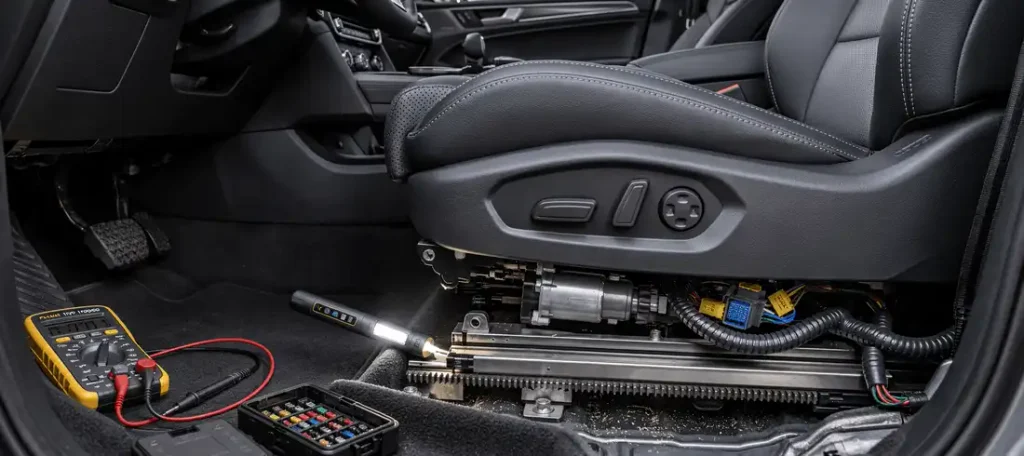
Contents
First: Is the Seat Safe to Use?
Never drive a vehicle if a stuck driver’s seat prevents you from reaching the steering wheel and pedals comfortably or sitting properly positioned for the seat belt and airbag.
Stop using the power-seat switches immediately if you notice any of these signs:
- The seat twists crookedly or moves unevenly on one side
- The track grinds, pops, or binds hard under power
- The seat moves on its own without anyone touching the switch
- A motor keeps humming after you release the control switch
- You smell burning plastic or electrical heat near the seat base
- The seat rocks or fails to stay locked securely in position
If you smell burning or see smoke coming from beneath the seat, shut the vehicle off immediately, exit the car, move away from the vehicle, and call 911 if you suspect a fire.
Power Seat Symptom Diagnostic Triage Table
Match what the seat and motors do when you briefly tap the controls to narrow down the fault area before booking a repair.
| What the Power Seat Is Doing | Most Likely Cause Group | Safe First Check |
| Completely dead in every direction (zero sound) | Blown seat fuse or circuit breaker, lost 12V feed, ground fault, or dead memory module | Test the passenger power seat if equipped, and check the manual’s fuse chart |
| Moves in one direction (or reclines) but refuses another | Worn switch contact, individual motor circuit, or directional track jam | Test each switch axis briefly while parked to log which directions work |
| Motor clicks or hums loudly, yet the seat does not move | Object wedged in track, stripped gear, or snapped drive cable | Shut the car off and shine a flashlight along both floor rails for debris |
| Seat twists crookedly (only one rail moves) | Disconnected or broken flexible drive cable on one side of the track | Stop pressing the switch immediately so you do not bend the steel rail |
| Seat crawls slowly or stops partway across the track | Binding debris in the rail, low 12V battery voltage, or thermal motor protection | Let the motor cool and inspect visible rail channels for floor mats or coins |
| Burning odor or motor keeps running after releasing switch | Stuck or damaged control switch causing continuous motor draw | Shut the car off, check for open safety recalls, and arrange immediate service |
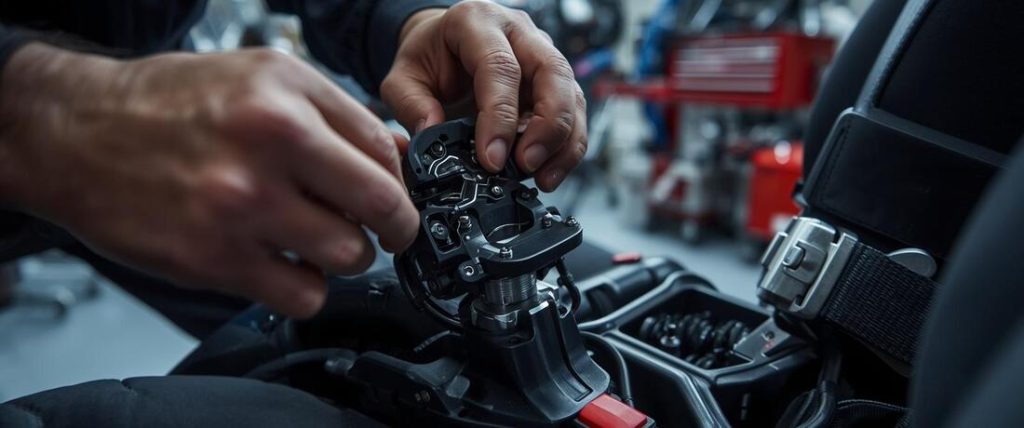
6 Common Causes of a Power Seat That Won’t Move
Modern power seats often use two to four separate motors alongside switches, tracks, and electronic modules. A technician should test power and mechanical binding before replacing expensive assemblies.
1. A Blown Seat Fuse or Tripped Circuit Breaker
If every adjustment on the seat goes completely silent at once, check the power supply first. If your vehicle has a power passenger seat that still works normally, you know the car’s main 12-volt battery is live and the issue is isolated to the driver’s seat fuse, breaker, or harness.
Check your owner’s manual to locate the exact power-seat fuse or resettable circuit breaker, and inspect it with the ignition off. For a clean walkthrough of continuity checks, review our guide on testing car fuses and relays safely with a multimeter. If a replacement fuse of the exact factory rating blows again immediately, stop—never install a higher-amperage fuse to keep the seat moving.
2. A Worn or Damaged Power-Seat Switch
Because seat switches sit right along the lower outer edge of the cushion, they take years of bumps from shoes, purses, and sliding in and out of the car. Worn internal contacts often kill just one direction—letting the seat slide forward while refusing to move backward, or letting the backrest recline while height adjustment stays dead.
Because a broken wire or jammed motor can mimic a bad switch, a technician should verify switch output against the vehicle’s wiring diagram before replacing the switch pack.
3. A Failed Motor or Thermal Overload Protection
Power seats use compact electric motors for sliding, lifting, tilting, and reclining. If you hear a steady hum with zero seat movement, the motor is receiving power while a mechanical drive part is jammed or stripped.
If a seat slows down and stops after several rapid back-and-forth adjustments, an internal thermal overload protector may have paused the motor to prevent overheating. Give it several minutes to cool rather than holding the switch down.
4. An Object Blocking the Seat Track
Pens, coins, charging cables, water bottles, or a bunched-up rear floor mat frequently wedge tightly inside the steel floor rails. Even a small metal coin jammed in a worm gear can stall a seat motor cold.
With the car parked and switched off, shine a flashlight down both sides of the seat rails from the front and rear footwells. Never put your fingers or tools inside the track while anyone touches the seat switch.
5. A Snapped Drive Cable or Stripped Track Gear
Most fore-and-aft power seats use a single electric motor connected to both left and right floor rails through two flexible drive cables. If one cable pops out of its drive socket or snaps, only one side of the seat moves while the opposite rail stays locked, twisting the seat crookedly.
Stop pressing the switch as soon as you feel the seat twist. Continuing to power one rail bends the seat frame and turns a straightforward cable repair into a full track-assembly replacement.
6. Under-Seat Wiring, Low Voltage, or Control Module Faults
Wires routed beneath a moving seat flex thousands of times over a vehicle’s life and can chafe, pinch, or get knocked loose by cargo sliding under the cushion. On vehicles with memory seats, a low-voltage event or body-module glitch can also disable movement; check for signs of a weak 12-volt battery or low system voltage if other cabin electronics are acting up at the same time.
Critical SRS Safety Warning: Under-seat wiring harnesses also carry power and sensor signals for side-impact airbags, seat-belt pretensioners, and Occupant Classification Systems (OCS). Automakers wrap these restraint circuits in bright yellow (or orange) looms and connectors. Never unplug, yank, or probe unknown under-seat connectors with a test light or multimeter, as improper testing can trigger SRS warning lights or compromise airbag deployment.

Check for Power-Seat Safety Recalls
A stuck or unresponsive power-seat switch can occasionally stem from an active safety recall rather than normal wear.
For example, NHTSA Safety Recall 26V664 (Hyundai Campaign 308 / Genesis 035G), filed October 8, 2026, covers 94,622 2015–2016 Hyundai Genesis and 2017–2020 Genesis G80 sedans equipped with non-memory front power seats. In affected vehicles, external impact against the front power-seat slider or height switch can dislodge internal components, causing the switch to stay engaged and run the motor continuously even after the driver exits, increasing fire risk.
Hyundai and NHTSA list a burning odor from the seat or an inoperative seat control switch as key warning signs, and advise affected owners to park outdoors away from buildings and other vehicles until the dealer remedy is completed (with planned notifications beginning December 6, 2026). That recall applies strictly to those covered VINs. Enter your own 17-digit VIN in the NHTSA VIN recall lookup to see whether any recall applies to your vehicle.
Safe Checks You Can Do Without Removing the Seat
Run through these quick, non-invasive checks while parked on level ground:
- Test each seat axis (forward, back, up, down, and recline) briefly to record which directions respond.
- Test the passenger power seat if equipped to see whether both seats lost power at once.
- Listen closely for a click, hum, grinding noise, or complete silence when pressing the switch.
- Shut the vehicle off and inspect both floor tracks with a flashlight for floor mats, coins, or loose bottles.
- Check the power-seat fuse with the ignition off using your exact owner’s manual fuse diagram.
- Run your VIN through the NHTSA VIN recall lookup if the switch feels jammed, loose, or warm.

When to Call a Technician
Schedule professional diagnosis if the seat stays completely dead after checking the fuse, if only one rail moves, if the seat cannot be locked into a safe driving position, or if you smell electrical heat. A qualified technician can safely depower the SRS system, unbolt the seat frame if needed, and test switch outputs, motor voltage, and track drive cables using your vehicle’s factory wiring diagram.
FAQs About Power Seat Won’t Move ?
Why does my power seat move in one direction but not the other?
When a seat slides forward yet refuses to move backward (or reclines while refusing to slide), the fault usually sits inside a worn directional switch contact, one leg of the motor circuit, or a one-way mechanical jam in the rail. Testing switch output confirms whether the switch or motor needs replacement.
Why does my power seat click or hum without moving?
A click or hum means electrical power is reaching the relay or motor while the seat cannot physically travel. Common causes include a coin or object wedged in the track, a stripped plastic gearbox gear, or a snapped flexible drive cable. Stop holding the switch so the motor does not overheat.
Can I manually move a stuck power seat?
Most modern power seats lock tightly on worm-gear tracks and cannot be pushed by hand. A few vehicles include a specific dealer service override, while forcing a jammed track by hand risks bending the rails or breaking mounts. Check your owner’s manual or let a shop release the track safely.
Is it safe to drive with a stuck power seat?
Only if the seat is locked solidly on its rails and positioned so you can reach the pedals, steer cleanly, and sit at a safe distance from the steering-wheel airbag. Never drive if the seat rocks loosely, is stuck too close or too far from the pedals, or smells like burning electrical plastic.
Can a power-seat problem affect my airbags?
A failed seat-adjustment switch or motor does not automatically disable your airbags, yet side-airbag and occupant-sensor harnesses run right underneath the seat cushion. Never unplug or test bright yellow under-seat SRS connectors yourself, as disturbing them can trigger an airbag warning light and disable crash protection.
Test each direction briefly, compare the passenger seat if equipped, check the floor rails with a flashlight, and verify the seat fuse against your owner’s manual before booking shop time. Keeping away from yellow SRS airbag wiring and stopping immediately if a rail twists or smells hot keeps a simple switch or track fix safe and affordable. For more circuit-testing walkthroughs, browse our automotive electrical troubleshooting guides and car problem and symptom troubleshooting guides.