
This article was updated in November 28, 2026 with new products and information by Mark S. Taylor
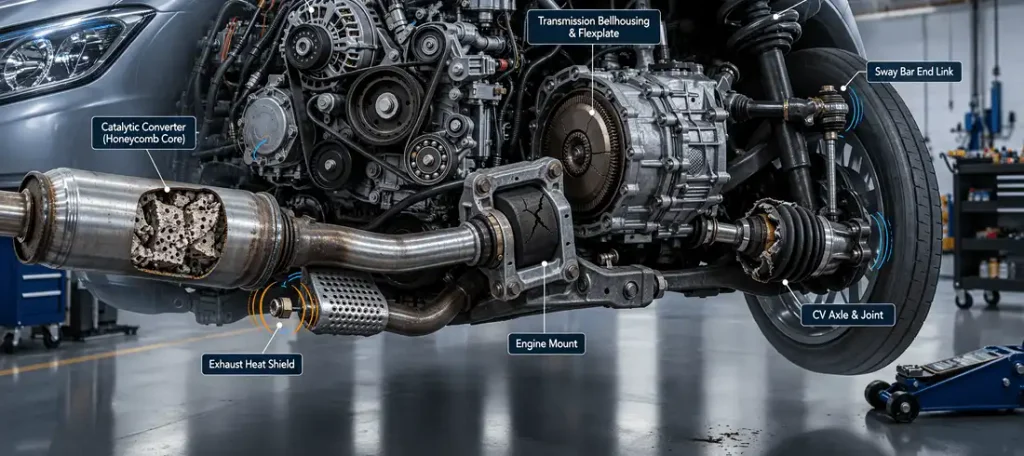
When a car makes a rattling noise when accelerating, the most common causes are a loose exhaust heat shield, a dangling underbody panel, a worn mount or hanger, internal catalytic converter breakup, or engine knock. Pull over immediately if you hear a deep knock, see warning lights, or smell cabin exhaust.
Pressing the gas pedal puts sudden torque and heat through your engine, mounts, and exhaust system. Sometimes that extra load triggers a harmless tinny buzz from a rusted clamp, and other times it exposes an internal engine knock that can wreck bearings in minutes.
Sound travels easily through a steel floor pan, so noise alone never proves which part failed. Paying attention to whether the rattle follows engine RPM, road speed, or uphill load lets you describe the issue clearly to a technician and know when to park the car immediately.
Contents
- 1 First: When Should You Stop Driving?
- 2 Acceleration Rattle Diagnostic Triage Table
- 3 7 Common Causes of a Rattling Noise When Accelerating
- 3.1 1. A Loose Exhaust Heat Shield or Bracket
- 3.2 2. A Loose Underbody Splash Shield or Skid Plate
- 3.3 3. A Broken Exhaust Hanger or Pipe Contact
- 3.4 4. Internal Catalytic Converter or Muffler Breakup
- 3.5 5. Worn Engine or Transmission Mounts
- 3.6 6. Engine Knock or Abnormal Combustion (Spark Knock)
- 3.7 7. Accessory Pulleys, Timing Components, or Low Oil Pressure
- 4 Safe Checks You Can Do Before Visiting a Shop
- 5 When Should You Tow the Vehicle Instead of Driving?
- 6 FAQs About Rattling Noise When Accelerating?
- 6.1 Is a rattling noise when accelerating always a bad catalytic converter?
- 6.2 Why does my car rattle only at one specific RPM?
- 6.3 Can a loose heat shield cause a rattling noise when accelerating?
- 6.4 Is a metallic rattling sound under acceleration dangerous to drive with?
- 6.5 Can low engine oil cause a rattling noise when I press the gas?
First: When Should You Stop Driving?
A faint metallic buzz that only appears briefly at one speed is rarely a roadside emergency, yet some acceleration noises signal active mechanical damage or a safety hazard.
Pull over safely and shut the engine off right away if the rattle comes with any of these signs:
- A heavy, deep knocking sound that grows louder as you press the gas
- A red oil-pressure warning light, flashing Check Engine Light, or rising temperature gauge
- Smoke, a burning smell, or exhaust odor inside the cabin
- Sudden loss of power, heavy shaking, or rough running
- A plastic splash shield or exhaust pipe visibly hanging or scraping the pavement
- A loud rattle that started immediately after hitting a pothole, curb, or road debris
Never crawl underneath a vehicle at the roadside to look for a rattle. Exhaust pipes stay hot enough to cause severe burns long after shutdown, and a roadside jack never supports a car safely for underbody inspection.
Acceleration Rattle Diagnostic Triage Table
Match the sound and driving condition below to narrow down where a technician should inspect first.
| Sound or Driving Pattern | Most Likely Cause Group | What the Clue Suggests |
| Thin, tinny metallic buzz at one narrow RPM band (often 1,800–2,500 RPM) | Loose exhaust heat shield, rusted clamp, or bracket | Engine vibration is hitting the shield’s natural resonant frequency |
| Plastic flapping or scraping over bumps and at highway speed | Loose underbody splash shield, skid plate, or missing fastener | Airflow and suspension travel are moving an unsecured cover |
| Clunk or rattle right when tipping into or lifting off the throttle | Worn engine or transmission mount, or broken exhaust hanger | Powertrain torque is rocking an exhaust pipe against the frame |
| Hollow, rocks-in-a-can rattle near the center underbody | Broken internal catalytic converter substrate or loose muffler baffle | Internal exhaust breakup is possible, though external shields sound similar |
| Sharp metallic pinging (“marbles in a can”) climbing hills or under heavy throttle | Abnormal combustion (spark knock or detonation) | Fuel octane, timing, carbon buildup, or engine heat needs diagnosis |
| Deep, heavy metallic knock paired with warning lights or power loss | Low oil pressure, rod bearing wear, or severe internal engine fault | Shut the engine off immediately and arrange a tow |
7 Common Causes of a Rattling Noise When Accelerating
These seven fault areas cover most acceleration rattles. Because unrelated components can sound identical from the driver’s seat, confirm the source on a lift or scan tool before buying parts.
1. A Loose Exhaust Heat Shield or Bracket
Thin stamped-aluminum heat shields sit between your hot exhaust pipes and the floor pan or fuel tank. Over winters of road salt, the small steel clips and washers holding those shields rust away, leaving the metal free to buzz loudly at one specific engine RPM while staying quiet at idle and highway speed.
Automakers regularly see model-specific shield and vibration complaints. For example, GM bulletin PIT5926A documents loose or missing heat-shield retainer clips causing under-vehicle rattles on specified 2021–2023 vehicles, while Honda TSB 19-021 (NHTSA MC-10160591) addresses a metallic buzz on certain 2016–2018 HR-V AWD models caused by drivetrain vibration that required a software update rather than new hardware. Those bulletins apply strictly to the listed models, showing why a proper inspection beats guessing.
2. A Loose Underbody Splash Shield or Skid Plate
Modern cars use large plastic or fiber aerodynamic panels beneath the engine and floor to shield wiring and improve fuel economy. Missing push-clips after an oil change, deep snowbanks, or road debris can leave one corner hanging loose so it flutters and rattles as speed climbs.
Similarly, Ford/Lincoln TSB 21-2322 documents underbody shield rattle and flutter on select Edge, MKX, and Nautilus models tied to specific fastener conditions. If you see a panel dragging near a tire or scraping the ground after parking, stop driving so it does not tear loose at highway speed.
3. A Broken Exhaust Hanger or Pipe Contact
Rubber hangers suspend the exhaust system so it can flex slightly as the engine rocks under acceleration. When a rubber hanger tears or a pipe bracket rusts through, the exhaust can swing sideways and tap against the heat shield, rear axle, or floor pan whenever you press the gas or hit bumps.
If a loose exhaust joint also produces a louder roar or lets fumes into the passenger compartment, stop driving and review what to do immediately if exhaust fumes enter the cabin.
4. Internal Catalytic Converter or Muffler Breakup
Inside your catalytic converter sits a fragile honeycomb ceramic core. Severe misfires, overheating, or an underbody impact can crack that ceramic brick loose so it tumbles inside the steel shell, creating a hollow, metallic rattle under throttle.
Never replace an expensive catalytic converter based on noise alone—or even on a single P0420 efficiency code—without confirming the exterior heat shields are tight and checking engine fuel trim. If the rattle pairs with a harsh sulfur smell, read our guide on diagnosing sulfur or rotten-egg exhaust odors alongside converter rattles. Never tap a hot converter with a tool to test it at home.
5. Worn Engine or Transmission Mounts
Hydraulic and rubber mounts anchor the engine and transmission to the chassis. When a mount cracks or collapses, the entire powertrain rocks farther than normal during hard acceleration, shifting, or hill climbs, pushing nearby exhaust flanges or brackets into contact with the body.
Never try to check mounts by having someone stand next to the hood while you shift between Drive and Reverse. A technician can inspect mount deflection safely using proper wheel chocks and lift procedures.
6. Engine Knock or Abnormal Combustion (Spark Knock)
A sharp, rapid metallic rattle or pinging sound—often described as marbles shaking inside a tin can—that appears only when accelerating uphill or merging onto a highway often points to abnormal combustion (detonation). Carbon deposits, overheating, a failing EGR system, or using lower-octane fuel than the engine requires can all trigger spark knock under load.
Start by checking whether your engine requires regular or premium octane fuel in your owner’s manual or inside the fuel door. Do not rely on bottled octane boosters or blindly replace a knock sensor to mask persistent pinging, as ongoing detonation can crack pistons.
7. Accessory Pulleys, Timing Components, or Low Oil Pressure
Some rattles follow engine RPM even when the car sits parked in Neutral. Worn serpentine belt tensioners, dry alternator or idler pulley bearings, stretched timing chains, or low engine oil levels can all rattle as engine speed rises.
Never lean over moving belts, cooling fans, or pulleys with the hood open while the engine runs. If a metallic rattle starts right after an oil change or pairs with low oil on the dipstick, shut the engine off immediately to prevent internal bearing damage.

Safe Checks You Can Do Before Visiting a Shop
Park on level ground, turn the engine off, and let the vehicle cool completely before checking anything.
- Check the engine oil level. Pull the dipstick once the engine is off and cool to confirm oil sits safely inside the operating range. Do not drive the car if the dipstick is dry.
- Note the exact trigger pattern. Write down whether the rattle happens only while moving under load, over bumps, or right at a specific RPM band.
- Walk around the car for hanging panels. Look from a standing or crouched distance without crawling underneath to see if a splash shield, mud flap, or exhaust hanger is hanging low.
- Record recent fuel or service changes. Note whether the noise started right after an oil change, a tank of fuel, or hitting road debris.
- Check dashboard warnings. Write down any Check Engine Light, oil warning, or temperature-gauge movement.
- Run a VIN recall check. Enter your 17-digit VIN in the NHTSA VIN recall lookup to see whether an open safety recall covers underbody shields, exhaust components, or engine hardware.
When Should You Tow the Vehicle Instead of Driving?
Call a tow truck instead of driving to the repair shop if the rattle is a deep metallic knock, if the oil-pressure or overheating warning lights turn on, if you smell exhaust or burning inside the cabin, if the engine loses power or shakes violently, or if an exhaust pipe or underbody panel is dragging on the road.
FAQs About Rattling Noise When Accelerating?
Is a rattling noise when accelerating always a bad catalytic converter?
No. Rusted exhaust heat shields, broken hangers, loose underbody splash panels, worn mounts, and engine spark knock all produce rattling sounds under acceleration. A shop must inspect the underbody on a lift before condemning a catalytic converter.
Why does my car rattle only at one specific RPM?
A loose exhaust heat shield or clamp vibrates most loudly when engine vibration matches the metal’s natural resonant frequency, often between 1,800 and 2,500 RPM. Above or below that narrow speed band, the metal often goes completely quiet.
Can a loose heat shield cause a rattling noise when accelerating?
Yes. Exhaust heat shields are one of the most common sources of thin, metallic buzzing during acceleration because road salt corrodes their small retaining clips over time. Have a shop inspect the shield on a lift to confirm it is not resting against a hot exhaust pipe or moving shaft.
Is a metallic rattling sound under acceleration dangerous to drive with?
It depends on the cause and companion symptoms. A light heat-shield buzz is usually less urgent than a deep engine knock, low oil level, smoke, cabin exhaust odor, or a hanging underbody panel. Stop driving immediately whenever warning lights, power loss, or heavy knocking appear.
Can low engine oil cause a rattling noise when I press the gas?
Yes. Low oil levels starve hydraulic timing-chain tensioners, lifters, and bearings of oil pressure, causing an audible metallic rattle or knock that worsens under acceleration. Check your dipstick on level ground with the engine off and cool before driving further.
Check your engine oil level cold, note whether the rattle ties to a narrow RPM band, uphill load, or bumps, and look from a safe distance for hanging panels before booking a shop visit. Sharing those exact clues lets a technician isolate a $10 heat-shield clamp from a serious engine knock without guessing at expensive parts. For more diagnostic walkthroughs, explore our engine and exhaust troubleshooting guides and car problem and symptom troubleshooting guides.