
This article was updated in July 29, 2026 with new products and information by Mark S. Taylor
Yes, your electric car has coolant, and yes, it eventually needs service — even though nobody mentioned it when you signed the papers. There’s no single interval that fits every EV: some makers call for a coolant service around every 4 to 5 years, others stretch it past 100,000 miles, and a few say wait a decade. Your owner’s manual is the only real authority. Expect to pay roughly $290 to $600 at most shops, more on some imports.
Here’s what the coolant loop does, when to service it, what it should cost, and why this is one job you shouldn’t try to knock out in the driveway.
Contents
- 1 What the EV Coolant Loop Actually Does
- 2 EV Coolant Is Not Engine Antifreeze
- 3 How Often to Service the Coolant Loop
- 4 What EV Coolant Maintenance Costs
- 5 Warning Signs Your EV Cooling System Needs Attention
- 6 Can You Do It Yourself?
- 7 How to Protect Your Battery Warranty
- 8 FAQs About EV Coolant Loop Maintenance Guide
- 9 Bottom Line
What the EV Coolant Loop Actually Does
Your EV’s battery is happiest in a narrow temperature band — think of it as room temperature, not too hot, not too cold. Push it outside that range and you lose range, lose fast-charging speed, and shorten the pack’s life. The coolant loop is what keeps it in the sweet spot.
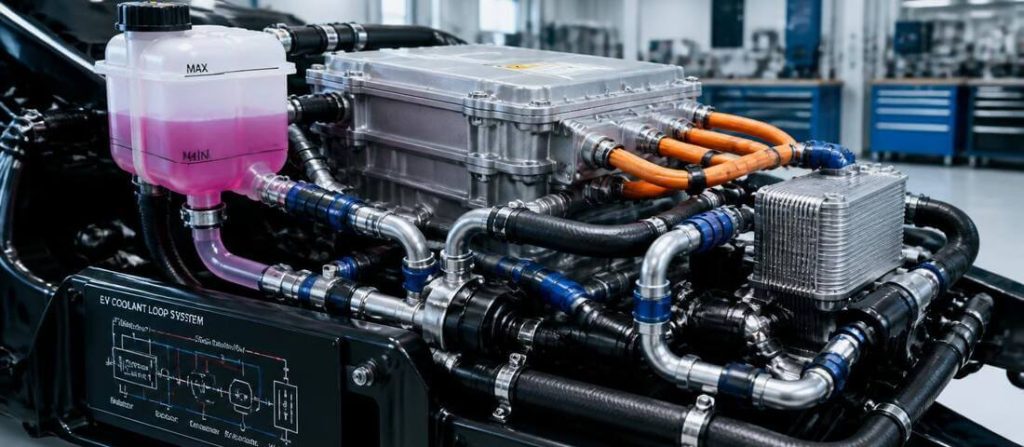
In a modern liquid-cooled EV, coolant flows through thin cold plates that sit against the battery modules. A pump pushes that fluid through the pack, where it soaks up heat, then out to a radiator or heat exchanger that dumps the heat into the air. When you’re fast-charging or flogging the car on a hot day, a chiller tied into the air-conditioning system steps in for extra cooling.
The clever part: the same loop works in reverse. In the cold, many EVs warm the coolant — with an electric heater or a heat pump — to bring the battery up to temperature so it charges and performs properly. It’s not just a cooling system; it’s a full thermal management system.
Not every EV uses liquid. Some older or budget models (the early Nissan Leaf, for example) cool the pack with air and fans instead. Those have less to maintain but also less precise temperature control. Most EVs sold today use a sealed liquid loop, and some split it into multiple loops — one for the battery, one for the power electronics and motor, one for the cabin. A Chevy Bolt, for instance, has three.
EV Coolant Is Not Engine Antifreeze
This is the mistake that gets expensive. The fluid in an EV battery loop is a specially formulated low-conductivity (dielectric) coolant, or a specific glycol blend the manufacturer calls out by part number. It’s designed so that if a tiny leak ever reaches a live battery component, it won’t conduct electricity and cause a short.
Standard engine antifreeze is the opposite — it conducts. Pour the wrong coolant into an EV battery circuit and you’re risking a genuine safety hazard, not just a maintenance slip. On top of that, using anything other than the specified fluid can void your battery warranty, which is the most valuable coverage on the whole car.
The rule is simple: use only the exact coolant your manufacturer specifies, and never mix types or colors. If a shop shrugs when you ask which fluid they’re using, that’s your cue to find one that knows EVs.
How Often to Service the Coolant Loop
There’s no universal number, and that’s exactly why owners get confused. The interval depends entirely on the make, the coolant chemistry, and the cooling design. Always defer to your manual, but here’s how real EVs compare:
| Vehicle / type | Typical coolant service guidance |
|---|---|
| Chevy Bolt | Around every 5 years (all loops) |
| Ford Mustang Mach-E | Roughly 100,000–200,000 miles |
| Kia Niro EV (newer) | Up to 10 years per the manual |
| Many EVs (general) | First check at 1–2 years, then every 4–5 years |
| Air-cooled hybrids | No coolant; inspect the cooling filter ~every 30,000 miles |
A few patterns hold across brands. The first inspection often comes earlier than the repeat interval. Hard use — frequent DC fast charging, towing, extreme climates — can shorten the interval. And “lifetime” or very long intervals still assume the system is sealed and never opened; if the pack or a component is replaced, that loop usually gets fresh fluid.
What EV Coolant Maintenance Costs
This is where quotes swing wildly, and now you’ll know why.
| Job | Typical cost |
|---|---|
| Single-loop flush and refill | $150–$300 |
| Full service (all loops) + air purge | $290–$600 |
| Import/luxury (special fluid, dealer-only) | $700–$1,500 |
| Specified coolant, per jug/liter | $65–$85 |
A basic Bolt owner reported all three loops done in about two hours for roughly $290. Meanwhile, some Kia and Hyundai owners have seen quotes near $1,000 to $1,500 — partly because the specified fluid is pricey and partly because some dealers, unfamiliar with EVs, misquote the job entirely.
Three things drive the price: how many loops your car has, whether the shop performs a proper air-purge/bleed afterward, and how expensive your manufacturer’s specified coolant is. If a quote looks sky-high, it’s worth calling an EV-experienced independent specialist for a second opinion.

Warning Signs Your EV Cooling System Needs Attention
A sealed loop shouldn’t need attention between services — but if something’s wrong, these are the tells:
Unexplained range loss with no change in driving or weather.
Slower DC fast-charging than the car used to accept, since the system throttles charge speed to protect a pack it can’t cool.
More frequent thermal warnings on the dash.
Reduced power or “derating” — the car pulling back performance to protect the battery.
A sweet coolant smell or visible coolant near the battery enclosure or under the car.
If you spot a puddle or the car suddenly limits power on a hot day, don’t wait for the next service interval — get it checked. A low or leaking loop can let the pack overheat, and heat is what permanently ages battery cells.
Can You Do It Yourself?
For most owners, this is a no. It’s not that draining the old fluid is hard — it’s everything around it.
First, the pack lives in a high-voltage system. Those thick orange cables carry enough voltage to kill you, and dangerous residual charge can linger even after shutdown. Second, refilling isn’t just “pour and go.” Air pockets trapped in the loop create hot spots, so the system needs a proper bleed or air-purge, often using a manufacturer scan tool to run the pumps and clear the air. Skip that step and you can cook the very battery you were trying to protect.
If you’re determined and experienced, at most you might:
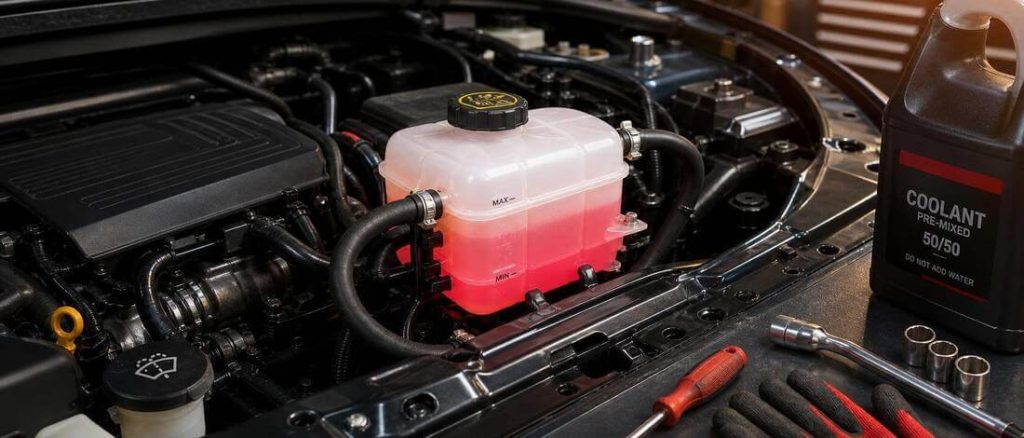
Check coolant reservoir levels against the min/max marks (where the manual allows).
Inspect for leaks, weeping hoses, or residue near the pack.
Keep radiator intakes clear of leaves and debris.
Everything past that — the drain, the specified refill, the air purge — belongs with a dealer or an EV-savvy independent shop.

How to Protect Your Battery Warranty
The coolant loop and your warranty are tied together, so treat both with care:
Use only the manufacturer-specified coolant — exact part number, no substitutes, no mixing.
Follow the manual’s interval, not a generic “every 30,000 miles” rule meant for gas cars.
Keep every service record, including the fluid used, in case you ever need to make a battery claim.
Use EV-trained technicians who perform the air-purge correctly.
Address leaks and thermal warnings immediately, since neglect that leads to overheating can jeopardize coverage.
FAQs About EV Coolant Loop Maintenance Guide
How often does EV coolant need to be changed?
It depends on the model. Some makers recommend service around every 4 to 5 years, others every 100,000 to 200,000 miles, and a few (like newer Kia EVs) up to 10 years. Your owner’s manual is the only reliable source — intervals vary too much to generalize.
How much does an EV coolant flush cost?
Usually $150 to $300 for a single loop and $290 to $600 for a full multi-loop service with an air purge. Some imports with pricey specified fluid or dealer-only service can run $700 to $1,500.
Is EV coolant the same as regular antifreeze?
No. EV battery loops use a low-conductivity (dielectric) or specific glycol coolant designed not to conduct electricity if it leaks onto live components. Standard engine antifreeze conducts and can create a safety hazard, plus using it can void your battery warranty.
Can I change EV coolant myself?
For most people, no. The high-voltage system is dangerous, and refilling requires an air-purge/bleed — often with a manufacturer scan tool — to avoid hot spots. You can safely check fluid levels and look for leaks, but leave the flush and refill to trained technicians.
What are the signs of a failing EV cooling system?
Unexplained range loss, slower fast-charging, more frequent thermal warnings, reduced power (derating), a sweet coolant smell, or visible coolant near the battery.
Does the coolant loop also heat the battery?
Yes. In cold weather many EVs warm the coolant with an electric heater or heat pump to bring the battery to its ideal temperature, which is why it’s called a thermal management system rather than just a cooling system.
Bottom Line
Your EV’s coolant loop is quiet, sealed, and low-maintenance — but it’s not no-maintenance. It keeps your battery in the temperature range that protects range, charging speed, and lifespan, so it’s worth respecting. Check your manual for the real interval, budget somewhere in the $290 to $600 range for most cars, insist on the exact specified fluid, and let an EV-trained shop handle the flush and air-purge. Do that, and the most expensive part of your car stays healthy for the long haul.