
This article was updated in August 14, 2026 with new products and information by Mark S. Taylor
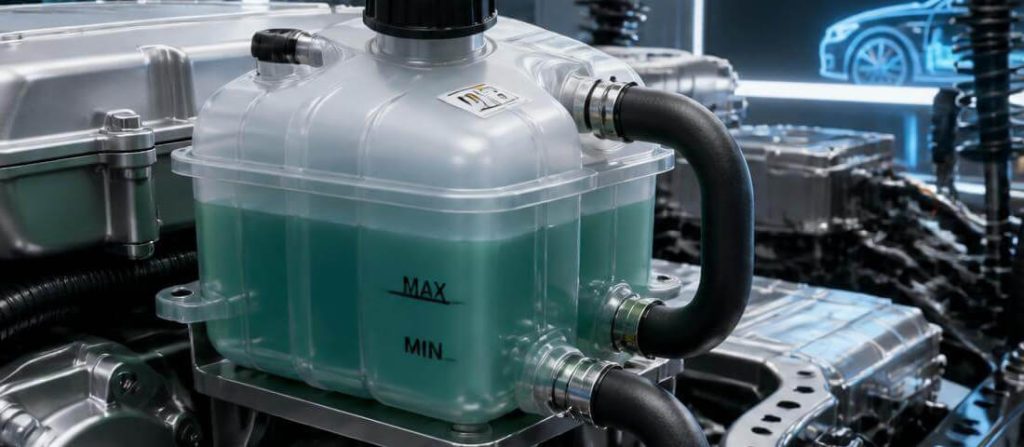
You popped the hood on your hybrid and saw something unexpected — two coolant reservoirs. One says “engine coolant.” The other says “inverter coolant” or “power control unit.” Now you’re standing in your driveway wondering if you need two different coolants, whether regular antifreeze will work, and if that dealer quote for an “inverter service” is legitimate or a money grab.
Your hybrid has two separate cooling systems, and they do not use the same coolant. The engine system is identical to a gas car. The inverter and battery system uses a special low-conductivity coolant that won’t conduct electricity around high-voltage components. Use the wrong fluid in either one, and you’re looking at corrosion, overheating, or a voided warranty.
In this guide, I’ll show you which reservoir is which, what coolant color goes where, what service actually costs, how often you need it, and what you can safely do yourself. I’ve serviced hybrid cooling systems since the first Prius landed in my bay. The confusion is understandable — the systems are more complex than most owners realize.
Contents
- 1 Why Hybrids Have Two Cooling Systems
- 2 Engine Coolant vs. Inverter Coolant: What’s the Difference?
- 3 What Type of Coolant Does Your Hybrid Need?
- 4 How Often to Change Hybrid Coolant
- 5 What Hybrid Coolant Service Costs
- 6 Can You Check or Top Off Hybrid Coolant Yourself?
- 7 What Happens If You Use the Wrong Coolant?
- 8 FAQs About Coolant for Hybrid Cars
- 9 Bottom Line
Why Hybrids Have Two Cooling Systems
A hybrid is not just a gas car with a battery bolted to it. It’s two powertrains sharing one chassis, and each generates heat differently.
The engine cooling system works exactly like a conventional car. A water pump circulates coolant through the engine block, radiator, and heater core. It handles combustion heat — the same 180–220°F temperatures any gas engine produces. This system uses a mechanical water pump driven by a belt or chain.
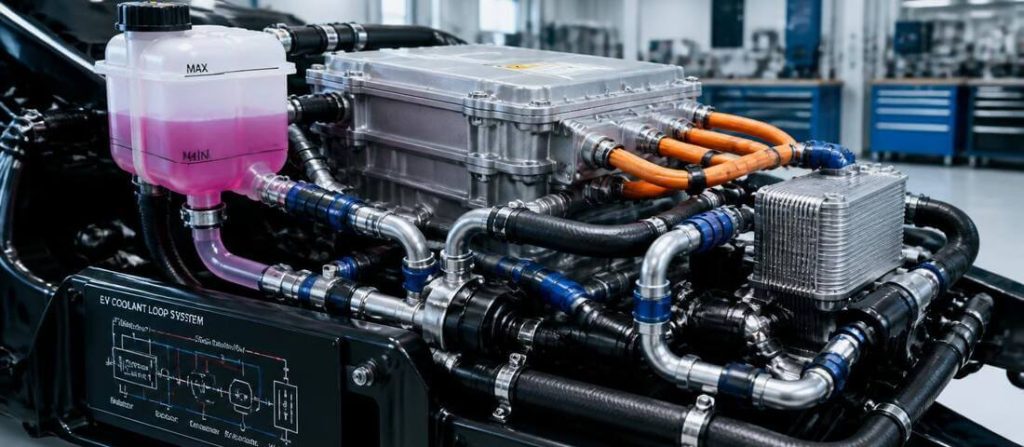
The inverter/battery cooling system is entirely separate. It uses electric pumps — not mechanical — to circulate coolant through the inverter, the power control unit, and in many designs, the battery pack itself. This system runs at lower temperatures and lower pressure than the engine loop. Its job is to keep electronics and battery cells in their happy zone — typically 68–95°F — not to manage combustion heat.
Because this second system touches components carrying 200 to 800 volts, the coolant must be electrically non-conductive. Regular antifreeze contains ionized additives that can carry current. Around a high-voltage battery, that’s a short circuit waiting to happen.
The two systems never mix. They have separate reservoirs, separate pumps, separate radiators, and separate fill points. What goes in one does not go in the other.
Engine Coolant vs. Inverter Coolant: What’s the Difference?
Here’s the side-by-side comparison I wish every hybrid owner had taped to their glove box.
| Feature | Engine Coolant | Inverter / Battery Coolant |
|---|---|---|
| Job | Cools combustion engine | Cools inverter, battery, power electronics |
| System pressure | 13–16 PSI (pressurized cap) | 5–10 PSI (lower pressure) |
| Pump type | Mechanical (belt-driven) | Electric (battery-driven) |
| Temperature range | 180–220°F | 100–140°F typical |
| Conductivity requirement | Standard (conductive is fine) | Must be low/non-conductive |
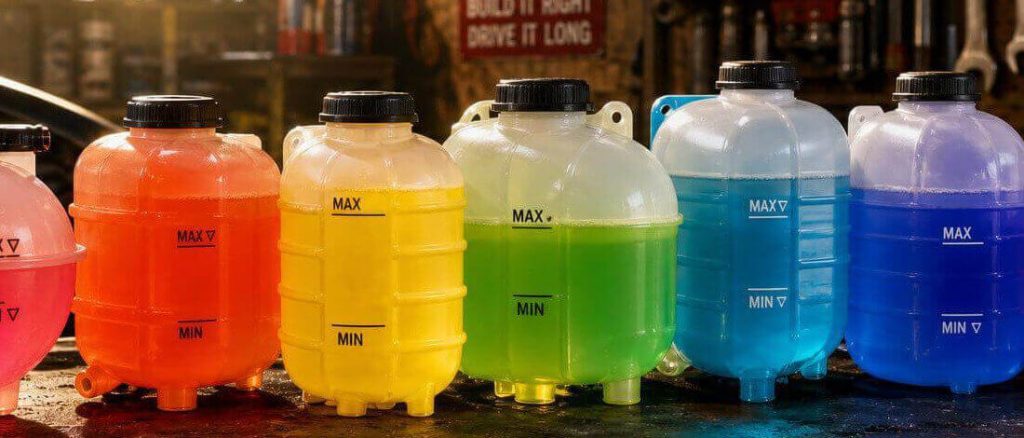
| Typical color | Green, orange, pink, blue (varies by OEM) | Pink, blue, blue-green (varies by OEM) |
| Service interval | 50,000–100,000 miles | 100,000–150,000 miles (first change) |
| Average flush cost | $131–$209 | $179–$341 |
The critical difference is conductivity. Engine coolant is designed to prevent corrosion and manage heat. It can be conductive — in fact, many corrosion inhibitors are ionic by nature. Inverter coolant must do the same heat management job while keeping electrical conductivity near zero. That requires a different additive package and often a purer base fluid.
If you pour regular green antifreeze into the inverter reservoir, it won’t cause an immediate fire. But over months, the ionic additives increase conductivity. Stray current starts flowing through the cooling loop. That causes electrolytic corrosion in the battery pack and inverter — damage you can’t see until it’s expensive.
What Type of Coolant Does Your Hybrid Need?
Coolant color is not universal. What Toyota calls “pink” is not the same as what Hyundai calls “pink.” Here’s what the major manufacturers actually use.
Toyota / Lexus
- Engine and inverter (newer models): Toyota Super Long Life Coolant (SLLC) — pink
- Inverter (older models): Same pink SLLC in both reservoirs
- Note: On most Toyota hybrids from 2010 onward, the same pink coolant services both systems. The reservoirs are separate, but the fluid spec is identical. Do not mix with older red Toyota coolant.
Honda / Acura
- Engine coolant: Honda Type 2 (blue) or Pro Honda HP Coolant
- Inverter/battery coolant: Honda specific low-conductivity coolant — typically blue on older hybrids, may match engine coolant color on newer models
- Note: Always verify in the owner’s manual. Honda’s inverter systems are sensitive to conductivity.
Hyundai / Kia
- Engine coolant (newer models): Pink phosphate-based ethylene glycol
- Inverter coolant (older models, e.g., 2021–2022 Tucson/Santa Fe Hybrid): Blue low-conductivity coolant — not the same as engine coolant
- Inverter coolant (newer models): Pink, but still a different spec from engine coolant
- Critical note: Hyundai’s blue inverter coolant is specifically low-conductivity for the high-voltage loop. A dealer TSB confirmed that blue coolant crystallizes over time, causing false “refill inverter coolant” warnings. If you have an older Hyundai hybrid with blue inverter coolant, monitor it closely.
Ford
- Engine coolant: Motorcraft Orange or Yellow (depending on year)
- Inverter coolant: Ford-specific low-conductivity coolant — often green or yellow
- Note: Ford hybrid cooling systems are complex. The Fusion and Escape hybrids have separate inverter loops with their own fill points.
Tesla / Rivian (for reference)
- Battery/motor coolant: G48 specification — blue-green color
- Note: Tesla recommends replacement every 4 years regardless of mileage. G48 is an ethylene glycol-based coolant with hybrid organic acid technology and low conductivity.
Aftermarket Options
- Peak Hybrid-EV Coolant: Formulated for electric and hybrid vehicles, matches OEM color requirements
- Zerex Hybrid Vehicle Coolant: Silicate-free, low-conductivity formulation
- Valvoline Hybrid Range: Includes low-conductivity options for Asian and European hybrids
My rule: If your car is under warranty, use OEM coolant. If it’s out of warranty, an aftermarket fluid that meets the OEM spec (not just the color) is fine. The spec matters more than the brand.
How Often to Change Hybrid Coolant
Service intervals for hybrid coolant are all over the map. One manufacturer says 150,000 miles. Another says 37,500. Here’s what the major brands actually specify — and what dealers often try to sell you.
| Manufacturer | System | First Change | Subsequent Changes | Inspection Interval |
|---|---|---|---|---|
| Toyota | Engine | 100,000 miles / 10 years | Every 50,000 miles / 5 years | Every 30,000 miles |
| Toyota | Inverter | 150,000 miles / 15 years | Every 50,000 miles / 5 years | Every 30,000 miles |
| Honda | Engine | 60,000–100,000 miles | Every 30,000–50,000 miles | Every 15,000 miles |
| Honda | Inverter | 60,000–100,000 miles | Every 30,000–50,000 miles | Check owner’s manual |
| Hyundai/Kia | Engine | 60,000 miles / 5 years | Every 30,000 miles / 3 years | Every 15,000 miles |
| Hyundai/Kia | Inverter (older blue) | 24,000–37,500 miles | Every 24,000–40,000 miles | Annually |
| Hyundai/Kia | Inverter (newer pink) | 80,000–120,000 miles | Every 40,000–50,000 miles | Every 15,000 miles |
| Ford | Engine | 100,000 miles | Every 50,000 miles | Every 15,000 miles |
| Ford | Inverter | 100,000 miles | Every 50,000 miles | Every 15,000 miles |
| Tesla | Battery/motor | 4 years (regardless of miles) | Every 4 years | Annual service |
The dealer upsell warning: I’ve seen Toyota dealers push “inverter coolant service” at 60,000 miles — a full 90,000 miles before the manufacturer requires it. On a 2017 RAV4 Hybrid, the owner’s manual specifies the first inverter coolant change at 150,000 miles. If your dealer is recommending earlier service, ask to see the test results. A refractometer reading or test strip showing failed additive package is the only legitimate reason to change early.
“Lifetime coolant” is a marketing term. It means “lifetime of the powertrain warranty,” not “lifetime of the car.” At 150,000 miles, the additive package is depleted regardless of what the brochure said.
What Hybrid Coolant Service Costs
Here’s what you’ll actually pay — and why quotes vary so wildly.
| Service | Independent Shop | Dealership | DIY (Top-Off Only) |
|---|---|---|---|
| Engine coolant flush | $131–$209 | $200–$350 | $30–$60 (fluid only) |
| Inverter coolant flush | $179–$341 | $300–$650 | Not recommended |
| Coolant reservoir replacement | $350–$500 | $500–$700 | $80–$200 (part only) |
| Inverter coolant pump replacement | $400–$700 | $600–$1,000 | Not recommended |
| Coolant inspection / level check | $0–$30 | $0–$50 | Free |
Why the huge range on inverter service? The procedure is more complex than a standard radiator flush. It requires:
- A scan tool to activate the electric water pump and cycle the valves
- A vacuum-filling tool to remove air from the system
- Specialized knowledge of the bleed procedure for that specific model
One Kia Niro EV owner was quoted $1,100 at a dealer who admitted they’d never serviced an EV before. Another dealer quoted $250 for the same job. A third charged $291 after initially quoting $240 for “gas vehicles.” Shop around — and ask if the technician has done this specific procedure before.
For Toyota hybrids, the inverter coolant flush is often simpler because the system shares the same fluid spec as the engine. Some independent shops can do both loops for $300–$400 total.

Can You Check or Top Off Hybrid Coolant Yourself?
You can do some of this safely. You cannot do all of it. Here’s the line.
What you CAN do:
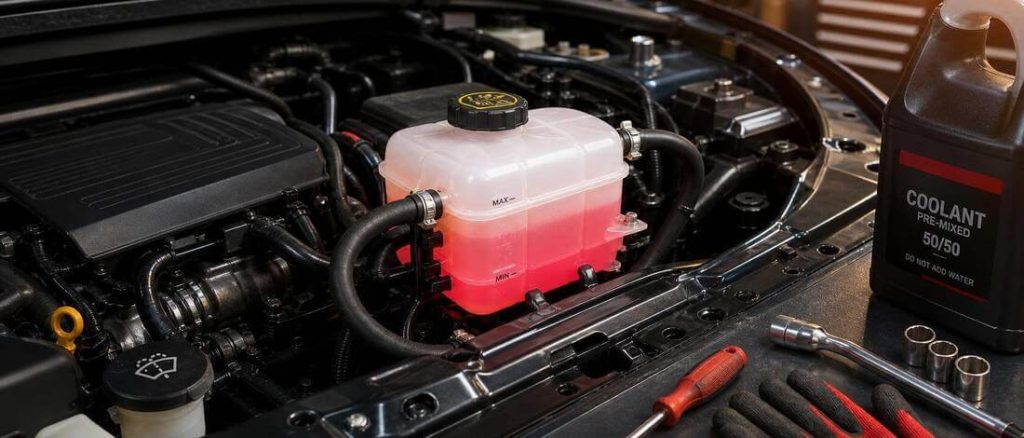
1. Check the reservoir levels. With the car cold and powered off, locate both reservoirs. Most have MIN and MAX markings. The level should sit between them. If the inverter reservoir is opaque (common on Toyota and Honda), you may need a flashlight to see the fluid.
2. Top off with the correct fluid. If the level is below MIN, add the manufacturer-specified coolant to the MAX line. Use a funnel. Do not overfill. Do not mix colors. If you’re unsure of the exact spec, buy OEM fluid from the dealer parts counter — it’s usually $20–$40 per gallon.
3. Inspect for leaks. Look under the car for puddles. Check hose connections for wetness or residue. A coolant leak on the inverter side often leaves a sweet smell but little visible fluid because the system is low-pressure.
What you CANNOT safely do:
Flush and bleed the inverter system. This requires a scan tool to command the electric water pump and open the valves. It requires a vacuum-filling tool to pull air out before introducing new fluid. Air pockets in the battery cooling loop create hot spots that can damage cells — and you won’t know until the battery degrades prematurely.
Pressure-test the inverter system. Some hybrid inverter loops have maximum pressures as low as 5–10 PSI. A standard radiator pressure tester set to 15 PSI can damage the battery pack.
My advice: Check your own levels. Top off with the right fluid. Leave the flush to a shop that has the scan tool and has done the procedure before.

What Happens If You Use the Wrong Coolant?
Three things can go wrong, and none of them are immediate — which makes them more dangerous.
1. Increased electrical conductivity. Regular coolant contains ionic additives (phosphates, silicates, borates) that conduct electricity. In the inverter loop, this creates stray current paths. Over months, electrolytic corrosion attacks the battery pack casing, the inverter heat sink, and the electric water pump. You won’t see it until a code throws or the battery fails.
2. Corrosion from incompatible chemistry. Mixing an OAT coolant with a silicated coolant creates gel and sludge. In a low-flow inverter system with narrow passages, that sludge blocks heat transfer. The inverter overheats. The car derates power or shuts down.
3. Crystallization. Hyundai’s blue inverter coolant has a known tendency to crystallize over time, causing false low-coolant warnings and potential pump damage. A TSB addressed this on some 2021–2022 Santa Fe and Tucson hybrids. If you own one of these, monitor the inverter coolant level closely and don’t ignore warning lights.
The warranty issue: If you use non-spec coolant and the inverter or battery fails, the manufacturer can deny warranty coverage. That’s a $3,000–$8,000 gamble to save $20 on a gallon of antifreeze.
FAQs About Coolant for Hybrid Cars
Can I use regular antifreeze in my hybrid?
In the engine loop, yes — if it meets the OEM spec (OAT, HOAT, etc.). In the inverter/battery loop, no. The inverter coolant must be low-conductivity. Regular coolant increases electrical conductivity and can cause corrosion in high-voltage components.
Why does my hybrid have two coolant reservoirs?
Because it has two separate cooling systems. One cools the gas engine. The other cools the inverter, battery, and power electronics. They run at different pressures, different temperatures, and use different fluid specifications.
How much does hybrid coolant service cost?
An engine coolant flush runs $131–$209 at an independent shop, $200–$350 at a dealer. An inverter coolant flush runs $179–$341 at an independent shop, $300–$650 at a dealer. Prices vary widely — shop around.
Is hybrid coolant the same as EV coolant?
Often yes. The inverter cooling system in a hybrid is functionally identical to the battery/motor cooling system in a BEV. Both use low-conductivity coolant, electric pumps, and require scan-tool bleeding. The specs are usually compatible.
Can I mix different coolant colors?
No. Different colors indicate different chemical formulations. Mixing them creates sludge, reduces corrosion protection, and can increase conductivity in the inverter loop. If you accidentally mix them, flush the system.
What is “lifetime coolant” in a hybrid?
It means the coolant is rated for the duration of the powertrain warranty — typically 100,000 to 150,000 miles. It does not mean it never needs changing. At high mileage, the additive package degrades and corrosion protection fails.
Bottom Line
Your hybrid has two cooling systems, not one. The engine loop is a standard car cooling system. The inverter loop is a low-pressure, low-conductivity system that protects $5,000+ worth of high-voltage electronics.
Pop the hood while the engine is cold. Find both reservoirs. Check the color of the fluid in each. Check the level against the MIN/MAX marks. Top off with the exact OEM-spec fluid if needed. If the level drops repeatedly, you have a leak — get it diagnosed.
If your dealer is pushing an inverter coolant flush, pull out your owner’s manual and compare their recommendation to the manufacturer’s schedule. At 60,000 miles on a Toyota, it’s probably premature. At 150,000 miles, it’s necessary.
Use the right fluid in the right reservoir. The $30 gallon of OEM coolant is cheaper than a voided warranty and a lot cheaper than a battery pack.